Sputnik International
US Urges Germany to Consider Sanctioning Russia Over Gas Supplies
https://sputniknews.com/20211025/us-urges-germany-to-consider-sanctioning-russia-over-gas-supplies-1090199074.html
There’s been a fun (but silly) long-running debate on Twitter whether economists need to read canonical texts: Smith, Marx, Ricardo, Keynes, etc. What caught my eye is that a mainstream economist compared economics to mathematics — why don’t we learn calculus by studying the history of calculus? Why this is interesting is that is showed a lack of understanding of the situation in both mathematics and economics.As an aside, having spent a good deal of time as an educator, I think that teaching the history of all subjects is worthwhile, both individually and as a whole in terms of major periods. This should begin in grammar school when the study of history is introduced.
Please note that this article is a discussion of the philosophy of teaching at the university level, so do not expect any conclusions that will help make analysing bond markets easier. That said, there is an outline of a critique of the core methodological principles of neoclassical macro.
I will first start with mathematics....
It takes a while for the mainstream organisations in economics, banking and finance to start to realise that the framework they use cannot explain the actual events in the real world, without serious revision. The problem though, is that the overall framework is flawed and the typical ‘response to anomaly’ approach, which changes a few assumptions to get ‘novel results’ is inadequate because it leaves one blind to all the possible policy solutions. The latest example is the Bank of International Settlements paper – Indebted Demand (released October 19, 2021) – which was written by three economists from Princeton, Harvard and Chicago Booth, respectively. They now recognise that rising inequality and massive household debt is a major problem for economic growth and macroeconomic stability. But, in maintaining ‘conventional’ assumptions about the government sector, they miss the vital linkages in the story, that Modern Monetary Theory (MMT) economists have been providing for the last 25 or so years. Whether these responses to anomaly represent progress or different variations in a flawed ‘chess’ strategy is a matter of opinion. My thought is they are a largely a waste of time, although marginally, they demonstrate that elements of mainstream macro theory that were considered core elements a decade ago are no longer sustainable....Bill Mitchell – billy blog
It beats the alternative.The Lens
Interesting video!
Capsian Report seem to be neutral, but I need to find out more about them. I don't know how correct their analysis is, but it seems feasible.
The world is a pretty dangerous place, with countries still up for grabbing each others resources and wealth, if they can, so China needs to hang into its inner regions, Tibet and Xinglian, etc, as a buffer zone against attack. But these regions are poor, so the richer coastal parts of China have to subsidise them, hence communism still serves China a purpose.
Southern China can suffer from floods, but the North can suffer from droughts, and both these have caused famines in the past, so the government is spending billions on one of the worlds most ambitious projects, and is building waterways to take some of the water from the South up to the North. But much of the water in the south comes from the rivers that flow from the mountains in Tibet, so China has always insisted that this region is part of its mainland because of its need for water security.
President Xi Jinping pledged to redistribute wealth while turning up the heat on China’s upscale citizens and businesses. So, what keeps Chinese communism going?
Capsian Report - Why China cannot abandon communism
Usually, a question in the title of an article is a teaser and the answer is almost always "no." Not in this case. The standard argument is that economic growth is necessary to create jobs and that unemployment results from the slowing or interruption of growth.Econospeak
Even advocates of degrowth or a steady-state economy assume a positive connection between growth and employment. Advocates prescribe reduction of working time as a means to mitigate job losses that would otherwise result from productivity gains.
In chapter 25 of Capital, volume one, however, Marx claimed that the same factors that spur economic growth also stimulate an expansion of the population supplying labour power and the "industrial reserve army." He proclaimed the growth of the surplus population relative to employed labour to be, "the absolute general law of capitalist accumulation."
That, of course, was just an assertion. Defenders of the conventional view argue that Marx either didn't explain a mechanism for his "absolute general law" or if he did it was either wrong or incoherent.
I don't want to pretend expertise on whether Marx's theory stands up to rigorous critique. I sort of suspect every economic theory has a crack in it. That's how the light gets in.
What I want to do instead is suggest that there was a more compact version of Marx's surplus population argument in the Grundrisse that hasn't been refuted because it has mostly gone unnoticed....
"Sanctions," Iran’s new president, Ebrahim Raisi, told the UN General Assembly, "are the US’s new way of war with the nations of the world." At least nineteen countries are currently besieged by the economic warfare of US sanctions.
As when they wage military war, the US is willing to accept the high civilian cost of sanctions. In their book Why Civil Resistance Works, Erica Chenoweth and Maria Stephan cite studies showing that sanctions "often harm the civilian population more than the targeted regimes." .…
Though sanctions do not produce the desired effects, they do, ironically, produce four undesired effects....
The current political era is best understood as a “great recoil” of economic globalization. It is a moment when the coordinates of historical development seem to be inverting, upsetting many of the assumptions that dominated politics and economics over the last decades. This moment corresponds to the “second movement” socialist economic historian Karl Polanyi described in his book The Great Transformation, when phases of capitalist expansion recede and are met by “societal responses.”ROAR
According to Polanyi, in phases of profound crisis like that opened by the 1929 Wall Street Crash, society tends to act defensively, erecting forms of social protection against a capitalist logic that has manifestly failed to deliver prosperity, yet becomes even more aggressive in its attempts to extract profit. During this moment, societies are involved in a process of “re-internalization” that aims to “re-embed” the economy in society....
Excerpt from Ours: The Case for Universal Property by Peter BarnesLike Marx said would happen due to internal contradictions in the design leading to breakdown.
Capitalism as we know it has two egregious flaws: it relentlessly widens inequality and destroys nature. Its ‘invisible hand,’ which is supposed to transform individual self-seeking into widely shared well-being, too often doesn’t, and governments can’t keep up with the consequences. For billions of people around the world, the challenge of our era is to repair or replace capitalism before its cumulative harms become irreparable.…
When I say the elite, I mean the ruling class, but when the Right say the elite, they mean educated people and academics, like climatologists, psychologists, and epidemiologists, etc.
If there’s one epithet the right never tires of, it’s “elitism.” Republicans are constantly accusing Democrats of it this campaign season, as when Kentucky Senate nominee Rand Paul attacked President Obama as “a liberal elitist … [who] believes that he knows what is best for people.” With the Tea Party’s rise, conservatives have even begun accusing each other of it, as Sharron Angle, the Nevada GOP nominee did when she charged that Robert Bennett, the outgoing senator from Utah, “has become one of the elitists that is no longer in touch.” Other days, they simply lament that the entire country is falling prey to it, as California Senate nominee Carly Fiorina recently did in asserting that “the American Dream is in danger” because of the “elitists” in charge of the government.
Thus did the son and grandson of admirals, a millionaire who couldn’t remember how many houses he owned, accuse his mixed-race opponent, raised by a single-mother and only a few years past paying off his student loans, being the real elite candidate in the campaign.
One of the great political changes of my adult lifetime has been the right’s abandonment of free market economics, as illustrated by the government imposing trade frictions within the UK and putting up the tax burden to what the OBR says will be “its highest level since Roy Jenkins was Chancellor in the late 1960s.” Two books I’ve read recently pose a question: might this shift be due in part to an awareness that markets are no longer the foundation of freedom we once thought they were?...Interesting contrast between libertarians of the right like Friedman, Hayek and Thatcher, and libertarians of the left, here Marx in particular.
Jack thinks we’re going “hyperinflation!”… “hahper!”… if we don’t get it, this could turn out to be another Trump Curse situation… he’s already dressed for it… wouldn’t have to change clothes…
Twitter CEO Jack Dorsey's dire warning: 'Hyperinflation' will soon 'change everything'https://t.co/dsP3ZoNhFO
— FOX Business (@FoxBusiness) October 24, 2021
American comedy this week.
I don't look for comedy, it just turns up in my YouTube app, but not so much has turned up lately.
FAT DRUNK PIG ROLLS DOWN A HILL[TRY NOT TO LAUGH]
This thing had a good 2 days Thursday and Friday… and it appeared to be in “liquidation only” on Friday my broker would not accept a market order to buy…. I don’t know if an ipo was ever treated like that before…
This is interesting from the Zero Hedge people here I don’t know if this is accurate or not:
Finally, we note that DWAC would have to reach $1,739 to be as large as Twitter... food for thought for analyst price targets.
And if Pinterest is supposed to be worth $50b I have to think the Trump thing would be worth at least as much as that…
Trump's "Truth" SPAC Halted 5 Times, Now 'Only' Up 120% Today $DWAChttps://t.co/KR17fgaAlJ
— 2 Cent Oil Baron (@avgjaneexp2) October 22, 2021
One topic in the coalition talks to form a new government in Germany is the legalization of cannabis products. All three parties are in favour of a regulated system for cultivation, trade, and sale. German pharmaceutical companies are also hoping for a boost from this.
When cannabis was legalized in Canada three years ago, many customers were eager to make the first legal purchase of marijuana. Today, the legal cannabis industry in Canada posts more than two billion euros in sales annually. The government there closely monitors cultivation and sales.
Germany on the brink of legalizing cannabis | DW News
But Nick Wright's negative experience is not uncommon.
How to scuttle relations right out of the box in choosing diplomats.
First, the Biden administration sends Victoria Nuland to negotiate with Russia, and now is proposing an outspoken China hawk as ambassador to China. Beyond dumb unless you want to program the outcome to fail, where in your own mind failure of better relations is success. A similar situation is unfolding in negotiations with Iran that guarantee no deal.
The US is sounding more and more like the British Empire before its dissolution as a result of WWI, engineered by Britain to preserve its empire, and then WWII, which was a direct result of WWI. Let hope that is not a precedent. The US and NATO have not fought a war where the other side could actually fight back since the stalemate in the Korean War after China entered it even though China then was only a shadow of what it is now.
But ka-ching for the MICIMATT (Military-Industrial-Congressional-Intelligence-Media-Academia-Think-Tank complex) and maybe some points in the toxic environment of US domestic politics.
AntiWarA study published in today’s Journal of the American Medical Association finds that getting the influenza vaccine lowers a person’s odds of a having heart attack, stroke, heart failure, or other major cardiac event—including death—by about a third over the following year.
What’s the connection between flu and cardiovascular problems? “When you get the flu, your body mounts an impressive immune response, which causes a lot of inflammation. As a result, the plaque inside your blood vessels can become unstable, which can lead to blockage and a possible heart attack or stroke,” says study leader Jacob Udell, MD, a cardiologist at Women’s College Hospital in Toronto and a clinician-scientist at the University of Toronto.
Julia Corliss - "Flu shot linked to lower heart attack, stroke risk - Harvard Health"
BlackRock Inc. CEO Larry Fink shared a cloudier view on climate change efforts and inflation than Bank of America Corp. CEO Brian Moynihan at a virtual industry gathering on Tuesday.
Fink said the U.S.’s long-term shift toward a gig economy has left workers without traditional pensions and other benefits, and is feeding a drive toward sharper wage increases nowadays.
“You have more flexibility, but we lost the connection between our workers and many companies,” Fink said in his remarks at the Institute for International Finance (IIF) annual meeting. “The fragmentation and polarization of society is because of these issues.”
Market Watch
Black Rock’s Larry Fink blames gig economy for stoking inflation
BlackRock - The company that owns the world?
#BlackRock. There’s a good chance you have never heard of them.
In less than 30 years, this American financial firm has grown from nothing to becoming the world’s largest and most trusted manager of other people’s money. The assets left in their care are worth a staggering 6.3 trillion US dollars – a figure with 12 zeroes.
Now it got Alec Baldwin…. They continue to drop like flies….
BREAKING UPDATE: Sheriff says Alec Baldwin fired what was supposed to be a prop-gun on a movie set that killed head of photography and injured director - https://t.co/JiyE1CA9Nq pic.twitter.com/ezFTdcMcCg
— Breaking911 (@Breaking911) October 22, 2021
Although my parents weren't religious they still sent my brother and me to Sunday school because they thought that we would pick up some good values there. A big black van would turn up outside people's houses every Sunday and all the kids would be bundled into the back. There were no seats or windows inside the back part of the van where they put us so we were just driven about like cattle. Fortunately, the Sunday school was just around the corner, so I didn't get travel sickness, something I suffered a lot from when I was young.
Most of the time what they taught us at Sunday school just went right over my head, especially as I had never seen a miracle before, and most of the teaching was about the miracles, like walking on water, and turning water into wine, etc, but none of it seemed to relate all that much to the world that I lived in which was a council estate in South London (see below). I don't think I really believed the stories all that much either, or rather, I didn't know quite what to make of it all.
They taught us the teachings of Jesus and he seemed to be a very nice person, who was very compassionate and considerate. They also told us about the parables: The Eye of the Needle and the Rich Man, Turn the other cheek, Forgive your enemies, etc.
Jesus answered, “If you want to be perfect, go, sell your possessions and give to the poor, and you will have treasure in heaven. Then come, follow me.”
Also they also told us what Heaven and Hell was like:
In Hell, they said, there were tables full of food, but everyone was hungry, because the spoons were really long, so they were unable to feed themselves. But in Heaven, everything was exactly the same, except no one was hungry because they fed each other with the long spoons.
Would Jesus recognise right-wing evangelical Christianity today ? I doubt it very much somehow.
White evangelicals are often seen as a solidly Republican voting bloc. In the 2020 election, 84 percent of them voted for Donald Trump. In fact, according to the Pew Research Center, many of Trump’s supporters began identifying as evangelical during his presidency.
But white evangelicals aren’t a monolith. In our first episode of Political Outliers, meet two devout evangelicals who were raised in conservative households, but are now self-proclaimed “progressives.” They both say that their political views became more liberal as they immersed themselves deeper into their faith
Why Some White Evangelicals Are Rethinking Their Politics l FiveThirtyEight
I went bit off the beaten track here last night when I added this part, but I decided I might as well post it now. The above article really got me into thinking about that early part of my life.
The Brandon Estate
I lived right next to the Branden Estate in Southwark, South London, between the ages of 6 to 8 years old and had many friends there who I would play on the estate with. I was amazed to find this old footage of the Branden Estate recently which was shot in 1961, although I live there between 1964 and 1966. The estate had a bad reputation although I don't remember there being any problems, but it might have got this reputation later. The kids were quite friendly too and I was never bullied by anyone here.
There’s no sound, and it may not be riveting, but it's exactly how it was, so it was fascinating to find it, but black and white makes it look more gloomy than it was.
Below is our prefab where we lived from 1964 to 1966, which was tempory home that was supplied by the council. They called these ones Mobile Homes to distinguish them from prefabs, but like the prefabs, they were made in a factory and then transported on a lorry, afterwhich a crane would put them into place. It was quite nice really, a detached bungalow, in fact, but there was one big problem - the whole thing was made of asbestos!
You can see the Brandon Estate in the background in the photo below.
The large flower pot is a barrow my dad cut in half. He was a butcher and he would get them from where he used to work. It was a popular idea where he worked.



My mum with me in the front garden. Apparently, that toy bus is worth a fortune now. I think my mum gave it away when I was very young after I hadn't played with it for years.
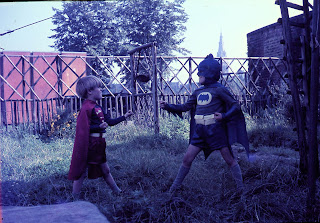
We went to St John's The Devine School, which was Protestant and very strict. In the background of the above photo you can see the steeple of St John's The Devine Church.
At school one day they got us into the assembly room to tell us about the school rules, and that if we broke them we would be severely punished, which might mean even getting the cane. I was only 6 years old and was very new at the school, and I had no idea what rules were, so I thought they must be 10 inch long glass rods that they kept in a locked glass cabinet in the headmasters room. They must be very special, I thought, but I couldn't figure out what the hell they would be used for, or how anyone could break one if they were in a glass box.
My mum made the Batman and Superman suits. She was a seemstress and she made us a lot of clothes. In the photo I have the Batman the suit on.

The church is regarded as a fine example of Victorian Gothic. The general construction is of red brick, but all parapets, window openings, doorways, etc. are dressed with stone. The upper part of the spire is entirely of stone. At over 260 feet, it is the tallest spire in south London and can be seen for miles around. The poet John Betjeman remarked that St John the Divine was "the most magnificent church in South London."


