Tuesday, February 24, 2015

Winterspeak — Social in the Media Age


Speaking of social media as we have been recently, Winterspeak shares some thoughts.

As it used to be said in advertising, people buy the sizzle rather than the steak.

Winterspeak
Social in the Media Age

Daily Treasury Statement: The government's checkbook reveals amazing secrets about the economy and the markets

Everyone is familiar with their own checkbook, right? Deposits, withdrawals. How much did you spend today, this month or, for the entire year? And how much did you take in, in deposits?

Well did you know that the Federal Government of the United States makes its checkbook available each and every day, online, for free for everyone to see?

That's right, every single deposit and every single withdrawal...shown every single day.

You can literally see the billions, tens of billions, hundreds of billions and even tens of trillions flowing into and out of the economy every single day, month and year!

Think about it...we get important economic reports every month, sometimes only every quarter (like GDP) and we're supposed to make investment decisions or forecasts based on that?

Yet here is a resource that practically nobody knows about that shows you exactly how much (in billions and even hundreds of billions, trillions even!) the government is pumping into and out of the economy EVERY SINGLE DAY! And did I mention...that PRACTICALLY NO ONE KNOWS ABOUT THIS?

This is by far the most powerful, potent, concise, real-time piece of economic data you are going to find anywhere because it is these financial flows between the U.S. Treasury and the economy that drive EVERYTHING! And it is there for anyone who wishes to access it.

I have spent YEARS analyzing and examining and working with this information. I have built a database and spreadsheets that look at day to day, month to month and year to year patterns. I have used these numbers to create really accurate economic forecasts and better yet...models of market behavior for stocks, currencies, commodities, bonds...you name it.

On Saturday, Feb 28, I will be giving a 1-day seminar in how to access, understand and analyze the Daily Treasury Statement. If you have any interest in economic forecasting or trading and predicting market moves or are just plain curious about the trillions the government spends EACH MONTH (that's right...trillions), then you should take this course.

Sign up now because spots are going quickly. The cost is $225 and believe me, it is well worth it. Information like this will pay for itself many times over in short order.

Click below to sign up.


Larisa Epatko — Eurozone extends Greece’s bailout by four months


Let the commentary begin.

PBS NewsHour 

Joel Kotkin — The three faces of populism

More than at any other time in recent memory, American politics now are centered on class and the declining prospects of the middle class. This is no longer just an issue for longtime leftists or Democratic or right-wing propagandists. It’s a reality so large that even the most detached and self-satisfied Republicans must acknowledge it.…
So, if populism will become a dominant theme in the next election, what form will it take? Populism itself is more a sentiment than a program; it reflects people’s deep-seated fears about the future and a festering resentment of the seemingly unassailable power of financial and other corporate elites.
 
But the ways of addressing these concerns are often contradictory and almost impossible to agree upon. Right now, we see three distinct types of populism. Two variants, that of the Obama administration and its critics further on the left ["progressives"], share an allegiance to Democratic Party orthodoxy on issues such as climate change, racial redress, feminism and other social issues. 
The third – and, as of now, least-coherent – variant could be described as constitutional conservatism, one that seeks to improve middle-class prospects by reducing federal regulations and taxes and by decentralizing power away from the Washington leviathan…
Over the coming years, party factions that can form a convincing and broad-based populist agenda will have an advantage. Any party that believes, as some Democratic shills now say, that things are “pretty awesome” misses broad-based public sentiment, which remains very negative about the state of the country and the economy. Growing inequality, reduced opportunity – particularly for the new generation – will remain the defining issue of our time. It is time for the political class, in both parties, to confront this reality.
Orange County Register | Opinion
Joel Kotkin: The three faces of populism
Joel Kotkin | R.C. Hobbs Fellow in Urban Studies at Chapman University in Orange and the executive director of the Houston-based Center for Opportunity Urbanism

Note that Orange County is one of the most conservative counties in the United States.

Don Quijones — Bank President to Spanish Judge: Making Me Pay for My Crimes Would Send “Message of Uncertainty to Markets”


This would be hilarious if it weren't so outrageous.

It's a variant of the financial oligarchy's threat to blow up the world economy if they aren't allowed to do as they please, which Lloyd Blanfein tells us is "doing God's work."

Raging Bull-Shit
Bank President to Spanish Judge: Making Me Pay for My Crimes Would Send “Message of Uncertainty to Markets”
Don Quijones

See also

New Economic Perspectives
Iceland’s Supreme Court Upholds Jail Sentences of Four Banking Executives
William K. Black | Associate Professor of Economics and Law, UMKC

David F. Ruccio — Varoufakis’s postmodernism

One rationality, embodied as much in the troika’s formula of austerity for Greece as in the lopsided economy recovery in the United States, is captured by neoclassical economics: everybody gets what they deserve, as long as free markets are unleashed on the world. The other rationality starts with the proposition that everyone should get what they deserve but they don’t—and can’t—within existing economic institutions. Those institutions—capitalist institutions—make “just deserts” impossible. 
That idea, that there’s a clash of rationalities within the world today, is precisely an effect of the postmodern questioning of metanarratives. Postmodernism, in this sense, represents a critique of a singular (humanist) rationality, just as it serves to undermine the neoclassical claim of a monopoly on scientific knowledge (indeed, the scientism that animates much of economic theory, mainstream as well as heterodox), the presumption of causal hierarchies within economic analysis (again, both mainstream and heterodox), and much else.
Is postmodernism just a destructive relativism that doubts and devalues so-called objectivity without replacing it with anything substantial? Not at all. It just wants to examine the foundations and criteria of putative objectivity to determine whether those foundations and criteria are themselves relative to point of view.
And that’s the point, isn’t it? The effects of the moves that we make, the demands we hold up, the criticisms we formulate depend on a specific context, on what is taken to be the existing common sense and how best to disrupt that common sense. The fact is, modernism (at least in economics) has long been associated with a humanist, universal, scientistic set of claims, and part of the task of carrying out a ruthless criticism of mainstream economics is to challenge and deconstruct those claims (including the idea that such claims are even possible). 
Is that all? No, of course not. In my view, the postmodern critique of mainstream economics needs to be supplemented by a Marxist critique. But, I want to be clear, it also goes in the other direction: that Marxist critique (traditionally formulated in terms of “laws of motion,” a hierarchy of base and superstructure, and so on) needs to be supplemented by postmodernism. 
In the end, the Varoufakises of the world may disagree. However, what I believe we can come to some agreement on is the need to continue to criticize “the inexorable devaluation of political goods, the vulgar commodification of human bodies and values, the impossibility of conceptualising freedom-from-the-market, the depiction of Central Banks as ‘independent’ only when under the thumb of financial capital, the confusion of liberty with the freedom to exploit and to demean and, above all else, the portrayal of coercion as tâtonnement.”
Occasional Links & Commentary
Varoufakis’s postmodernism
David F. Ruccio | Professor of Economics University of Notre Dame Notre Dame

Dean Baker — The Patent Theory of Knowledge


I would call the patent theory of knowledge part of the rent theory of "free market" economics along with other types of enclosure of the commons since privatization and monetization are needed to avoid "the tragedy of the commons," since the commons would either go to waste or else be misused. Neoliberalism is not actually liberalism, since it is not about free markets and perfect competition but economic power and the development and extension of asymmetries of power, information, and access that disadvantage "commoners."

Beat the Press
The Patent Theory of Knowledge
Dean Baker | CEPR

Matias Vernengo — Jean Tirole is afraid of heterodox economics


Jean Tirole thinks that conventional economics is science rather than a subset of social and political philosophy mixed with history, psychology and cognitive science, sociology, anthropology, and political science.

He is wrong about that.

If economic is conventional science, it is junk science and should be junked before it does more damage.

Of course, Tirole would simply ignore heterodox economics if it were not for the formidable success of Piketty's work and his indictment of conventional economics even though he has mastered it and uses its tools deftly. Might this success be sticking fear on the hearts of conventional economists now that they cannot avoid dealing with one?

Naked Keynesianism
Jean Tirole is afraid of heterodox economics
Matias Vernengo | Associate Professor of Economics, Bucknell University

Michael Hudson — U-V: Usury to Vested Interests


Next installment.

Michael Hudson
U-V: Usury to Vested Interests

Bill Mitchell — Groupthink and Denial on a Grand Scale – Early peek


Sneak peek at Bill/ forthcoming book on the EZ.

Bill Mitchell – billy blog
Eurozone Dystopia – Groupthink and Denial on a Grand Scale – Early peek
Bill Mitchell | Professor in Economics and Director of the Centre of Full Employment and Equity (CofFEE), at the Charles Darwin University, Northern Territory, Australia

Bill Black — Remember When Carmen Segarra Exposed the NY Fed’s Refusal to Stop Goldman Sachs and Banco Santander’s Scam to Inflate Santander’s Capital? How’d that Work Out?


How the US ad world faced financial collapse at the time the Lehman crashed and burned — and could again because the conditions that created the crisis remain in place.

New Economic Perspectives
Remember When Carmen Segarra Exposed the NY Fed’s Refusal to Stop Goldman Sachs and Banco Santander’s Scam to Inflate Santander’s Capital? How’d that Work Out?
William K. Black | Associate Professor of Economics and Law, UMKC

As Always, The Real Angst Is Not Over Public Initiative ... Rather, The Argument Is About Whom Public Wealth Is Dispersed To

   (Commentary posted by Roger Erickson)

Turns out that even those supposedly terrified by a Fiat "Deficit" are in reality just fine with any amount of fiat spending ... to directly fund anyone EXCEPT the Middle Class.

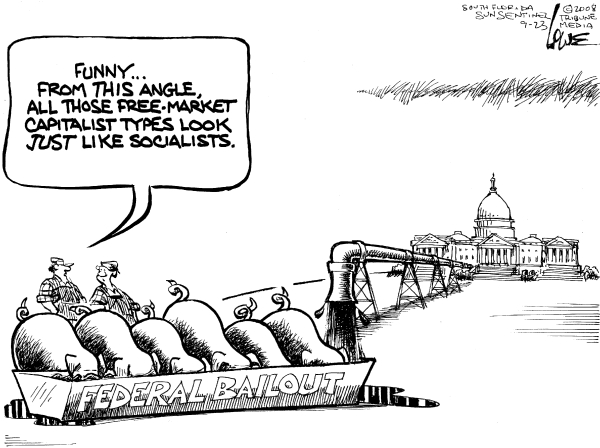
The eternal jostling at the pig trough, to hoard our still increasing Public Initiative.*


Dick Bove: There's a new mortgage crisis brewing
***
  [Cross posted from John Lounsbury, at GEI]
Mortgage funds appear to be drying up. Bove says that banks are not finding it profitable to originate mortgages with record low interest rates. The FHFA (Federal Housing Finance Agency), which operates the government mortgage banks Fannie Mae and Freddie Mac, has been weakening the mortgage underwriting rules imposed in 2010 and the years following. This includes reversing the plan to reduce Fannie and Freddie participation in the mortgage market with the goal of reducing their activity to zero by 2018 and easing the qualification requirements for mortgages to accept lower credit scores and reduce down payments to 3%.

Bove says the following about the possible return to losses for Fannie and Freddie or, alternatively, tightening of the underwriting rules for mortgages and the return to the plan for Fannie and Freddie to withdraw from the mortgage market:
"Now some people are beginning to get concerned. They are worried that taxpayers may be forced to provide Fannie and Freddie with more cash. They fear more large losses could be reported by these companies. 
Moreover, the people who take a close look at the balance sheets of Fannie and Freddie see that their equity is disappearing in payments to the U.S. Treasury while their guaranteed book of loans is growing. These people are beginning to understand that Fannie and Freddie are building the debt obligations of the United States government and no one is stopping them; certainly not Congress who is looking benignly on. 
The dilemma is: If the policymakers stop the growth of Fannie and Freddie, they will stop the growth of housing. If they do not stop the growth, Fannie and Freddie will increase the debt obligations of the United States." D. Bove
Whatever happens the housing market for the U.S. is headed for trouble again, according to Bove, and the mortgage market (or actually the lack of a mortgage market) will be at the bottom of it. For the past 2-3 years Keith Jurow has been tracking local housing markets throughout the U.S. and has repeatedly warned that the housing "recovery" was actually no such thing. In fact he is concerned about all aspects of real estate. See herehere and here.

***


* Public Initiative = Fiat Spending = An arbitrarily defined accounting "Deficit"
         (which = currency creation;  it's what currency issuers DO)


Ask not for whom the currency is created.

It's created for ... your masters? Or for you?


Aggregate Dystopia – Groupthink and Denial on a Grand Scale; Refusing To Acknowledge The Simple Act Of Aggregate Growth

   Commentary posted by Roger Erickson


Take another example, please!
Eurozone Dystopia – Groupthink and Denial on a Grand Scale

Once considered from another perspective, why should this surprise anyone? Is pan-cultural "dystopia" really so different from the painful, required responses required of other, observable growth spurts? Do the random DETAILS really matter that much? There are 1001 ways to reconfigure any nation, culture or economy. Yet it has to start with a consensus Desired Outcome, and the distributed will to achieve it, regardless of how.

Look at it this way. Just like human adolescents, any aggregate undergoing a rapid growth spurt HAS to get clumsier before it can re-establish how to rewire it's feedback & self-control instrumentation & management apparatus (e.g., "neuronal" systems), in order to regain and/or add aggregate agility for the new, enlarged size.

The red lines in the plot above are hypothetical, but believable, based on what we've already observed. Do institutional, national and cultural rates of change HAVE to peak, and decline? Is death and rebirth also the fastest way for nations and cultures to grow, just as for individual humans? Or can the pattern of cultural growth rate transition to a smoother, continuous progression?

Clearly, subtle extensions to Darwin's theory of evolution must be appreciated. Species and aggregate survival depends NOT just upon adaptive rate, but also upon the ability to sustain positive adaptive rates, and then also upon the ability to avoid intervening backward steps. It's the evolutionary rate, stupid! That rate is the running sum of all Output Gaps and Adaptive Gaps. Once opened, those gaps can never be regained. Allowing those gaps takes our destiny out of our own hands, and increasingly places it in the hope that competing aggregates may be even dumber and lazier than we are. Good luck with that hope.

For now, it's enough to stress that for a growing aggregate, e.g., a growing nation and/or human culture, it's the institutions which have to emerge, disappear or evolve in some new pattern, in order to fit changing scale. Even literature majors eventually catch on to this primordial reality.

"Everything [beneath the surface] needs to change, so everything can [appear to] stay the same."

Ya think? By one perspective, some quite obvious stages of adaptation are:

1) Recognize that self-awareness & self-control changes with size;
    (That's when honest feedback says things aren't working; "frictions" start to accrue,
     from skinned knees in adolescents, to depressions/recessions/class-wars in aggregates)

2) Prepare to change many things, as size changes (practice);
    (In physiological systems, various agents (molecular signals and/or hormones) have 
     evolved which help to actively grease the skids, so to speak, so that rates of 
     deconstruction & reconstruction in neural systems tracks the rate of growth in other 
     organ systems. This is true for everything from pupating insects to molting birds to
     growing human teenagers - and is still evolving in human super-aggregates, i.e., nation 
     states & human cultures)

3) Define success (what should the new-size aggregate be capable of accomplishing?) - and then don't settle for anything less.
    (Individual human "outcomes" and adaptive responses have slowly been defined, over 
     millenia of evolution. Human cultures are virtual machines, capable of rapid 
     adaptations ... when they select to adapt. If this perspective was instilled in our 
     education process, maybe our schools wouldn't be so obsolete.)


Why can't national populations re-define and "re-wire" their national institutions? And why won't they do so a helluva lot faster than in previous decades? Only for lack of intent, education, preparation and practice? What else do we have to do, that is all that more enticing or important? Watch videos? Overeat? Get drunk & pass out on the curb? Hoard nominal currency units?

All that is at stake is our cultural adaptive rate.

And all that's waiting is our endless list of expanding, aggregate options.

What are YOU waiting for?


Monday, February 23, 2015

Ezra Klein — Krugman: soaring inequality isn’t about education; it’s about power


Krugman lays the ""p"-word on the table.
"All the big gains are going to a tiny group of individuals holding strategic positions in corporate suites or astride the crossroads of finance," writes Krugman. "Rising inequality isn’t about who has the knowledge; it’s about who has the power."
VOX
Krugman: soaring inequality isn’t about education; it’s about power
Ezra Klein

Anastasia Skorondaeva — Yevgeny Yevtushenko: 'You shouldn’t rush to call people lost'

Yevgeni Yevtushenko is Russia most renown living poet. Babi Yar is one of his most famous poems. The interview he gives at the link reflects this sentiment expressed in Babi Yar.


Babi Yar
By Yevgeni Yevtushenko
Translated by Benjamin Okopnik, 10/96
(Babi Yar is a ravine in Kiev that was the scene of German massacres of Jews in WWII.)

No monument stands over Babi Yar.
A steep cliff only, like the rudest headstone.
I am afraid.
Today, I am as old
As the entire Jewish race itself.

I see myself an ancient Israelite.
I wander o'er the roads of ancient Egypt
And here, upon the cross, I perish, tortured
And even now, I bear the marks of nails.

It seems to me that Dreyfus is myself. *1*
The Philistines betrayed me - and now judge.
I'm in a cage. Surrounded and trapped,
I'm persecuted, spat on, slandered, and
The dainty dollies in their Brussels frills
Squeal, as they stab umbrellas at my face.

I see myself a boy in Belostok *2*
Blood spills, and runs upon the floors,
The chiefs of bar and pub rage unimpeded
And reek of vodka and of onion, half and half.

I'm thrown back by a boot, I have no strength left,
In vain I beg the rabble of pogrom,
To jeers of "Kill the Jews, and save our Russia!"
My mother's being beaten by a clerk.

O, Russia of my heart, I know that you
Are international, by inner nature.
But often those whose hands are steeped in filth
Abused your purest name, in name of hatred.

I know the kindness of my native land.
How vile, that without the slightest quiver
The antisemites have proclaimed themselves
The "Union of the Russian People!"

It seems to me that I am Anna Frank,
Transparent, as the thinnest branch in April,
And I'm in love, and have no need of phrases,
But only that we gaze into each other's eyes.
How little one can see, or even sense!
Leaves are forbidden, so is sky,
But much is still allowed - very gently
In darkened rooms each other to embrace.

-"They come!"

-"No, fear not - those are sounds
Of spring itself. She's coming soon.
Quickly, your lips!"

-"They break the door!"

-"No, river ice is breaking..."

Wild grasses rustle over Babi Yar,
The trees look sternly, as if passing judgement.
Here, silently, all screams, and, hat in hand,
I feel my hair changing shade to gray.

And I myself, like one long soundless scream
Above the thousands of thousands interred,
I'm every old man executed here,
As I am every child murdered here.

No fiber of my body will forget this.
May "Internationale" thunder and ring *3*
When, for all time, is buried and forgotten
The last of antisemites on this earth.

There is no Jewish blood that's blood of mine,
But, hated with a passion that's corrosive
Am I by antisemites like a Jew.
And that is why I call myself a Russian!

Russia Beyond The Headlines

Debidatta Aurobinda Mahapatra — No borders in India-Russia defence ties

Though the Rafale deal has been on the card for the last three years, there has been no finalisation on it as India and France have developed differences, particularly on the issues of the cost escalation and transfer of technology.… 
Contrast this to the Russian policy of ‘no borders’ with India in the context of jointly designing and building defence products. While speaking at Aero-2015, the head of International Cooperation Department of Russian company Rosetec, Viktor Kladov, stated that Russia is quite keen to meet IAF’s requirements for cutting-edge aircraft. The traditional partner is not purely motivated by profit-loss, or give-take, framework. Rather, it is interested in fully cooperating in developing India’s indigenous arms industry. “We don’t sell like other nations. We have a very special relationships … When it comes to India we don’t have any borders… ” said Kladov. 
It is doubtful whether the other suppliers, whether active or potential, can adopt such an approach while dealing with India.…
The major deal regarding the Fifth Generation Fighter Aircraft (FGFA) will likely be finalised this year. The FGFA is critical forthe Indian Air Force’s ‘future capability’, and is crucial for its evolving structure, revealed India’s Air Force chief. This year, both the countries would develop a detailed design of cooperation in developing the aircraft. A successful deal on the FGFA would not only strengthen Indian armour, but would be another landmark in defence cooperation.…
 Among India’s suppliers, Russia has been forthcoming in sharing technologies with India. This has helped serve a two-fold purpose. Besides bolstering India’s defence and security, it has also enabled the growth of India’s indigenous technology.
For India, Russia is ready to replace Rafale with Su-30MKI - Rosoboronexport
Russia’s arms establishment appears to have taken note of the changing world, in which there many defence suppliers have emerged. The new players have attempted to woo India’s market and benefit from the country’s fast growing economy. Russia appears to be ready to play in this new format.…
BRICS.

Russia & India Report
No borders in India-Russia defence ties
Debidatta Aurobinda Mahapatra

Also
Western sanctions against Russia have turned out to be beneficial for Russian arms exports, state-owned arms exporting firm Rosoboronexport said on Monday.
"Here, at the world's largest exhibition IDEX-2015, and other previous trade fairs, we see heightened interest of partners and customers in our products. This has become the result of the [West’s] sanctions policy against Russia. And this is beneficial to us," the company’s deputy head, Sergey Goreslavsky told TASS, adding that many customers wanted to have more reliable partners like Russia, in contrast to the countries pursuing the sanctions policy.
The cost advantage is also huge owing to the fall of the ruble. A French or US aircraft is just not worth twice as much as a comparable Russian one. Add to that the politics, and it's a no brainer. Add to that the recognition that the Global South (BRICS) may be facing a war with the Global North (NATO) in the not too distant future. Russia and China are already ramping up. India is, of course, aware of that.

Western sanctions beneficial for Russian arms exports

Rosoboronexport: Russia to fulfill $15 bln weapons export plan in 2015 despite sanctions

James Oliphant — Paralyzed By Ukraine, Dumbfounded by Russia


The US debate over Russia that could affect the future of humanity'
But more critically, isolating Russia and treating it like a second-rate European nation belies the reality of its nuclear arsenal. In the wake of the two countries' deteriorating relationship, Russia said late last year that it would boycott a planned summit on nuclear security to be held in the U.S. And there are growing worries that the U.S. and Russia no longer have the controls in place that kept nukes secure during the Cold War, giving rise to fears that a misunderstanding could have lethal consequences. 
Putin's Russia, says Brookings' Jeremy Shapiro, "is the only existential threat the United States faces. Even if it is a low-probability outcome, it is a very bad one. I think it's worth talking about up front." 
Shapiro does not support arming Ukraine. He says Obama should engage Putin directly to defuse the crisis and perhaps even grant Russia some say in the affairs of its border nations rather than stumble into a war incrementally. 
While the Obama administration has been cool to the very notion of foreign "spheres of influence," Shapiro notes that the United States, as a matter of policy, has never much cared whether Ukraine is part of the West. 
"We are literally risking World War III for something we do not want," Shapiro says. "We forget we're not fighting for anything worth having. That's the real danger."
On the other hand, US hawks are hell-bent on rushing where angels fear to tread, as most of the post documents. Avoiding another Chamberlain at Munich, or repeating the mistake of Napoleon and Hitler?

"The secret of politics? Make a good treaty with Russia." — Otto von Bismarck

National Journal
Paralyzed By Ukraine, Dumbfounded by Russia
James Oliphant

James K. Galbraith — "Reading The Greek Deal Correctly"

Alexis Tsipras stated it correctly. Greece won a battle – perhaps a skirmish – and the war continues. But the political sea-change that SYRIZA’s victory has sparked goes on. From a psychological standpoint, Greece has already changed; there is a spirit and dignity in Athens that was not there six months ago. Soon enough, new fronts will open in Spain, then perhaps Ireland, and later Portugal, all of which have elections coming. It is not likely that the government in Greece will collapse, or yield, in the talks ahead, and over time the scope of maneuver gained in this first skirmish will become more clear. In a year the political landscape of Europe may be quite different from what it appears to be today.
Social Europe Journal
"Reading The Greek Deal Correctly"
James K. Galbraith | Lloyd M. Bentsen Jr. Chair in Government/Business Relations and a professorship of Government at the Lyndon B. Johnson School of Public Affairs, The University of Texas at Austin

Pepe Escobar — Year of the Sheep, Century of the Dragon?


Enter the dragon. The size boggles the mind, and the economic data is astounding. Repeat of some material Pepe has posted before, but worth going over again.

The World Post
Year of the Sheep, Century of the Dragon? — New Silk Roads and the Chinese Vision of a Brave New (Trade) World
Pepe Escobar

Moon of Alabama — White House Denies Interference In Venezuela - Promises More Of It

Do these spokespersons even recognize how those proclaimed positions, uttered just seconds apart, conflict with each other?
Moon of Alabama
White House Denies Interference In Venezuela - Promises More Of It

Matt Bruenig — Human Capital Confusion


More.

Demos.org 

Merijn Knibbe — The largest ‘Bild’ lie ever? Factchecking Bild-zeitung

“We wanted to make sure that the … money for Greek bank recapitalisation is for that purpose, not for recapitalisation of the government,” Dijsselbloem said. 
Bild-Zeitung, the largest newspaper of Europe, owned by Axel-Springer press, tells its readers that the money used to bail out Greece is used ‘for instance’ to pay pensioners and teachers. It does not tell its readers that by far the larger part of it is used to bail out creditors and refinance debts…
Real-World Economics Review Blog
The largest ‘Bild’ lie ever? Factchecking Bild-zeitung
Merijn Knibbe

Matthew Martin — Is human capital capital?


More thoughts on human capital.
Of course, human capital is not capital. If it were, we'd just call it capital and lump it in with the rest--the purpose of the term "human capital" is to distinguish it from actual capital.

So, if it's not capital, what is human capital? At most, I'd say it's a modeling insight. The vague notion of "skills" and knowledge that it stands in for are very real, but when it comes to modelling we are really just pretending it's a kind of capital stock. The key insight was in recognizing that skills and knowledge share a few of the same kinds of intertemporal dynamics as capital, and that we can obtain accurate predictions by modeling them as such, even though they differ in lots other ways.…
Separating Hyperplanes — A blog between the spheres of Economic Theory and Policy Analysis
Is human capital capital?
Matthew Martin | health economist and programmer for the Cancer and Blood Diseases Institute at Cincinnati Children’s Hospital Medical Center

William K. Black — HSBC CEO: My Pay Was so Outrageous I Had to Use Tax Havens to Hide it from My Peers

Greetings from Quito [Ecuador], where I will be spending four months teaching at IAEN about effective regulation and building ties with UMKC. 
The latest twists on the latest HSBC tax evasion and tax avoidance scandal is that it has come out that Stuart Gulliver, HSBC’s head, put his money where his mouth wasn’t. He personally used double tax havens – Panama plus Switzerland – to hide his income and wealth from view because his pay was so outrageous that even other HSBC executives would have been outraged by it.
How bizarre is that!

New Economic Perspectives
HSBC CEO: My Pay Was so Outrageous I Had to Use Tax Havens to Hide it from My Peers
William K. Black | Associate Professor of Economics and Law, UMKC

Red Pill Times — WSJ reports: The $1.6 Billion fortune of Hillary Clinton, given to her by the largest companies in America


I knew it was bad, but not this bad, assuming it checks out.

Even the remote possibility that the US have a match up between Hillary Clinton and Jeb Bush is mind-boggling, and it is far from remote. This is where the money is being placed by the big players.

Red Pill Times
WSJ reports: The $1.6 Billion fortune of Hillary Clinton, given to her by the largest companies in America
TSam Levine

Konrad Stachnio — Can Ukraine exist without UPA and SS ‘heroes’?


This post gives a glimpse into how complex is in Post WWII Europe, and how the situation is determined historically by ideology and nationalism, along with hysteresis and path dependence. 

Americans tend to view the participants there as people more or less just like them. This post shows how delusional that is, unless Americans take their own dark side into account to, which most are not wont to do because "American exceptionalism."

Caution. Strong stuff for those with weak stomachs and refined sensibility.

New Eastern Outlook
Can Ukraine exist without UPA and SS ‘heroes’?
Konrad Stachnio is an independent Poland based journalist, he hosted a number of radio and TV programs for the Polish edition of PrisonPlanet, exclusively for the online magazine “New Eastern Outlook”.

Jonathan Steele — Frontline Ukraine: Crisis in the Borderlands by Richard Sakwa review – an unrivalled account


Jonathan Steele reviews Richard Sakwa's latest book, Frontline Ukraine: Crisis in the Borderlands. Sakwa is a professor of Russian and European politics at the University of Kent.

This one of the more balanced accounts to appear in the Western media, especially in the UK where the media is extremely anti-Putin.

The Guardian
Frontline Ukraine: Crisis in the Borderlands by Richard Sakwa review – an unrivalled account
Jonathan Steele is a former Guardian Moscow correspondent, and author ofEternal Russia: Yeltsin, Gorbachev and the Mirage of Democracy
ht Johnson's Russia List

Art Shipman — Excellent! Excellent!


Art directs us to Michael Hudson, “How economic theory came to ignore the role of debt”, real-world economics review, issue no. 57, 6 September 2011, pp. 2-24,

The New Arthurian
Excellent! Excellent!
Art Shipman

See also "The New Arthurian Economics" by Arthur F. Shipman, 16. January 2009

Lars P. Syll — Fiscal debt — what we should be aiming for


Excerpt from a video of Lynn Parramore interviewing Mario Seccareccia. Seccareccia explains why the Chartalist view is key to understanding the problems besetting the EZ and how to deal with the issue within the EZ structure.

Lars P. Syll’s Blog
Fiscal debt — what we should be aiming for
Lars P. Syll | Professor, Malmo University

Sunday, February 22, 2015

Susan Rakoczy — The best kept secret of the Catholic Church—its social teachings


Papal encyclicals and letters on social justice and social teaching began with Rerum Novarum (1891). The Latin term rerum novarum, literally new things, signifies revolution. It was the Church's answer to revolutionary Marxism. 

This teaching was continued and expanded in Quadragesimo Anno, Pacem in Terris, Mater et Magister, Populorum Progressio, Mulieres Dignitatem, Laborem Excercens, Centisimus Annus, Caritas in Veritate, and Evangelii Gaudium. Pope Francis is presently working on an encyclical on ecology.
The response from Catholics to these developments has been mixed. Surveys of young Catholics indicate that “many young adults are inspired by Catholic social teaching, affirming that this is the dimension of church doctrine with which they must clearly identify.” The adult education program “Just Faith” has helped Catholics to become familiar with new thinking, but conservatives often take exception to any criticism of capitalism and growing inequality. For them, the Church’s teachings on economic justice are not ‘good news.
Open Democracy
The best kept secret of the Catholic Church—its social teachings
Susan Rakoczy | Professor of Spirituality at St. Joseph’s Theological Institute and the School of Religion, Philosophy and Classics at the University of KwaZulu-Natal, South Africa

It's not just the Church's social teaching that is its "best kept secret." This is also the case with its mystical tradition, and many of the greatest mystics such as Meister Eckhart and Madame Guyon, are still treated as heretics. This is quite different in the Orthodox tradition. For example, the tradition of the spiritual teacher is alive and well in Eastern Orthodoxy. In the Russian Orthodox Church, spiritual teachers are generally monks recognized as being of high spiritual caliber. The Russian word is staretz, similar to guru, lama and roshi in other Eastern traditions.