Showing posts with label Dr. Housing Bubble. Show all posts

Saturday, April 13, 2013

Dr. Housing Bubble — The Good, the Bad, and the Ugly aspects of the American housing market: Key indicators of the 2013 real estate market.

The US housing market is massive. You would expect this from a nation of 315,000,000+ people spanning over 50 states. So it is important to understand the various dynamics occurring over many states. In regards to single family home buyers, in most of the United States home prices are very reasonable. This is hard for some in the coastal regions to digest or even comprehend. When you look at certain markets in high priced areas, many people have a hard time penciling out the financial details. Yet with such a large number of investors purchasing with cash, a new market has been created. But if we are to take the US market and make a wide-eyed observation, we will find some good, bad, and ugly aspects of the current housing market. Whereas in 2008 through 2010, the market was dominated by the bad, ugly, and grotesque. What can we say about the current US housing market?
Dr. Housing Bubble
The Good, the Bad, and the Ugly aspects of the American housing market: Key indicators of the 2013 real estate market

Wednesday, March 13, 2013

Dr. Housing Bubble — Global housing bubbles unite

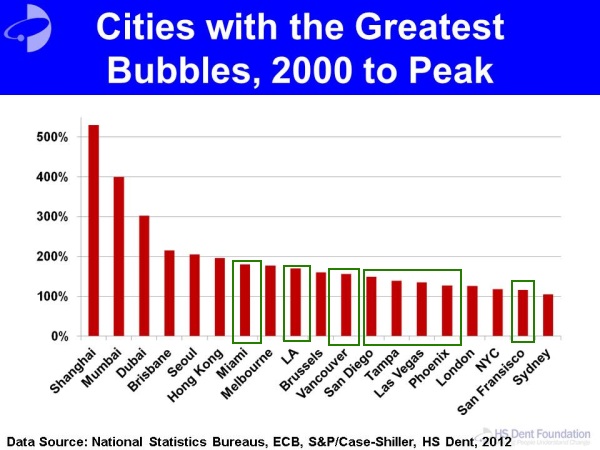
Economic history is a fascinating subject. Yet in our modern day of instant news and second to second market analysis, it seems like the media is bent on skimming over on only what is going on at the moment. Even the deepest financial crisis since the Great Depression is now gone into the vortex of cultural amnesia. What is interesting however, is that many countries around the world being incredibly different culturally, went down into the rabbit hole of housing mania as well. If you ever think Southern California home prices are outrageous, you need only look at Northern California. If you live in the Bay Area, all you need to do is look at Canada. There has never been, from all the history I’ve reviewed, of a universal and unified housing bubble that touched nearly every continent at the same time at such a big magnitude. Let us take a trip around the world and see what other housing markets are doing.
Dr. Housing Bubble
Global housing bubbles unite: How easy debt has created the first ever worldwide housing boom and bust. The busted, the leveled, and the booming.

Saturday, March 9, 2013

Dr; Housing Bubble — Will there be a steady supply of homes for sale from aging baby boomers in this decade? Who will they sell to and at what price?

From 2010 to 2020 we are going to have a large number of baby boomers entering into their retirement years. Many will look to downsize and the projections have been, that this would add a steady supply of housing. Issues like negative equity have kept many potential homeowners from actually listing their homes on the market for sale. It is also the case that a younger and less affluent generation is going to struggle to pay top dollar for many of the properties hitting the market. Many are resorting to using loans that are insured by theFHA that allow 30x leverage just to get their foot in the door. It is interesting to see this trend unfold because there is nothing that can be done to stop the momentum of age. Banks can alter accounting rules and hold off inventory to create artificially low supply but there is nothing that can stop our inherent biological aging process. Some interesting data is coming to the surface regarding baby boomers and the demographic changes that will impact housing. Will baby boomers add a significant number of homes to the market in this decade?
Dr. Housing Bubble
Will there be a steady supply of homes for sale from aging baby boomers in this decade? Who will they sell to and at what price?


Sunday, February 17, 2013

Dr. Housing Bubble — The Wall Street fascination with rentals

The flood of investors into the real estate market is no tiny trend. This has been a big force in the market for a few years now. Someone in the real estate industry commented in an e-mail that FHA buyers are viewed as the new subprime when it comes to the hierarchy of buying a new home. They didn’t mean this in a derogatory sense but meant that if they have an all cash offer with a quick close versus a loan with high leverage, chances are the all cash offer will win out. This is simply the case in this low supply market where the last thing people in the industry want to do is extend the process trying to close on a property only to see it fall out of escrow. With an all cash close, you can get the deal done rather quickly. We’ve never seen this level of institutional buying in the housing market for this prolonged of a period. What are the implications of Wall Street’s current fascination with rentals?

Locking up supply for years to come
Dr. Housing Bubble
The Wall Street fascination with rentals: Is the big rush with investor buying locking up the supply of real estate? How retail buyers are priced out of the equation

Thursday, February 14, 2013

Dr. Housing Bubble — The next generation of home buyers and our over investment in real estate: first time home buyers and move up buyers see their net worth crushed during the last few years.

In general, Americans are very poor when it comes to saving money. One of the stunning revelations that came out of the financial crisis was that the median household net worth fell from $126,400 in 2007 to $77,300 in 2010. What was even more interesting in the report put out by the Fed Consumer Survey was that median home equity fell from $110,000 to $75,000. Think about this for a second. Most of what Americans have in what we would consider as wealth is locked up in housing. In fact, non-housing equity wealth was $16,400 in 2007 and fell to a paltry $2,300 in 2010. Is it any wonder why so many Americans depend on Social Security deep into retirement as their main source of income? While the stock market has rallied dramatically from the lows reached in early 2009 the housing market is still far away from the peak. What is interesting is the lack of move up buyers in the current market. With such little inventory I’ve been seeing the first-time home buyers diving in simply with maximum leverage. Americans if given the chance would borrow a million dollars at zero percent (the big banks are doing this). What does the future hold for the next wave of young home buyers?
Dr. Housing Bubble
The next generation of home buyers and our over investment in real estate: first time home buyers and move up buyers see their net worth crushed during the last few years.

Thursday, December 27, 2012

Dr Housing Bubble — The echo housing bubble across the United States – Rising home prices in the face of stagnant household incomes. How the Fed is manipulating the monthly payment to keep home prices inflated.

The Case Shiller data is showing a steady increase in home prices across the United States. The headline figures are clear but rarely make the connection that much of this gain is coming on the back of unprecedented Federal Reserveintervention. Data is clear that household income is not making any significant gains. These gains are coming largely from added leverage produced by lower mortgage rates. We’ll go into the details on this but you will see how a tiny drop in mortgage rates can supercharge home prices especially in a market where inventory is tightly managed as the year comes to a close. The Case Shiller is a better measure of home prices because it looks at repeat home sales. Yet even here we are seeing signs of bubble like activity in a handful of markets. An echo housing bubble is a possibility in many markets.
Dr Housing Bubble
The echo housing bubble across the United States – Rising home prices in the face of stagnant household incomes. How the Fed is manipulating the monthly payment to keep home prices inflated.

Friday, May 4, 2012

Dr. Housing Bubble — What if housing doesn’t recover for another decade?

Robert Shiller of the famed Case-Shiller Index came out only a few days ago stating that housing may not recover for over a decade.  As dire as this may sound, we have a similar example to look at in Japan.  It wasn’t like he stated this just to cause a stir but talked about compressed household wages, record low mortgage rates, and a large pipeline of distressed inventory.  Even though real estate values are now down 35 percent from their peak taking values back to 2002 (a lost decade) we would need to increase housing values nationwide by 50+ percent to get back to the peak.  This is what he was discussing about home values not recovering to that price point.  Japan has had well over two decades of a depressed real estate market and values today still do not approach the peak values reached in the early 1990s in spite of their central bank pushing rates even lower than theFederal Reserve.  In fact, prices are holding closer to the trough.  Examining the data we already find ourselves into one lost decade.  Is another possible?
Read the rest at Dr. Housing Bubble
What if housing doesn’t recover for another decade? When the young cannot afford to buy a home from their parents. The reemerging trend between the US and Japan housing bubbles.
by Dr. Housing Bubble

Something to consider before we start to celebrate the housing bottom being in (if indeed it is).

This is a symptom indicating we are in a depression instead of a normal kind of recession. The cause? Too much private debt, and the deleveraging process takes a long time to work out.

Unfortunately, the US is not making much of a dent in it where it counts, young people who usually start families and buy houses. They are expanding student debt instead.

Thursday, March 15, 2012

Dr. Housing Bubble — Tectonic shift affects housing market

Buying a home is something embedded in the American economic DNA.  Purchasing a home is the biggest financial decision most households will make in their entire lives.  In the past the act of buying a home was more of a ritualistic rite of passage; you scrimp and save for the down payment, you purchase a home where your family will set roots, and eventually you will aim for that mortgage burning party.  The entire process was accelerated in the last decade to create a perpetual churn.  A mortgage was merely a temporary tool in the non-stop property ladder progression to the top.  The equation did not leave room for falling home prices or a weakened economy.  So we are left with a battle for the soul of US housing.  Do we go back to more tested ways of a boring housing market where banks actually verify financials or do we juice up the machine again?  The only issue is that the market no longer believes in the new way of financing housing and the government now has to step in to soften the withdrawal with loans such as FHA insured products.  Yogi Berra once said it’s tough to make predictions, especially about the future.  But the past is set in granite stone.  What will the future look like for the American housing market?
Read it at Dr. Housing Bubble

The future of the American housing market just became more complicated: The impact of the mortgage settlement and financial tectonic plates shifting.
by drhousingbubble

Tuesday, March 13, 2012

Dr. Housing Bubble — The question of housing affordability

Housing affordability matters.  One of the biggest line items used to qualify home buyers is your household income.  This is why it is hard to understand why some people simply choose to ignore the most important factor in sustaining housing markets.  
Household income drives rental prices and also drives household values historically.  Should these ratios get out of whack because of exotic mortgages or imprudent lending then prices will rise but as we are seeing, will adjust lower back to more historical trends once the unsustainable trend pops.  Some arguments hold very little water in the current landscape.  Many markets in the US may be near market bottoms and we will highlight 17 of them.  
They all have very similar characteristics and some are here in California.  Other areas are still over priced by historical measures.  Let us examine the markets where price bottoms may have been reached.
Read it at Dr. Housing Bubble
The question of housing affordability – 17 US markets near potential price bottoms
by Dr. Housing Bubble

Wednesday, March 7, 2012

Dr. Housing Bubble — Will 2012 begin the unclogging of 6,000,000 distressed properties?


The housing market is clogged like backed up plumbing in an old building.  The shadow inventory is still very present even though visible inventory declined last year.  It seems like we are diving back into the rabbit hole where information is disguised and bad news is spun as being good.  Take for example the number of homes actively in foreclosure.  Early in 2009 we had roughly 2,000,000 homes actively in foreclosure.  The number today?  2,000,000.  The Catch 22 of the giant bank bailouts and financial shell game was the bet (hope) that housing prices would have gone back up after five years especially with trillions of dollars funneled into the banking sector.  I mean what can go wrong when you trust banks with housing right?  The reality is sinking in that home prices are going nowhere but down unless household incomes rise and that is why we saw foreclosure starts surge last month.  The shadow inventory is coming online and that means lower prices.  Don’t think this is a shell game?  Over 40 percent of the 2,000,000 foreclosures have not had a payment in two years.  This isn’t even factoring in the 4 million delinquent loans that are working their way into the REO side of the equation.
Read it at Dr. Housing Bubble
Will 2012 begin the unclogging of 6,000,000 distressed properties? Over 40 percent of the 2 million active foreclosures stand with no payment in over two years and some with three years and more. Foreclosure starts surge 28 percent in last month of data. Mid-tier markets in Los Angeles and Orange County contract severely in 2011.
by Dr. Housing Bubble

BTW, Calculated Risk reports that LPS and CoreLogic both reported declines in house prices by 1% in January.

Monday, March 5, 2012

Dr. Housing Bubble — The brewing bubble in higher education


There is high-quality evidence suggesting that higher education is deep in a bubble.  When I examine the weakness in the housing market I also think of the massive expansion of debt with student loans.  The biggest expansion in student debt occurred in a decade where household incomes stalled out.  Many of the recent graduates are struggling to find good paying work so it has become much tougher for these young professionals to purchase homes.  It becomes even more difficult if they live in a state like California where housing is still showing hints of a bubble in many markets.  I get e-mails from young families looking to buy but their incomes simply cannot afford prices in mid-tier markets, at least where prices stand today.  They are saddled with debt not seen in previous generations and they are more reluctant to jump into a massive mortgage payment.  There is little sign that the bubble in higher education is slowing down and we have some new perspectives on the data.
Read it at Dr. Housing Bubble
The brewing bubble in higher education – in 2000 student debt made up 3 percent of all household debt. Today it has doubled to 7.5 percent and has grown by 511 percent in the last decade.
by Dr. Housing Bubble

Monday, February 27, 2012

Dr Housing Bubble — The Down Payment Boogeyman


There was a time in our more stable housing history where people wouldn’t even consider buying a home unless they had an adequate down payment.  Part of the buying process required families to tighten their belts and save for a few years for that trek into home ownership.  When so much time, effort, and capital is put into buying a property less people are going to walk away from a mortgage.  This also created a positive buffer zone.  
Starting in the late 1990s and going into the 2000s the idea of a down payment played into the narrative that all debt was somehow golden.  Why does anyone need to save when you can simplytake on a mortgage and forego the years of saving?  
Banks loved it because the mortgage volume churn was like having a money making machine.  Of course much of this philosophy and mentality is what led into the bubble peaking with no-doc, no-job, no-money down mortgages.  Today we examine the down payment debate closely and analyze why it is important to have a bigger down payment especially with government backed loans.

Dr Housing Bubble
The down payment boogeyman – report finds requiring a 20 percent down payment would push out 60 percent of borrowers from qualified residential mortgages (QRMs). Those 29 to 34 acquired a mortgage for the first time in 1999 to 2001 at a 17 percent rate but that rate is now down to 9 percet.
by Dr Housing Bubble

Friday, February 24, 2012

Dr. Housing Bubble — Japanification of US RE market?


The case of having a Japan like correction in our real estate market grows stronger as each year goes by.  The entire notion of zombie banks derives from the crisis in Japan.  Shadow inventoryand the suspension of mark-to-market accounting are part of the life support that is keeping many US banks operating.  Two decades later, with low interest rates and no signs of real estate values going up, the Japanese housing market is virtually stuck in a holding pattern.  One thing is now different however as Japan is now starting to run trade deficits.  Japan recently posted a record trade deficit because of a strong yen and rising imports on fuel.  Yet the real estate market has yet to recover and is back to 1980s values.  Can you imagine housing values in the US going lower or sideways well into the 2020s?  Hard to believe but let us examine a few areas where the pattern is playing out on a similar note with new data.
Read it at Dr. Housing Bubble
A mirror in the real estate sun – Japan posts record trade deficit while real estate values go deep into the 1980s. US has decade long collapse in real estate values in spite of record low mortgage rates. The path of two lost decades in US real estate values is looking very similar to Japan.
by Dr. Housing Bubble


Sunday, January 29, 2012

Dr. Housing Bubble — Get ready for the next stage of the bailouts


The Federal Reserve recently came out with an unprecedented analysis directed to the Committee on Financial Services regarding various methods to improving the housing market.  The paper is striking because it magnifies how little was learned from this banking and housing debacle.  One of the big recommendations centers on creating a “REO to rental” program by facilitating bulk sales to large investors.  Ironically the Federal Reserve by bailing out select banks has allowed home values to remain inflated thus causing this backup in inventory to emerge in the first place.  Setting that obvious point aside, let us examine the merits of an REO to rental program.
Read it at Dr. Housing Bubble
REO-to-rentals another Fed subsidy for big investors and select banks. Federal Reserve looking to engineer yet another bailout for key banking allies. Fed acknowledges 12,000,000 homes with negative equity.
by Dr. Housing Bubble


Wednesday, January 25, 2012

Global housing collapse coming — Dr. Housing Bubble


Never in the history of our modern economic system have we had coordinated housing bubbles rage across the world like some sort of financial plague.  The proliferation of boiler plate media and the ubiquitous spreading of banking debt made the real estate religion spread quicker than any time in the past.  The way real estate was being played up in the media was like some sort of spiritual revival.  I remember a colleague showing me a clip of a real estate seminar in California at the peak of the bubble where people looked as if they were in some sort of glorified peyote induced trance.  At the core of any mania is human psychology and herd behavior.  People never want to believe that their special niche market is not in some sort of bubble.  On January 15 we discussed theCanadian housing bubble and many people fell off their rockers as if this was some sort of spectacular revelation.  Reading through the comments on the Canadian bubble post is very reminiscent of 2007 in California where the “not in my back yard” arguments dominated the discussion.  The nature of this housing bubble is global and the collapse of markets across the globe will have wide ranging impacts that are yet to be felt.
Read the rest at Dr. Housing Bubble

When the global housing bubbles collapse like a row of dominoes – Canadian housing bubble at apex. Real estate markets from Australia, UK, Italy, and Ireland now into correction phases.

Steve Keen agrees.

The good news for the US is that housing bubble already popped. The bad news is that is still further to go in the correction, and a global contraction due to a worsening financial crisis could stifle the recovery, especially with the austerity talk that is coming out of Washington and being echoed in state capitols.

Monday, January 16, 2012

Dr. Housing Bubble — Canada bubble ripe to pop?


The other CA bubble – Canadian housing bubble ripe for popping. Vancouver real estate increased by 142 percent from 2002 to 2011. Average detached home in Vancouver costs roughly $1 million while the median household makes $67,000 per year.
by drhousingbubble
In the last few years I’ve noticed that many of the cable finance and housing shows highlight families in Canada.  Shows that talk about debt or home buyers are usually focused on families in Canada which is rather odd given that we are here in Southern California.  Yet the funny thing about these shows is that they rarely identify that they are in Canada although I recognize locations like Vancouver.  If one simply tuned into the show it would appear that a bubble was still going on in the states.  This is probably the point.  After all, the cable shows focused on flipping houses or making quick bucks on real estate started going off the air yet another bubble was still going on up north.  Obviously these shows had an audience otherwise they would not be on the air.  Now the focus is on the Canadian bubble and American audiences can swim in the nostalgic dreams of the glory days of domestic housing.  Yet the shows rarely mention their location as if English-speaking families and cookie-cutter condos and homes are so easily interchangeable that they will fool an audience.  Yet one thing the shows fail to acknowledge is that the Canadian housing bubble is even more pronounced than that in the United States.

Tuesday, November 8, 2011

Dr. Housing Bubble takes on hyperinflation


Speaking of hyperinflation, Dr. Housing Bubble addresses it in housing.
I’m not sure why a few are looking at real estate as some safe haven from hyperinflation.  Do they even know what hyperinflation looks like?  Let us set aside the reality that since the crisis hit with a full frontal attack and the bubble popped in 2007 we have been living through a debt destruction deflationary period.  All the Federal Reservegimmicks and banking bailouts, trillions of dollars of digital funds, have largely gone to the financial sector with little relief to households.  The data is rather clear and what we have seen is a shattering of household net worth primarily with real estate while bailout funds have gone to plaster over the Swiss cheese like balance sheet of banks.  As absurd as the hyperinflation argument is, I think it is worth examining as a thought experiment what may happen to U.S. real estate going forward under various scenarios.... (emphasis added)
Read the rest at Housing apocalypse prediction of hyperinflation and real estate values – Debunking the hyperinflation argument to purchase housing. Examining real estate in deflation, inflation, and hyperinflation.

Friday, October 14, 2011

Dr. Housing Bubble —The twin bubbles of housing and higher education


The twin bubbles of housing and higher education – housing bubble expanded from 1997 to 2007 and imploded. Since 2000 tuition costs have been soaring but graduate pay has been falling. What happens when you price out a generation looking for starter homes?
This post is a shocker if you are not up on the numbers. Looks ominous.

Financialization is spreading to all areas from which rent can be extracted. With incomes stagnant or falling and debt burden increasing, what can the next generation hope for and how is this going to effect the economy?