(Commentary posted by Roger Erickson)

Please America, listen up.
You can't miss this illuminating summary of Marriner Eccles found ... of all places ... buried in a neglected college textbook!
pp: 504-557 in
I'm only part way through, but it's a bombshell of observations driving home the point that
what some of us know can be totally neglected by the bulk of us ... for multiple generations! Early on it quotes Shakespeare's Polonius, and just keeps getting better.
This fascinating book-chapter carries common sense to new heights, and skirts on the edge of multiple system sciences, and even all the way out to pseudo-religions like orthodox macro economics.
Let's start with Polonius.
"By indirection, find direction." That's meant as a sly double-entendre in a Shakespeare play, but it's used as a direct, methodological insight in this book chapter. It's also remarkably similar to a famous IBM mantra about software development:
"For every intractable problem ... there is a solution, and that solution will involve another level of indirection."
Who knew that every single organizational task facing growing aggregates -
including the organization of currency systems - involves re-organizing to employ expanding levels of indirection? Only people considering autocatalysis?
Maybe we should just abandon the old class-based or "Royal" approach to economics as methods by which elites manage the rubes? That's Central Planning by any other name. Let's just throw out economics, and replace it with the more fundamental approach of ecological autocatalysis. Please?
Now let's turn to
Marriner Eccles himself. In 1930, as President of the Utah Bankers Association since 1925, and owner of multiple banks and businesses in Idaho and Utah, Eccles already knew that the entire US economy was imploding. To understand why, he felt compelled to ask himself tough questions, and to actively consider un-learning most of what he'd been taught.
"Night after night I would return home exhausted by the pretensions of knowledge I was forced to wear in a daytime masquerade."
That's where references to
Cotton Mather and his commentaries about
farming & industry, credit & currency, production & consumption crop up (pun intended).
Like others before him, who recognized that
autocatalytic systems
(e.g., social species, such as humans and their human cultures) cooperate, and gain the amazing, institutionalized
return-on-coordination, Eccles soon concluded on his own that
actual savings = actual investment, when optimized, and that
actual production = actual consumption when optimized.
Well Duh! say the ecologists, but then ecologists tend to ignore how much royalty-instilled economics our citizens must unlearn, to even start optimizing the adaptive rate of our own human cultures & our own economy. In Eccle's words,
"The very essence of capitalism implies a debtor-creditor relationship ... to save successfully, someone has to borrow what is saved ... bankers, the arch symbols of capitalism, are the greatest borrowers ..."
And that little trivia about optimal production = optimal consumption? For Pete's sake, one look at an ant colony or beehive reveals the power of teamwork among social species.

'When inventories rose there appeared to have been too much production, but that was "in reality, underconsumption when judged in terms of the real world instead of the money world." '
So even by 1930 some still realized that the "money world" was just a method for tracking and
denominating parts, but by no means all, of the real world?
Will prior blunders never cease! Why must grandchildren re-learn lessons their grandparents learned the hard way, and their parents either forgot, or weren't taught? How many times will this particular cycle repeat, before we decide to permanently capture this and other, easily learned, lessons?
A foolish population and their grandchildren's options are soon parted.
That's the old lesson about parasites, about the divine right of crooks and scoundrels, and about the class-based hegemony undermining all democracies everywhere.
"What passed as a 'lack of confidence' was really nothing more than an investors recognition of the fact that new plant facilities ... [were] over built when judged in terms of the effective demand consumers could make on the output of that plant."
So supply and demand can appear to be uncoupled
if feedback from consumers to producers is either too slow or merely under sampled? So much for supposed "business intelligence." Macro economics is mostly about how smart an aggregate allows its collective self to be.
'Moreover, the only way economic growth could could continue was if the changing balance of consumption and savings .. could "provide men with buying power equal to the amount of goods and services offered by the nation's economic machinery." With this Eccles not only had grasped the bookkeeping essential of elementary macro economics, but he realized the dynamic properties as well. '
'The wrong ratios of consumption to savings could cause the growing system to plow itself into the ground. It was Roy Harrod's 1948 book on economic dynamics that first explained in formal terms the paradox of self-destructive macroeconomic growth.'
This is amazing. So common sensical bankers - and even a few ostracized economists - once wandered into the most basic axioms of all system sciences? What happened? The offending economists and bankers were later excommunicated by their brethren in the halls of ideological orthodoxy, for betraying the divine right of the aristocracy to be fundamentally wrong about EVERYTHING?
And here's another kicker.
'Eccles also figured out the "fallacy of composition." What was good for the bankers in a depression was bad for everyone else: "By forcing the liquidation of loans and securities to meet the demands of depositors, were we not helping to drive prices down and thereby making it increasingly difficult for our debtors to pay back what they had borrowed from us?" '
Gosh! When will US citizens be educated enough to realize that they are "prosumers?"

Eccles to the Utah Bankers Association: "... hard work means more production, but thrift and economy mean less consumption. Now reconcile those two forces, will you?"

Even by 30 pages in, there's much more, on the topic of nationalizing the Federal Reserve to balancing dynamic national budgets. There's too much to quote here, so I'll give a flavor of the insights in a summary quote.
'In 1937 [Treasury Secretary Morgenthau] gave a budget-balancing speech before the Academy of Political Science, which Roosevelt had actually helped draft. Eccles was outraged, beside himself at the duplicity and stupidity of it. The economy was diving and Eccles thought he had been bringing FDR around to some compensating deficit spending. ... On Nov 10, 1937, in the afternoon, FDR had seemingly approved of a shift in fiscal policy toward the deficit. That night Morgenthau dropped his bomb (to the accompaniment of some drunken laughter in the audience).
Eccles [later] wrote: "The contradictions between the afternoon and evening ... made me wonder at this time whether the New Deal was merely a political slogan or if Roosevelt really knew what the New Deal was. This is an ungenerous comment, yet it faithfully reports what I felt at the time."
Shortly thereafter ... FDR turned and supported an increased deficit. ... [FDR] didn't care, because he didn't have to.'
Even half way through, this book chapter drives home the reality that those who don't know their grandparents own history, are easily condemned to repeat it.
“Isn’t it about time that we learned this simple truth? Is it so hard to understand that when an individual owes money, he generally owes it to another individual, but when a nation owes [its own currency] it owes it to itself?* When an individual pays a debt, he pays it to someone else. When a nation pays a [T-Bond] debt, it pays it to its own people.” Marriner Eccles, 1938 **
Isn't it time that all US students learn such a simple truth, by age 10?
Past time.
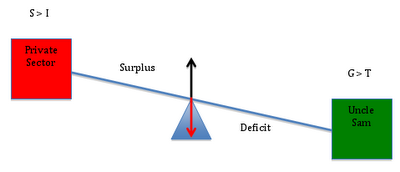
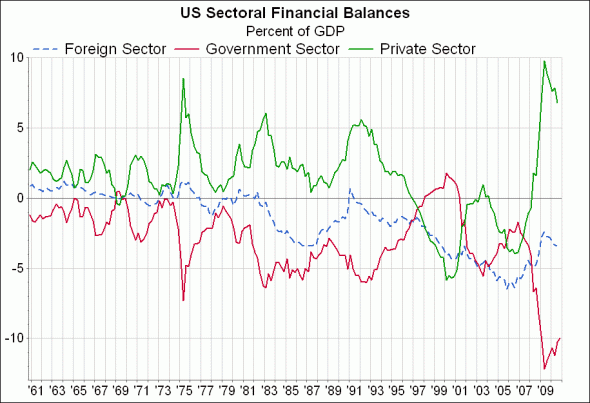
And finally, another useful image. Banksters throughout banking history have repeatedly been caught trying to control the net currency supply, for personal gain, regardless of how much it hurt the nation which such Control Frauds parasitize. They can always stash the supposedly valuable currency in off-shore accounts, even if the nation they parasitize collapses.
And once currency supply is emancipated, through adoption of fiat currency? Then, the same Control Frauds simply transition their game. Currency supply itself is not purposefully manipulated. Instead, the fraud narrows to a focus on
unbalancing the distribution of incomes, so that the same effect is gained without disturbing the alarms raised when wild swings in currency supply occur. [And remember, old frauds may be easily revisited the instant a compliant electorate once again becomes ignorant enough to be duped in the same old ways, all over again.]

We're left with a recurring question.
Is it true that Neo-Liberals can't understand the Fallacy of Scale? Or true that kleptomaniacs can't help themselves? The answer seems obvious, and we can again find direction through indirection. In a truly recombinant culture, there will always be some residual number of NeoLiberals, kleptomaniacs and other Luddites. It's our job to NOT promote concentrations of any sociopathy to overly infest positions of authority, where they can have excessively negative effects on emerging aggregate policy.
###
* ps: And then ONLY because we choose to peg currency issuance to sales of bonds - as a archaic, useless tax on currency issuance, no matter how small.
** ps: ps: The honest, intelligent banker Marriner Eccles never did see eye to eye with the American Bankers Association, as
subsequent letters show. We need more people like Marriner Eccles. We have them, of course. We're just not sending them into government anymore, nor to run the ABA. There are always many things we have to start doing differently. History shows that there's no point in waiting to institute intelligent change, only harm. When we change, only 3 outcomes (worse, same, better) can occur, and two of them are bad ... yet change we must. Our task is to select wisely, not to fail or refuse to select.