Showing posts with label rent. Show all posts
Showing posts with label rent. Show all posts
Sunday, April 7, 2019
LarsP. Syll — Mainstream theories of income distribution
Increasing asymmetry of income and wealth, which now goes by the name "inequality" as the buzzword, arises either from the function of perfect markets or from asymmetry of power. A perfect market is one in which there is no asymmetry, that is, the agents are homogenous.
A perfect market could generate asymmetry through difference in ability that lead to differences in distribution owing based on merit and just deserts (as conventional economics assumes). However, perfect markets don't exist other than as modeling constructs. Class structure, for example, generates asymmetries. Always has and always will, to the degree that is is permitted and not compensated for.
Addressing rising inequality by addressing the causes involves addressing the asymmetries from which inequality arises. Libertarians assume that all asymmetry of power and influence is introduced by "state" (government) influence on markets. That is only partially true, however. Influence does often occur through government but this is through asymmetrical power that exists among agents, enabling capture. In addition, economies of scale produce greater efficiency but at the expense of concentration, which risks monopoly and monopsony power and monopoly and monopsony rents as a consequence. This generates "monopoly capitalism."
The upshot is that market "imperfections" lead to asymmetric power, and asymmetric power enable the extraction of economic rent as unearned gains, which in turn results in asymmetric distribution that is not based on merit and gained through competition in perfect markets.
Further elaboration of this cycle is needed to clarify for electorates what the reasons for rising inequality rather rather than appealing to models based on unrealistic assumptions that exist only in economists' brains.
This necessitates an investigation of power and its operation in a society as a social system (complex adaptive system). This was initiated by the classical economists in their investigation of economic rent, continued by Karl Marx, taken up by Veblen and the institutionalists, and subsequently shunted over to sociology ( cf. C. Wright Mills) and political science since the advent of marginalism explained economic rent away based on idealistic models of a market economy based on near perfect markets.
Conventional economists know about market imperfection, rent, rent-seeking and rent extraction but they have avoided dealing with it as a socio-economic factor. Now rising social dysfunctionality is forcing a return to investigating distribution and the causes of increasing inequality of income and wealth.
This can no longer be avoided but no one has yet grasped the "third rail" of economics — other than the Marxists and Marxians, that is, which a reason no one else dares touch it, since contemporary capitalism is based on it and argues unequal distribution is necessary because "incentive." Well then, even if this would be the actual reason, which is highly doubtful, it is a bug rather than a feature.
LarsP. Syll’s Blog
Mainstream theories of income distribution
Lars P. Syll | Professor, Malmo University
See also
Michael Roberts Blog
Invisible Leviathan – Marx’s law of value in the twilight of capitalism
Michael Roberts


Friday, April 27, 2018
Dick Bryan — New type of poverty hurting middle class
The banking and finance royal commission has cast light on a new type of poverty to emerge in our society: middle class poverty.
To understand it, we have to go back to an earlier government inquiry: the 1972 Commission of Inquiry into Poverty, conducted by Professor Ronald Henderson. That commission had no real policy impact, but its cultural impact was profound. It gave prominence to the Henderson Poverty Index: a measure of consumption described by Henderson as so austere that it was unchallengeable. Updated versions of this index remain a standard benchmark of poverty.
But more than 45 years on, the royal commission into finance is revealing that poverty is no longer just about low income. The commission has heard that Australian banks have adopted actual lending practices (as distinct from their official lending policies) that claim so much household income for contract payments that borrowers are left without enough money to fund basic consumption levels: they are living in poverty....
Sunday Morning Herald
New type of poverty hurting middle class
Dick Bryan
See also
CBPP
Trump Plan Would Raise Rents on Working Families, Elderly, People With Disabilities
Will Fischer | Senior Policy Analyst
See also
CBPP
Trump Plan Would Raise Rents on Working Families, Elderly, People With Disabilities
Friday, March 25, 2016
Nick Johnson — Power under capitalism: the public and the private
The Political Economy of Development
Power under capitalism: the public and the private
Nick Johnson
Saturday, July 18, 2015
Reddit — Member of the 1% Shocks Reddit: ‘I’m Voting for Bernie Sanders. Here’s Why’
Why? Economic performance is a matter of maintaining circular flow at dynamic equilibrium with respect to population growth, and increasing per capital product to the degree possible through innovation.
Rent detracts from circular flow, as does hoarding. If this were invested, especially in innovation, it would not make any substantial difference to the economy other than distributively. But it is not, regardless of the intense propaganda to the contrary.
The pie is smaller than it could be as a result, and distribution is adversely affected too, starving the bottom unless the bottom is subsidized.
Every economist is well aware of this.
AlterNet
Member of the 1% Shocks Reddit: ‘I’m Voting for Bernie Sanders. Here’s Why’
Reddit
Rent detracts from circular flow, as does hoarding. If this were invested, especially in innovation, it would not make any substantial difference to the economy other than distributively. But it is not, regardless of the intense propaganda to the contrary.
The pie is smaller than it could be as a result, and distribution is adversely affected too, starving the bottom unless the bottom is subsidized.
Every economist is well aware of this.
AlterNet
Member of the 1% Shocks Reddit: ‘I’m Voting for Bernie Sanders. Here’s Why’
Tuesday, December 16, 2014
Lynn Parramore — Joseph Stiglitz: Economics Has to Come to Terms with Wealth and Income Inequality
Clear and concise presentation of Stiglitz's position relative to the approach of Picketty. Many solid points including monopoly power and capital share versus labor share through exploitation based on market power favoring capital. Stiglitz also hones in on rent and rent-seeking.
I think that the thrust of my book, The Price of Inequality, and a lot of other work has been to question the margin of productivity theory, which is a theory that has been prevalent for 200 years. A lot of people have questioned it, but my work is a renewal of questioning. And I think that some of the very interesting work that Piketty and his associates have done is providing some empirical basis for doing it. Not only the example that I just gave that if you look at the people at the top, monopolists actually constrain output. People who make the most productive contributions, people who make lasers or transistors, or the inventor of the computer, DNA researchers, none of these are the top wealthiest people in the country. So if you look at the people who contributed the most, and the people who are there at the top, they’re not the same. That’s the second piece.
A very interesting study that Piketty and his associates did was on the effect of an increase in taxes on the top 1 percent. If you had the hypothesis that these were people who were working hard and contributing more, you might say, ok, that’s going to significantly slow down the economy. But if you say it’s rent-seeking, then you’re just capturing for the government some of the rents.INET
Joseph Stiglitz: Economics Has to Come to Terms with Wealth and Income Inequality
Lynn Parramore
Thursday, November 20, 2014
Kimball Corson — The Core Problem Of The World Economy And With Capitalism Is Income Distribution
The core problem worldwide is productive capacity has largely out run the capacity of consumers to buy the goods and services capable of being produced.
The core problem creating this situation are the skewed distributions of income worldwide. High income earners and banks are hoarding money and not lending or spending it. A continuing economic malaise results.
The core problem worldwide is productive capacity has largely out run the capacity of debt ridden and poorly paid workers/consumers to buy the goods and services capable of being produced. A decade or so ago, producers sought out new middle class consumers in developing countries to avoid the impact of the imbalance in their home countries, but that option is now waning. This leaves few good investment opportunities worldwide and the problem is fast becoming one that is global.…
Income distribution problems are the world's core problem, I suggest….
Capitalism as we know it is in trouble.Wandering the Oceans
The Core Problem Of The World Economy And With Capitalism Is Income DistributionKimball Corson
Tuesday, October 28, 2014
Saturday, October 25, 2014
Dietz Vollrath — Scale, Profits, and Inequality
But if we take seriously the incentives behind innovation, then it isn’t simply the genius of the individual that matters for growth. The scale of the economy is equally relevant.I would say that scale is much more relevant than innovation. Innovation is not new. What is new is population size and mass markets that serve either the entire market or major segments. There is still significant innovation in niche markets, but the innovators are not rewarded anywhere near like those who can capture market share in a mass market. It's the existence of mass markets (scale) that results in the level of inequality that prevails and promises to be become the norm as more an more niches are absorbed into conglomerates and smaller less efficient firms merged and consolidated. You know, "the economies of scale." Do we need unlimited inequality to incentive innovation in this environment? Why? Most of the gains are simply rents that are extracted because they can be.
The Growth Economics Blog
Scale, Profits, and Inequality
Dietz Vollrath | Associate Professor of Economics at the University of Houston
h/t Mark Thoma at Economist's View
Sunday, August 24, 2014
Dr. Housing Bubble — Building for a future of American renting serfs
There was much celebration regarding the jump in private housing starts. However, once you begin to look beyond the headlines you realize that the big jump came largely because of multi-family starts. In other words, building more rentals in the form of apartments for a growing population that rents. Private starts for places with 5 units or more has now hit a post recession high. This makes sense given the fall in rental vacancy rates and the rise in rental prices. Yet what we find is that more income is being siphoned off into a less productive sector of our economy. Real estate tends to be a big plus for an economy when it happens organically with rising incomes, good overall employment prospects, and first time buyers leading the charge. Today it is more of a shifting of assets into fewer hands while extracting more income from the productive sectors of the economy. Not everyone can have their flipping show on cable television. For example, over 11 million Americans now pay 50 percent or more of their income to rent. Many of those people are here in California. The trend to building rentals aligns with the underlying reality that many future Americans will be less affluent compared to their parents.Dr. Housing Bubble
Building for a future of American renting serfs: Private housing starts for structures with at least 5 units hits a post recession high. More than 11 million Americans spend more than 50 percent of income on rent
Monday, August 11, 2014
Matt Bruenig — It Matters How Rich the Rich Are
…the economy is itself just a large government program. Through its laws and the police, the government has put in place a vast array of economic institutions that collectively determine who gets what at any moment in time. To assess the effectiveness of the institutional design choices the government has made, we need to know who is benefiting from them and to what degree. That means, among other things, knowing how rich the rich are.Policy Shop
Matt Bruenig
Saturday, June 28, 2014
Zero Hedge — Why CEOs Love Buybacks (In 1 Simple Chart)

Zero Hedge
Why CEOs Love Buybacks (In 1 Simple Chart)
Posted by Tyler Durden
Just deserts based on performance and merit, or rent extraction?
Saturday, May 31, 2014
Brad DeLong — Unjust Deserts
We would have a much clearer discussion of issues of inequality and distribution if we would simply stick to considerations of human wellbeing and useful incentives. The rest is meritocratic ideology; and, as the reception of Piketty’s book suggests, that ideology may now have run its course.Project Syndicate
Unjust Deserts
J. Bradford DeLong | Professor of Economics at the University of California at Berkeley and a research associate at the National Bureau of Economic Research
Thursday, May 29, 2014
David F. Ruccio — Capital, labor, and inequality
... as I suspected, the main line of attack (at least within mainstream economic thinking) against Piketty’s treatment is to undermine the idea of capital versus labor and to focus instead on growing inequality among workers....
In my view, the problem with juxtaposing ownership-of-capital inequality and labor-earnings inequality is that it ignores the extent to which earnings at the top are themselves distributions of the income captured by capital. That’s a point that seems to have been missed by both Piketty and his critics.A point I have made previously. Treating "income" at the top as income from work is just silly and completely ignores institutional arrangements and power. Much if not most of it is rent-extraction. Counting "income" of the top tier as "labor" share is an oxymoron. It's capture of the surplus, just because those that the top can, i.e., have the institutional power to do so.
Occasional Links & Commentary
Capital, labor, and inequality
David F. Ruccio | Professor of Economics University of Notre Dame Notre Dame
Friday, May 16, 2014
Advent Of The Renter Nation
(Commentary posted by Roger Erickson)

The author make many interesting points, yet jumps to agreement with Gundlach, that more renters will mean fewer homes constructed. Not sure that that correlation necessarily follows, even with increasing urban concentration. Construction will just transition to multi-family homes, until population stabilizes.
The author make many interesting points, yet jumps to agreement with Gundlach, that more renters will mean fewer homes constructed. Not sure that that correlation necessarily follows, even with increasing urban concentration. Construction will just transition to multi-family homes, until population stabilizes.
Wednesday, May 7, 2014
"Beyond Squid" making fiat credit functions as simple as possible, but no simpler
(Commentary posted by Roger Erickson; hat tip to EconIntersect)

When a VC whirs its blender vanes in Silicon Valley, it's never too late to short John Deere? :(
When a VC whirs its blender vanes in Silicon Valley, it's never too late to short John Deere? :(
So get yer synthetic food while it's cheap .... 'cuz Vampire Squid is coming to town.
These techie inventors initially seemed a bit naive about basic food & fiber operations (e.g., distinction between more-hydrolyzed canola oil vs, say, less-hydrolyzed olive oil - since corrected, apparently) - not to mention water itself.
“How I Stopped Eating Food”Initial ingredients posted here.
These techie inventors initially seemed a bit naive about basic food & fiber operations (e.g., distinction between more-hydrolyzed canola oil vs, say, less-hydrolyzed olive oil - since corrected, apparently) - not to mention water itself.
Maybe Monsanto has already patented a follow-on, Colon Cleanser, derived from ... non-GMO-FOOD!!! [Nobody could have predicted that, right?]
Regardless, the biggest revelation is that extracted nutrients are currently so much cheaper than raw food! Ponder the likelihood. That outcome is a byproduct of existing but transient industrial and tax policy. An "externality," you might say - and therefore subject to arbitrage.
Next? Look for Goldman Sachs to start buying & hoarding basic nutritional ingredients, in the same warehouses* as their aluminum & copper & politician stockpiles? Just like rentiers buy up cultural information, and hoard it as "copyrighted" material, instead of serving culture, by distributing it wherever & whenever useful.
Regardless, the biggest revelation is that extracted nutrients are currently so much cheaper than raw food! Ponder the likelihood. That outcome is a byproduct of existing but transient industrial and tax policy. An "externality," you might say - and therefore subject to arbitrage.
Next? Look for Goldman Sachs to start buying & hoarding basic nutritional ingredients, in the same warehouses* as their aluminum & copper & politician stockpiles? Just like rentiers buy up cultural information, and hoard it as "copyrighted" material, instead of serving culture, by distributing it wherever & whenever useful.
Per the classic plot line of Greek Tragicomedy, after Guar Gum Wars story appears, look for the inevitable Return of the Rentiers.
And in subsequently expected episodes: The Vampire Strikes Back, followed by something featuring colon-cancer rates and an unfinished Barf Star doomsday weapon.
Actually, all this also leads directly to a proposed OpenSource or fiat book:
"Beyond Squid"
making fiat credit functions as simple as possible, but no simpler
If OpenSource-Fiat is the basic medium of information, which binds all culture together, then the SquidSide of the farce is the inevitable parasite, opposing culture. A Squid Lord, you say? Supposedly extinct for 80 years? And how could one exist undetected in the midst of Democracy? Hmmm. Always tentacles there are. So which is the Squid, and which are the suckers?** To unravel this mystery, we need to travel back through UMKC, to the center of the universe, and on further, to Ogden, Utah, where local prophesy holds that another Marriner will someday bring nuance to the farce.*** Even those in Darwin should approve.
---
* Congress is merely a Goldman Sachs warehouse? Where bankers stockpile policy, before doling it out to the highest bidders?
** Hiding in plain sight, as rentier & renters?
** but only when ready, these electorates are
Monday, May 5, 2014
Dan Kervick — Laissez-faire’s Piketty Problem
Excellent analysis comparing Piketty's Capital and Tyler Cowen's Average is Over, explaining in some detail Piketty's argument based on rent accrual. Dan lets Piketty sum up his own argument:
The problem posed by this use of the word “rent” is very simple: the fact that capital yields income, which in accordance with the original meaning of the word we refer to as “annual rent produced by capital,” has nothing to do with the problem of imperfect competition or monopoly. If capital plays a useful role in the process of production, it is natural that it should be paid. When growth is slow, it is almost inevitable that this return on capital is significantly higher than the growth rate, which automatically bestows outsized importance on inequalities of wealth accumulated in the past. This logical contradiction cannot be resolved by a dose of additional competition. Rent is not an imperfection of the market: it is rather a consequence of a “pure and perfect” market for capital, as economists understand it: a market in which each owner of capital, including the least capable of heirs, can obtain the highest possible yield on the most diversified portfolio that can be assembled in the national or global economy. (p. 423)
I suspect that Piketty and Cowen have complementary points.
Piketty claims that the fundamental architecture of capitalism results in a tendency toward rent accrual by owners of capital. Since capital tends to concentrate, this results in a privileged class. This seems to be true.
Cowen argues that technology has reached the point that labor is becoming increasing obsolete. The tendency is toward the need for and high compensation of only the highly knowledgeable and highly skilled, a small portion of the population. Therefore, employee compensation will concentrate that the top end, with technological innovation rendering lower skilled workers redundant. This seems to be true also.
The labor problem here is also that workers at the upper end of the pay scale, where compensation includes not only salary but also other forms of compensation, are not paid based on their marginal productivity. Owing to competition among firms for the best of the best, top level employees can command a residual over MP as a form of rent. They can capitalize their "labor assets." Those lower on the pay scale where labor is abundant are either paid at their MP or even less when government subsidies to the working poor allow for this, since they own no labor assets that they can capitalize as rent.
This is a pincers movement that is putting not only the poor and less educated in jeopardy, but also the broad middle class, as jobs migrate to the top end, to what we now call the upper middle class and lower level rich. The bulk of capital gets increasingly concentrated in the future at the level of the super-rich.
If these analyses are correct, the developed nations first and then the entire world faces bleak social prospects unless political steps are taken to overhaul the institutional arrangements that are producing this kind of result.
Rugged Egalitarianism
Laissez-faire’s Piketty Problem
Dan Kervick
Friday, February 21, 2014
Alan Pyke — Wall Street Is Drooling Over The Money It Will Make On Americans Who Can’t Afford Houses
Think Progress
Bad news for American families is great news for the financial industry, according to the real estate finance industry trade magazine CRE Finance World (CREFW).
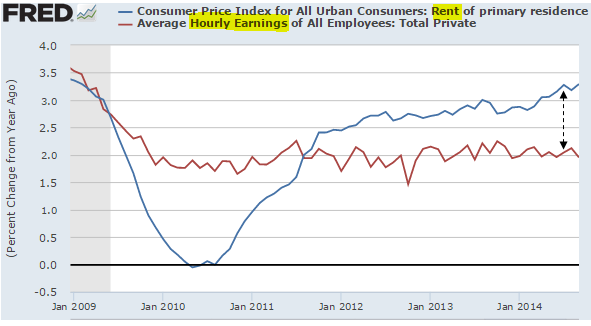
Workers’ incomes will continue to decline and homeownership will become an ever more remote dream for the typical American, boosting demand for rental housing and pushing the cost of rent up, an article in the magazine’s new edition says. That will cause the market for rental housing securities — complex financial contracts backed by rental properties — to explode over the next year, Deutsche Bank analyst Harris Trifon writes.
Wall Street Is Drooling Over The Money It Will Make On Americans Who Can’t Afford Houses
Alan Pyke
First, securitize the mortgages, then foreclose, then securitize the rents. What could go wrong?
Tuesday, February 4, 2014
Karl Smith — Not All Forms of Wealth Are Equally Pernicious
Karl Smith reflects on Thomas Picketty's Capital: Land (rent) is different from (productive) capital.
This is the tyranny of land. Ignore it at your peril.
The Financial Times — FT Alphaville
Not All Forms of Wealth Are Equally Pernicious
Karl Smith | Assistant Professor of Economics and Government at the University of North Carolina
Saturday, August 3, 2013
beowulf — Dealing with stagnant wages the Jason Statham way
The ever-resourceful beowulf comes up with another ingenious plan, this time for a minimum wage by locale that pits employers against landlords and city against city.
Monetary Realism
Dealing with stagnant wages the Jason Statham way
beowulf
Sunday, March 31, 2013
Yves Smith — Obama Plans to Sacrifice Ordinary Americans Yet Again in “Public/Private Partnership” Infrastructure Scam
Apparently Obama’s idea of a Holy Week sacrifice is to feed American citizens to rapacious bankers, this time through the device of “public/private partnerships” to support infrastructure spending. Some NC readers were correctly alarmed by a speech by Obama on Friday on using public/private partnerships to fund infrastructure spending. This is not a new idea; Obama first unveiled it in his Statue of the Union address. But it is a singularly bad idea, that is, if you are anyone other than a promoter of or investor in these deals.
As we’ve discussed at length earlier, these schemes are simply exercises in extraction. Investors in mature infrastructure deals expect 15% to 20% returns on their investment. And that also includes the payment of all the (considerable) fees and costs of putting these transactions together. The result is tantamount to selling the family china and then renting it back in order to eat. There is no way that adding unnecessary middlemen with high return expectations improves the results to the public. In fact, the evidence is overwhelmingly the reverse: investors jack up usage fees and skimp on maintenance. And their deals are full of sneaky features to guarantee their returns.Naked Capitalism
Obama Plans to Sacrifice Ordinary Americans Yet Again in “Public/Private Partnership” Infrastructure Scam
Yves Smith
Piling on more rent instead of government funding "in order to advance democracy and the free market." Neoliberalism aka crony capitalism at work.
Subscribe to:
Posts (Atom)