Showing posts with label the good life. Show all posts

Monday, June 25, 2018

Julian Baggini — Book clinic: which books best explain why life is worth living?


Short.

These excerpts summarize the answer I would have given, too.


Q. Which books can tell me, from a philosophical standpoint, what makes life worthwhile or worth living?
A. Philosopher and author Julian Baggini writes: 
Surprisingly, few of the world’s great philosophers have directly addressed this question. Instead, they have focused on a subtly different question: what does it mean to live well?
In his Nicomachean Ethics, Aristotle emphasised the need to cultivate good character, finding the sweet spot between harmful extremes. For example, generosity lies between the extremes of meanness and profligacy, courage between cowardice and rashness. A remarkably similar vision is presented in the Chinese classics The Analects of Confucius and Mencius.…
Should all else fail, there is my own What’s It All About?, which aims to shows how philosophy does not so much answer the big questions as help provide us with the resources to answer them for ourselves.
Some of the most important questions are "the enduring questions" that have to be approach anew in every era and also answered personally.

One of these enduring questions is, what does it mean to live a good life as an individual in a good society.

The Guardian
Book clinic: which books best explain why life is worth living?
Julian Baggini

See also

Good review that reconciles opposing viewpoints. Ibn Khaldun was a precursor of modern sociology and economics. Longish.

3:AM Magazine — Whatever It Is, We Are Against It
Good Orientalism: Robert Irwin vs Ernest Gellner on Ibn Khaldun. Boom!
Richard Marshall

Monday, June 20, 2016

Alexander Douglas — Some explanation on my last post


Alex Douglas thanks all for their support and asks for suggestions.

My suggestion is to take John Kenneth Galbraith's The Good Society: The Humane Agenda and Economics and the Public Purpose and update them in light of MMT. Of course, these books segue into lots of other relevant contributions No need to reinvent the wheel, just return the conversation from the trivial to the important. However, I think that "the good society" and "public purpose" are a good lede. 

As Alex notes this is essentially a philosophical issue. As I have said, it goes back to ancient Greece in the Western intellectual tradition. The Greeks were absorbed in the question of what it means to live a good life as an individual in a good society. Aristotle observed that humans are social animals and therefore the good life must include citizenship.

The Greeks also introduced liberalism as the prioritizing of freedom. Freedom from constraint and freedom to choose are necessary for freedom for self-actualization as an individual and self-determination as a state (Gk: polis).

In my experience, ethics and aesthetics rest on ontology and epistemology as a foundation, and social and political philosophy rests on ethics. For example, one's world view ("philosophy" in the broadest sense) is foundational since one's world view is the conceptual model of reality that one employs. 

A key fundamental in a world view is the conception of human nature, for example. One's conception of human nature greatly influences one's world view both individually and socially. See, for instance, Twelve Theories of Human Nature, which is hardly exhaustive.

Here is a comment I left at The Multidisciplinarian yesterday that speaks to this:

“Philosophy” has many different meanings and to hold out one as the meaning would difficult to impossible to defend. Yes, I have those three letters after my name.

In the broadest sense philosophy is summarized in the colloquial question, “What’s your philosophy?” Philosophy in this sense it is reflection on one’s fundamental assumptions and those of society not only in particular but as a world view, that is, a conceptual system that models reality in symbols expressed as words rather than numbers.

Philosophy deals with quality as well as quantity and other uses of language than purely descriptive, as well as modality. The primary tool is logic and the method is reasoning. Just as mathematics is the language of science and accounting the language of business, logic is the language of philosophy.

Most people’s world view is acquired through socialization and education. Much of it remains implicit, and most people don’t endeavor to make it explicit or reflect on foundational matters much or even at all. Plato attributes to Socrates the observation that a life not reflected upon is not worth the living. This is generally taken to be the earliest and clearest definition of philosophy. Philosophy is reflection using reason in this broad view. What’s not to like about that?

Since there are many fields of life and knowledge, philosophy has many branches that attempt to make the implicit explicit and to subject it to a rigorous logical critique through debate. This is the Socratic dialectic. This post and comment thread is an example of it in action.

Moreover, philosophy isnt’ just shooting the bull over beers, although a lot of philosophizing is done that way. But philosophy is concerned with foundations rather than trivia. Philosophy of science can also be called “foundations of science,” for example. This involves the attempt to reflect on key fundamentals such as causality in order to clarify them, as well as to uncover inconsistencies in assumptions and presuppositions.

Philosophy in the broadest sense is the attempt to reflect on the foundations of a world view, making as much of it explicit as possible and then critiquing it rigorously using reason. This is pretty much the objective of Phil 101, which is about the basics of reasoning, logic and critical thinking, usually with reference to some of the “enduring questions” that continue to be debated since no resolution has been arrived at that compels assent since agreed upon criteria are lacking.

These questions used to be studied in terms of the great thinkers of the Western intellectual tradition and some professors still follow this course. Many others chose to seat the questions in current affairs and controversies such as medical ethics, liberal democracy, and other matters that are sure to result in spirited debate.
  • #2 by Bill Storage on June 19, 2016 - 9:42 pm
    Thanks for the those well-expressed thoughts on logic, reasoning, and their application, Tom. I fear that spirited debate may be out of fashion in my neighborhood, where critical thinking is believed to kill creativity and most skepticism is viewed with skepticism.
    • #3 by Tom Hickey on June 19, 2016 - 9:51 pm
      Some would say critical thinking went out of fashion along with liberal education. I would be one of them.
I also came to the conclusion over the years that it's not possible to deal with social and political philosophy without also dealing with both the philosophical foundations of economics and political economy. Since economics now concerns monetary production economies that also involves money & banking, and finance.

This is a big chunk and no one person is going to resolve the issues. But some people need to get the ball rolling if this debate is to take place.

The world badly needs an undated theory of liberalism made practical as an antidote to the faux liberalism that is actually illiberal, or, in the criticism of Karl Marx, bourgeois liberalism grounded in the freedom for accumulators to accumulate based institutional power and the power of the captured state.

Origin of Specious
Some explanation on my last post
Alexander Douglas | Lecturer in Philosophy at Heythrop College, London

Friday, September 11, 2015

Eric Schliesser — On Plato's System of Natural Liberty (and Adam Smith's True Religion)


Weekend reading.

The issue in The Republic is living a good life in a good society.

Digressions&Impressions
On Plato's System of Natural Liberty (and Adam Smith's True Religion)
Eric Schliesser | Professor of Political Science, University of Amsterdam’s (UvA) Faculty of Social and Behavioural Sciences

Tuesday, June 2, 2015

Marc Lee — Climate Justice and the Good Life, for Everyone


If there is one phrase that sums up what's wrong with economics, it is "specious assumptions." The most specious assumption is that science is an independent disciple that investigates reality in order to discover natural invariances that can be modeled formally, similar to physics.

This involves denial that economics is a social science with emphasis on social. The social aspect of economics implies, first, that the subject matter is different from natural science, which also implies the need to employ different methodology in approaching it. 

Secondly, as an implication of the assumption that economics is natural science, it is also assumed that outcomes are "natural" as long as natural processes, here market forces, are not interfered with artificially. 

This is based on a concept of human being, called homo economicus, that does not accord with the findings of other disciplines about human being as homo socialis. It also puts economics at odds with widely accepted norms of social justice based on liberal principles grounded in equality of persons and the fairness this implies as the basis for rights.

There are good argument against government imposing any particular moral code in a liberal society. But to conclude from this that society is therefore immoral would be a violation of the fundamental principles of liberalism, which include egality and solidarity along with freedom.

Morality and ethics are imposed socially by political decisions taken democratically in a liberal society and promulaged through positive law and rights based on a concept of justice that is founded on the liberal principles of equality of persons before the law and due process. This implies lack of privilege and social fairness.
A growing body of research into well-being and happiness tells us to look beyond money and consumption. While income matters a great deal at lower levels – when one is poor, a little money makes a big difference – but once basic needs are met, higher income does not necessarily translate into gains in happiness. Research points to substantial benefits to be had from a more equitable distribution of wealth – inequality manifests in weaker performance on a range of social and health indicators. Social fairness in terms of income and employment distribution may, in fact, be vital for achieving the changes required for a transition to a sustainable economy. 
Some key insights into well-being relevant to a new conception of “the good life” include (key references at end): 
  • Full employment and decent work....
  • Time use and work-life balance....
  • Community and social cohesion.... 
One major report to the French government from two Nobel laureates [Joseph Stiglitz and Amartya Sen] in economics argues that progress should be understood by assessing a diverse array of well-being indicators to capture a more comprehensive understanding of people’s lives, spanning key areas of: health, education, environment, employment, material comfort, interpersonal connectedness and political engagement. 
The Canadian Index for Wellbeing (CIW) was launched only recently in 2010 as a counterweight to the gross domestic product numbers. It aims to measure and track the quality of life of Canadians and is comprised of 64 indicators. The CIW has demonstrated that Canadians’ quality of life has not kept pace with the country’s economic growth from 1994 to 2008, where although GDP grew 31%, CIW rose only 11% in the same period. A key reason is that Canadians are spending less and less time on healthy social and leisure activities, and the state of the environment has declined.
This growing body of research is broadly consistent with the notion of climate action and climate justice....
The Progressive Economics Forum

Sunday, December 7, 2014

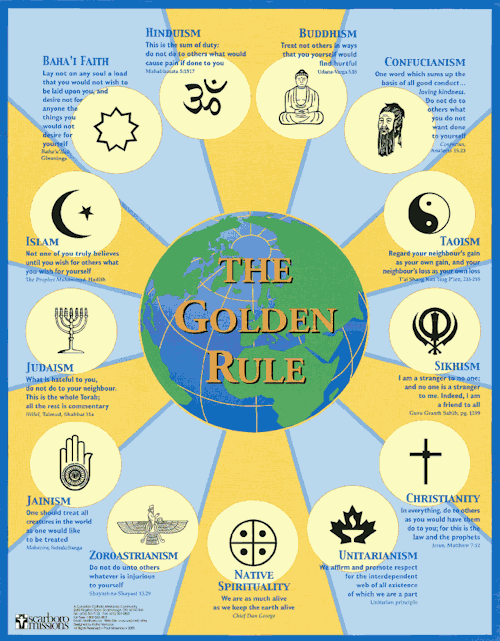
Miles Kimball — Liberty and the Golden Rule


A paradox of liberalism:
Part of the problem is in the limitations of the golden rule: “Do unto others as you would have them do unto you.” That is all well and good if they have the same preferences, but not if they want something different from what you would want in the same circumstances. Until further advances in technology, we are shut out of knowing directly what the world looks like from inside someone else’s mind, and have to guess based on how we would feel. But that sometimes steers us badly off target. Giving everyone personal liberty is a safeguard against our blind meddling.

Of course, applying the golden rule at a meta-level would say “I want liberty, so I should give others liberty as well.” But there are many times when liberty is a higher law than the applying the golden rule at the detailed level.
Confessions of a Supply-Side Liberal
Liberty and the Golden Rule
Miles Kimball | Professor of Economics and Survey Research at the University of Michigan


Wednesday, September 25, 2013

Nigel Warburton — Talk With Me

...Conversation without critical judgment becomes mere chatter and airing of different opinions — as William Empson wrote in his poem ‘Let It Go’ (1949):
"The contradictions cover such a range.The talk would talk and go so far aslant.You don't want madhouse and the whole thing there."
However, it was John Stuart Mill who crystallised the importance of having your ideas challenged through engagement with others who disagree with you. In the second chapter of On Liberty (1859), he argued for the immense value of dissenting voices. It is the dissenters who force us to think, who challenge received opinion, who nudge us away from dead dogma to beliefs that have survived critical challenge, the best that we can hope for. Dissenters are of great value even when they are largely or even totally mistaken in their beliefs. As he put it: ‘Both teachers and learners go to sleep at their post, as soon as there is no enemy in the field.’
Whenever philosophical education lapses into learning facts about history and texts, regurgitating an instructor’s views, or learning from a textbook, it moves away from its Socratic roots in conversation. Then it becomes so much the worse for philosophy and for the students on the receiving end of what the radical educationalist Paolo Freire referred to pejoratively in Pedagogy of the Oppressed (1970) as the ‘banking’ of knowledge. The point of philosophy is not to have a range of facts at your disposal, though that might be useful, nor to become a walking Wikipedia or ambulant data bank: rather, it is to develop the skills and sensitivity to be able to argue about some of the most significant questions we can ask ourselves, questions about reality and appearance, life and death, god and society. As Plato’s Socrates tells us, ‘These are not trivial questions we are discussing here, we are discussing how to live.’
Aeon
Talk with me
Nigel Warburton

Sunday, September 8, 2013

INET — The Philosophy of Economics: The Institute Kicks Off Event in China

The Institute for New Economic Thinking and China’s Tsinghua University today kicked off their seminar in Shenzhen, China, called “The Good Life: The Challenges of Progress in China.”...
[Robert] Johnson set the tone for the conversation by stating that the goal of the conference was to address the elements and mechanisms needed to create “the good life” and how society can achieve it....
The good life has an ancient and modern meaning. In modern terms, "the good life" means material prosperity. The ancient meaning signified a life that unfolded maximum potential as both as a human being and as an individual — as a human being in terms of achieving the good for man or the summum bonum, and as unique person in terms of using personal endowment to optimal advantage individually and socially. 

Plato and Aristotle held that the good life as the human ideal included the good society, since human beings are inherently social and cannot find full expression exclusive of social relationships. Thus, living a good life implies a good society.
Kaletsky then followed with a discussion of the economic lessons from the most recent financial crisis. He said that the meltdown revealed that economics provided no theories to help us understand what had happened or what our next step should be. This failure has resulted in questions about the role of economic policy and the proper division of macro and microeconomics. Kaletsky urged society to recognize the imperfections in current economic theories and to go beyond traditional thought to come up with new ways of thinking about economies.
Johnson closed the evening by noting that the economic theories that have been predominant over the past few decades have broken down, and we now have to start creating a new economics that reflects the realities of today.
Let's hope that INET realizes that Kaletsky's assertion, "the meltdown revealed that economics provided no theories to help us understand what had happened or what our next step should be," is incorrect. It should read, "the meltdown revealed that [conventional] economics provided no theories...." Nor is Johnson's assertion that it is necessary "to start creating a new economics that reflects the realities of today" completely correct either, in that it is not necessary to start from scratch. The first step is to jettison the dead weight of conventional economics and the second is to turn the focus on existing heterodox solutions that predicted the global financial crisis and warned about the euro debacle, and so provided solutions. 

Hopefully,  the MMT analysis and prescription will be presented. If not, why not?

And will they actually integrate the philosophy of economics with traditional philosophical investigation of the good life in a good society that has been central since ancient times? Or will "the good life" be seen as only a chicken in every pot and a car in every garage?

Sunday, August 25, 2013

Stephanie Kelton — The Good Society: Lessons Not (Yet) Learned

John Kenneth Galbriath’s book, The Good Society: The Humane Agenda, creates a blueprint for a more just, prosperous and stable world. I’m re-reading it for the nth time because I continue to believe we might just get there one day. Indeed, I’m convinced we must.
Here are some excerpts....
New Economic Perspectives
The Good Society: Lessons Not (Yet) Learned
Stephanie Kelton | Associate Professor of Economics and Chair of the Economics Department, UMKC

A fundamental question of the global intellectual tradition and perennial wisdom is, What is the good life for individuals in a good society, and how to achieve it. The history of thought is about the different answers based on different ontological, epistemological, ethics, aesthetic assumptions about reality, experience, and the place of humanity in it. These assumptions underlie social and political thought.

Economics generally presupposes foundational assumptions and makes theoretical and methodological assumptions based on such implicit prior assumptions that frame the enquiry.

Since the Enlightenment, the design problem has been reconciling social, political and economic liberalism, along with developing institutions and policy based on different design solutions. These solutions differ based on both normative assumptions for example, that serve as criteria, as well as differences in worldview that frame reality differently.

In The Good Society (1996), John Kenneth Galbraith presents his summation of a 20th century liberal position eloquently, and, if one shares his values and worldview, convincingly.

Contrasting positions are developed by: 
These positions are now the dominant subject of discussion in American political economy today rather than Galbraith's The Good Society.

Notable is that there is nothing on the right that mentions society.This is unsurprising since the underlying assumption of these works is methodological individualism grounded in the implicit assumption of ontological individualism.

The exception to this is journalist Walter Lippmann's The Good Society (1937). Lippmann is remembered, however, more for A Preface to Morals (1929) and The Public Philosophy (1955). While very influential in presenting the conservative viewpoint in the last century, he is hardly cited today, like his then famous opponent on the left, American educator and philosopher John Dewey. "... [Dewey] wrote in The Public and its Problems: "Till the Great Society is converted in to a Great Community, the Public will remain in eclipse. Communication can alone create a great community" (p. 142).

Time to again shine the light on the living a good life in a good society and the great community of humanity as we enter the age of globalization and a rising collective awareness of humanity, as well as ecological interdependence in the community of being.

Sunday, March 17, 2013

Sandra LaFave
 — The Marxist Critique of Consumer Culture


Sunday evening reading. Particularly significant is section III, on "the good life," which analyzes Marx's debt to Aristotle on the good life.


The Marxist Critique of Consumer Culture
Sandra LaFave
 | West Valley College

Thursday, March 14, 2013

Dirk Ehnts — The Good Economist

AEN: I take it that you don’t hold much confidence or faith in attempts at economic prediction through econometric techniques.
SHACKLE: No, frankly I don’t. I shall be shot out of the profession even further than I have been already; this will be the end of my career, if it hasn’t ended many years ago. However, I will be honest and say that I don’t think that economics can yield constants of the kind that physics does. Physicists have constants, e.g., the acceleration due to gravity, the table of atomic weights. I don’t believe that economics can have constants like that, You might make measurements which are all right for today. But, there are countless people whose interest it is to make nonsense of those measurements tomorrow. Well, now I have really been quite honest.
AEN: If one takes that position, then a question could be asked of you: Given what you have said, what should economists do? 
SHACKLE: I think they should give up giving advice, except on the most hesitant, the most broad grounds. I think they should introduce an ethical element, a more than ethical element. If a man is asked whether public expenditure should be cut or not, he perhaps should say, “Well, if we cut it, we shall cause a great deal of misery; if we don’t cut it, we don’t know what the consequences will be, but we can’t at least have this misery on our consciences”. This sort of argument is not an economic argument, it’s an argument with one’s conscience.
econoblog101
The Good Economist
Dirk Ehnts | Berlin School of Economics and Law

Sunday, March 3, 2013

Ian Welsh — The Keys to Prosperity

I’ve mentioned before that I’m writing a book on how to create prosperity. Let’s run through the basics. 
First, you have to produce enough. Goods and services. Everything from food and shelter, to music and philosophy.
Second, because prosperity means widespread affluence, you have to take what you produce and get it to everyone or as many people as possible.
Third, you have to be sure you’re producing the right stuff – food that makes people healthy, philosophy that doesn’t turn people evil, housing that keeps people healthy and in good social contact with each other, and producing in a way which doesn’t destroy the bases of prosperity, whether that’s the soil, water and climate you need to grow food, or the ethics which make prosperity possible.
The principles behind this aren’t that difficult, really. Use the free market for what it’s good at (creating and distributing certain types of goods and services.) Discourage rent-seeking. Understand that how much money people get is largely unrelated to their contribution to society. Remove bottlenecks to growth. Don’t destroy your sinks (like carbon in the atmosphere), don’t overuse renewable resources, understand the obsolesence of non-renewable resources. Keep the rich poor, so they don’t buy the political system, keep influentials independent as much as possible, keep the interests of the powerful alligned with the mass of society. Don’t financialize.
Oh, to be sure, there are technical details, but the core is ethical. The people who make up society must want to do the right thing, must believe in a particular conception of kindness and fairness....
Ian Welsh
The Keys to Prosperity


Sunday, February 24, 2013

Peter Cooper — Inner Growth Requires Time to Self Reflect

I would say that in the area of economics I have only ever had three light-bulb moments : perceiving the source of surplus value (Marx) ; encountering the principle of effective demand (Kalecki, Keynes) ; and understanding the implications of monetary sovereignty (MMT). Each of these insights had a big impact on me and made sense of a lot of other things all at once.
In thinking about paths to a better society, the understanding of monetary sovereignty seems the most important of the insights. It makes clear that real resources are the only genuine constraint and that, regardless of what capitalists or ‘bond vigilantes’ might think of the matter, economic activity need not be for profit, growth is not compulsory, materialism is not the only alternative, and the wage-labor relation or income tied to labor time is not a law of nature. None of these things are necessary or inevitable for a monetarily sovereign society, if we so choose.
But what will we choose? Do we even know what we really want? As regular commentator jrbarch often points out most eloquently, to know what we really want, we have to know ourselves. Light-bulb moments in our inner lives require self-reflection.
heteconomist.com
Inner Growth Requires Time to Self Reflect
Peter Cooper

Saturday, March 10, 2012

Colin McGinn — Philosophy by Another Name


Some philosophers have physics envy, too, largely because they think that only real scientists get respect in the currency of contemporary culture.

Pitiful. Typifies what is wrong with academic philosophy. The obvious retort is. if you want to be considered a scientist, then do the math.

Oh right, academic philosophers in the US already did that by focusing attention on logical positivism in the early 20th century and then symbolic logic back in the Sixties.

Traditional inquiry about the enduring questions based on perennial wisdom went out the window. Just as contemporary New Classical economists do not read in the history of economics, so too, contemporary philosopher have abandoned the history of ideas.

As a result, philosophy now has bad name since it has not live up to its stated purpose, "philosophy" meaning love of wisdom. Contemporary academic philosophy aborted that search when scientists started getting all the respect, since they apparently felt left out, as McGinn's article shows.
The word “philosopher,” as everyone knows, means “lover of wisdom,” from the Greek. Its origin is sometimes attributed to Pythagoras, who is said to have coined it in order to distinguish people like himself from the sophists (both words have the same Greek root, “sophia”). Sophists, Pythagoras argued, are not genuine lovers of knowledge but only purveyors of rhetorical tricks, whereas another group of thinkers — those who possess a true “thirst for learning” — qualify as the real thing. This name stuck and came to be used to describe a very wide range of thinkers — anyone with a real intellectual interest. It is now, however, used extremely narrowly, at least within the academy, excluding people from most academic departments, but still applied to the few who study the subject now called “philosophy.”Those inquirers in other fields have new names more suitable to their specificity: physics, chemistry, biology, psychology and history among them. But philosophy is still called by the old highly general name Pythagoras introduced. And here we already see an obvious objection to the label: Isn’t everyone employed in a university, and indeed some people beyond, a “lover of wisdom”?
Most academics are not “sophists”! Physicists, say, have the attitude described as much as philosophers. But why should one particular discipline be characterized by reference to an attitude instead of a subject matter?
Here is a "philosopher" who does not know the meaning of the term "wisdom" as used by the ancients.

One the first day of my first class in philosophy in 1959 as a college junior, the meaning of "philosophy" was explained in detail. We learned that "philosophy" was Greek for love of wisdom and that "philosophy" in ancient times signified a way of life dedicated to the pursuit of wisdom. The goal of the genuine philosopher was to become a sage rather than simply a purveyor of information about the material side of life.

Significantly, the two most influential philosopher-sages in the West have been Socrates and Jesus, neither of whom either was an academic nor did either of them write a word. But their influence is still pervasive, and Western culture is inconceivable without their seminal contributions to living the good life and attaining wisdom, which Socrates called "self-knowledge" and Jesus "the kingdom," through the core spirituality taught by the sages of perennial wisdom of all times and climes.

Actually, I agree with McGinn that academic philosophy should change its name to distinguish itself as emulating scientists rather than sages. The present approach to philosophy in academia dishonors the discipline and has relegated it to comparative irrelevance.

OK, maybe I am being too hard on Professor McGinn. His work demonstrates keen interest in the most important philosophical subjects of the day, including the philosophy of consciousness, which is the next frontier. But I stand by what I have written about the views stated above.

Read it at The New York Times
Philosophy by Another Name
By Colin McGinn | Professor and Cooper Fellow, University of Miami