Showing posts with label GDP. Show all posts

Sunday, June 30, 2024

Atlanta Fed reduces Q2 GDP forecast once again, as I said they would

 Back in April, the Atlanta Fed's first GDP forecast for Q2 was 4.2%. I said that was ridiculous based on the year-over-year drop in net government transfers. I said they would have to revise that lower, probably equal to Q1 GDP of 1.6% if that. And sure enough, they did...FIVE TIMES, until they got it down to 1.5%-1.6%.

Then, because of one strong retail sales report in May, they boosted it back up to 3.2%. Once again, I said they'd have to bring that down because the year-over-year drop in net government transfers had gotten worse. And sure enough, they did. Now they have it at 2.1%, which probably has to decrease even more.

I don't know what their model is, but mine is very simple, more accurate, and timely. Net government transfers are the first derivative of all economic activity.

Monday, June 25, 2018

Austin Clemens — Policymakers can’t tackle inequitable growth if it isn’t measured

What we need is to disaggregate growth and report on the progress of all Americans. Instead of the one-number-fits-all approach of GDP growth, this new system would report growth for Americans along the income curve, much as the graphs above do. It might indicate, for example, that the bottom 50 percent of Americans experienced growth of 1.3 percent while Americans in the top 1 percent of earners experienced 4.5 percent income growth.
Unfortunately, such a system is not currently possible. The graphs above were created using academic datasets for which no federally produced analog exists. GDP growth is reported by the U.S. Commerce Department’s Bureau of Economic Analysis, but the BEA is currently incapable of creating a system of distributional national accounts because it lacks the necessary data to do so. This problem is outlined in our recent report on the issue. Correcting it will require action from Congress and the executive branch. Without it, policymakers and pundits will continue to trumpet a measure of economic progress that does not tell the real story of the economy.
WCEG — The Equitablog
Policymakers can’t tackle inequitable growth if it isn’t measured
Austin Clemens | Computational Social Scientist at WCEG

Sunday, April 29, 2018

David Pilling — Rethinking Economic Growth: A Review Of “The Growth Delusion”


Conventional economics prioritizes "growth" measured chiefly by per capita real GDP, assuming that increasing per capita real GDP increases the standard of living of a society. However, per capita real GDP is not a metric of the standard of living since it does not include distribution. They becomes crucial as inequality of income and net worth increases. A small segment of the population can be getting better off, while most of the society either languishes or declines.

The typical argument based on conventional economic reasoning is that "growth" makes everyone better off by increasing national wealth regardless of distributional effects, because "a rising tide lifts all boats." 

This is called "trickle down." According to Margaret Thatcher, "there is no alternative" (TINA) for achieving growth other than trickle down.

The assumption of trickle-down is used to justify prioritizing capital as a factor of production, folding land into capital. Prioritizing capital over labor is assumed to increase capital formation, which is in turn assumed to be the most important factor in growth and growth rate flow.

Now the push is to include "human capital" in capital, assuming that labor power is determined by knowledge and skill, which is workers' "capital."
It is also imperative to seriously rethink the nature, composition, and distribution of economic growth in order to make growth, and its GDP measure, humane. Economic thinkers belonging to the “classical school” of economic thought believed that the question of distribution of surplus couldn’t be separated from production, as the contribution of different economic classes to social production was dictated by the prior distribution of endowments among them. To turn the focus back to ‘distribution’ we can draw inspiration and insights from the classical school.
The classical school culminated in the work of Karl Marx and Friedrich Engels. Arguably it was continued by Thorstein Veblen and the institutional economics he inspired by continuing the exploration of the effect of class and class endowments. But for all practical purposes, the classical approach was sidelined by the rise of marginalism and the neoclassical approach based on it.

Raghunath Nageswaran

Wednesday, January 17, 2018

David Pilling — 5 ways GDP gets it totally wrong as a measure of our success

GDP's inventor Simon Kuznets was adamant that his measure had nothing to do with wellbeing. But too often we confuse the two. For seven decades, gross domestic product has been the global elite’s go-to number. Fast growth, as measured by GDP, has been considered a mark of success in its own right, rather than as a means to an end, no matter how the fruits of that growth are invested or shared. If something has to be sacrificed to get GDP growth moving, whether it be clean air, public services, or equality of opportunity, then so be it....
GDP is not a measure of “wealth” at all. It is a measure of income. It is a backward-looking “flow” measure that tells you the value of goods and services produced in a given period in the past. It tells you nothing about whether you can produce the same amount again next year. For that, you need a balance sheet - a measure of wealth. Companies have balance sheets as well as income statements. Nations don’t.…
Yes. GDP is an ingenious measure. It tells us something. It should definitely not be scrapped - it is still far too valuable a policy tool for that. And GDP growth can provide the wherewithal for the other things we want in life: health, education, security, opportunity, goods.
But we need to pay more attention to other measures to complete the picture, some of which already exist and some of which we may have to invent. Measures of wealth, equality, leisure, wellbeing and net domestic product, adjusted for negatives like pollution, are places to start.
Good post on GDP versus welfare. Worth reading in full.

World Economic Forum
5 ways GDP gets it totally wrong as a measure of our success
David Pilling | Africa Editor, The Financial Times

Monday, November 20, 2017

Jon Hellevig — Despite Sanctions Russia’s GDP Shoots over $4 Trillion – The Difference between Nominal GDP and PPP GDP Explained

According to fresh figures from the IMF (October 24), Russia’s GDP is expected to exceed $4 trillion first time ever. By this measure, Russia is the 6th largest economy in the world, virtually on par with Germany, who scored $4.15 trillion.
At the same time, China has solidified its position as the world’s indisputably largest economy. With its $23 trillion, China’s economy is already bigger 1/5th than the U.S. economy with its $19 trillion [based on PPP]....
Emerging countries, and not only China, are developing quickly as they play catch up, while the developed countries are topping out in comparison.

Hellevig explains PPP versus nominal GDP in terms of the economic goods that are real and financial goods that are monetary. Economic comparison is best done using actual output rather than nominal value. Most of the post is about this. It is worth reading in full. Here are the highlights.
These GDP figures are calculated according to the PPP method. PPP stands for purchasing power parity and it aims to capture the value of the real economic output contrary to the method of rendering GDP in nominal USD figures. The nominal method, converts a country’s GDP calculated in the local currency to the USD using the market exchange rates. The figures calculated with the nominal method is what the media tends to report. But, the Nominal GDP method contains several grave errors. There’s a huge calculation bias in favor of the countries possessing the dominant world currencies, that is, the Western countries. Thanks to the dominant currencies, their GDPs tend to be inflated in value as compared with the countries with currencies that are not widely used globally. This way, the economies of the Western countries would seem bigger than they are if one only goes by the nominal market exchange value....
Before we proceed further, I must note that any GDP (Gross Domestic Product) calculation is a statistical exercise based on a host of assumptions on how to arrive to the total value of everything produced. Therefore, the step from Nominal GDP to PPP method is just one of the thousands of assumptions, the one method is not based on more exact input data than the other.
The volume of the economy is expressed in a monetary form, because that is the only way you can make all the millions of products statistically comparable, but what we really need to know is how much of each product has been produced, how many cars, how many houses, how many tomatoes etc. But, by using the USD exchange rate as the multiplier we lose the comparability. (Global GDP comparisons are always given in USD).
If one kilo of tomatoes costs 90 rubles or 1.5 USD in Russia and 4.5 USD in the States, then according to the Nominal method the U.S. economy would be 3 times bigger by this parameter, even though both countries would produce the same amount of tomatoes. In fact, on average, almost everything is 3 or 4 times less expensive in Russia, therefore, by converting the Russian prices to USD according by the market exchange rate, Russia’s economy would seem 3 to 4 times smaller than it actually is. This is where the PPP method comes in to remove the calculation biases and currency fluctuations. The PPP method looks beyond the US dollar, striving to capture the actual volume of goods and services produced in a country. In comparing the size of the economy of different countries, that is precisely what we want to do, to measure their real output of goods and services.
The starting point for the PPP GDP is the Nominal GDP calculated in the local currency of any country. This is then adjusted by the PPP coefficient, which is the average price difference between products in the given country and the U.S. The local GDP figure is multiplied with the PPP coefficient and this way we reach the more accurate comparison of the actual volumes of the economies. We are still using the USD as the currency for comparing all the world’s economies, but have adjusted them to eliminate the market exchange rate biases.
Another way to express this is to say that we check how much of any given product we can by for one dollar in various countries.…
I often find myself in online arguments with Nominal GDP apologists, where I go through all these arguments and many more. But, they just go on and on, till we come to the final argument that would shut them up – literally. I tell them that Russia’s nominal GDP in 2016 was $1.28 trillion and it is expected to reach $1.47 trillion by 2017. That’s a 14.5% growth, I point out, and then I ask them to explain how Russia has reached this absolutely spectacular growth. “That’s not real growth, it’s just the exchange rate difference when the ruble appreciated,” they frown. – Exactly, that’s what it is. That’s what the Nominal GDP is, an illusion based on fluctuating and biased exchange rates.

Wednesday, July 26, 2017

Brian Romanchuk — Book Review: GDP

GDP: A Brief but Affectionate History by Professor Diane Coyle offers an interesting popular history of the concept of gross domestic product (GDP). GDP is a mental construct, and is the result of somewhat arbitrary decisions. The book discusses the history of the idea, tied in with economic history as well as the history of economics.… 
GDP is one of three aggregates that are theoretically equal to each other (in practice, there is a statistical discrepancy, since they are based on three different input data sets).
  1. The sum of all production in the domestic economy.
  2. The sum of all expenditures in the domestic economy.
  3. The sum of all incomes in the domestic economy (Gross Domestic Income, or GDI)....
I believe that a lot of the kvetching about GDP would disappear if we got rid of it, and replaced it with Gross Domestic Income. Since the two values are theoretically the same, we would be theoretically in the same boat. However, economists would be less hung up on their theoretical preconceptions....
Bond Economics
Book Review: GDP
Brian Romanchuk

Monday, July 17, 2017

Peter Cooper— Short & Simple 8 – Measuring GDP

In part 7, we arrived at a fundamental National Accounting identity:
 GDP = Total Output = Total Income = Total Spending
This identity suggests various ways of measuring GDP.
The income method takes advantage of the fact that GDP is defined to be equal to total income. By adding up the various categories of income – most notably, wage income and profit income – it is possible to arrive at a measure of GDP.
The value added approach adds up the new output that is created at each stage of production. This works because GDP is also defined to be equal to total output. In this method, it is necessary to subtract the value of ‘intermediate goods’ from the value of output at each stage of production. This is to avoid double counting. For example, flour is used to make bread, and so is an intermediate good in the production of bread. When bread output is added to total output, the value of flour used in its production is subtracted, since it is counted as part of flour output.
Here, we will focus on the expenditure method of measuring GDP. This makes use of the fact that GDP is defined, in a third way, as being equal to total spending.
This method involves adding up all the spending on domestically produced goods and services that has occurred over the year:
GDP = Domestic Private Spending + Domestic Government Spending + Foreign Spending on Domestically Produced Goods and Services
heteconomist
Short & Simple 8 – Measuring GDP
Peter Cooper

Thursday, July 13, 2017

Peter Cooper — Short & Simple 7 – A Fundamental National Accounting Identity

The reason real output (or real GDP) is measured in monetary terms is that there is no good way to add up physical quantities of different goods and services to arrive at a single number. For example, imagine an economy that produces just three goods with the following physical output:
Physical Output = 50 computers + 75 motor vehicles + 40,000 apples
We cannot add up these quantities to arrive at a single measure of physical output. The goods have different units of measurement. They are incommensurable.
But if we know prices, we can express the output of each good in monetary terms. All output will then be measured in a common monetary unit and can be added together.
Obvious maybe, but what are the implications?

heteconomist
Short & Simple 7 – A Fundamental National Accounting Identity
Peter Cooper

Sunday, May 14, 2017

Tuesday, February 14, 2017

David F. Ruccio — Make GDP great again

Here’s what folks need to understand: mainstream economists like Feldstein, who celebrate an economic system based on private property and free markets, build and use models in which market prices capture all the relevant costs and benefits to society. And, since GDP is an accounting system based on adding up transactions of goods and services based on market prices, for mainstream economists it should represent an accurate measure of the “public’s well-being.”
Mainstream economists can’t have it both ways—either market prices do accurately reflect social costs and benefits or they don’t. If they do, then Feldstein & Co need to stick with the level and rate of growth of GDP as the appropriate measure of the wealth of the nation. And, if they don’t, all their claims about the wonders of free markets simply dissolve.…
This quote summarizes the point — market information doesn't capture social welfare. More good stuff at the link. GPP measures transactions rather than product. Many transactions are non-productive.

Occasional Links & Commentary
Make GDP great again
David F. Ruccio | Professor of Economics, University of Notre Dame

Thursday, June 23, 2016

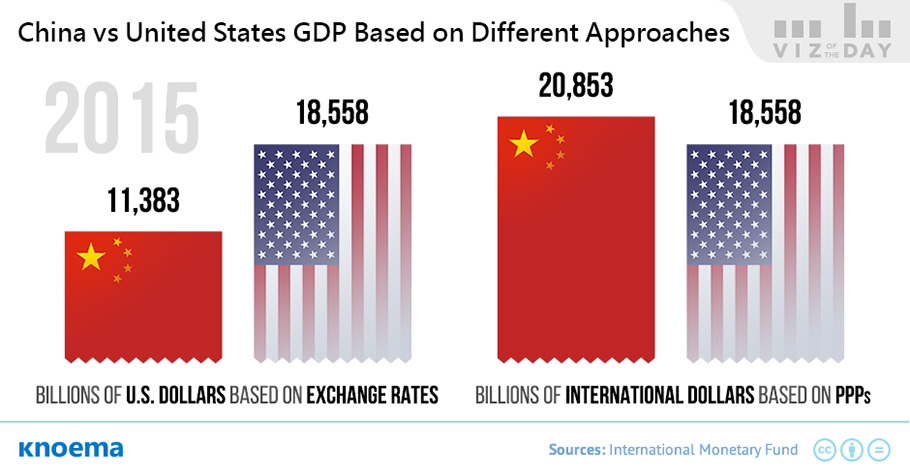
Knoema — The world’s largest economy: China or the United States?


Take the defense budget. While the actual figures are a state secret, the reported figures show the US to be greatly outspending China with the implication that the US military is larger than the PLA. That may be a false implication, however, since China has nowhere near the economic rent in military expenditure that the US does. That means bigger bang for the buck since more of the expenditure goes into production.

Real-World Economics Review Blog
The world’s largest economy: China or the United States?

Saturday, March 26, 2016

Jason Hickel — To Save The Economy, We Have To Break Its One Sacred Rule

We must stop worshiping the false god of GDP growth [because "trickle down].
As Joseph Stiglitz has put it, "What we measure informs what we do. And if we’re measuring the wrong thing, we’re going to do the wrong thing."
co.exist
To Save The Economy, We Have To Break Its One Sacred Rule
Jason Hickel
ht Don Quijones at Raging Bull-Shit


Tuesday, November 17, 2015

Stanley Fischer — The transmission of exchange rate changes to output and inflation


Download PDF.

Stanley Fischer: The transmission of exchange rate changes to output and inflation
Speech by Mr Stanley Fischer, Vice Chair of the Board of Governors of the Federal Reserve System, at the research conference “Monetary Policy Implementation and Transmission in the Post-Crisis Period”, sponsored by the Board of Governors of the Federal Reserve System, Washington DC, 12 November 2015

Thursday, August 27, 2015

Deficit too small? Then how'd we get a 3.7% GDP growth rate?

Second quarter GDP just came out with a 3.7% growth rate. Not too shabby. But the deficit is supposedly too small,  so how did we achieve such a strong growth rate?

As Matt and I have been saying here, for the last two years: when top line government spending is over $4 trillion annually, that's a leading flow. That drives everything. The deficit is what it is. Looking at the deficit will send you astray and you will lose money. We're the only ones getting this correct.

It's not about the size of the deficit.

Friday, May 1, 2015

Even the "owners" are getting ripped off

The plunder of wealth by the oligarchs and elites has reached levels where even the "owners" of enterprises are being ripped off.

Remember George W. Bush and the "ownership" society? That was a euphemism for, "We're going to cut your wages and salaries, make jobs hard to get and fast-track the flow of wealth up to the top. So if you want a piece of the pie, you'd better become an owner, like, own stocks or assets or something. Own a business."

So that's what most people did because they had no choice. Jobs became scarce so they either had to take a risk and start a business (most fail) or, they were forced to scrimp and save and add, monthly, to their 401k's and other retirement vehicles that mostly invested in stocks. They became "owners."

This directive continues on today under Obama, so don't think that he is not part of this scheme. He is.

I'll leave aside for a moment that the banksters and other Wall Street "geniuses" nearly killed everybody's savings with their wild casino games (and many people still haven't recovered), which in the end we had to pay for with higher taxes and more cuts in spending (taxes), leaving us profoundly ripped off.

But some of us still had our stocks, either held directly or through those retirement plans and we were happy and placated, because stocks came back and dividends grew--not by much--but they grew and we felt as if that ownership society thing was finally paying off like they told us it would.

Oh really?

Well, take a look at these two graphs. One is corporate profits as a percentage of GDP and the other is dividends as a percent of personal income.

Corporate profits as a percent of GDP


 Dividends as a percent of Personal Income

As you can see, profits are at an all-time high as a percent of GDP, whereas dividends are not even though profits and stock prices are.

So what's happening here?

The only explanation is that the executives running these enterprises (who are, in 99% of the cases NOT the real owners) are taking more and more for themselves and giving us--the real owners--less. In fact, it almost looks like, if dividends rise too fast, as they did coming out of the Great Recession, they will deliberately slow the pace of  wealth sharing because they need to take even more for themselves.

And you wonder why stock analysts are now saying valuations are high? BECAUSE PROFITS ARE FLOWING INTO THESE MOTHERFUCKERS' POCKETS. THAT'S WHY!

This is once again a blatant screw job by elites and oligarchs who are really nothing more than a bunch of corrupt, scumbag mafia and they have taken control of our lawmakers our government and our lives. 

We really need to take back control of what is rightfully ours. This shit's gotta end.

Monday, April 6, 2015

C.P. Chandrasekhar and Jayati Ghosh — China and India in the World Economy

Indian media – as well as several official representatives of the government – are full of excitement at the possibility that in the coming year India’s rate of growth of economic activity might actually be higher than that of China. It is not just that the extremely rapid growth of the giant Asian neighbour is slowing down substantially, but also that India’s GDP growth is projected to be higher than before, and the CSO’s latest revisions to the GDP estimates suggest that the recent deceleration was less sharp than generally perceived. 
But as it happens, over the past two decades the differential performance of the two economies has been such that – even with the recent slowdown – China is still likely to account for a larger contribution to global GDP growth than India for some time to come, simply because of its much greater size.....
Triple Crisis
China and India in the World Economy
C.P. Chandrasekhar and Jayati Ghosh

Tuesday, December 23, 2014

Matias Vernengo — A brief and dispassionate note on 'GDP'


Short summary of GDP (and NIPA) as the basis of macro.

Naked Keynesianism
A brief and dispassionate note on 'GDP'
Matias Vernengo | Associate Professor of Economics, Bucknell University

5 percent GDP!!!!

This blog had it right all along. Matt Franko and I had been focusing on what mattered--gross, topline government spending. We never wavered from our bullish forecasts.

The people who have been looking at the shrinking deficit for the past two years just don't get it. It's not about the deficit. All the deficit is, is what's left over after all spending and taxpaying is done, i.e. financial savings.

It's all about how much is being spent and not even that important as to who is doing it, so long as some entity is spending.

We are light years ahead of the other forecasters here. They're  stuck.

-Mike Norman