Showing posts with label currency devaluation. Show all posts

Wednesday, October 31, 2018

Dean Baker — Does China's 2.5 Percent Inflation Rate Really Explain the Decline in the Value of Its Currency Against the Dollar?

The vast majority of economists believe that the Fed's asset holdings keep down U.S. interest rates. It is inconsistent to believe that the Fed's holdings of U.S. assets keep down interest rates here, but China's holding of foreign assets does not keep down the value of its currency.
Beat the Press
Does China's 2.5 Percent Inflation Rate Really Explain the Decline in the Value of Its Currency Against the Dollar?
Dean Baker | Co-director of the Center for Economic and Policy Research in Washington, D.C

Tuesday, September 27, 2016

Ari Andricopoulos — On Currency Devaluation (Deliberate and Otherwise)

It is an unstated central bank policy in many parts of the world to reduce the value of their currency to below its fair value. The reason for doing so is 'competitiveness'. A weaker currency means lower global prices for your goods and hence increases your exports, while at the same time reducing imports. Since a fundamental equation of economics says that GDP = C+I+G+X, or consumption plus investment plus government expenditure plus net exports; it would appear self evident that an increase in net exports would increase GDP.
This is, unfortunately, completely wrong. There are two ways that it is wrong, both pretty fundamental….
Notes on the Next Bust Ari Andricopoulos, principal at Dacharan Advisory AG, PhD. in Financial Mathematics

Friday, August 14, 2015

Roger Farmer — Somebody at the PBC blinked

What’s happening and why? It's my guess that there are investors on the margin who are pulling money out of the Chinese market and moving it into the world capital markets. Those investors are betting against the valuation that the PBC is putting on domestic assets. The outflow of funds puts downward pressure on the RMB and if the PBC were to maintain its previous parity they would be obliged to sell their holdings of dollar denominated assets to support the currency.
Farmer apparently understands the accounting, but uses "outflow of funds."
The PBC blinked! But that's a good thing. They’ve chosen a domestic target over an exchange rate target and to make that work, the world needs to keep buying Chinese goods.
I have advocated a policy of Treasury and Central Bank intervention to stabilize domestic asset markets. What we are seeing in the Chinese case is that this policy is inconsistent with a fixed exchange rate. 
Roger Farmer's Economic Window
Somebody at the PBC blinked
Roger Farmer | Distinguished Professor of Economics , UCLA

Thursday, August 13, 2015

Xinhua — US experts, IMF support China's move to improve FX formation system

The Chinese central bank's decision to improve its foreign exchange rate formation system is market-oriented and helpful in sending the RMB into the Special Drawing Right (SDR) of the International Monetary Fund (IMF), US experts said Tuesday.
Earlier in the day, the People's Bank of China (PBOC) announced the decision to improve its central parity system to better reflect market development in the exchange rate between the renminbi against the US dollar.
"The IMF has a number of issues for the Chinese to consider changing ahead of SDR basket acceptance. One of those is the shift to a more market-set currency rate," Robert Savage, CEO of CC Track Solutions, told Xinhua.
"This move to make the fixing more market-oriented will be supported by the IMF," he said.
Chris Low, chief economist for FTN Financial, also noted that China's markets are more open than ever in an effort to meet the requirements of the IMF and join the SDR.
Meanwhile, the experts dismissed the idea that the Chinese central bank's move aims to gain a competitive advantage in exports.…
Greater exchange rate flexibility is important for China as the country strives to give market forces a decisive role in the economy and is rapidly integrating into global financial markets, the spokesperson said.
The IMF also said it believes China can achieve an effective floating exchange rate system within two or three years.
The US Treasury said it would continue to monitor the Chinese central bank's move, reiterating that policies that reflect China's desire to move towards a consumption-driven economy are in the best interests of China and the United States. 
"While it's too early to judge the full implications of the change in the PBOC reference rate, China has indicated the changes announced today are another step in its move to a more market-oriented exchange rate," the Treasury said in a statement.
Best analysis I've seen so far.

Want China Times (Taiwan)
US experts, IMF support China's move to improve FX formation system
Xinhua
When China's central bank unexpectedly adjusted its yuan central parity system, it triggered the currency's biggest decline in decades.
So, what exactly happened?
On Tuesday, the People's Bank of China (PBOC) changed the way it calculated the yuan central parity rate, to close the gap between the rate and the actual trading rate on the money markets.
From Tuesday, the central parity rate has taken into account the previous day's inter-bank market closing rate, supply and demand in the market and price movements of other major currencies.
Ma Jun, a central bank economist, described the change to the way the central parity rate is calculated as a "one-off" technical correction that should not be seen as the beginning of a devaluation trend.…

Adam Haigh and Jason Clenfield — Deflation Ice Age Looms After Yuan Move, Albert Edwards Says

China’s currency devaluation took Albert Edwards a step closer to realizing his doomsday prediction: deflation spreading from Asia to the U.S. and Europe and sending economies crashing. 
Tumbling emerging-market currencies will now accelerate their declines, curbing import costs in developed nations and triggering a broad drop in prices that will undermine economic growth, according to Edwards, the top-ranked global strategist at Societe Generale SA.
According to Edwards, "this is the start of something big, something ugly.” While I would agree that t this is a big move, it is hardly the start. Deflationary pressure began building at the time of the 2007 financial emergency that morphed into a full-blown financial and economic crisis that threatened the global economy and was narrowly avoided. However, there has been no significant recovery, or anaemic one at best.

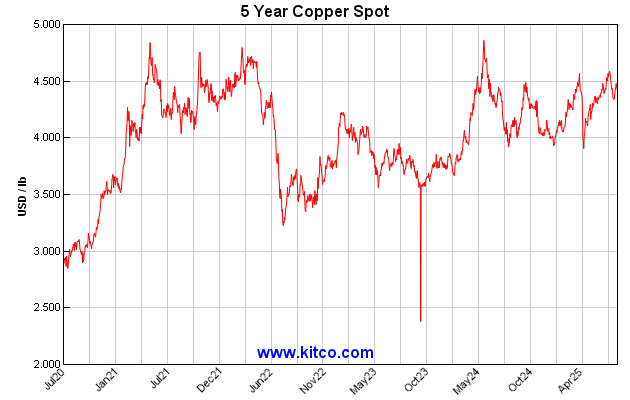
The bursting of the commodity bubble that Randy Wray and others like Jeremy Grantham predicted some time ago has taken hold with a vengeance, especially with oil still testing the bottom. Bell-weather copper is crashing, too.


The neoliberal and neoclassical preference for austerity as economic policy is creating severe drag on the economies of many developed nations, in particular the Eurozone. Political instability is also rising in the developing world.

Japan and then the Eurozone adopted QE for a variety of reasons but one effect, certainly anticipated was a weakening of the yen and the euro. Both Japan and the Eurozone typically strive to run a mercantilist policy emphasizing net exports and fiscal surpluses.

Concurrently, the USD has been rising as a safe haven, with the US not only the largest economy and most powerful nation politically, but also recovering better than most, not to mention the Fed beginning to raise the interest rate soon.

As a result, China also saw its currency rising, the renminbi being pegged to the USD. China has also been running a mercantilist policy as a new exporter and began to see its exports shrinking with yuan getting relatively more expensive.

Thus, China recent action has been defensive and should have been expected, although it seems to have caught markets by surprise.

Nevertheless, the size and influence of China as a global exporter reducing the cost of its exports by currency devaluation is going to have a further deflationary effect. 

The global economy is experiencing a huge demand deficiency problem, which is especially dangerous where there is also elevated private debt or there is a balance of payments issue in USD with dollars becoming more expensive relatively.

The deflationary pressure is now being noticed. If it took China's move to call attention to it, that's a good thing. Without acknowledging the challenge, the situation is likely to "ugly," as Edwards writes.

It's long overdue to address the demand deficiency and debt overhang with fiscal remedies instead of relying on monetary policy that has shown itself to be ineffective. It's also time to confront the erroneous assumption that neoliberalism is the only alternative. As Margaret Thatcher put it, "There is no alternative." 

There is an alternative, and Keynes set it forth in the midst of the Great Depression. It's past time to listen to him again.

However, we have come a long way since Keynes was writing and advising governments. Post Keynesianism and MMT have articulated those insights and taken them further. There is no time to lose in addressing real challenges with effective solutions that have been shown to work historically instead of imaginary issues with speculative cures that don't have a good track record empirically. We need to do this before things get ugly.

Bloomberg Business
Deflation Ice Age Looms After Yuan Move, Albert Edwards Says
Adam Haigh and Jason Clenfield

Tuesday, August 11, 2015

Thursday, May 15, 2014

Marshall Auerback — The ECB Agrees With France: The Euro Is Too High


When neo-mercantilism is the model, then currency devaluation bestows competitive advantage in trade, and currency appreciation undercuts exports upsetting the business plan.
Focusing on the euro, ECB President Draghi pointed to large capital outflows out of Russia of about $160bn. Some of this may have gone into euro denominated investment, increasing unwanted upward pressure on the currency.
Macrobits by Marshall Auerback
The ECB Agrees With France: The Euro Is Too High
Marshall Auerback