Showing posts with label financial instability hypothesis. Show all posts

Thursday, April 25, 2019

Brian Romanchuk — Minsky Versus Steindl Debt Dynamics?

In Marc Lavoie's Post-Keynesian Economics: New Foundations, he has an interesting discussion in Section 6.10.4, which is labelled "Minsky or Steindl Debt Dynamics?" The Minsky dynamics are the well-known Financial Instability Hypothesis (link to primer), while the Steindl dynamics refers to the discussion in Maturity and Stagnation in American Capitalism by Josef Steindl. Lavoie's discussion raises some issues with the limitations of aggregated analysis in this context. This is a brief comment on this topic.…
In summary, we need to be cautious about putting too much emphasis on aggregate debt ratios as a shorthand for riskiness of borrowing.
Important for the topic itself but also as a demo of how care must be taken to include all the factors that are relevant to analysis. 

What appears to be a simple issue may be complicated by additional factors, or it may even be complex and therefore affected by emergence that can't be foreseen from the data. In a word, uncertainty rather than risk that can be projected by probability and statistics. 

This pertains to non-ergodic systems like social systems, and to a lesser degree biological systems, as evolutionary theory shows. The more psychology enters into the picture, the less ergodic the system.

Rules of thumb are just that and no more — heuristic rather than analytic.

Bond Economics
Minsky Versus Steindl Debt Dynamics?
Brian Romanchuk

Wednesday, April 10, 2019

Brian Romanchuk — Primer: Financial Instability Hypothesis (Part I)

The Financial Instability Hypothesis was associated with the economist Hyman Minsky, although it could be viewed as Minsky’s interpretation of Keynes. One summary of the concept is that stability is destabilising: economic stability leads to changes in behavioural changes that destabilise the economy….
Bond Economics
Primer: Financial Instability Hypothesis (Part I)
Brian Romanchuk

Thursday, November 29, 2018

Jerome H. Powell — The Federal Reserve's Framework for Monitoring Financial Stability

It is a pleasure to be back at the Economic Club of New York. I will begin by briefly reviewing the outlook for the economy, and then turn to a discussion of financial stability. My main subject today will be the profound transformation since the Global Financial Crisis in the Federal Reserve's approach to monitoring and addressing financial stability. Today marks the publication of the Board of Governors' first Financial Stability Report. Earlier this month, we published our first Supervision and Regulation Report. Together, these reports contain a wealth of information on our approach to financial stability and to financial regulation...
Mentions Hyman Minsky's view on financial instability.

Board of Governors, Federal Reserve
The Federal Reserve's Framework for Monitoring Financial Stability
Jerome H. Powell, Chairman

See also
To our thinking, Chair Powell’s speech was a stroke of genius. By easing the Fed’s public stance on rates, he puts all the responsibility for near term market direction on President Trump’s shoulders as he prepares to meet Chinese President Xi at the G20….
Nicholas Colas, DataTrek

Wednesday, October 24, 2018

Brian Romanchuk — Primer: Minsky's Financial Instability Hypothesis

The "Financial Instability Hypothesis" is a phrase describing the economist Hyman Minsky's views on the driver of the business cycle. The description here is based on the essays found in the book Can "It" Happen Again? Essays on Instability and Finance. The objective here is to capture highlights of his thinking, and not attempt to cover the breadth of his world view.
If the reader wishes to find a fuller description, I would recommend the essay "The Financial Instability Hypothesis: A Restatement" on pages 90-116. This article is a very high level overview of that summary article. At the end of this article, I will comment on some of the implications of the hypothesis....
Bond Economics
Primer: Minsky's Financial Instability Hypothesis
Brian Romanchuk

Monday, March 19, 2018

Edward Harrison — Hyman Minsky And Asset Price Inflation Versus Consumer Price Inflation

Hyman Minsky’s financial theory of investment rests on a bifurcation of an economy’s price systems. On the one hand, there’s the price system for goods and services. And inflation here is what central banks look to hold in check. But at the same time, there is a wholly separate price system for assets. And it’s here where stability leads to asset price inflation, a build up in debt, instability, and, eventually, crisis.
Economics professor Randall Wray is a real Minsky scholar. He studied under Minsky at Washington University in St. Louis. And last year, he wrote a book “Why Minsky Matters: An Introduction to the Work of a Maverick Economist“. Here’s what Wray says about Minsky’s two price systems:
Credit Writedowns
Hyman Minsky And Asset Price Inflation Versus Consumer Price Inflation
Edward Harrison

Wednesday, December 13, 2017

Edward Harrison — Minsky’s financial instability hypothesis and the Fed’s reaction function

As the Federal Reserve meets today to decide how to communicate its messaging on future rate hikes and balance sheet reduction, financial stability will play a key role. Yesterday, I wrote about the Bank of International Settlements new warnings on financial stability. And just this morning, I read a piece from Goldman Sachs Asset Management EMEA division head Andrew Wilson, warning that the risk of overheating was real. So let’s put some framing around this issue and ask how the Fed reacts as the data come in down the line.
In the past decade on Credit Writedowns, I have had a lot of good commentary from different writers on financial stability. And most of it is based around Hyman Minsky’s Financial Instability Hypothesis. As someone who used to work in debt capital markets and do financial models for private equity investing and corporate finance for mergers and acquisition, I find the Minsky analysis a huge benefit in thinking about the macroeconomy that standard macro modelling techniques don’t incorporate. So I want to use this as the prism through which to look at the Fed’s reaction function to predict future yield curve flattening and the resulting economic impact....
Randy Wray post follows.

Credit Writedowns
Minsky’s financial instability hypothesis and the Fed’s reaction function
Edward Harrison

Monday, October 30, 2017

Tyler Durden — Minsky Cycle 2017: Where Are We Now

Over the weekend, DB's credit strategist Aleksandar Kocic discussed what Minsky Dynamics for the "New Normal" look like based on a matrix that charted the various progressions of Leverage vs Volatility, with four possible end states. However, since that graphic explanation proved too problematic for some, another Deutsche macro analyst, Alan Ruskin, released a far simpler representation of the current (and historical) Minsky cycle, which compartmentalizes the world's various assets in their 7 discrete states along the Minsky cycle (as defined in Charles Kindelberger's ‘Manias, Panics and Crashes – A History of Financial Crises’). These start with the 1) macro shock ‘displacement’, move to 2) ‘healthy expansion’, to 3) ‘leveraged driven gains’, to 4) ‘euphoria’, 5) ‘insider profit-taking’, 6) ‘liquidation and panic’ and onward and downward to 7) ‘revulsion and discredit.’

Where are we now?
Zero Hedge
Minsky Cycle 2017: Where Are We Now
Tyler Durden

Tuesday, June 13, 2017

Nick Johnson — In brief: the economics of Hyman Minsky


Like it says, short summary of Minsky's thought emphasizing the financial instability hypothesis. Although not stated in the post, Minsky also proposed a job guarantee. His connection with the development of MMT is through his student Randy Wray, who wrote the first book on MMT, Understanding Modern Money: The Key to Full Employment and Price Stability (1998).

The Political Economy of Development
In brief: the economics of Hyman Minsky
Nick Johnson

Sunday, July 31, 2016

The Economist — Minsky’s moment

Having grown up during the Depression, Minsky was minded to dwell on disaster. Over the years he came back to the same fundamental problem again and again. He wanted to understand why financial crises occurred. It was an unpopular focus. The dominant belief in the latter half of the 20th century was that markets were efficient. The prospect of a full-blown calamity in developed economies sounded far-fetched. There might be the occasional stockmarket bust or currency crash, but modern economies had, it seemed, vanquished their worst demons.
Against those certitudes, Minsky, an owlish man with a shock of grey hair, developed his “financial-instability hypothesis”. It is an examination of how long stretches of prosperity sow the seeds of the next crisis, an important lens for understanding the tumult of the past decade. But the history of the hypothesis itself is just as important. Its trajectory from the margins of academia to a subject of mainstream debate shows how the study of economics is adapting to a much-changed reality since the global financial crisis.
The Economist
Minsky’s moment

Monday, March 7, 2016

Noah Smith — The Folk Theory of business cycle


Hmm.

1. NS doesn't seem to know that Minksy's financial instability hypothesis is based on quality as well as quantity of debt.

2. NS doesn't seem to realize either the difference between a currency issuer and currency users, nor does he realize how the currency issuer's debt is the inverse of currency users' debt.

Funny things. People subscribing to the "folk theory" of the business cycle, actually financial cycle, warned about financial fragility prior to the financial crisis while conventional experts in finance and economics missed it.


James K. Galbraith, Who Are These Economists, Anyway?  (2009)

Noahpinion
The Folk Theory of business cycle
Noah Smith | Assistant Professor of Finance, Stony Brook University

Wednesday, November 4, 2015

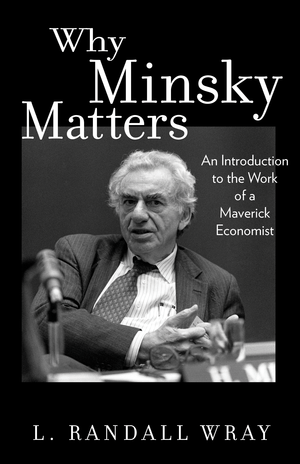
Michael Stephens — “Why Minsky Matters” Now Available


Randy Wray's latest. Looks like a must-read for economists, political scientists, and policy-makers. Perhaps this will be many more people's introduction to MMT. Very moderately priced, too. It should be a a big seller.

Multiplier Effect
“Why Minsky Matters” Now Available
Michael Stephens


Publisher's blurb:


Why Minsky Matters:
An Introduction to the Work of a Maverick Economist
L. Randall Wray

Hardcover | 2015 | $27.95 | £19.95 | ISBN: 9780691159126
288 pp. | 5 1/2 x 8 1/2

Add to Shopping Cart

eBook | ISBN: 9781400873494 |
Our eBook editions are available from these online vendors

Reviews | Table of Contents
Introduction[PDF]

Perhaps no economist was more vindicated by the global financial crisis than Hyman P. Minsky (1919–96). Although a handful of economists raised alarms as early as 2000, Minsky’s warnings began a half-century earlier, with writings that set out a compelling theory of financial instability. Yet even today he remains largely outside mainstream economics; few people have a good grasp of his writings, and fewer still understand their full importance. Why Minsky Matters makes the maverick economist’s critically valuable insights accessible to general readers for the first time. L. Randall Wray shows that by understanding Minsky we will not only see the next crisis coming but we might be able to act quickly enough to prevent it.

As Wray explains, Minsky’s most important idea is that "stability is destabilizing": to the degree that the economy achieves what looks to be robust and stable growth, it is setting up the conditions in which a crash becomes ever more likely. Before the financial crisis, mainstream economists pointed to much evidence that the economy was more stable, but their predictions were completely wrong because they disregarded Minsky’s insight. Wray also introduces Minsky’s significant work on money and banking, poverty and unemployment, and the evolution of capitalism, as well as his proposals for reforming the financial system and promoting economic stability.

A much-needed introduction to an economist whose ideas are more relevant than ever, Why Minsky Matters is essential reading for anyone who wants to understand why economic crises are becoming more frequent and severe—and what we can do about it.

L. Randall Wray is professor of economics at the University of Missouri, Kansas City, and senior scholar at the Levy Economics Institute of Bard College. He is the author of many books, including Modern Money Theory and Understanding Modern Money. He was a student and colleague of Hyman Minsky.

Reviews:

"An accessible introduction to the economist who saw the global financial crisis coming."--Bookseller Buyer’s Guide

Endorsements:

"Ever since the climax of the financial crisis in 2008–09, Hyman Minsky has become an iconic point of reference. Why Minsky Matters renders the authentic Minsky accessible to a wide readership for the first time. L. Randall Wray has a comprehensive grasp of Minsky’s thought, and the capacity to express it in a compact, highly readable fashion. This is a book of rare clarity, importance, and usefulness."--James K. Galbraith, author of The End of Normal: The Great Crisis and the Future of Growth

"Hyman Minsky is the most important economist since Keynes, yet it’s virtually impossible to find any books about him. Why Minsky Matters should be read not just by anyone who wants to understand Minsky, but anyone who wants to understand our economy. The reason, as L. Randall Wray makes obvious, is that Minsky does a better job of explaining the global financial crisis--and why it isn’t over yet--than anyone else. Everyone should read this book."--Michael Pettis, author of The Great Rebalancing: Trade, Conflict, and the Perilous Road Ahead for the World Economy
"Intelligent, accessible, and clear, Why Minsky Matters brings Minsky’s ideas to life and explains why they help us understand the world in which we live."--Steven M. Fazzari, coauthor of After the Great Recession

Table of Contents:
Preface vii
Introduction 1
1 Overview of Minsky’s Main Contributions 21
2 Where Did We Go Wrong? Macroeconomics and the Road Not Taken 47
3 Minsky’s Early Contributions: The Financial Instability Hypothesis 71
4 Minsky’s Views on Money and Banking 87
5 Minsky’s Approach to Poverty and Unemployment 109
6 Minsky and the Global Financial Crisis 137
7 Minsky and Financial Reform 163
8 Conclusion: Reforms to Promote Stability, Democracy, Security, and Equality 193
Notes 223
Further Reading 253
The Collected Writings of Hyman P. Minsky 257
Index 269

Thursday, October 1, 2015

Jon Danielsson, Marcela Valenzuela, Ilknur Zer — Volatility, financial crises and Minsky's hypothesis

Does low volatility in financial markets mean that another financial crisis is more likely? And should we be worried when everything is OK? This column presents the first empirical results that find a strong validation of Minsky's hypothesis – obtained from 200 years of historical cross-sectional data – that low volatility increases the likelihood of future financial crisis by increasing risk-taking.
Perhaps the most significant thing about this study is that people are starting to look at Hyman Minsky and take him seriously.
While the common view maintains that volatility directly affects the probability of a crisis, this has been proven difficult to verify empirically.
In what we believe is the first study to do so, we find direct empirical evidence that the level of volatility is not a good indicator of crisis, but that unexpectedly high and low volatilities are.
This is directly in line with what is predicted by theory and provides a validation of Minsky's hypothesis – stability is destabilising.
Market volatility is of clear interest to policymakers, with the quote of chairwoman Yellen above just one example.

By documenting how volatility can affect the risk-taking behavior of economic agents and hence, the incidence of financial crises, policymakers and market participants alike would gain a valuable tool in understanding crises, tail events and systemic risk.
VOXEU
Volatility, financial crises and Minsky's hypothesis
Jon Danielsson, Marcela Valenzuela, Ilknur Zer

Monday, August 24, 2015

Oleg Komlik — China’s Minsky moment: stability leads to instability

Hyman Minsky (1919–1996) was a distinguished American scholar and prominent post-Keynesian economist. In the wake of the 2008-2009 crisis Minsky’s invaluable scientific contribution has widely spread, but soon he has unfortunately disappeared from public and economic discussions. 
While most of the mainstream economists are of the view that economic busts are the outcome of various external shocks, Minsky held that the capitalist system itself generates shocks through its own internal dynamics and financial capitalism is inherently unstable. A key mechanism that pushes an economy towards an inevitable crisis is the rampant speculation and the accumulation of debt by the private sector (investors, banks, companies). Minsky claimed that in prosperous times, when corporate cash flow rises beyond what is needed to pay off debt, actors take on more risk and a speculative euphoria develops. Soon thereafter debts exceed what borrowers can pay off from their incoming revenues (especially during the period of monetary tightening) which in turn produces a financial crisis. This slow movement of the financial system from stability to fragility followed by sudden major collapse is famously known as “Minsky moment”.…
Economic Sociology and Political Economy
China’s Minsky moment: stability leads to instability
Oleg Komlik | founder and editor-in-chief of the ES/PE, Chairman of the Junior Sociologists Network at the International Sociological Association, a PhD Candidate in Economic Sociology in the Department of Sociology and Anthropology at Ben-Gurion University, and a Lecturer in the School of Behavioral Sciences at the College of Management Academic Studies

Wednesday, March 25, 2015

Paul Mason — To Move Beyond Boom and Bust, We Need a New Theory of Capitalism

Terry Jones’s documentary film Boom Bust Boom hits the cinemas this month. Using puppetry and talking heads (including mine), Jones is trying to popularise the work of Minsky, a US economist who died in 1996 but whose name has become for ever associated with the Lehman Brothers crash. Terrified analysts labelled it the “Minsky moment”. 
Minsky’s genius was to show that financially complex capitalism is inherently unstable. Under conditions of stability, firms, banks and households will, over time, move from a position where their income pays off their debt, to one where it can only meet the interest payments on it. Finally, as instability rises, and central banks respond by expanding the supply of money, people end up borrowing just to pay back interest. The price of shares, homes and commodities rockets. Bust becomes inevitable.

This logical and coherent prediction was laughed at until it came true. Mainstream economics had convinced itself that capitalism tends towards equilibrium; and that any shocks must be external. It did so by reducing economic thought to the construction of abstract models, which perfectly describe the system 95% of the time, but break down during critical events....
For me, the most fundamental question in economics still concerns the 2008 crisis. Was this event the last in a series of shocks needed to allow a third technological revolution to take off? Or was it evidence that capitalism’s tendency to adapt and reshape in response to technology has stalled, or is even finished? That is the shadow we have to jump over in economics. Amid a mania for “new economic thinking”, it is what we need to think hardest about.
The Guardian (UK)
To Move Beyond Boom and Bust, We Need a New Theory of Capitalism
Paul Mason | economics editor of Channel 4 News

Friday, April 18, 2014

Michael Stephens — Minsky and Financial Reform’s “Never Ending” Struggle

In a new policy brief, Jan Kregel looks at a lesser-known, early period of Minsky’s work on financial reform. In the ’60s, Minsky was a consultant to a number of government agencies, including the Federal Reserve, on issues related to financial regulation. In this context, he came up with a new approach to bank examination, which he called “cash-flow based.” The new approach evaluated bank liquidity, not as an innate feature of a particular class of assets, but as a function of the balance sheet of the institutions under examination, the markets for those assets, the state of the macroeconomy and the financial system as a whole, and much else. In fact, as Kregel explains, what Minsky was after here was related to an early form of what we now call “macroprudential regulation.”
Multiplier Effect
Minsky and Financial Reform’s “Never Ending” Struggle
Michael Stephens

Wednesday, April 16, 2014

Marshall Auerback — Will The NASDAQ Sell-Off Create Contagion For The Real Economy?


About more than the equities market.
The passage of time is everything. In essence it is the stability begets instability theme of Hy Minsky, but of a magnitude he never imagined.
I think it may turn out to be the most essential dynamic of our time in history. The question now is whether the environment will foster ever more complacency and ever lower risk perceptions.
It appears that this is happening. I think we are far along. The longer we go on this path, the harder it is to have a big washout. Until the market gets so extended and the debts rise so much that it all becomes too unstable. Then of course the crash must occur. I suspect we are two thirds of the way down this road and far enough along that we go the whole way.
Macrobits

Wednesday, February 19, 2014

Randy Wray — Minsky on Banking: Early Work and Critiques by Krugman and Horizontalists Revisited

In this piece I will revisit only the main underlying issue: what was Minsky’s early approach to banking? Did Minsky adopt an endogenous money approach–at the time that he was first developing his financial instability approach? If he did, that, by itself, does not prove that his FIH is consistent with an endogenous money approach. Nor does it disprove the claim that there is a Says Law of finance. Both of those criticisms could still be made whether or not Minsky held and explicated an endogenous money approach. I have argued elsewhere, however, that these positions do not hold up to scrutiny. In fact, Minsky’s FIH relies critically on an endogenous approach to money, and the Say’s Law approach of some Post Keynesians is fundamentally flawed. In any case, we will not detail those critiques here. (4)
Further, it is useful to return to Krugman’s critique of Minsky to compare Minsky’s early view of banking with the current view held by many macroeconomists. I’ll argue that Minsky’s views over half a century ago are far more advanced than those held today by Krugman.
Economonitor — Great Leap Forward
Minsky on Banking: Early Work and Critiques by Krugman and Horizontalists Revisited
L. Randall Wray | Professor of Economics, University of Missouri at Kansas City

Thursday, January 16, 2014

Brad DeLong — Morning Must-Read: John Aziz: Stopping the Next Financial Crash Is Impossible


Congratulations, John. You are being noticed.

John cites Minsky concerning financial instability being built into a credit system, so the conclusion that industrial capitalism involves a cycle of booms and busts based on overproduction and liquidation of unplanned inventory must be complemented by the conclusion that finance capital results in a cycle of booms and busts based on the credit cycle that revolve though hedge, speculative, and Ponzi stages.

John concludes that a capitalist monetary production economy is cyclical and that government does not have the power to prevent this. 
Ultimately, I think we need to move beyond the impossible dream of preventing financial crises before they occur. Laws to prevent theft, fraud, intentionally misleading investors, and gambling with other people’s money or with an implicit guarantee (like Glass-Steagall) are prudent regulations. But they do not eliminate booms and busts. Booms and busts are normal behavior in markets, because the future is so hard to predict and people are so unpredictable.

In the long run, I think policy must focus on being more responsive to the booms and busts of the market by minimizing real world damage as problems occur. This means more firefighting — to prevent damagingly excessive unemployment or a deflationary spiral following a financial crisis. That may not be as clean and satisfying as making the problem go away altogether. But if the problem of financial crashes is inherent to financial markets — which it certainly appears to be — making it go away altogether is not an option.
MMT proponents would agree that business and financial cycles are not entirely preventable in a monetary production economy. However, they would also say that a lot more can be done to reduce the phenomenon through adoption of more optimal legal, financial, and economic policy. See, for instance, Warren Mosler's proposals for reform. MMT would also use functional finance and the MMT JG to ameliorate the conditions that lead to cyclical excess and also deal with the social and economic consequences of cyclical behavior.

Washington Center for Equitable Growth


Tuesday, September 17, 2013

Michael Stephens — Janet Yellen on Bubbles and Minsky Meltdowns

Back in 2009, Janet Yellen delivered a speech at the Levy Institute’s Minsky conference that explained how the financial crisis had changed her views about the role of central banks in handling financial instability. At the time she was the head of the San Francisco Fed.
The focus of her 2009 remarks was the question of how (or whether) central banks should try to counteract bubbles in asset markets. (Yellen also recalled the unfortunate topic of her 1996 conference speech: supposedly promising new innovations in the financial industry for better measurement and management of risk.) Bursting suspected bubbles has become the topic du jour in US monetary policy discussions, as it currently stands as the fashionable justification for tightening despite low inflation and high unemployment.
With the announcement that Larry Summers’ name has been withdrawn from consideration for the next Fed chair, the spotlight has turned to Yellen. Here (from the 2009 conference proceedings) is the text of her speech and a transcript of the brief Q&A that followed:

A Minsky Meltdown: Lessons for Central Bankers?
Multiplier Effect
Janet Yellen on Bubbles and Minsky Meltdowns
Michael Stephens