Showing posts with label game theory. Show all posts

Wednesday, October 31, 2018

Jean Pisani-Ferry — The Global Economy’s Three Games

Three major players – the United States, China, and a loose coalition formed by the other members of the G7 – are shaping the future of the international economic and geopolitical order. And they are all engaged in three contests simultaneously, without knowing which one is the most important.
This is about international relations, geopolitics and geo-strategy, and these fields are generally analyzed in terms of game theory.

The only one that can know which game the US is currently playing is Donald Trump and he is not saying. My money is on the third scenario, and I suspect that China and Russia see it that way, too.

Project Syndicate
The Global Economy’s Three Games
Jean Pisani-Ferry | Professor at the Hertie School of Governance (Berlin) and Sciences Po (Paris), the Tommaso Padoa-Schioppa chair at the European University Institute and senior fellow at Bruegel, a Brussels-based think tank

Saturday, April 14, 2018

Tyler Cowen — Syria War's Game Theory Is Too Complex to Predict

The number of countries involved in festering Middle East conflicts most closely resembles the situation before World War I. That's frightening....
Bloomberg View
Syria War's Game Theory Is Too Complex to Predict
Tyler Cowen | Holbert C. Harris Chair of Economics at George Mason University and chairman and general director of the Mercatus Center

Saturday, July 2, 2016

New Deal Democrat — How "the Ultimatum Game" explains the Populist backlash to Globalism

In the Ultimatum Game, one player is given $100 with complete discretion as to how much to share with a second player, whose only power is to accept or reject the division. While a strictly rational economic player would accept even a $1 share, in real life most people reject any share under $30. In so doing they harm themselves, but inflict even more harm on the greedy player, enforcing altrusim over the longer term.
Rationality is not a simple as economists make it out to be because interests not merely economic. Moreover, interest involves not only reason but morals, involving sentiment. As contemporary cognitive-affective research shows, cognition is joined at the neurological level with affect, that is, reason with feeling.

"In so doing they harm themselves, but inflict even more harm on the greedy player, enforcing altrusim over the longer term."

This behavior is observed in primates, for example, suggesting that it is an evolutionary trait. Social animals depend on "morals" to function together as units, beginning with the family, since this requires in-group coordination as well as competition. Free riding is discouraged (punished) at much lower levels. The issue is not so much altruism as a choice as much as reciprocity as a requirement.
I do think Brexit and, to a lesser extent, the nomination of Donald Trump by the GOP are watershed moments, where the elites in powerful Western nations have been suddenly and utterly swept aside. I expect this to be a dominant theme in politics over the next 10 years or more, as the neoliberal centrist consensus is destroyed and the left and right offer competing visions of a New Deal 2.0 vs. neofascism to replace it.

Friday, January 29, 2016

Yanis Varoufakis — How Do the Economic Elites Get the Idea That They ‘Deserve’ More? Lessons from Game Theory

The ‘haves’ of the world are always convinced that they deserve their wealth. That their gargantuan income reflects their ingenuity, ‘human capital’, the risks they (or their parents) took, their work ethic, their acumen, their application, their good luck even. The economists (especially members of the so-called Chicago School. e.g. Gary Becker) aid and abet the self-serving beliefs of the powerful by arguing that arbitrary discrimination in the distribution of wealth and social roles cannot survive for long the pressures of competition (i.e. that, sooner or later, people will be rewarded in proportion to their contribution to society). Most of the rest of us suspect that this is plainly false. That the distribution of power and wealth can be, and usually is, highly arbitrary and independent of ‘marginal productivity’, ‘risk taking’ or, indeed, any personal characteristic of those who rise to the top. In this post I present a body of experimental work that argues the latter point: Arbitrary distributions of roles and wealth are not only sustainable in competitive environments but, indeed, they are unavoidable until and unless there are political interventions to keep them in check.…
Evonomics
How Do the Economic Elites Get the Idea That They ‘Deserve’ More? Lessons from Game Theory
Yanis Varoufakis

Thursday, July 9, 2015

Alexrpt — German newspaper editor for Die Zeit calls it…Tsipras won. Even if Greece leaves Eurozone, it stays in EU with ‘access to zillions of money’

German Chancellor Angela Merkel “knows she does not want to have a dead body on her hands — not in Europe, not in her Europe,” Josef Joffe told CNN’s Christiane Amanpour on Monday.
Alexrpt:
Is it game theory at its best? 
Is this why Alexis Tsipras and Yanis Varoufakis were so relaxed throughout this whole process? 
Perhaps the only reason Tsipras is actually working to strike a deal with creditors is because he has been given a cleat mandate by the people…negotiate a better debt deal, but do not leave the Eurozone. 
So Tsipras is negotiating to get a debt deal that, at its best, eases five years of austerity, but at its worst does not mean a Grexit…but even at its worst one fact should be emphasised, Greece will remain in the European Union. 
Let’s emphasise this again. Even if Greece leaves the Eurozone (the currency union) it will remain in the European Union, and that means access to all the benefits of the EU without the terror of the currency.
Merkel knows this. Hollande knows this, and this is why German newspaper editor of Die Zeit, Josef Joffe, believes the EU will eventually blink…and even if it does not blink, which is possible knowing the poor calibre of leader Merkel is, Tsipras and Varoufakis may actually have the last laugh.
The free market will ensure that whatever Greece lacks, due to its past Euro import-dependant economy, its future “drachma” economy will find ways to substitute and this will snowball into big time growth.
Red Pill Times

The eurocrats have lost in any case.

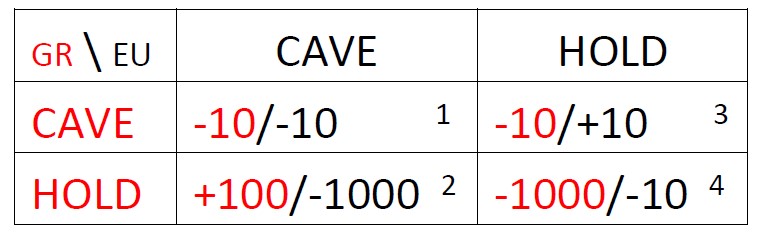
1. Tsipras caves to austerity; Greece becomes a failed state in Europe.

2. The eurocrats cave and this sets an example for other countries to demand  similar treatment.

3. Grexit and the eurozone is threatened.

There is no good solution for the eurocrats and the only good solution is to admit that Maastricht has failed.

Tuesday, July 7, 2015

Peter Cooper — Either the Troika Has No Hand, Or I’m No Game Theorist

Mainstream media, in presenting Greece as without hand, appears to be laboring under two very big misconceptions.
The first is a mistaken view that grexit would be disastrous for Greece. If issuing your own currency was disastrous, the rest of the world would be the economic basket case, rather than the eurozone. It is not without good reason that successive UK governments have given the euro a wide berth all these years. Under present arrangements, the euro is economically and politically unsustainable. Reintroducing the drachma would facilitate a prompt restoration of economic stability and growth in Greece.
The second mistake is to imagine that debt relief and an end to austerity in Europe is “unaffordable” and would destroy the euro. The ECB has unlimited capacity to issue euros, just as currency sovereign national governments have unlimited capacity to issue their own currencies, and such issuance is needed right now to restore demand (employment, growth) and price stability (avoid deflation).
heteconomist
Either the Troika Has No Hand, Or I’m No Game Theorist
Peter Cooper

Here's my take which I just shared with Clonal:

I agree that the eurocrats have backed themselves into a corner. They cannot give Greece a beneficial deal or the other peripheral countries will want similar treatment. 

So the alternatives are that either Syriza caves, is replaced by a compliant government, or Grexit. 

I think the many in the German elite are looking at Grexit and just being done with Greece once and for all as more trouble than it is worth.

The US looks at it differently. European integration for the US means NATO under US control and the US has no overriding interest in the EZ or a united Europe. 

In fact, a United States of Europe would be fearsome competitor for the US and would likely threaten NATO. A Europe allied with Eurasia would end US global hegemony.

Above all, the US doesn't want Greece moving closer to Russia and China, potentially threatening NATO domination in Europe.

So while Germany is the key player in the EZ, the US is the elephant in the room. The US strategists are certainly focusing on this today.

Friday, June 26, 2015

William K. Black — The BBC’s Inept but Revealing Attempt at a Game Theoretic View of Greek Crisis


This is published by the BBC but written by an economist that should know better. He misunderstands the basics of the game that is going on. Excellent analysis by Bill as usual.

New Economic Perspectives
William K. Black | Associate Professor of Economics and Law, UMKC

Thursday, May 14, 2015

Anatole Kaletsky — Why Syriza Will Blink

Tsipras and Varoufakis assume that a default would force Europe to choose between just two alternatives: expel Greece from the eurozone or offer it unconditional debt relief. But the European authorities have a third option in the event of a Greek default. Instead of forcing a “Grexit,” the EU could trap Greece inside the eurozone and starve it of money, then simply sit back and watch the Tsipras government’s domestic political support collapse. 
Such a siege strategy – waiting for Greece to run out of the money it needs to maintain the normal functions of government – now looks like the EU’s most promising technique to break Greek resistance.....
For the EU authorities, by contrast, a Greek default would now be much less problematic than previously assumed. They no longer need to deter a default by threatening Greece with expulsion from the euro. Instead, the EU can now rely on the Greek government itself to punish its people by failing to pay wages and pensions and honor bank guarantees.
Tsipras and Varoufakis should have seen this coming, because the same thing happened two years ago, when Cyprus, in the throes of a banking crisis, attempted to defy the EU.....
As soon as Tsipras realizes that the rules of the game between Greece and Europe have changed, his capitulation will be just a matter of time.
What happens when you climb in bed with psychopaths. Can anyone explain to me the difference between this and Eastern Europe being trapped in the USSR?

Project Syndicate
Why Syriza Will Blink
Anatole Kaletsky | Chief Economist and Co-Chairman of Gavekal Dragonomics and Chairman of the Institute for New Economic Thinking

Tuesday, May 12, 2015

Leonid Bershidsky — Gaming the Ukraine Crisis


Here is a game theory analysis of the Ukrainian situation. Keep it in mind as the scenario develops and see how successful the analysis turns out to be. I rather doubt it will be very relevant since it is developed from a Western mindset.

Bloomberg View
Gaming the Ukraine Crisis
Leonid Bershidsky

Thursday, April 30, 2015

Steve Randy Waldman — There is a name for this


Must-read.
Politically motivated riots are a form of altruistic punishment. Look it up. Altruistic punishment is a “puzzle” to the sort of economist who thinks of homo economicusmaximizing her utility, and a no-brainer to the game theorist who understands humans could never have survived if we actually were the kind of creature who succumbed to every prisoners’ dilemma. Altruistic punishment is behavior that imposes costs on third parties with no benefit to the punisher, often even at great cost to the punisher. To the idiot economist, it is a lose/lose situation, such a puzzle.
Lose/lose is also the basis of MAD (mutually assured destruction) as a WMD deterrent. And, yes, it is a strategic "game" (as in "game theory") that has been employed tactically to relatively successful effect by imposing costs, even disproportionately. Russia imposed severe losses on itself in order to make the cost prohibitively high for the attacker.

I had to make a choice when it came dissertation time between doing it on Ludwig Wittgenstein or the ethical implications of the Pentagon employment of game theory in strategy, especially mutually assured destruction as a deterrent strategy. I chose to write on Wittgenstein, but this debate over game theory and a lose/lose strategy was going on decades ago.

Something similar happened in WWII between Germany and Russia, and before that with Napoleon when he invaded Russia and was met with a "scorched earth" response.

It would be well to keep this in mind in dealing with Russia now, especially since the recent publication of Generalplan Ost*. The Russian deep state is convinced that the current policy of the US approximates this plan. The response is to re-establish MAD, potentially by using a doomsday scenario that would completely destroy continental US and possibly Europe through the after effect by using a nuclear weapon to create geophysical destruction of the North American continent.

Rioting may imposed much less cost than war, but it is use of a similar strategy. It is not "irrational" at all.

Interfluidity
There is a name for this
Steve Randy Waldman

*Generalplan Ost [Source]
Rechtliche, wirtschaftliche und räumliche Grundlagen des Ostaufbaus
Vorgelegt von SS-Oberführer Professor Dr. XX, Berlin-Dahlem, 28.Mai 1942

This text is the famous Hitler’s “Generalplan Ost” – Nazi’s project of the Germanisation of Western Europe, which envisioned mass extermination and resettlement of Russians, Poles, Ukrainians. Having been considered lost of a long time, the text of the plan was found back in the 80’s. But it is only now that anybody interested can access it. NTV correspondent Sergey Morozov was one of them.
The publication of these documents is accompanied with apologies. The council of gardening and agriculture faculty of Berlin Humboldt university regrets the fact one of its former directors, SS member professor Konrad Meyer, did so much for the development of “Generalplan Ost”. Now this most secret document which was only know to the top leaders of the Reich is available for everyone.

“The German arms have conquered the areas in the East which we have contested for centuries. The Reich sees turning them into its imperial provinces as its most important task”, the document says.

The text has been considered lost for a long time. Only a six-page extract from it was obtained for the Nuremberg trials. The plan was composed by the Supreme Imperial Security directorate, and the other variants of this plan were burnt in 1945. “Generalplan Ost” shows in most meticulous detail what the fate of the USSR would’ve been had the Germans won. And it becomes clear why this plan was kept in strict secret.

“At the forefront of the German people’s fight against Asiatism there are areas of special importance for the Reich. In order to secure the Reich’s vital interests in these areas it is necessary not only to apply force, but the native German population has to be moved there. It has to be firmly rooted in a completely hostile environment”, the text recommends.

Yevgeny Kulkov, senior research associate of World History Institute of the Russian Academy of Sciences: “They planned to resettle the Lithuanians beyond the Urals and to Siberia, or exterminate them. This is all practically the same. 85% of Lithuanians, 75% of Belarussians, 65% of Western Ukrainians, up to 50% of the Baltic states’ population”

While matching the sources, the scholars found out that the Nazis planned to move 10 million Germans to the Eastern lands and move 30 millions of indigenous population from there to Siberia. Leningrad was planned to be turned in a German settlement of 200 000 out of a city of 3 000 000. Millions of people had to die of starvation and diseases . Hitler planned to finish Russia off completely by means of dissecting it into a number of isolated parts.

“Following the directions of SS Reichsfuhrer, these provinces should be settled first: Ingermanland (Petersburg province), Gotengau (Crimea and Kherson province, former Tauria), Memelnrava province (Belostok and Western Lithuania). The Germanisation of this province is already underway by means of the return of the Volksdeutsche”.

It is interesting that the lands beyond the Urals seemed such a deadly territory for the Germans they weren’t even considered in the first place. Still, fearing that the exiled Poles might create their own state there, the Nazis decided to send exile them in Siberia in small groups.

This plan not only had estimates of how many cities were to be cleared for the future colonists, but also how much this was going to cost and who would bear the expenses.

After the war the compiler of this document Konrad Meier was acquitted at the Nuremberg trials and continued his teaching career at German universities. Publishing the original text of this ominous plan in the Web, the scholars commented that the German society hasn’t yet repented enough of the Nazi crimes.The Vineyard of the Saker
Vineyard of the Saker 

Monday, February 16, 2015

Myles Udland — CITI: Greece's bailout negotiations are just getting started

"We think it is still early days in these negotiations," [Citi's Steve] Englander wrote on Monday. "Both sides see themselves a lot better off if the negotiations succeed on their terms, and importantly, think the other side will be better off giving in than going to the brink. So notwithstanding comments on both sides that this is not game theory, there is a striking resemblance."
Business Insider
CITI: Greece's bailout negotiations are just getting started
Myles Udland

David F. Ruccio — Game theory—in practice


Occasional Links & Commentary
Game theory—in practice
David F. Ruccio | Professor of Economics University of Notre Dame Notre Dame

Tuesday, February 10, 2015

The next card Yanis Varoufakis will play


Strategic ambiguity.

The Conversation
The next card Yanis Varoufakis will play
Partha Gangopadhyay | Associate Professor of Economics at University of Western Sydney
ht Yves Smith at Naked Capitalism

David Woodruff — Can Greece escape the ultimatum game? (And no, Draghi's not trying to help them do it)


Political Economy in Public
David Woodruff | Associate Professor of Comparative Politics, LSE
ht Mark Thoma at Economist's View

I think that there is at least one other major alternative. Syria does not need to accept or reject  either compromising or caving in order to proceed. It can simply say that it is not possible to accomplish what it promised to do and resign, letting the eurocrats deal with a new government, which would likely be Golden Dawn. The alternative to that is a military coup if Golden Dawn were to win and push comes to shove, ending Greek democracy and imploding the EU that way.

Monday, February 9, 2015

Anatole Kaletsky — Greece is Playing to Lose


Kaletsky doesn't understand game theory and Yanis does. The game that Syriza is playing with the eurocrats is all or nothing. Either the eurocrats cave or else one of two things happens. They kick Greece out of the EZ or Syriza is replaced by a new government, which, won't be imposed on the troika but will be elected by Greeks in a new election, the winner of which will be Golden Dawn, as Syriza has already warned.

There is a similar scenario developing in the Ukraine. The US is determined to escalate right up to the point of intervening militarily, which would risk WWIII. Game theorists in Russia can be sure that either the US will pull back from this or risk blowing up NATO, since Ukraine is in no one's vial interest but Russia's and no one doubts that Russia will give it all its got. 

This is similar to hand to hand combat. The person not afraid to die will usually win, even if mismatched.

As Kaletsky says, "Game theory suggests that some of the most unpredictable conflicts are between a weak, but determined, combatant and a strong opponent with much less commitment. In these scenarios, the most stable outcome tends to be a draw in which both sides are partly satisfied." This is why Merkel and Hollande are correct and the neocons are wrong.

The neocons may be able to convince American leaders that Ukraine is worth risking WWIII, but they will never convince the Europeans. It will be the beginning of the end of NATO. In fact, this was clear as soon as the Baltics were admitted to NATO. Europe now has put its future in the hands of loose cannons on Russia's border. And recall that Russia did send regular troops into South Ossetia while the West looked on fuming because they knew it was not significant enough to start a war with Russia over.

Never pick a fight unless you are ready to fight and give it all you've got. Both Syriza and Russia understand this. Does Europe and America?

Project Syndicate
Greece is Playing to Lose
Anatole Kaletsky | Chief Economist and Co-Chairman of Gavekal Dragonomics and Chairman of the Institute for New Economic Thinking

Monday, October 7, 2013

Douglas T Kenrick — Cruzonomics: The Problem of Free Market Psychology


How people actually choose and make decisions — not the way conventional economists and market fundamentalists assume, or game theorists.

Truthout | News Analysis

Cruzonomics: The Problem of Free Market Psychology
Douglas T Kenrick, Psychology Today

Friday, October 4, 2013

Justin Fox — Understanding the Game Being Played in Washington


Game theoretical analysis.

The secret to success is maintaing a credible threat by appearing to be irrational, or actually being irrational. Fox doesn't draw the conclusion, but I will — that's why those behind the veil have picked the crazies to represent their interests.

The Harvard Business Review — HBR Blog Network
Understanding the Game Being Played in Washington
Justin Fox