Showing posts with label US government. Show all posts

Sunday, October 15, 2017

Sean Illing — 20 of America's top political scientists gathered to discuss our democracy. They're scared.

“If current trends continue for another 20 or 30 years, democracy will be toast.”
It isn't toast already? The next iteration, burnt toast?

Vox
20 of America's top political scientists gathered to discuss our democracy. They're scared.
Sean Illing

See also
Each of four theoretical traditions in the study of American politics—which can be characterized as theories of Majoritarian Electoral Democracy, Economic-Elite Domination, and two types of interest-group pluralism, Majoritarian Pluralism and Biased Pluralism—offers different predictions about which sets of actors have how much influence over public policy: average citizens; economic elites; and organized interest groups, mass-based or business-oriented.

A great deal of empirical research speaks to the policy influence of one or another set of actors, but until recently it has not been possible to test these contrasting theoretical predictions against each other within a single statistical model. We report on an effort to do so, using a unique data set that includes measures of the key variables for 1,779 policy issues.
Multivariate analysis indicates that economic elites and organized groups representing business interests have substantial independent impacts on U.S. government policy, while average citizens and mass-based interest groups have little or no independent influence. The results provide substantial support for theories of Economic-Elite Domination and for theories of Biased Pluralism, but not for theories of Majoritarian Electoral Democracy or Majoritarian Pluralism.
Martin Gilens and Benjamin I. Page, Testing Theories of American Politics: Elites, Interest Groups, and Average Citizens

also

The New Yorker (April 18, 2014)
Is America an Oligarchy?
John Cassidy


Monday, July 31, 2017

Pew Research Center — Public Trust in Government: 1958-2017

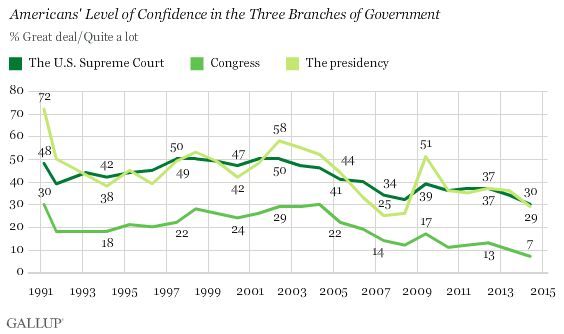
When the National Election Study began asking about trust in government in 1958, about three-quarters of Americans trusted the federal government to do the right thing almost always or most of the time. Trust in government began eroding during the 1960s, amid the escalation of the Vietnam War, and the decline continued in the 1970s with the Watergate scandal and worsening economic struggles. Confidence in government recovered in the mid-1980s before falling again in the mid-1990s. But as the economy grew in the late 1990s so too did confidence in government. Public trust reached a three-decade high shortly after the 9/11 terrorist attacks, but declined quickly thereafter. Since 2007, the share saying they can trust the government always or most of the time has not surpassed 30%....
Pew Research Center
Public Trust in Government: 1958-2017

Zero Hedge — Sarah Sanders Attempts To Explain What The Hell Is Going On At The White House

*SANDERS: ALL WHITE HOUSE STAFF REPORT TO CHIEF OF STAFF KELLY
The military junta consolidates control. Trump a figurehead.

General John Kelly (USMC ret.) — White House Chief of Staff
Lt. General H. R. McMaster (US Army) — Director of National Security
General James Mattis (USMC ret.) — Secretary of Defense
Mike Pompeo (West Point graduate and veteran of the US Army) CIA Director

Zero Hedge
Watch Live: Sarah Sanders Attempts To Explain What The Hell Is Going On At The White House
Tyler Durden


Sunday, November 9, 2014

Peter Dale Scott — The Deep State and the Bias of Official History

How do Wall Street, oil companies and the shadow government agencies like the CIA and NSA really shape the global political order? 
That’s the question author Peter Dale Scott examines in his forthcoming book “The American Deep State: Wall Street, Big Oil and the Attack on U.S. Democracy,” due out on Nov. 12. Scott, a professor emeritus of English at Berkeley and former Canadian diplomat, is considered the father of “deep politics”—the study of hidden permanent institutions and interests whose influence on the political realm transcends the elected. 
In the “American Deep State,” Scott takes a compelling look at the facts lurking behind the official histories of events to uncover the real dynamics in play. In this exclusive excerpt—the first of several we will feature on WhoWhatWhy—he looks at the revolving door between Wall Street and the CIA, and what that demonstrates about where power truly resides.
WhoWhatWhy
The Deep State and the Bias of Official History
Peter Dale Scott

Sunday, August 10, 2014

Dominique Mosbergen — Ron Paul Says U.S. 'Likely Hiding Truth' About MH17 Crash


Trouble on the anti-government right.
"Questions do remain regarding the serious international incident," Paul wrote last week of the MH17 crash. "Too bad we can’t count on our government to just tell us the truth and show us the evidence. I’m convinced that it knows a lot more than it’s telling us." 
This isn't the first time that Paul has accused the government of spreading "propaganda" following the MH17 crash. As The Hill points out, Paul -- in the days after the tragedy -- accused the Obama administration and the Western media of "join[ing] together to gain the maximum propaganda value from the disaster." He also suggested at the time that the U.S. might be partly to blame for the crash.
The Huffington Post
Ron Paul Says U.S. 'Likely Hiding Truth' About MH17 Crash
Dominique Mosbergen