The notion that trade surpluses are a measure of a country’s economic prowess dates back centuries. In 16th-century Europe, “mercantilists” from England to Venice sought to accumulate gold by promoting exports and discouraging imports. Their intellectual heirs today think trade surpluses boost national welfare, employment and economic growth, while deficits do the opposite.So far, so good. Then...
The preoccupation with surpluses is based on dubious arithmetic: since one country’s exports are another’s imports, it is impossible for all countries to be net exporters. It also overlooks a more fundamental point about trade. The main benefit from trade is imports – foreigners sending the fruits of their labour for us to enjoy, allowing us to focus on what we do best. Working to produce exports is the price we pay to enjoy these benefits.
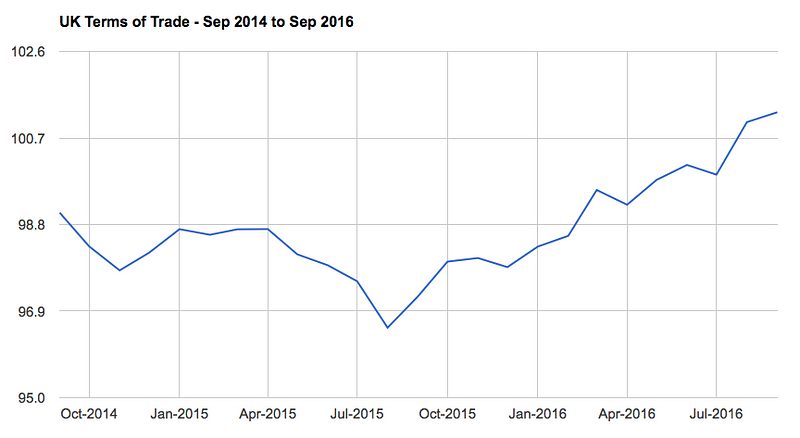
A better goal is to reduce the export effort needed to obtain a given quantity of imports. Economists call this “enhancing the terms of trade”. This makes intuitive sense in our own lives: you run a surplus with your employer in order to run deficits with your local grocery store, your daughter’s football league and your favourite restaurant. Now imagine if you could run those same deficits while spending only half as much time at the office.
Adam Smith recognized in 1776 that the true wealth of a nation was not the gold and silver in its coffers, but the productivity of its labour force. “Nothing can be more absurd than this whole doctrine of the balance of trade,” he wrote. Fast-forward to the present day, and his warning is once again going unheeded by policy-makers.…
The only way to shift the current account balance is to alter savings and investment behaviour by households, firms and governments.
Mistakes an accounting residual for a cause.
Then it gets back on track.
Then it gets back on track.
Popular discontent over trade springs from genuine problems. Market-opening agreements have amplified technological trends that deliver outsized gains to small numbers of individuals, firms and regions. Closing markets solves none of these, but would hurt voters’ purchasing power, destabilize businesses and weaken future productivity.But no proposals for accomplishing this.
Governments need to develop policies and institutions that cushion the blow from changes brought by both competition and technology, constrain runaway inequality, and equip people and businesses of all sizes to share in the opportunities presented by the global economy. This is the real challenge in trade. Current-account balances are merely a distraction – albeit one that could prove costly indeed.
World Economic Forum
It's time to ditch our obsession with trade deficits. Here's why
Arancha González Laya | Executive Director, International Trade Centre