Monday, July 7, 2014

Update on Term Deposit facility

Its been a few months since my earlier post discussing the Fed's new Term Deposit Facility. Since then, the scope of this program has grown significantly, with auctions growing from around $25 billion per week, to a massive $125 billion in last week's auction.

These term deposits are simply one-week CD's offered by the Fed. Participating depository institutions have their reserve accounts debited, and then re-credited 7 days later, plus the small, but free amount of interest. While each institution can only tender a maximum of $10 billion, the amount of participating institutions has more than doubled since March of this year-- from 27 to 58. Not surprisingly, this growth in participation follows the Fed's gradual raising of the rates it will pay, from 26 basis points in March, to 30bp just today. Not surprisingly, the 26bp auctions had fewer participants than the 29 bp auction, since many institutions likely figured that getting a one-basis point spread over what they receive on their excess balance accounts (25bp) was not worth the trouble. For now, the Fed has stated that 30 basis points will be the ceiling for this round of term deposit auctions, with the first 30bp auction set to go off today.


The size of this latest auction demonstrates the ease to which the Fed can drain reserves if it chooses to. It simply states the rate that it will pay on term deposits,  and accepts bids. Last week in a matter of hours, the Fed was able to drain $125 billion in reserves from the banking system, with no problems. It will be interesting to see how much higher the Fed may decide to pay on its Term Deposits, and how large these auctions may become as a result. Unfortunately, the Fed states on multiple TDF related pages that the auctions "are a matter of prudent planning and have no implications for the near-term conduct of monetary policy."

It remains to be seen if this statement holds true in the future, since it seems to me that these term deposits are an easier way of raising rates if the Fed needs to, as opposed to trying to sell off their securities portfolio and expose themselves to potential losses. From a political standpoint, it will certainly be easier to expand the TDF than to try and "unwind QE", as many analysts put it.

Bill Mitchell — Ireland national accounts and [tax] inversion

Last week (July 3, 2014), the Irish Central Statistics Office (CSO) released the – Quarterly National Accounts, Quarter 1 2014 -which showed that real GDP grew by 2.7 per cent (Q4 2013 to Q1 2014), while Gross National Product (GNP) grew by 0.5 per cent.
That result tells us two things:
1. There was solid real GDP growth in the first-quarter 2014.
2. Most of the benefits did not flow to the Irish, given that GNP growth was very modest (see below for more explanation).
"Tax inversion" = tax avoidance.

Bill Mitchell – billy blog
Ireland national accounts and inversion
Bill Mitchell | Professor in Economics and Director of the Centre of Full Employment and Equity (CofFEE), at the Charles Darwin University, Northern Territory, Australia

Neil Wilson — On the Nature of Banks - Payment Clearing

A couple of comments over the last week have suggested that the nature of the payment clearing system isn't perhaps obvious to all. I hope this post will help you see how it works, and show you why banks don't really lend reserves.
3spoken
On the Nature of Banks - Payment Clearing
Neil Wilson

VOP study — A Not So Divided America

Introduction

A cornerstone of democracy is the idea that elected representatives to some extent represent the views of their constituents. Thus, the policy conflicts between Democratic and Republican Members of Congress are often assumed to mirror differences in public attitudes in the districts or states that they represent. If so, the views of people in "red" districts or states would presumably be distinctly different from views of people in "blue" districts or states on policy issues. But is this true?

Much has been written recently about the growing partisan polarization that can be seen in response to ideological questions. One might expect this to lead to substantial differences between red and blue districts and states on policy prescriptive questions—i.e. concrete questions about what the government should actually do on specific policy issues. However, if this were not the case—and differences between red and blue districts and states on policy questions are minor—it would suggest that it is unlikely that polarization in the public is driving the polarization on policy issues in Congress; and that the drivers may lie in other sources of influence on Congress.

In light of these questions, we conducted a study that compared the responses to policy prescriptive poll questions of people who live in "red" districts or states to those who live in "blue" districts or states. 

Procedure

Selection of Source Surveys: We first sought out surveys that provided data showing the Congressional district in which each respondent resided. We found 14 different surveys with datasets that included information about the respondents' congressional districts. We also included 10 surveys conducted by the Pew Research Center and several major media outlets that only provided state-level breakouts. The surveys were conducted from 2008 through 2013. 

Selection of Poll Questions: From these surveys we selected 388 questions on a wide range of policy issues. Questions were limited to those that were policy-prescriptive: i.e., they asked respondents to weigh in on a policy choice the government could make or had made. The overwhelming majority of 339 questions were divided by districts, while 49 were divided by states.

Key Findings

1. Comparing the views of people who live in red Congressional districts or states to those of people who live in blue Congressional districts or states, across 388 questions, majorities or pluralities took opposing positions in about one out of thirty cases (just 3.6 percent of the time). In two out of three cases there were no statistical differences.

2. The few questions for which views were polarized between red and blue districts or states dealt with policy topics that are familiar, high-profile, 'hot-button' partisan issues. However, for all of these topics there were also other questions that did not elicit polarized responses between red and blue districts or states.

3. There were numerous areas associated with high-profile partisan conflict in which no questions appeared where people in red districts/states and blue districts/states took polarized positions.

4. Hearing strongly-stated arguments for and against a policy position, ones that respondents might have recognized as characteristic of partisan ideology, did not subsequently increase the incidence of polarization between red and blue districts on policy-prescriptive questions.

5. In the current environment, the parties have taken strong positions on the budget—with Republican members of Congress strongly opposing revenue increases and Democrats strongly opposing cuts to entitlements. However, when respondents were asked to make up their own federal budget, there were only slight differences between respondents in red and blue districts. In both cases majorities both raised revenues and trimmed entitlements.
Conducted by Program for Public Consultation: A Joint Program of the Center on Policy Attitudes and the School of Public Policy at the University of Maryland

Sunday, July 6, 2014

FRB Atlanta — The Story of Money


Good resource. Well illustrated.
A highlight of the Monetary Museum is the story of money as told through an exhibit of artifacts, coins, and currency notes in sixteen display cases.
With gold nuggets and wampum and much more, you can trace the evolution of money from barter to modern currency along with the story of banking and money in America right up to the founding of the Federal Reserve System in 1913. Take a look at the unusual objects, rare coins, and beautifully detailed currency notes in our outstanding collection.
Just click on the sections below to learn the fascinating story of money.
Federal Reserve Bank of Atlanta
The Story of Money
(h/t John Hobgood)

Daniel Little — What drives organizational performance?

We have a pretty good idea of the characteristics that support very high individual performance in a variety of fields, from jazz to track to physics to business. An earlier post discussed some of the different combinations of features that characterize leaders in several different professions (link). And it isn’t difficult to sketch out qualities of personality, character, and style that make for a great teacher, researcher, entrepreneur, a great soccer player, or an exceptional police investigator. So we might imagine that a high-performing organization is one that has succeeded in assembling a group of high-performing individuals. But this is plainly untrue — witness the New York Yankees during much of the 2000s, the dot-com company WebVan during the late 1990s, and the XYZ Orchestra today. (Here is a thoughtful Mellon Foundation study of quality factors in symphony orchestras; link.) In each case the organization consisted of high-performing stars in their various disciplines, but somehow the ensemble performed poorly. The lesson from these examples is an obvious one: the performance of an organization is more than the sum of the abilities of its component members.
In fact, it seems apparent that organizational performance, like physical health, is a function of a number of separate parameters:
Understanding Society
What drives organizational performance?
Daniel Little | Chancellor of the University of Michigan-Dearborn, Professor of Philosophy at UM-Dearborn and Professor of Sociology at UM-Ann Arbor

Ezra Klein — Transformers 4 is a master class in economics

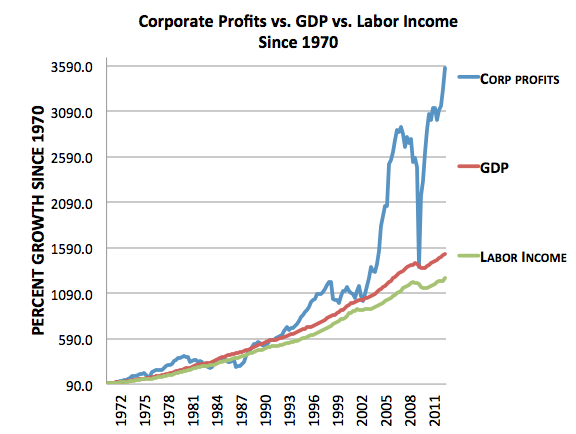
A different way of putting this is that as capital rises in importance, labor loses its bargaining power. You can see that happening in the economy in recent decades. Corporate profits have skyrocketed as advances in technology have allowed corporations to make more things and sell them to more people. At the same time, the share of the profits going to labor — to workers — has fallen, as this graph from the Atlantic's Derek Thompson shows:

Capsule version of Piketty.

VOX
Transformers 4 is a master class in economics
Ezra Klein

Miles Kimball — John Stuart Mill's Brief for Individuality

I have been publishing a post based on John Stuart Mill’s On Liberty every other Sunday since January 27, 2013. Each of these posts is a bit like a homily based on a passage of scripture; but the “scripture” in this case is On Liberty, and occasionally I disagree with John. (You can seem them all onmy Religion, Science and Humanities sub-blog.) 
Chapter I of On Liberty is an introduction. When I completed my series of posts on Chapter II of On Liberty, “Of the Liberty of Thought and Discussion,” I organized that series of posts in “John Stuart Mill’s Brief for Freedom of Speech.” That post is 43d in my latest list of most popular posts,and exhibits a continuing steady popularity long after its first appearance. I have now completed my series of posts of Chapter III of On Liberty, “Of Individuality, as One of the Elements of Well-Being.” So I wanted to do a post gathering together links to all my posts based on that chapter. 
Time has passed quickly enough that I am surprised by the total number of posts. I think the titles of these posts give a pretty good idea of the progression of John’s argument….
Confessions of a Supply-Side Liberal
John Stuart Mill's Brief for Individuality
Miles Kimball | Professor of Economics and Survey Research at the University of Michigan

The tension between liberal democracy and social democracy revolves around the integration of personal freedom and social solidarity in community. In the socialization process we all go through in civilization, children learn that these poles must be integrated for equality of persons to be realized. One person cannot be truly free in a democracy without according other persons the same rights and respect. 

Equality does not imply uniformity or require conformity, other than recognizing equality of persons as persons along with difference as unique individuals. From the negative standpoint, both individuality and community need to be protected, and from the positive standpoint, both individuals and the community need to be able to unfold inherent potential through individual choice and common agreement. 

This involves setting boundaries and individuals set them differently within community, resulting in tension, and different communities set different boundaries, resulting in tension among communities. It's a balancing act that is never final and complete.

Equality of persons is based on the universality of human nature. We are all human beings playing on team human regardless of whether we realize it. From the spiritual perspective, the more one realizes universality, not only of persons but also of being, the more spiritually mature one is and the more naturally the virtues that constitute character are lived spontaneously. In this way, individuality and community are naturally complementary and the tension between them is overcome.

Just as the level of awareness of universality is the measure of spiritual maturity and integration, so to the level of awareness predominating in a community reflects the level of collective consciousness of that group. In the view of virtue ethics, e.g, as set forth in Aristotle's Nichomachean Ethics, the fundamental purpose of education is to develop awareness of unity underlying diversity in order to make virtue natural through character building. This fits individuals as citizens for productive and contributory life in a polis, that is a community under the rule of law. 

Freedom is self-determination. In a democracy, the law is determined by the people themselves, who are free to change it as they see fit over time.

Saturday, July 5, 2014

Seth Ackerman — The Red and the Black


This is an astute examination of the issues involves in moving from capitalism in liberal democracy to socialism in social democracy (not to be confused with statism). It's also a good lesson in the history of economics.

Jacobin
The Red and the Black
Seth Ackerman | editor at Jacobin and a doctoral candidate in history at Cornell
(h/t Brad DeLong)

Joshua Gans — Another choice: The Intellectual Property Strategy

Thusfar, I have considered two options that have in common that they are focused on execution. Recall that being focused on execution means that a start-up embraces potential and on-going competition and formulates a plan to continually beat that competition by developing and continually re-investing in capabilities that allow the venture to beat the next wave of competition on quality, cost or some combination of the two. However, in choosing to focus on execution, a start-up can choose whether to be oriented towards competition (and building out a new value chain in competition with established firms) or to be oriented towards cooperation (and work within existing value chains). These two strategies were termed disruption and value chain respectively and each might be the appropriate one to be matched with an entrepreneurial idea.
Today I want to turn to strategies that are based on investing in control rather than execution. As I pointed out in a previous post, investing in control represents a somewhat familiar — or textbook — path to earning monopoly rents (or competitive advantage) as it involves undertaking a strategy that gives the entrepreneur control over key resources or assets that themselves allow the entrepreneur (or others) to create entry barriers. Thus, in contrast to focusing on execution, control involves more investment upfront but then, if successful, an easier competitive life later on as the venture can live off the future monopoly rents as it would an annuity because its customers would have fewer options to switch out to in the future.…
Digitopoly
Another choice: The Intellectual Property Strategy
Joshua Gans
(h/t Mark Thoma at Economist's View)

Unlearning Economics — Perverting Piketty

I recently wrote about the numerous misconceptions over Thomas Piketty's use and definition of capital in his book Capital in the 21st Century. Sadly, it seems there are a number of other common, equally important mischaracterisations of Piketty's model floating around. Here I will consider 5 of the most widespread and show, using direct quotes from Piketty himself, why they are off the mark. The first 3 are simple errors of interpretation with regards to Piketty's theoretical framework, while the latter 2 are problems with how people have responded to Piketty in general. Although the latter 2 are inevitably more subjective, they are still important for trying to understand and reframe the debate between Piketty and his critics.
Pieria
Unlearning Economics

Friday, July 4, 2014

Happy Independence Day


Let's remember our nation was fighting against him:


And NOT for her:


Raúl Carrillo — Keeping It Real: Law, Coercion, & The Frontiers of Public Finance

If you missed this, it is crucial to understanding economics, MMT, Post Keynesianism, Insitutionalism, and how the world works. Social relationships are government much more by positive law and institutional arrangements, which are themselves outcome of cultural convention and custom, than "natural law."
Political economy and legal analysis are two sides of the same coin. The struggle of individuals, groups, and institutions for resources occurs in the context of rules normatively crafted by legislators, judges, and bureaucrats, whether you like it or not. Such is the insight of a school of thought known as Legal Realism and its intellectual progeny. In many ways, Legal Realism is a sister paradigm to Modern Money, and to Post-Keynesianism generally, as it encourages people to investigate institutional components, but also recognize the plasticity of those pieces due to their political underpinnings. Realism holds that legal reasoning and legal institutions are inescapably political, rather than natural or autonomous, and that every legal action is soaked with moral controversy and coercion rather than a mere reflection of a neutral rule.
In this vein, one of the greatest Realists, Robert Lee Hale, a Columbia Law School professor and an architect of the New Deal, taught that every market exchange, no matter how ostensibly voluntary or unbiased, exists in the tension of power relations. There is rarely any net liberty or freedom to be gained from the implementation any particular economic policy. Policymakers mostly deal in trade-offs. Granting one person “liberty” almost inevitably entails “coercing” other people who may not recognize that individual’s alleged rights or freedoms.…
Like financial policy, fiscal policy can evolve via a synthesis of Legal Realism and Post-Keynesian insights. If federal taxes for revenue are obsolete, and the government taxes not to fund social programs, but to drive the currency, maintain price stability, and disincentive certain activities, then fiscal policy is not primarily about redistribution. More accurately, it’s about distribution of entirely new funds and subsequent draining of said funds at the cusp of inflation. This is a truly transformative realization, and as a result, there is much work to be done to integrate the Modern Money framework for distribution with Realist arguments about distributive justice. A useful starting point is to consider how the central thesis of Modern Money—that the U.S. government can and should spend money up until the point price stability is harmfully disrupted for the public—changes legal arguments for basic welfare rights.…
At the same time, dynamic, Realist changes in property law in the 20th Century indicate underlying economic concepts are more malleable than even most MMT economists are prone to note, and thus the parameters of conversation around public finance can be further eased. For example, in Goldberg v. Kelly, (1970), the Supreme Court case enshrined welfare benefits as a form of Constitutional property, opining that “Public Assistance, then, is not mere charity, but a means to ‘promote the general Welfare, and secure the Blessings of Liberty to ourselves and our posterity”, allowing people to meaningfully participate in community and political life. With that decision, welfare benefits joined a list of things, like bank accounts, that were not initially considered property via common law but have since achieved that status.
Similarly, another string of cases did not transform legal categories of the economy, but protected low-income people from discrimination in the context of public finance. In Griffin v. Illinois, (1956), the Supreme Court held that a criminal defendant may not be denied the right to appeal by inability to pay for a trial transcript, finally recognizing that laws that may not be discriminatory against low-income people on paper may be discriminatory in practice. In the striking case of Department of Agriculture v. Moreno, (1973), the Court prohibited withholding of food stamps from household based on their familial composition. Without explicitly stating such, the Court showed willingness to require a substantive reason for exclusion from basic economic guarantees.Moreno has never been overruled. It’s still “good law.”
Thus, Legal Realist arguments in context of case law demonstrate it is possible and reasonable to interpret the Constitution to include basic socioeconomic rights. Reciprocally, Modern Money grants sound economic arguments as to how the government can “afford” to ensure those basic rights, or at least cannot reasonably discriminate in the distribution of current funds due to an appeal to fiscal soundness. The deep penetrating questions mentioned at the beginning of this essay can enter the courts. For example, if there is no money scarcity, only real resource scarcity, and taxes and bond payments don’t necessarily link to outlays, who is to say they deserve monetary stimulus more than anyone else? There’s a lawsuit in the making. If there is no affordability constraint until there is inflation, what are the rational bases for excluding some people from adequate public benefits based on their level of wealth? There’s a strengthened argument for litigation. When we recognize that federal taxation and borrowing are functionally separate from expenditure, the moral landscape changes. We can go deeper and deeper. If the federal government has excess funds and there is no threat of inflation, what is the compelling argument against a right to the minimum level of purchasing power necessary to ensure a secure livelihood? If the federal government doesn’t need the money to fund other programs, what is the compelling justification for why working people should suffer from regressive taxes like the payroll tax? At the very least, Modern Money breathes new life into legal arguments against socioeconomic discrimination.…
It is worth remembering that for Legal Realists, rights do not fall from the sky. They are demanded in the face of social wrongs, sought via politics, wrought via law. They must be fought for, if not in the streets, then in the courthouses. The Equal Protection Clause is not likely to be the most important or effective tool for achieving basic economic security going forward, but an understanding of Modern Money could retool and refuel Justice Sonia Sotomayor’s opinions in ways Justices Thurgood Marshall and William Brennan could never have dreamt of.… Comprehension of the Modern Money framework would strengthen the arguments of social justice advocates and make their goals more viable than ever.
Ironically, it  might be a new breed of lawyers that saves us.

This is just a summary of key insights. For those interested in MMT, it's important to understand the legal rationale for a new progressive policy agenda.
To quote Johnson again, “the sheer amount of new federal money provided to states under the stimulus, and the conditions attached to some of these federal funds, raise questions about the federal government’s expanding power to shape, through spending, a broad set of institutional arrangements at the state and local levels.” Considering it’s all new federal money, that statement is even more important than Johnson seems to indicate. The scope of our discussion about public finance needs to be magnified.
For example, although at the end of the day, poverty is relative, there is now much we can do to end absolute indignities, given sufficient knowledge of the legal-financial matrix. As Emma Coleman Jordan has stated, what passes as rational conversation about economic policy choices these days is “devoid of all understanding and empathy for the choices of people who have no choice.” I’d add it is also devoid of institutional perspective and accuracy regarding modern money, functional finance, and national accounting. In the words of a recently deceased human rights activist, Yuri Kochiyama, consciousness is power, and with a revamped economic education, social justice advocates can build tomorrow’s world.…
Beyond the myths about money, beyond the intellectually impotent and incoherent conceptions of government intervention, deregulation, and redistribution, we can have that real talk about who gets what, when, where, how, and why.
New Economic Perspectives
Keeping It Real: Law, Coercion, & The Frontiers of Public Finance
Raúl Carrillo | student at Columbia Law School

Alberto Martin, Jaume Ventura — Managing credit bubbles


Not in paradigm with MMT, but interesting in that it consolidates the monetary (cb) and fiscal (Treasury) functions as government and sees the role of fiscal policy in stabilizing the credit cycle. So while not in paradigm, it's edging closer. Worth a look.

Vox.eu
Managing credit bubbles
Alberto Martin, Jaume Ventura

Glynn Moody — The FLOK Society Project: Making The Good Life Possible Through Good Knowledge

One of the most striking and important developments in the world of technology over the last two decades or so has been the rise of an alternative mode of production that is open, collaborative and global. This began in the world of software, with Richard Stallman's GNU project, but has now been extended to the realms of text, data, science and hardware, among others. The free sharing of information to form a kind of digital commons, which lies at the heart of these projects, has also been applied to business, albeit in the modified form of collaborative consumption -- things like Airbnb. These different manifestations of fundamentally similar ideas have sprung up in a largely uncoordinated way, but an interesting question is whether they could be drawn together into a unified approach, applied to a whole country, say. That's what Ecuador's FLOK Society (original in Spanish) has been exploring. "FLOK" is derived from "free", "libre" and "open knowledge"; here's how David Bollier, an expert on the commons, describes the project…

TechDirt
Glynn Moody

Jared Bernstein — Evidence: Is It Really Overrated?

A few weeks ago, during the evidentiary dustup between Piketty and the FT, I quasi-favorably quoted a Matt Yglesias line re empirical evidence being overrated. A number of readers were understandably unhappy with that assertion, arguing that they come here to OTE for fact-based analysis based on empirical evidence (with, admittedly, a fair bit a heated, if not overheated, commentary). If facts all of the sudden don’t matter anymore, why not just call it a day and join the Tea Party?
So let me add a bit more nuance. The statement is about the quality and durability of evidence, which is not only varied of course, but, at least in the economic policy world, increasingly problematic by which I mean that a number of developments have significantly lowered the signal-to-noise ratio.
I’d divide the evidence problem into two separable categories. First, statistical issues about what’s “true” and what’s not, and second, ideological ways in which the noise factor is amplified at the expense of the signal.
Jared Bernstein | On the Economy

David Beckworth — How Long Did It Take the United States to Become an Optimal Currency Area?


Spoiler. 150 years.

Macro and Other Market Musings
How Long Did It Take the United States to Become an Optimal Currency Area?
David Beckworth | Assistant Professor of Economics at Western Kentucky University in Bowling Green, Kentucky

JW Mason — Boulding on Interest


That's Kenneth Boulding.

The Slack Wire
Boulding on Interest
JW Mason | Assistant Professor of Economics at Roosevelt University

Brian Romanchuk — If r < g, DSGE Model Assumptions Break Down

The relationship between interest rates and the growth rate of the economy is critical for government fiscal dynamics. In the literature for Dynamic Stochastic General Equilibrium (DSGE) models, the discussion of the governmental budget constraint appears to have an embedded assumption that the real interest rate on government debt is greater than the economic growth rate (“r>g”). However, there is no reason that this has to be true, and the mathematics of the budget constraint fails if the condition does not hold. This poses a problem for the constraint, as a true mathematical constraint is something that is always true. Once this constraint is dropped, a good portion of the recent academic literature discussing fiscal policy becomes irrelevant. (Despite my opportunistic use of “r” and “g” in the title of this article – in order to capitalise on the popularity of a recent book – it has nothing to do with inequality.)
Bond Economics
If r < g, DSGE Model Assumptions Break Down
Brian Romanchuk

Lars Syll — Keynes on the use of mathematics in economics


Lars P. Syll’s Blog
Keynes on the use of mathematics in economics
Lars P. Syll | Professor, Malmo University

It's the assumptions, stupid.

See also Krugman on the relevance of the history of economic thought on the failure of the mainstream to foresee impending crises based on the (false) assumption that uncertainty is reducible to risk.

Randy Wray — BATTLING THE MASTER BAITERS: In the Trenches for MMT. Troll Friday


Randy comments on comments on debt-free money, most of which have nothing to do with debt-free money but repeat standard criticisms of MMT.

Economonitor — Great Leap Forward
BATTLING THE MASTER BAITERS: In the Trenches for MMT. Troll Friday
L. Randall Wray | Professor of Economics, University of Missouri at Kansas City

Thursday, July 3, 2014

If you missed my past Forex classes you have another chance. I will be giving a class July 21 - 25.

I will be giving another online Forex trading course July 21 -25. 

This course will teach you my proprietary methods of how to successfully
trade foreign currencies.


Past students have gone on to success. Read the testimonials here.
This is also the only Applied MMT course you will find anywhere. I teach
you how to use the principles of MMT to make money trading the
currency markets.


In addition I teach you about *Market Composition.* When you understand market
composition you know who is in the market and exactly what they are doing and
how they are likely to react. It's literally like knowing the cards that other players in a poker game are holding.


Finally, I put you through a mental "Boot Camp." It is absolutley true that trading
success is 100% mental. I train you in how to develop the all important mental traits that will allow you to operate successfully as a trader.


My course is taught online. No special software is required. It is 5 days, M-F, 8am NY time to 4pm NY time. We will cover Forex market theory, fundamentals and three days of live trading.

The course fee is $2995. Once you take my course you can enroll in any future course that I give for free, and as many times as you like.

For more info go here.

To sign up right now click the button below or click on the banner ad in the left margin of this blog.


Bill Mitchell — New economics – not much will change at the current rate

My upcoming book about Europe is tentatively called ‘European Groupthink: denial on a grand scale’. I have covered the concept of Groupthink before but I have been thinking about this in relation to the economics curriculum, given our textbook is entering its final stages of completion. When I was at the iNET conference in Toronto in early April, there was much to-do about the so-called ‘exciting’ new developments in economics curricula being sponsored by iNET at their Oxford University centre (CORE). Forgive me for being the ‘wet blanket’ but the more I spoke to people at the conference the more I realised that the neo-liberals were reinventing themselves as ‘progressive’ or ‘heterodox’ and hi-jacking the reform process. I mentioned this to one of the iNET Board members who I shared a flight with back to San Francisco. He seemed taken aback. My expectation is that very little of substance will change in this new approach to economics. It will dispense with the most evil aspects of the current dominant framework but will remain sufficiently engaged with it that we will not see a truly progressive teaching approach emerge that can deal with evidence and real world facts. People are scared to break out of the ‘group’.…
Bill Mitchell – billy blog
New economics – not much will change at the current rate
Bill Mitchell | Professor in Economics and Director of the Centre of Full Employment and Equity (CofFEE), at the Charles Darwin University, Northern Territory, Australia

Bill Black — Obama Consults a “Wide Variety of Economists” – Just Not Those Who Got it Right

In a PR effort that aptly illustrates his approach to governance, President Obama has revealed that he is meeting with a “wide variety of economists” to try to figure out what economic policies he should follow. “Obama Seeks Advice From Wide Variety of Economists.”
Obama is already well into the lame duck phase of his presidency, so this is simply a PR exercise. The message Obama wants to send is the same one he has sounded throughout his presidency. He is open to economic views from the parts of the political spectrum that range from the hard right to the mild left.

Obama is not open to hearing the economic views of anyone who got the crisis correct or anyone his advisors consider to the left of Paul Krugman (who is mildly left in economic terms). James Galbraith captured the first point brilliantly in an essay about a Krugman column. Krugman was making the correct point that conservative economists had gotten the crisis wrong and, in passing, mentioned less than a handful of economists he considered to have gotten it right. Galbraith stressed Krugman’s lack of interest in what economists got the crisis right and Krugman’s failure to list the economists who had actually gotten it right and had theoretical explanations for the causes of the crisis that had proved accurate in multiple crises.
New Economic Perspectives
Obama Consults a “Wide Variety of Economists” – Just Not Those Who Got it Right
William K. Black | Associate Professor of Economics and Law, UMKC

Scott Fullwiler — “Debt-Free Money” and “ZIRP Forever”

I wrote a while back about how neoclassical economists don’t realize their view that interest on reserves (IOR) stops “printing money” from being inflationary also means that it’s impossible to create inflation by “printing money.” See here.
I’m not 100% sure on this one (and please feel free to correct me if you know better than I do) because I admittedly haven’t given the literature a thorough read, but from what I can tell, it appears “debt-free money” advocates may not realize they are similarly overlooking the actual operations of the monetary system. So, apologies in advance if I’ve misinterpreted. 
From what I’ve seen, “debt-free money” (DFM) advocates want a world in which the government spends via cash (i.e., paper money). They are against government issuing bonds or any interest on the debt, since that would suggest the government’s money isn’t “debt free” (again, please correct me if I’m wrong in this description).

What they may not realize (or they might and I just haven’t come across it), though, is that it’s not possible in a modern monetary economy to force “cash” on the private sector (note here that “cash” is not the same thing at all as “income” or “wealth,” as obviously there’s infinite demand for those). There are significant implications for neoclassicals (as I explained in the post I linked to above) and now DFM advocates as well.
(A side note—as Randy Wray explained, the term “debt-free money” is a non-sequitir. I’m going to use the term here simply to identify a group of people with particular views. Also, my overarching point here is to elaborate Randy’s phrase “ZIRP forever” near the end of that post, said in reference to and in some apparent solidarity with DFM’ers.)
New Economic Perspectives
“Debt-Free Money” and “ZIRP Forever”Scott T. Fullwiler | James A. Leach Chair in Banking and Monetary Economics and is an Associate Professor of Economics at Wartburg College

YoY Fiscal Recovery in June


Chart below depicting a nice $19B YoY gain in Treasury withdrawals for June.

Full YoY withdrawals are still running behind by about $35B YoY compared to total Treasury net withdrawals this year of $3.165T through end of June.


Wednesday, July 2, 2014

Fiat Currency Operations For Dummies, 5yr Olds, and Politicians

(Commentary posted by Roger Erickson.)


Warren Mosler Explains Fiat Currency to Poland
Warren patiently makes some absolutely trivial points here, that should be the simplistic taking-off point for all other fiscal policy discussions:

1) lost output from current under-employment is always in danger of being greater than the sum of all prior output (simply because humanity is still growing to record capabilities; ~ min47 in the video)

2) our stds of living could be many multiples of current stds, if not for unemployment induced by misbalancing the ratio of net fiat_taxes to net_fiat_spending

3) our exponentially expanding options worth exploring ALWAYS exceed the number of people available to do available work
(see the following, about exponentially expanding aggregate options, cost of coordination, and return on coordination:

http://econintersect.com/b2evolution/blog2.php/2012/12/16/redefining-fiscal-policy-outcomes-so-that-our-definition-of-successful-investing-isn-t-depriving-our-grandchildren-of-options

http://seekingalpha.com/user/830328/comments/2

  [see "Falling Down The Elevator Shaft" comment]


Warren is right that confusion about these drop-dead simple system axioms is the greatest systemic barrier to improving the level of discussion for all subsequent policy complications.

An understanding of fiat currency operations doesn't automatically answer all policy questions, but it is an absolutely necessary but not sufficient step in understanding all subsequent national policy options.

No policy foundation? Then no policy stability from an uninformed electorate. And a constrained Adaptive Rate to boot.


"Successful" Politics ... At Expense Of General Welfare Of The People?

   (Commentary posted by Roger Erickson.)


Translation: "Only 2 Presidents in last 50 years to REDUCE PRIVATE FINANCIAL SAVINGS"

This is a sad commentary on public awareness. Marriner Eccles must be turning over in his grave.

We need to add a simple message to K-12 education, so that Joe/Jane Sixpack don't find the fundamentals of fiat currency operations to be a surprise, or feel implausible. We can't afford to let most citizens erroneously "believe" that the Earth is flat, nor can we afford to let ourselves believe that we can run out of fiat.

In a fiat currency system, the public Currency Issuer's "Deficit" = the private Currency Issuer's financial savings, or financial equity.

(Public Appropriation) - (Taxes) = Currency Already Available for Private Sector Use.

Anything more comes only from MORE fiat.

The independent variables to manage are national capabilities, national output, national policy, and of course inflation/deflation .... but the currency supply itself is a purely nominal, DEPENDENT variable. Not so different from the # of numerals utilized by math students as they practice and apply their profession.

Fiat currency supply follows Public Initiative. There's no point in "balancing" public fiat, unless you want to freeze both US population and national capabilities. Good luck trying to apply that tourniquet to our own necks. We always pass out before managing to completely strangle our growing nation.

As Paul Meli recently noted, our entire stock of $US was on the order of $1Trillion at the close of WWII. Today, the stock of distributed $US is on the order of $60Trillion. Paul asks whom we supposedly "borrowed" that subsequent $59Trillion dollars from, when the US Treasury is the monopoly supplier.


Neil Wilson — On the Nature of Banks - 'Insured' vs. 'In Specie'

I've never been entirely sure why banks confuse people so much. They really are very simple creatures. They make loans and back those up with deposits and other borrowings, charge a margin for one over the other in return for making an underwriting decision, and undertake to swap their liabilities around in various manners to maintain their liquidity.
And that's about it really. In fact all the problems start happening when you let lending banks do anything much more than this.…
3spoken
On the Nature of Banks - 'Insured' vs. 'In Specie'
Neil Wilson

Tuesday, July 1, 2014

Randy Wray — Debt-Free Money: A Non-Sequitur In Search Of A Policy

While we are on the topic of monetary cranks, I thought it might be useful to quickly address a cranky idea that often comes up in comments to my blogs and also during Q&A after presentations: so-called “debt-free money”. 
The first time I heard it, my immediate reaction was “Say what?”, and the second was puzzlement at the non-sequitur. 
I am not sure exactly which of the crank approaches explicitly adopt the notion, but it seems common to a lot of them. I’m not going to address any particular approach but instead will address only the idea that we can have a “money” that is not a “debt”. 
But first I want to tie up a loose end from my last blog, Something is Rotten in the State of Denmark: The Rise of Monetary Cranks and Fixing What Ain’t Broke, which was carried at GLF, NEP, and Naked Capitalism.…
New Economic Perspectives
L. Randall Wray | Professor of Economics, University of Missouri at Kansas City
Crossposted at Economonitor — Great Leap Forward and Naked Capitalism