Tuesday, September 28, 2010
We should all pray for higher rates!
Frequent contributor to this blog, Matt Franko, posted a brilliant observation in the comment section of the prior post.
He points out that the public's holdings of Treasuries exceed $10 trillion, which is more than total loans and leases outstanding. If the Fed were to raise interest rates it would constitute a HUGE fiscal transfer via the interest/income channel. This means that, while most of the "know-nothings" (including many Fed board members) are talking about the need to raise rates now to stave off an incipient inflation, doing so would result in just the opposite. Higher rates would give a huge income boost to the public via higher interest payments, without a concomittant increase in production. That would absolutely drive inflation higher. The Fed is unwittingly keeping inflation down by keeping rates at or near zero, yet their own members and much of the financial community and the public don't even realize this.
Kudos to Matt for pointing this out. Trust me folks, you won't find this stuff anywhere else!!


Fed finally admits what MMTers have been saying for a long time: There is no "money multiplier."
| A second issue involves the effect of the large volume of reserves created as we buy assets. [. . .] The huge quantity of bank reserves that were created has been seen largely as a byproduct of the purchases that would be unlikely to have a significant independent effect on financial markets and the economy. This view is not consistent with the simple models in many textbooks or the monetarist tradition in monetary policy, which emphasizes a line of causation from reserves to the money supply to economic activity and inflation. . . . [W]e will need to watch and study this channel carefully. Donald L. Kohn, Vice Chairman of the Federal Reserve Board, March 24, 2010 |
Fed finally admits what MMT'ers have been saying for a long time. The "money multiplier" is fiction, which is why all their easing efforts have had zero effect on the economy, bank lending and inflation.
Here is the link to the Fed's paper. Read here.
Friday, September 24, 2010
House Panel Clears Bill To Penalize China Over Currency
CNBC story here. Excerpt:
This could be just election season political posturing or the start of something big for currencies, price stability and the persistent U.S. external deficit.
"A House panel, in a move likely to increase trade tensions with China, approved on Friday a bill that allows the United States to slap duties on goods from countries with fundamentally undervalued currencies."
This could be just election season political posturing or the start of something big for currencies, price stability and the persistent U.S. external deficit.
Thursday, September 23, 2010
Republicans' "Pledge to America" looks like a lot of spending cuts and vague proposals
So the Republicans released their "Pledge to America" and the draft is available online at . Basically, here are the main points regarding the economy.
1. Stop job-killing tax hikes.
They don't identify which tax hikes, but presumably they mean extending the Bush tax cuts.
2. End the attack on free enterprise.
This is very vague. I don't know what attack on free enterprise they are referring to. Perhaps it means repealing Finreg and all regulations so that big business can generate and hoard more profits at workers' expense. Maybe do away with minimum wage??
3. Roll back spending to pre-bailout, pre-stimulus levels.
This would drop the amount of expenditure by over $1 trillion annually or another way to say it, reduce GDP by 7%!. That would put growth at best around -5.5%. With the multiplier effect it would probably be more like -15%. That's a full blown depression. This is how they intend to create jobs?
4. Hold weekly votes on spending cuts.
As you can see, they're very serious about cutting spending. They will cut something from the budget pretty much every week.
5. Enact strict budget caps.
Yes and enact a balanced budget amendment as well, which would ensure mass poverty for generations to come.
6. Net freeze on gov't hiring.
Given that the vast majority of new jobs created this year were in the gov't sector, this means monthly payrolls will fall steeply into the negative. How do you think the market will take this?
7. End gov't control of Fannie Mae
We tried this already--privatizing Fannie and Freddie and it led to the housing market collapse. So do they really want to bring this idea back to "save" the Federal Government $30 bln annually after it has already cost us trillions???
8. Repeal health care.
Might not be a bad idea, but what do they replace it with? The old system, where 30 million people had no health care and insurance companies rationed as they pleased?
Some of their favorite sound bites that have no basis in reality:
"Federal Spending is 'crowding out' the private economy."
Where, exactly, is this crowing out? We are suffering from historic overcapacity in everything from housing, to plant and equipment to workers. And interest rates are at record lows. There simply is no crowding out.
"We cannot spend our way to prosperity."
Every successful businessman knows that you have to spend money to make money. They're supposed to be the party of business, but they don't understand that??
1. Stop job-killing tax hikes.
They don't identify which tax hikes, but presumably they mean extending the Bush tax cuts.
2. End the attack on free enterprise.
This is very vague. I don't know what attack on free enterprise they are referring to. Perhaps it means repealing Finreg and all regulations so that big business can generate and hoard more profits at workers' expense. Maybe do away with minimum wage??
3. Roll back spending to pre-bailout, pre-stimulus levels.
This would drop the amount of expenditure by over $1 trillion annually or another way to say it, reduce GDP by 7%!. That would put growth at best around -5.5%. With the multiplier effect it would probably be more like -15%. That's a full blown depression. This is how they intend to create jobs?
4. Hold weekly votes on spending cuts.
As you can see, they're very serious about cutting spending. They will cut something from the budget pretty much every week.
5. Enact strict budget caps.
Yes and enact a balanced budget amendment as well, which would ensure mass poverty for generations to come.
6. Net freeze on gov't hiring.
Given that the vast majority of new jobs created this year were in the gov't sector, this means monthly payrolls will fall steeply into the negative. How do you think the market will take this?
7. End gov't control of Fannie Mae
We tried this already--privatizing Fannie and Freddie and it led to the housing market collapse. So do they really want to bring this idea back to "save" the Federal Government $30 bln annually after it has already cost us trillions???
8. Repeal health care.
Might not be a bad idea, but what do they replace it with? The old system, where 30 million people had no health care and insurance companies rationed as they pleased?
Some of their favorite sound bites that have no basis in reality:
"Federal Spending is 'crowding out' the private economy."
Where, exactly, is this crowing out? We are suffering from historic overcapacity in everything from housing, to plant and equipment to workers. And interest rates are at record lows. There simply is no crowding out.
"We cannot spend our way to prosperity."
Every successful businessman knows that you have to spend money to make money. They're supposed to be the party of business, but they don't understand that??
Wednesday, September 22, 2010
It's a race to the bottom right now
Countries everywhere have abandoned strategies to boost domestic spending because of real or perceived debt fears. Instead, growth policies have all become focused on exports. Whether you are talking about Europe, the U.S. Japan or China it's all about exports. The problem is, there's no one to sell to. In the past the United States was the buyer and because of this it was seen as the engine of global growth. But now the Obama Administration is looking to double exports in the next 5 years. How is that achieved? Currency devaluation and wage and income suppression. That's the problem, all the major countries are looking to boost growth the same way. It can't happen. That's why we're probably close to another leg down in the global economy or some kind of currency crisis.
Under this scenario it looks like the euro has the most to lose.
Republicans threatening to shut down the government again!
| The continuing resolution (CR) to allow the government to function beyond the end of the fiscal year Sept. 30 is likely the last legislation lawmakers will send to the president before breaking for the campaign’s home stretch. The resolution is needed to avoid a government shutdown, because Congress hasn’t cleared any of the dozen appropriations bills for fiscal 2011. |
Here we go again. Just like 1995 when the GOP shut down the government under the "leadership" of Newt Gingrich, they are threatening to do it again.
The U.S. can't default because it is a currency issuing nation and its debts are denominated in its own currency. Under those criteria it can't default. However, if it voluntarily decides to stop paying its debts because these Republican crazies shut down the government, then yes, that's a default.
Saturday, September 18, 2010
ECBs Securities Markets Programme:
Back in May of this year, the ECB started their Securities Markets Programme where the Central Bank intervened to purchase securities in both Government and Private debt securities markets.
Information is hard to find about the progress of this program, but here is a report on monetary operations (under the "Ad-Hoc" tab) related to the liquidity absorption of these purchases. Excerpt:
How does this $79B equivalent of purchases compare to the stock and flows of government securities of these three countries? Data from an OECD website here.
Total Government Debt (Stock) of:
Portugal: $191B
Ireland: $108B
Greece: $430B
So the $79B of purchases represent 10.8% of the total government debt outstanding of these countries combined.
Total YoY ('08 to '09) Government Debt net issued (Flow):
Portugal: $27B
Ireland: $38B
Greece: $66B
Accordingly this $79B of ECB purchases represents 60% of this recent flow measure.
If this ECB program is indeed focused on the liquidity of the government securities of basically just these three countries, it is probably a substantial factor in the ability of these countries to issue or at least issue at reasonable rates.
Information is hard to find about the progress of this program, but here is a report on monetary operations (under the "Ad-Hoc" tab) related to the liquidity absorption of these purchases. Excerpt:
......A variable rate tender with a maximum bid rate of 1.00% will be applied and the ECB intends to absorb an amount of EUR 61 billion. The latter corresponds to the size of the Securities Markets Programme, taking into account transactions with settlement at or before Friday 10 September, rounded to the nearest half billion. As the settled SMP transactions last week were of a volume of EUR 237 million, it happens that the rounded settled amount - and the intended amount for absorption accordingly - remains unchanged at EUR 61 billion.......So it looks like the ECB has so far purchased e61B ($79B) since mid-May. I have not been able to find any details about securities purchased or country of original issue, but the general suspicion is that some of the European countries with smaller economies that have larger, persistent external deficits were/are having problems with issuing their government securities and the ECB has stepped up as effectively a buyer of last resort. Three countries perhaps in this category are Greece, Ireland, and Portugal.
How does this $79B equivalent of purchases compare to the stock and flows of government securities of these three countries? Data from an OECD website here.
Total Government Debt (Stock) of:
Portugal: $191B
Ireland: $108B
Greece: $430B
So the $79B of purchases represent 10.8% of the total government debt outstanding of these countries combined.
Total YoY ('08 to '09) Government Debt net issued (Flow):
Portugal: $27B
Ireland: $38B
Greece: $66B
Accordingly this $79B of ECB purchases represents 60% of this recent flow measure.
If this ECB program is indeed focused on the liquidity of the government securities of basically just these three countries, it is probably a substantial factor in the ability of these countries to issue or at least issue at reasonable rates.
Thursday, September 16, 2010
How to double exports in five years. Step one: Destroy the dollar. Step two: Enact policies that keep wages low. Step three: Repeat!
We're getting a real time look at what policies are necessary to achieve Barak Obama's goal of doubling U.S. exports in 5 years.
Step 1. Destroy the dollar.
Making the dollar weak brings us instant export competitiveness. The only problem is, it reduces our real terms of trade, which is the same as saying it lowers Americans' standard of living relative to the rest of the world.
The Administration is attacking China now and pushing it to raise the value its currency so that ours can go in the toilet. That is their brilliant idea and it's also an idea that is adored by so many mainstream economists. Go figure.
Step 2. Enact policies that keep wages and incomes low.
By keeping incomes low we also achieve comparative advantage. Other nations find it more cost effective to buy our products if we don't pay our workers very much.
How do we keep incomes low? Simple. Give huge tax breaks to corporations that are not likely to be passed along to workers. Don't cut taxes for people; just for businesses. Keep unemployment very high so that people become so desperate they'll take any low paying job they can find. Reduce spending on education so that more people will have to settle for low-paying jobs. Cut social supports so that people become destitute enough to work for practically nothing. Target unions or any organizations that are countervailing forces to businesses.
Step 3. Repeat!
Those three steps toward greater exports for America are now happening. And for us Americans it means we will send more of the fruits of our labor to foreigners and we will have a lower standard of living, but hey, we will have created a few jobs. Yippeee!!!
FedEx 1Q profit doubles; will cut 1,700 jobs
Is this good news or bad news? Yahoo story here.
This is probably a perfect example of how productivity increases can outpace general economic growth and result in more people being thrown out of their jobs, even though corporate results can be improving.
The ONLY way to manage against this trend at this point is through fiscal policy that leads to broad increases in incomes or direct hiring of the unemployed.
And instead we have the former Fed Chairman advocating for tax increases? Our leadership is indeed clueless.
This is probably a perfect example of how productivity increases can outpace general economic growth and result in more people being thrown out of their jobs, even though corporate results can be improving.
The ONLY way to manage against this trend at this point is through fiscal policy that leads to broad increases in incomes or direct hiring of the unemployed.
And instead we have the former Fed Chairman advocating for tax increases? Our leadership is indeed clueless.
Wednesday, September 15, 2010
Greenspan says taxes must rise so that the economy can expand!!!
| "We should not have tax cuts with borrowed money, but we should have tax cuts, and the more as far as I'm concerned the better, but only in the context of bringing the deficit down," he said. "Unless we do that, I think we have very grave problems ahead." |
Greenspan is certifiable. He's either gone off the deep end or just "talking the book" of whoever he is working for now. Pimco?? I guess they want him to help engineer a depression so that their Treasury portfolio soars and they end up managing all the money in the world and controlling the world. This is better than any suspense novel.
Obama's Thatcherite Gift to the Banks
Great article by Michael Hudson here. Thanks to Tom Hickey, reader of this blog!
America got rich from the Progressive Era onward by a different kind of big government than we have today. From the Cumberland Road and Erie Canal onward, it provided roads and other basic services at public expense for free or at subsidized prices. The guiding idea was that the “return” to public investment should be measured by the degree to which it lowers the economy’s costs of living and doing business, not in the amount of income it could extract. This threatens to be the kind of tollbooth program that the World Bank and IMF have been foisting on hapless Third World populations for the past half-century. The “infrastructure bank,” reports The New York Times, “would be run by the government but would pool tax dollars with private investment.” It would be a test balloon for financing “a broader range of projects, including water and clean-energy projects,” for which Democrats already are drawing up a blueprint: “[Connecticut Democrat Rosa] DeLauro’s plan would create an infrastructure bank that would be part of the United States Treasury, where it would attract money from institutional investors, then channel the funds to projects selected by a panel. The program, which would make loans much like the World Bank, would finance projects with the potential to transform whole regions, or even the national economy, the way the interstate highway system and the first transcontinental railway once did. “The outside investors would expect a competitive return on their money, so many of the completed projects would have to charge fees, taxes or tolls. In an interview, Ms. DeLauro said she would be “looking at a broader base,” meaning the bank would finance not just roads and rails, but also telecommunications, water, drainage, green energy and other large-scale works. “But if the projects did not raise enough money, the Treasury might get stuck paying back the investors, a prospect that gave pause to so-called deficit hawks like [Ohio Republican Congressman Pat] Tiberi. In an e-mail last week, he said he agreed the nation’s road and communications networks needed to be improved but was concerned about creating another company like Fannie Mae that might need a bailout.” Sheryl Gay Stolberg and Mary Williams Walsh, “Obama Offers a Transit Plan to Create Jobs,” The New York Times September 7, 2010. |
Tuesday, September 14, 2010
Small business aid bill set to clear the senate
Another hollow victory for Obama. The bill will give money to banks, with the intention that they make loans. Apparently no one in the Administration understands banking, because lending is not constrained by reserves. How do they expect banks to lend to businesses without customers and sales when no one has a job or where millions have seen their incomes reduced to nothing??? Can't anyone in the Administration figure this out???
This money will sit on banks' books, just like TARP and other, similar measures. Or worse, it will go to big bonuses again for bank executives. It's looting the taxpayer to give money to business executives in the financial sector. Scandalous!!! We should have a revolt against this shit once and for all!!!
Monday, September 13, 2010
NJ Gov Chris Christie is a fascist!
NJ Gov Chris Christie is not only a big, fat, lying, hypocrite, but a fascist as well. He's determined to destroy any last vestige of working peoples' income and dignity so that the wealthy and big business can gain.
Here he is berating a poor teacher and treating her like a piece of garbage while at the same time flaunting his hypocrisy when he says that the reason he had to cut the state's education budget was because the Federal Government did not provide enough money. (He will NOT increase taxes on the wealthy as another option.)
While a candidate for NJ Governor and since he has been sworn in, Christie ARGUED VEHEMENTLY AGAINST FEDERAL STIMULUS AND INCREASED SPENDING!!
His comments reflect monumental hypocrisy and an authoritarian arrogance. He's a fascist, but his approval ratings are very, very, high, suggesting that fascism is becoming popular in America.
Fascism...coming to your home state soon!
Thursday, September 9, 2010
Pea brain automaton of Peter Schiff--Michael Pento--doesn't see the illogic of his own argument!
Pento is a Schiff automaton who went on CNBC recently and was so rude that usually docile Erin Burnett went ballistic and basically sent him out the door from CNBC with a kick in the ass.
Leaving that aside for a moment, listen to what Pento says in response to Burnett's comment that despite the fact that the debt has risen sharply, interest rates are at historic lows.
Pento says it's because "The Fed is keeping rates low by buying securities."
Duh!! Yes!!! That's how it works, Pento!!! The Fed sets rates, just as you stated, not the Chinese or Japanese savers or anyone else. These idiots--Pento, Schiff--are so blind it's amazing. I'm very happy that Burnett has pretty much banned this Schiff automaton from CNBC (quite a bit of moxie on her part), but it would have been great if she caught him on that piece of illogical reasoning.
ECB's Ordonez: ECB funding shouldn't become 'permanent channel'
Is it time to start shorting the euro again?
Bank of Spain Governor and European Central Bank Governing Council member Miguel Angel Fernandez Ordonez said that ECB funding shouldn't become a "permanent channel."
I've been of the opinion that it's contrary to everything the ECB believes in, ideologically speaking, to be an open-ended funding mechanism for national governments. Ordonez seems to be echoing these sentiments.
If things start falling apart again I wonder how willing the ECB will be to continue funding without limit? There may be a point where they pull the plug and force national governments to submit to some very nasty medicine.
If that were to happen, the euro would be toast.
Wednesday, September 8, 2010
Monday, September 6, 2010
August: $150B Fiscal Deficit
Based on the end of August Treasury Statement:
Total Withdrawals: 987,829
Treasury Sec. Redemption: 645,620
Net Withdrawals: 342,209
Total Deposits: 1,060,167
Treasury Issuance: 867,796
Net Deposits: 192,371
Net Withdrawals - Net Deposits = 149,838 for the month. This is a big number...quite a bit larger than it has been over the previous months of the FY. This would scale to a $1.8T annual fiscal deficit.
Total Withdrawals: 987,829
Treasury Sec. Redemption: 645,620
Net Withdrawals: 342,209
Total Deposits: 1,060,167
Treasury Issuance: 867,796
Net Deposits: 192,371
Net Withdrawals - Net Deposits = 149,838 for the month. This is a big number...quite a bit larger than it has been over the previous months of the FY. This would scale to a $1.8T annual fiscal deficit.
Friday, September 3, 2010
Call me a Socialist if...
I posted this as a comment on the prior post, but I thought it was worthy of its own post.
| I'm fine with the "Socialist" label if you want to pin it on me and if you believe that Socialism entails some kind of central planning. Because if that's true, then we're all Socialists even if we don't know it. We've had central planning in this country for the past 40 years, perhaps not from the government, but from the corporate "state." Everything we buy; all of our consumption decisions, plus, income policy, wage policy, trade policy, monetary policy, tax policy, the way the nation's resources, capital and labor are allocated...ALL of these things are dictated and decided by corporate interests. The government has been COMPLTETELY out of the equation with the exception of enforcing what these interests desire. And what do we have to show for it? A vapid, ignorant, programmed consumer class that ends up buying lots of plastic junk that swiftly ends up in a landfill because some philandering golfer or the Kardashian girls tell them to. Either that, or we have an arrogant coterie of professional gamblers who call themselves "financiers" who feel it's their birthright to eviscerate private savings, create untold havoc and instability and destroy companies because their "analyses" tells them it's okay to do so. On the other hand, if I'm a Socialist because I want to see more public investment in infrastructure, education, health care, basic R&D and transportation, for starters, then by all means call me a Socialist! |
What Does $300B of a 'QE2' Look Like?
I've added an approximate $300B red line of newly created reserve balances to the Feds current graphical report on existing reserve balances. This would represent the result of a potential new $300B round of "Quantitative Easing" that the Fed could enact in response to further economic weakness.

Why would the addition of the red line be meaningful when we have already experienced the so-called "stimulative effects" of the blue line that precedes it for 2 years?

Why would the addition of the red line be meaningful when we have already experienced the so-called "stimulative effects" of the blue line that precedes it for 2 years?
Thursday, September 2, 2010
Money is merely a unit of accounting
Modern money is merely a unit of accounting. When people ask, "Where does the government get the money to pay for this or that?" they fail to understand that the government's "money" is merely an accounting entry on a spreadsheet. To better understand this think about where you got the number "1" the next time you type it on your spreadsheet? Or the number "1000?" Or the number "100,000,000,000,000,000,000?" You just typed it in. Same thing with modern money. Many people have trouble with this idea because they still believe that money is something we dig up out of the ground.
Wednesday, September 1, 2010
Stimulus Spending Is "Hurting the Economy," Says Brian Wesbury
Chief Economist Wesbury makes some misguided statements here in a Yahoo! video. At one point he makes the statement that $1 of government spending actually results in less than that amount of economic activity.
He is almost corrected by one of the moderators who reminds him that the US government is actually borrowing a lot of the 'money' from the Chinese so it should not be as harmful to the domestic sector!
If you understand Modern Monetary Theory, this almost becomes like an old 'Abbot & Costello' skit.
Tuesday, August 31, 2010
Voracious and out of control Finance Capitalists: coming to devour the public sector next
| Producing nothing of real value, fatally hooked on ever-mounting rates of return, simultaneously divorced from and a parasite on the “real” economy, and with the executive and legislative branches in their pockets, the Lords of Capital are set to devour the entirety of the public sector – while forcing the public to finance the feast. The rallying cry is “austerity,” but the motivation is not, as New York Times columnist Paul Krugman maintains, ideological. Rather, it is hunger. Finance capital is, at this stage of the system’s decline, incapable of reproducing itself through productive investment, and so must feed on existing producers or on the State. Since Wall Street over the decades has already broken up, consumed and exported much of the U.S. productive economy, that leaves the State and all of its parts. Far from acting as a brake on his vampire friends, Obama leads the charge on corporate hijacking of public education, and signaled in January 2009 that all elements of the safety net, including Social Security, should be “on the table” – which can only mean some form of privatization. |
Scary stuff.
Read entire article here. Then, get ready to fight!
JP Morgan closing down commodity prop trading to comply with Volker rule
The company said it will be closing fixed income and equity prop trading next.
It sounds too good to be true, right?
Well it probably is. That's because most of these traders will end up at hedge funds. The only really effective way to end all this speculation is to ban it and I don't see that happening anytime soon.
Here's the story.
Sunday, August 29, 2010
Saturday, August 28, 2010
The "Golden Age of Monetary Policy " is...
...OVER!

(Hat Tip to mortgage angel for data)
Somebody needs to tell Fed Chairman Bernanke. From his speech this week in Jackson Hole:
How's that? If not Fiscal Policy, then how can Monetary Policy help at the 0% bound? The only "tools" he has left rely on the "Quantity Theory" of money (increasing the so-called "Money Supply"), and this theory has been laid bare as another economic fraud in recent events that have seen money "measures" increase asymptotically while output, employment and indeed many prices have fallen.
It's over Mr. Chairman, the 30-year "Golden Age of Monetary Policy" that started when a former Fed raised the Policy Rate to 20% and ushered in a 30 year era where the Fed could consistently reduce policy rates over this time is now at the zero bound and has ended. Fiscal Policy is all we've got now...as Mike has said "somebody has got to spend".
The sooner our policy makers realize this the better.
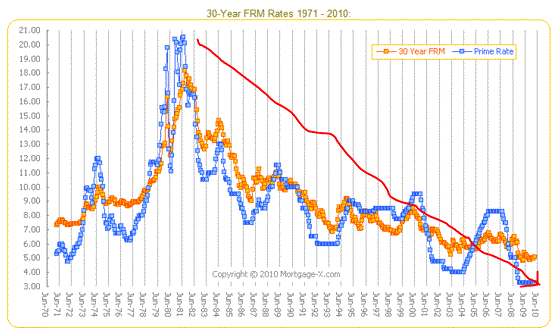
(Hat Tip to mortgage angel for data)
Somebody needs to tell Fed Chairman Bernanke. From his speech this week in Jackson Hole:
Fiscal policy--including stimulus packages, expansions of the social safety net, and the countercyclical spending and tax policies known collectively as automatic stabilizers--also helped to arrest the global decline. Once demand began to stabilize, firms gained sufficient confidence to increase production and slow the rapid liquidation of inventories that they had begun during the contraction. Expansionary fiscal policies and a powerful inventory cycle, helped by a recovery in international trade and improved financial conditions, fueled a significant pickup in growth.
At best, though, fiscal impetus and the inventory cycle can drive recovery only temporarily......
How's that? If not Fiscal Policy, then how can Monetary Policy help at the 0% bound? The only "tools" he has left rely on the "Quantity Theory" of money (increasing the so-called "Money Supply"), and this theory has been laid bare as another economic fraud in recent events that have seen money "measures" increase asymptotically while output, employment and indeed many prices have fallen.
It's over Mr. Chairman, the 30-year "Golden Age of Monetary Policy" that started when a former Fed raised the Policy Rate to 20% and ushered in a 30 year era where the Fed could consistently reduce policy rates over this time is now at the zero bound and has ended. Fiscal Policy is all we've got now...as Mike has said "somebody has got to spend".
The sooner our policy makers realize this the better.
Thursday, August 26, 2010
Bond market: "Reports of my death have been greatly exaggerated"
If you're like me I'm sure you've been hearing a lot of talk about a bond bubble recently. It's everywhere--on TV, in the news, everywhere. You can't go five minutes without somebody talking about how the bond market is in a bubble and how it's going to burst. That's just for starters, because when they tell you it's going to burst they say that when it does it will make the housing and dot-com bubbles look tame by comparison.
Some of these Cassandras have been shouting their warnings for a long, long time. People like Peter Schiff, Jim Rogers and Marc Faber have been telling us that bonds have nowhere to go but down for years. Meanwhile, the bond market has done nothing but go up. I'm absolutely positive that Rogers, Schiff and Faber wouldn't have any money at all if they followed their own advice. That's why they don't. They've cleverly fashioned lucrative businesses for themselves that keep them far away from the dirty and distasteful chore of having to earn money off their own investment ideas. Rather, they earn money the modern American way: through clever marketing, celebrity, advisory fees, book sales and public appearances. Maybe this is a testament to their business savvy, I don't know, but one thing I do know for sure is that it's certainly a sign of their disingenuousness.
Their message has been finely honed: the United States government is borrowing its way into oblivion and pretty soon there won't be anyone around to buy our debt. We ought to get down on our knees and thank God that all those generous Chinese people buy our bonds because without that we'd be another Zimbabwe. The outrageously flawed analogy to Zimbabwe is one of their favorites and they invoke it often and with great flair! Sometimes they'll even display a real, 100 trillion Zimbabwe note and say that it wouldn't even buy you a 2 cent stick of gum. In the next sentence they'll confidently predict that the dollar is headed for the same fate if the U.S. keeps up this "profligate" spending. You have to admire their showmanship; it's just too bad the comparison to Zimbabwe, Wiemar Germany or Argentina is completely ridiculous.
When I hear people say that the U.S. is broke and that we only exist because of the kindness of the Chinese, I have to ask them a very simple question: What exactly is America borrowing? I mean, seriously, what are we borrowing? Let's be specific here! After all, if you want to solve a problem or understand something complicated you sometimes have to break it down.
So, let me repeat...what are we borrowing?
The answer is, if we're borrowing anything at all (and that's debatable), we're borrowing dollars. Not Chinese yuan or Japanese yen or Euros or Beanie Babies. We're borrowing dollars. Even the "Debt/Doomsday" crowd wouldn't disagree on this one.
Once you accept that dollars are being borrowed, not yuan or yen or Euro, then the next question has to be, where did those dollars come from? Yes, maybe some of those dollars came from China, but where did the Chinese get them from? Ultimately there is only one place where anyone can get dollars from and that is the U.S. Government. The United States is a sovereign currency issuing nation and the monopoly issuer of the dollar. Dollars cannot not be gotten anywhere else; if they are, they're counterfeit.
It follows that in order for anyone to have the dollars to lend us the government had to have spent those dollars into existence in the first place or nobody would have them--period! They can't come from any other place. Moreover, the government must spend more of its dollars than it collects in taxes and fees for the non-government (that's me, you, businesses, states and the rest of the world) to have a surplus of dollars to "lend." There's simply no other way.
It should now be obvious that the money that goes into Treasuries--whether that comes from American citizens or foreigners--is not really a loan at all. A bond is nothing more than a savings account that the government offers to people who hold dollars. That's it. And the money to buy bonds comes from government spending itself (more accurately, deficit spending).
I'd like to bring the Fed into the equation at this point because I started out talking about how this is not a bond bubble and I'll need the Fed to help explain this. (Short sellers, pay attention!)
The Fed's main policy tool is the setting of interest rates. The Fed does this by buying or selling government securities. Yes, those very same bonds, notes and bills that the public holds. When the Fed buys securities it credits the reserve accounts of banks. Reserves are added to the banking system and, voila!, the interest rate goes down. If the Fed wants to raise interest rates it does the opposite: it sells securities and that results in the debiting of reserve accounts and rates go higher.
Throughout this economic crisis the Fed has been bringing interest rates down, in fact, it has brought rates down a lot. The Fed funds rate is currently close to zero and it has been there for quite some time. In order to get the funds rate to zero it has had to be a buyer of securities as per my explanation. Moreover, the Fed recently said that it would start to target longer term rates, so it has begun buying bonds. Remember it is buying bonds from the public. I often hear people say that the Fed is buying bonds from the U.S. Treasury so that the government has the money to spend. That is completely wrong. I explained earlier that the government spends by issuing its own money, which gets spent into the private economy and some of it is held by the public in Treasuries.
The Fed will continue to buy until it reaches the rate of interest that it feels is appropriate and it will maintain that buying as needed to keep the rate there.
This is where the short sellers and bond bubbleheads need to pay very close attention.
The Fed's checkbook is unlimited and it will use that checkbook to any degree necessary to implement its policy. That is why talking about a bubble is simply ludicrous. Bonds are up for one reason: because the Fed continues to guide interest rates lower and it is telling us that they're likely to keep them low for an extended period of time. That means, a lot more bond buying. It also means that no matter how many short sellers there are in the Treasury market no one is going to "break" this market if the Fed does not want it to be broken. Moreover, it doesn't matter if China, Japan, the U.K. the Saudis or anyone else never buys a single bond again; it does not hinder the U.S. Government's ability to spend in its own currency.
In the meantime, interest and principle will be paid the same way it has always been paid, which is by crediting bank accounts electronically. Changing the numbers. Marking them up. That's how it's always been done and that's the way it will continue to be done.
In the end the "bubble" will burst when the Fed tells us it is going to reverse its policy. In other words, when it says it's going to start raising interest rates again. In the meantime, if you've been thinking about going short because of all this talk about a bubble, save yourself some money and go have a beer instead.
Wednesday, August 25, 2010
Pay-Go: Dems Consider Cuts to Food Stamp Program to "Pay For" Anti-obesity Project
Hat tip HUFFPO.
Here, in irony, fiscal balances may be transferred to child nutritional consultants, I suppose, instead of low income families including children who may need income support for food.
This would result in the same sort of macro results for the broad economy, as the fiscal deficit would probably remain unchanged, but it would extend the current Obama Admin. policies of favoring the upper income demographic.
Excerpt: "The House will soon consider an $8 billion child nutrition bill that's at the center of the first lady's "Let's Move" initiative. Before leaving for the summer recess, the Senate passed a smaller version of the legislation that is paid for by trimming the Supplemental Nutrition Assistance Program, commonly known as food stamps."Welcome to the surreal world of "pay-go" where the Federal Government constrains itself to find fiscal spending offsets for any new Federal initiatives.
Here, in irony, fiscal balances may be transferred to child nutritional consultants, I suppose, instead of low income families including children who may need income support for food.
This would result in the same sort of macro results for the broad economy, as the fiscal deficit would probably remain unchanged, but it would extend the current Obama Admin. policies of favoring the upper income demographic.
Tuesday, August 24, 2010
Koo Says Maintain Fiscal Stimulus to Avoid Double Dip
Nomura Chief Economist, Richard Koo, has it right!
Governments must maintain fiscal stimulus measures to prevent their economies from sliding back into recession, according to Richard Koo, chief economist at Nomura Research Institute Ltd. in Tokyo. “Political momentum all around the world now is to try and reduce budget deficits,” Koo said in a speech in Johannesburg today at a function hosted by Nedbank Group Ltd. “If you try to reduce budget deficits, we’ll enter the double dip.” “This is no time to cut budget deficits,” said Koo. “This is a different disease -- this is not a normal recession by any stretch of the imagination.” “The market is saying if you have highways or schools to build, do it now.” |
Saturday, August 21, 2010
How do you reduce the national debt and is it desirable?
Let's face it, the only way to lower the national debt is by reducing the non-governmental sector's net financial balance. Why this is desirable I have no idea. Sectoral balances must equate to zero as a matter of accounting. If the gov't runs a deficit of $1 trillion the non-government (domestic plus Rest of World) runs a $1 trillion surplus. It is much more desirable, in my opinion, for the sovereign currency issuer to run a deficit than the private sector. We tried the latter and it didn't work out so well.
Republicans propose tax cuts combined with spending cuts, however, that combination adds no new net financial assets. It merely redistributes income. (You're giving money to some and taking money away from others.) Moreover, taxes do not fund spending under a regime of floating FX/non-convertibility. Taxes merely function to regulate demand.
The idea of raising taxes to "fix" the deficit and/or provide funds for the government to spend ignores the operational realities of the current monetary system where spending is not constrained (only politically, perhaps). Gov't "debt" is an asset of the non-gov't. Reducing gov't debt reduces the non-government's wealth, by definition.
Let's get real about this!
Subscribe to:
Posts (Atom)