Showing posts with label Nate Silver. Show all posts

Sunday, March 16, 2014

Joe Coscarelli — Nate Silver on the Launch of ESPN’s New FiveThirtyEight, Burritos, and Being a Fox

Stats superstar Nate Silver hates the term “data-driven.” He also hates the work of just about every popular columnist at all of the major newspapers, including his former employer, the New York Times. But he loves burritos. On March 17, Silver will deliver his fix — yes, it’s data-driven — for the world of journalism in the form of a new FiveThirtyEight, now owned and operated by ESPN (and its parent company, Disney-ABC). Along with covering his signature topics of sports and politics, Silver’s staff aims to apply an accessible, quantitative approach to economics, science, and the catch-all topic “lifestyle.”....
I hate data-driven as a term — but data journalism takes on a lot of different forms for us. Often, yeah, it does mean numbers and statistics as applied to the news, but it also means data visualization, reporting on data that is both numerate and literate; down the road, it came mean investigative journalism. It can mean building models and forecasts and programs. At the same time, it’s still data journalism. It’s not enough just to be smart. There’s a particular series of methods and a way of looking at the world.

Plenty of pundits have really high IQs, but they don’t have any discipline in how they look at the world, and so it leads to a lot of bullshit, basically....
They don’t permit a lot of complexity in their thinking. They pull threads together from very weak evidence and draw grand conclusions based on them. They’re ironically very predictable from week to week....
It’s people who have very strong ideological priors, is the fancy way to put it, that are governing their thinking....
... we’re not trying to do advocacy here. We’re trying to just do analysis. We’re not trying to sway public opinion on anything except trying to make them more numerate.
Sounds refreshing. I suspect we are going to be hearing a lot more about data-driven analysis.

New York
Nate Silver on the Launch of ESPN’s New FiveThirtyEight, Burritos, and Being a Fox
Joe Coscarelli
(h/t Brad DeLong)

Monday, January 6, 2014

Michael Wolff — Ezra Klein, Glenn Greenwald and the odd rise of personal brand journalism

There is a new vision of journalism – call it the auteur school – in which the business shifts from being organized by institutions to being organized around individual journalists with discrete followings.
The latest development is the announcement by Ezra Klein that he will leave the Washington Post and is looking for investors to back him – with a reported eight figure investment (ie more than $10m!) – in an independent enterprise. Last week Kara Swisher and Walt Mossberg, who ran the Wall Street Journal tech conference AllThingsD, announced that, following the WSJ ending its relationship with them, they were setting up in business backed by NBC and other investors.
 Glenn Greenwald, who broke the NSA-Edward Snowden story for the Guardian, is the headliner in a new left-oriented journalism venture backed by eBay founder Pierre Omidyar.
The former New York Times data wiz-kid, Nate Silver, has left the Times to set up a new site and vertical business under the auspice of ABC and its subsidiary ESPN. Andrew Sullivan, a blogger first at the Atlantic and then at the Daily Beast, may be the grandfather of the auteur school, leaving the Daily Beast a year ago to set up his own subscription site.
In fact, one might as well include here Tina Brown, who used the seemingly attractive economics of the web, along with her personal brand and the backing of Barry Diller, to claim journalistic independence with the Daily Beast – and in the process lost, I am reliably told, an astounding $100m.
And that leads to my cautionary question: is this all journalistic vanity and hubris, ending in certain tears, or is there plausible economic logic to individual journalistic fiefdoms?

Saturday, May 25, 2013

Lars P. Syll — Are economists rational?


Lars quotes über-statistician Nate Silver suggesting NOT! Just when the market was suffering from "irrational exuberance" (Robert Shiller), most economists were "overconfident" even though they were in the favorable position of being able to acquire relevant data and presumably knowing how to use it. Prediction success? Abysmal.

Lars P. Syll's Blog
Are economists rational?
Lars P. Syll | Professor of Social Studies and Associate Professor of Economics, Malmo University


Thursday, December 20, 2012

Cathy O’Neil: Why Nate Silver is Not Just Wrong, but Maliciously Wrong


Ouch. Cathy O'Neil, who blogs as mathbabe, takes Nate to the woodshed for being as out of touch as neoclassical economists with their model-worship.

Naked Capitalism
Cathy O’Neil: Why Nate Silver is Not Just Wrong, but Maliciously Wrong
Cathy O’Neil

Wednesday, November 28, 2012

Nate Silver — In Silicon Valley, Technology Talent Gap Threatens G.O.P. Campaigns


Nate investigates why the president had such an overwhelming tech advantage.
Even without the Bay Area’s vote, Democrats would still be favored to win California by solid margins. So why does any of this matter? 
The reason is that Democrats’ strength in the region is hard to separate out from the growth of its core industry — information technology – and the advantage that having access to the most talented individuals working in the field could provide to Democratic campaigns.
Companies like Google and Apple do not have their own precincts on Election Day. However, it is possible to make some inferences about just how overwhelmingly Democratic employees at these companies are based on fund-raising data. (The Federal Election Commission requires that donors to presidential campaigns disclose their employer when they make a campaign contribution.)
Among employees who work for Google, Mr. Obama raised about $720,000 in itemized contributions this year, against only $25,000 for Mr. Romney. That means that Mr. Obama took almost 97 percent of the money between the two major candidates.
Apple employees gave 91 percent of their dollars to Mr. Obama. At eBay, Mr. Obama took 89 percent of the money from employees.
Over all, among the 10 American-based information technology companies on the Fortune’s list of “most admired companies,” Mr. Obama raised 83 percent of the funds between the two major party candidates.
Mr. Obama’s popularity among the staff at these companies holds even for those which are not headquartered in California. About 81 percent of contributions at Microsoft, which is headquartered in Redmond, Wash., went to Mr. Obama. So did 77 percent of those at I.B.M., which is based in Armonk, N.Y.
It does not require an algorithm to deduce that the sort of employees who might be willing to donate substantial money to a political campaign might also be those who would consider working for it.
The New York Times | FiveThirtyEight
Nate Silver

Monday, January 16, 2012

Romney v. Obama


Nate Silver all but calls it for Romney.

Read it at The New York Times — FiveThirtyEight
National Polls Suggest Romney Is Overwhelming Favorite for G.O.P. Nomination
By Nate Silver

Now the question is who Wall Street will choose as its champion?

UPDATE:

Whoever Wins in November Will Be an Economic Genius
by Keven Drum at Mother Jones
Eventually the American economy will recover no matter how badly we screw things up. Ezra Klein explains what this could mean:
"Because a recovery is likely within five years, whichever party wins the White House in 2012 is likely to get the credit, and so too will its policy agenda. You can see how this will work. If Romney wins the presidency and the economy begins to rebound, Republicans will argue, and America’s experience will seem to show, that they were right all along: The stimulus was useless and the regulatory uncertainty the Obama administration created with its health-care plan and its talk of cap-and-trade and all the rest kept businesses from investing."
The nightmare scenario would be four more years of Reaganonomics heavily influenced by the Tea Party base toward fiscal austerity, privatization, and Rothbardian Libertarianism.

Friday, November 18, 2011

Do economic indicators predict presidential elections?


Nate Silver does an in depth analysis of economic factors wrt presidential elections. The conclusion? Economic indicators are not very good predictors of election results.
The broader point — and one thing this evidence is fairly definitive upon — is that the rate of change is what counts. Americans will give a fair amount of credit to a president in an economy that is still below its full productive capacity provided that it seems to be getting better.

Read the whole post (long and detailed) at The New York Times
Which Economic Indicators Best Predict Presidential Elections?

Monday, June 20, 2011

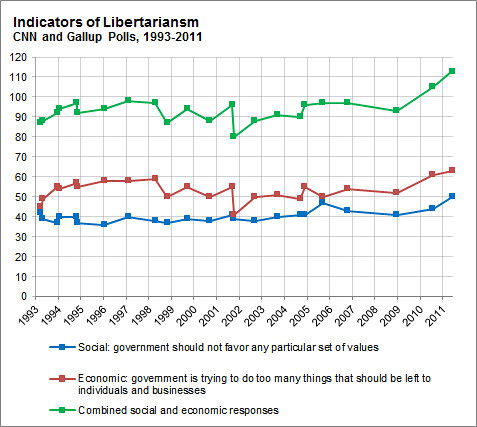
Libertarianism On The Rise

Über-statistician Nate Silver notes that according to recent polling, libertarian views are on the rise, both social libertarian and economic libertarian.

Image

As a libertarian of the left this is welcome news to me. But as someone who understands the basics of MMT, along with the scientifically established fact that human beings are primarily social rather than individualistic, it is not all good news.

It is good news in that the country is moving past the days when culture was largely dictated by mores of the past. On the positive side for all libertarians, that is, of both left and right, this means that broader freedom and fundamental human rights are being recognized to a greater degree. We don't need politicians in our bedrooms, or government in the doctor's office when we visit.

On the negative side for those who understand MMT, the economic data may suggest a failure to comprehend sectoral balances and how government and non-government cannot be in surplus simultaneously. (See Stephanie Kelton, What Happens When the Government Tightens its Belt? and What Happens When the Government Tightens its Belt? (Part II) for the MMT reasoning.)

Ignorance of sectoral balances inevitably leads to policy choices that result in economic contraction and loss of financial independence for many as they are forced to draw down savings, sell assets, or borrow to maintain lifestyle, which is unsustainable. Those in the most precarious postion begin to fall into poverty — the opposite of libertarian values.

Read Nate's post at the New York Times (subscription required, but you can get in with this link)