Showing posts with label free capital flow. Show all posts

Monday, December 9, 2019

Bill Mitchell— Free flows of capital do not increase output but do increase inequality

There was an IMF paper released in April 2018 – The Aggregate and Distributional Effects of Financial Globalization: Evidence from Macro and Sectoral Data – that had a long title but a fairly succinct message. It indicates that the IMF is still in a sort of schizoid process where the evidential base has built up so against the political voice and practice that the IMF has indulged itself as a front-line neoliberal attack dog that elements in its research division are breaking ranks and revealing interesting information. In part, the Brexit debate in Britain has been characterised by economists supporting the Remain argument claiming that free capital flows within Europe (and Britain) are the vehicle for strong output growth and better living standards. They claim that when Britain leaves the EU global capital flows will be more restricted in and out of Britain and that will be damaging. It is really just a rehearsal of the standard mainstream economic claims found in monetary, trade and macroeconomics textbooks. What the IMF paper does is provide what they call a “fresh look at the at the aggregate and distributional effects of policies to liberalize international capital flows” and the researchers find that, “financial globalization … have led on average to limited output gains while contributing to significant increases in inequality”. That is, the pie hasn’t really grown much as a result of all these free trade moves but a growing share is being taken by an increasingly wealthier few. And workers are the losers....
Bill Mitchell – billy blog
Free flows of capital do not increase output but do increase inequality
Bill Mitchell | Professor in Economics and Director of the Centre of Full Employment and Equity (CofFEE), at University of Newcastle, NSW, Australia

Sunday, September 10, 2017

Yilmaz Akyüz — The Asian financial crisis: lessons learned and unlearned

Asian economies are commended for improving their external balances and building self-insurance by accumulating large amounts of reserves. However, whether these would be sufficient to provide adequate protection against a reversal of capital flows is contentious. After the Asian crisis external vulnerability came to be assessed in terms of adequacy of reserves to meet short-term external dollar debt. However, short-term debt is not always the most important source of drain on reserves. Currencies can come under stress if there is a significant foreign presence in domestic markets and the capital account is open for residents. A rapid exit could create significant turbulence even though losses from declines in assets and currencies fall on foreign investors and mitigate the drain of reserves.
In all four Asian countries directly hit by the 1997 crisis, international reserves now meet short-term external dollar debt. But they do not always leave much room to accommodate a sizeable and sustained exit of foreigners from domestic markets and capital flight* by residents.
* "Capital flight" in an environment of free capital flow means selling the domestic currency in the foreign exchange market for a foreign currency and depositing this in foreign financial institutions. This depresses the exchange value of the domestic currency and lowers the price of the domestic assets being sold. In volume ("rushing for the door"), this puts pressure on domestic economies owing to existing commitments. It does not mean taking the domestic currency out of the country.

Oupblog
The Asian financial crisis: lessons learned and unlearned
Yilmaz Akyüz | former Director of Division on Globalization and Development Strategies at UNCTAD, principal author and head of the team preparing the Trade and Development Report, and coordinator of research support to the Group-of-24 in the IMF on International Monetary and Financial Issues

Friday, September 2, 2016

TASS — Russia has no plans to limit movement of capital — Putin

"We have never moved away from the once approved principle to liberalize movement of capital. Even in the most difficult conditions of 2008-2009, I did not limit export of capital", Putin said.
"Such proposals were also voiced last year. We did not do it and we are not going to do it," he added.
TASS
Russia has no plans to limit movement of capital — Putin

Friday, February 5, 2016

C.P. Chandrasekhar and Jayati Ghosh — Capital Bleeds from Emerging Asia

Everyone knows that 2015 was a terrible year for emerging markets – but exactly how bad it was has become clear only recently. Not only was it an annus horribilis in terms of net exports of goods and services, which declined sharply and even turned negative for some previously buoyant exporters, but it was also a time when capital flows reversed course. The downturns in both indicators have been much more widespread and substantial than they were initially expected to be, and even greater than mid-year assessments suggested.…
Naked Capitalism
Capital Bleeds from Emerging Asia
C.P. Chandrasekhar, Professor of Economics, Jawaharlal Nehru University, New Delhi; and Jayati Ghosh, Professor of Economics and Chairperson at the Centre for Economic Studies and Planning, Jawaharlal Nehru University, New Delhi

Friday, December 11, 2015

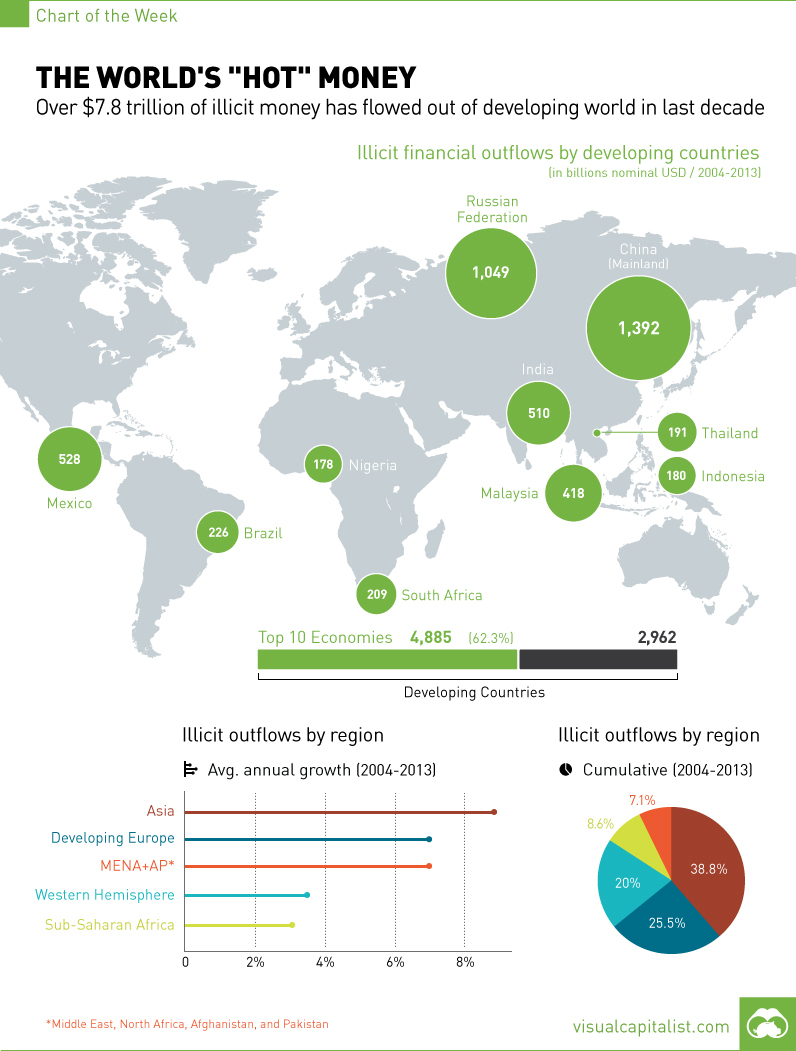
Visual Capitalist — The World’s “Hot” Money [Chart]


How does this “hot” money leave these countries [illegally]? Global Financial Integrity has calculated that 83% of illicit financial flows are due to what it calls “trade misinvoicing”.
Visual Capitalist
The World’s “Hot” Money [Chart]
Jeff Desjardins


Wednesday, October 7, 2015

Bank of England — Minouche Shafik: Fixing the global financial safety net – lessons from central banking

The benefits of free trade are now well established. Similarly, economic theory provides compelling arguments for the potential advantages of integrated global capital markets based on the efficient allocation of resources. But, in practice, cross-border capital flows can be fickle and flighty, with destructive effects on the real economy. It is fair to say that the case for the free movement of capital took something of a knock following the string of crises since the early 1990s in Latin America, East Asia, Russia and most recently in Europe. As a result, a variety of means to insure against sharp changes in capital flows have developed at domestic, regional and international levels which are collectively referred to as the “global financial safety net”.3 The cross border impact of the global financial crisis has forced a fundamental rethink about whether this global financial safety net is functioning as efficiently as it should, and whether more needs to be done to contain the systemic spillovers from sovereign crises.….

Today, given my current role overseeing the Bank of England’s market functions, as well as my previous experience at the IMF dealing with the crisis in the Eurozone and in the wake of the Arab Spring, I would like to offer some thoughts on how lessons from reform to the domestic financial safety net for banks could be applied to sovereigns, to the IMF as international lender of last resort and to the global financial safety net more broadly. I will argue that we need a stronger and more resilient global financial safety net to reduce the systemic implications of sovereign crises and allow nations to cope with shocks in order to reap the economic rewards of an integrated system of trade and finance. I will also argue that the effectiveness of that safety net would be enhanced by implementing policies that strengthen surveillance and the stress testing of countries balance sheets, and better mechanisms for resolving sovereign debt crises when they occur. These are of course my personal thoughts rather than an official UK position, but I offer them in the spirit of encouraging debate.…
Another indication that capitalism gives rise to internal contradictions that only governments have the authority and capacity to address. That economic liberalism results in spontaneous natural order that optimizes distribution of scarce resource most efficiently and effectively as possible is a crock.

Minouche Shafik: Fixing the global financial safety net – lessons from central banking

Speech by Ms Minouche Shafik, Deputy Governor for Markets and Banking of the Bank of England, at the David Hume Institute, Edinburgh, 22 September 2015.

Thursday, May 28, 2015

Yves Smith — The Fed’s Dereliction of Duty and False Capital Flows Morality

On both the military and financial front, America seems to be making things up as it goes along, driven by a toxic mix of bad ideology and domestic priorities. No wonder the rest of the world is so keen to join the Chinese-sponsored Asian Infrastructure Investment Ban. Any means of providing a nexus of power outside the US looks like a step in a better direction.
Shooting yourself in the foot.

Naked Capitalism
The Fed’s Dereliction of Duty and False Capital Flows Morality
Yves Smith

Thursday, April 17, 2014

Joseph Joyce — Capital Liberalization and Inequality

Inequality, which has drawn a great deal of comment and analysis following the publication of Thomas Piketty’s Capital in the Twenty-First Century, has sometimes been seen as a byproduct to increased international trade. But now other international economic linkages are being investigated. The International Monetary Fund’s Managing Director, Christine Lagarde, has acknowledged the need to take distributional consequences into considerationwhen designing IMF policy programs. Moreover, Fund economists have contributed to the research on the linkages between financial globalization and inequality.
Davide Furceri and Prakash Loungani of the IMF have investigated the effect of capital account liberalization on inequality. They looked at 58 episodes of capital account reform in 17 advanced economies, and found that the Gini coefficient (a measure of inequality) increased by about 1% a year after liberalization and by 2% after five years....
Angry Bear
Capital Liberalization and Inequality
Joseph Joyce | Professor of Economics at Wellesley College and the Faculty Director of the Madeleine Korbel Albright Institute for Global Affairs

Monday, April 14, 2014

Joseph P. Joyce — Capital Liberalization and Inequality

Inequality, which has drawn a great deal of comment and analysis following the publication of Thomas Piketty’s Capital in the Twenty-First Century, has sometimes been seen as a byproduct of increased international trade. But now other international economic linkages are being investigated. The International Monetary Fund’s Managing Director, Christine Lagarde, has acknowledged the need to take distributional consequences into considerationwhen designing IMF policy programs. Moreover, Fund economists have contributed to the research on the linkages between financial globalization and inequality.
Davide Furceri and Prakash Loungani of the IMF have investigated the effect of capital account liberalization on inequality. They looked at 58 episodes of capital account reform in 17 advanced economies, and found that the Gini coefficient (a measure of inequality) increased by about 1% a year after liberalization and by 2% after five years. One channel of transmission from the capital account to inequality could be the increased borrowing by domestic firms that allows them to hire skilled workers, who pull ahead of the less-skilled workers....
Neoliberalism is advocacy not only of free markets, but also free trade and free capital flows, where "free" and "liberalization" mean deregulation and privatization.

Economonitor
Capital Liberalization and Inequality
Joseph P. Joyce | Professor of Economics at Wellesley College and the Faculty Director of the Madeleine Korbel Albright Institute for Global Affairs

Wednesday, February 19, 2014

Adair Turner — "In Praise of Capital Market Fragmentation"

Financial liberalization was lauded because it enabled capital to flow to where it would be used most productively, increasing national and global growth.

But empirical support for the benefits of capital-account liberalization is weak. The most successful development stories in economic history – Japan and South Korea – featured significant domestic financial repression and capital controls, which accompanied several decades of rapid growth.

Likewise, most cross-country studies have found no evidence that capital-account liberalization is good for growth. As the economist Jagdish Bhagwati pointed out 16 years ago in his article “The Capital Myth,” there are fundamental differences between trade in widgets and trade in dollars. The case for liberalizing trade in goods and services is strong; the case for complete capital-account liberalization is not.

One reason is that many modern financial flows do not play the useful role in capital allocation that economic theory assumes....
And yet, despite the growing evidence to the contrary, the assumption that all capital flows are beneficial has proved remarkably resilient. That reflects the power not only of vested interests but also of established ideas. Empirical falsification of a prevailing orthodoxy is disturbing. Even economists who find no evidence that capital-account liberalization boosts growth often feel obliged to stress that “further analysis” might at last reveal the benefits that free-market theory suggests must exist.

It is time to stop looking for these non-existent benefits, and to distinguish among different categories of capital flows. Some are valuable, but some are potentially harmful....
In the past, policymakers have been at pains to stress that no such fragmentation will be allowed. But we need to be blunt: Free flows of short-term debt can result in capital misallocation and harmful instability. When it comes to global capital markets, fragmentation can be a good thing.
Social Europe Journal
"In Praise of Capital Market Fragmentation"
Adair Turner


Adair Turner

Monday, February 10, 2014

Dani Rodrik — Death by Finance


That neoliberal "free markets, free trade and free capital flows" theory isn't as advertised. Puncturing  the myths.

Project Syndicate
Death by Finance
Dani Rodrik | Professor of Social Science at the Institute for Advanced Study, Princeton, New Jersey

Friday, January 31, 2014

Yves Smith — Former IMF Chief Economist, Now India’s Central Bank Governor Rajan Takes Shot at Bernanke’s Destabilizing Policies


The consequences of free capital flow as a pillar of neoliberalism.
Narrowly, Rajan is correct, but the underlying problem is much bigger and most orthodox economists are unwilling to confront it because it conflicts with their free markets religion. Carmen Reinhart and Ken Rogoff, in an analysis that got much less attention that their work on debt levels and growth, looked at 800 years of history of crises and found a strong correlation between the level of international capital flows and the frequency and severity of financial crises. That’s implicit in his discussion of the impact of hot money flowing in and out. The Reinhart/Rogoff finding was confirmed by a 2010 paper by Claudio Borio and Piti Disyatat of the BIS that argued that what drives financial crises is not net capital flows (“global imbalances”) but gross capital flows (too much financial “elasticity” as they called it, or what most of us would describe as too much speculation). But Rajan may in fact be referring to remedies like capital controls when he says, basically, that the industrial economies may not like the remedies that emerging economies implement.
Naked Capitalism

Yves Smith 

Wednesday, January 29, 2014

Monday, January 6, 2014

Noah Smith — The Dark Side of Globalization: Why Seattle's 1999 Protesters Were Right

The WTO demonstrators were the "Occupy" movement of the late-20th century—mocked, maligned, and mostly right.
1. loss of labor bargaining power with importation of embedded labor (job loss and wage competition).

2.  importation of unsafe product

3. exportation of negative externalities and reduction of domestic environmental standards to compete

4. negative global effects (climate change)

Noah closes with "U.S. inequality is up since Seattle, but global inequality has declined. The industrialization of China and (to a lesser degree) India has been the biggest and most effective anti-poverty program the world has ever seen. Capitalism has its flaws, but it works." Standard neoliberal bullshit about accepting the consequences of negative externalities as being "worth it" based on quantitative measurement. Stop drinking the Kool-Aid, Noah.

The Atlantic
The Dark Side of Globalization: Why Seattle's 1999 Protesters Were Right
Noah Smith | Assistant Professor of Finance, Stony Brook University

Also recalls Ross Perot's "giant sucking sound" of US jobs leaving when NAFTA was being debated.


Monday, August 20, 2012

Jens Petersen — The Impossible Trinity

The Impossible Trinity

But why does it have to be so complicated? Why bother to establish offshore RMB hubs? Wouldn't it be more feasible simply to remove the capital controls? The answer to these questions can be traced back to what economists have dubbed "The Impossible Trinity". Ideally a country's central bank would like to be able to (1) fix a country's exchange rate, (2) allow a free capital flow, and (3) lead an independent monetary policy. However, in praxis this is hardly possible and the central bank will have to forfeit one of these three items. While countries such as the United Kingdom and United States of America largely have relinquished their exchange rate controls to maintain free movement of capital and an autonomous monetary policy, the Chinese government chose to sacrifice the free cross-border flow of capital to keep a fixed exchange rate and control money supply.
The Impossible Trinity also highlights the connection between China's recent moves to lessen capital controls while expanding the daily trading band of the RMB. China may be at a point where it needs to let capital flow more freely in order to facilitate a more efficient distribution. A prime example in this regard is the country's overheated real estate market, where considerable amounts of Chinese have put their savings due to the lack of alternative investment options. Allowing Chinese companies and individuals to invest more freely abroad could not only help China to deflate some of the domestic asset bubbles, but could also deliver some of the much needed capital for struggling western economies like the ones of Europe.
Furthermore, if Chinese investors and enterprises were less constrained with regards to outbound investments, the People's Bank of China - China's central bank - would be less dependent on buying US treasury bonds and could thereby more easily diversify its holdings into other asset classes. The extra outbound investments would most likely cause the RMB to depreciate against the Dollar. In fact, this process may already have begun, as China's stock of outbound investments continues to increase while its foreign exchange reserves slowly are starting to decline. This development has so far been accompanied by two percent depreciation of the USD/RMB exchange rate since the beginning of May 2012. 
Conclusion
China may have a long way to go before it can claim a truly international currency. Meanwhile, the primary obstacles to convertibility are associated with capital accounts restrictions and lack of access to the Chinese capital markets. The ability to raise capital and hedge risk is consequently restricted.
Caijing.com.cn
Chinese Currency Controls and the Liberalization of the Renminbi
Jens Petersen,China Briefing

Sunday, June 17, 2012

Macrobusiness — Finance and the Mafia State

As I have argued before, it is impossible to deregulate financial markets because money is rules about value and obligation. So what happened instead when financial markets were “deregulated” is that the governments’ role as the setter of rules was handed over to traders, who made up their own rules: more than $700 trillion of derivatives, intense high frequency trading and so on. It results in a weird contradiction: governments trying to save their systems from the new rules being created by the traders, yet the traders relying on the state’s rules about finance to overlay their games of meta money. Meta money traders have to have conventional share trades between buyers and sellers to apply algorithms to manipulate the markets at high speed.

You need conventional commerce in commodities to use derivatives to play commodity futures, for example. It is why governments are constantly attacked by players in the financial markets who are simultaneously hard at work exploiting those “errors” to make money. Meta hypocrisy to accompany the meta money, I suppose.

The tsunami of this meta money, which is borderless, stateless and has no thought for its effect on governments or polities, still relies for its very existence on the rules set up by governments. And as has been obvious since the GFC, governments and tax payers are expected to clean up the mess when it inevitably all goes wrong. That can be done once. When it goes wrong a second time, the firepower will not be there, as is increasingly evident in Europe. The conventional rules will have been weakened too much by the rules invented by the traders of meta money....
The danger is that it is a road to anarchy, no matter how often one quotes Adam Smith and fantasises about the invisible hand. Even Alan Greenspan eventually figured that out: that letting self interest and greed run rampant is not a sure fire route to an altruistic result. Such liberalist logic can be defensible in commercial markets; it is nonsense in finance.
Rather than Bobbit’s market state, the breakdown of rules, the capturing of policy and the utter mess that is confused public and private interests suggests something more redolent of Moises Niam’s “Mafia State”.
It represents a comprehensive failure of government, and will not lead to the creation of a new type of state. It is rather a new type of chaos.
Read it at Macrobusiness
Finance and the Mafia State
Posted by Sell on News in Capitalism
(h/t Yves Smith at Naked Capitalism)