Showing posts with label institutional economics. Show all posts

Wednesday, August 8, 2018

World Economic Forum — Emerging economies are now richer than the West

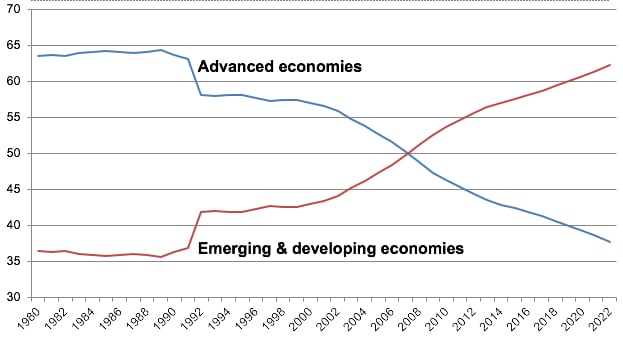
 Emerging and Developing Economies for the First Time Account for a Larger Share of World GDP or Global Output Than Developed Economies; A Point Surpassed After the 2008 Financial Crisis That Has Continued Apace (See Figure 1)....
How has this been achieved? Possessing good institutions is what economists have come to focus on and the spread of such institutions seems to have been key, as the father of New Institutional Economics predicted. The seminal work in this area was by Douglass North who was frustrated by neoclassical economic models that focused on measurable factors like workers and investment, with attempts to measuring technological progress, even though they could not fully explain why some economies grow well and others do not.

So, North took economics out of its comfort zone, which consisted of examining more easily measured inputs like labour and capital, and instead brought in politics, psychology, and strategy, as well as history, in order to understand why some countries succeed and others fail. He stressed that there was no reason why countries could not learn from more successful economies to better their own institutions. That finally happened in the 1990s....
This sort of imitation of good institutions and effective economic policies was as outlined by institutional economists such as Douglass North. It took the fall of the Berlin Wall, the rescue of India by the IMF in 1991 as well as China’s re-orientation towards the global economy in 1992 for these economies to look to adopt a new course. By emulating ‘best practice’ in other economies as well as opening up, which meant learning from more successful foreign companies, these countries have made tremendous progress as North would have expected. He would have approved of these economies looking more widely than just on capital or labour or technology in fashioning their growth policies.

North once remarked: “My pet peeve all through the last twenty years or thirty years has been the narrowness of economists, in fact of all social scientists, in not opening up whole new areas” (North et al. 2015: 9). And his ideas have brought us closer than ever before to answering the age-old question of how countries can become rich.
The take-away from Douglass North's work is not so much that capitalism is the superior system in the sense that conventional economics treats it as that Western approaches to socio-economic and political organization proved superior to other approaches. The issues are more complicated than the simplified models of conventional economics, with their restrictive assumptions that are ideologically based — e.g., maximization and equilibrium. North recognized that broader scope was required.

North adopted a different methodology that includes all factors he found to be relevant rather than seeking formal elegance but sacrificing empirical relevance. North was an institutional economist that specialized in development economics, and he worked in quantitative economic history (cliometrics), as well, which was needed for his empirical research.

World Economic Forum
Emerging economies are now richer than the West
In collaboration with VoxEU

Friday, December 9, 2016

Erik Bähre — Towards a Heterodox and Reflexive Economics

After the 2008 financial crisis, the call for a more heterogeneous approach to studying and teaching economics intensified. But how can heterodoxy take up a more prominent place in economic science? A cultural anthropologist offers three suggestions.
Category of doh. Conventional neoclassically trained economists don't get any of this. Institutional economists do.

The Human Economy
Towards a Heterodox and Reflexive Economics
Erik Bähre | Associate Professor, Institute of Cultural Anthropology and Development Sociology, Leiden University

Saturday, May 14, 2016

Joseph Stiglitz — The New Era Of Monopoly Is Here

For 200 years, there have been two schools of thought about what determines the distribution of income – and how the economy functions. One, emanating from Adam Smith and 19th-century liberal economists, focuses on competitive markets. The other, cognisant of how Smith’s brand of liberalism leads to rapid concentration of wealth and income, takes as its starting point unfettered markets’ tendency toward monopoly. It is important to understand both, because our views about government policies and existing inequalities are shaped by which of the two schools of thought one believes provides a better description of reality.…
Joe goes "there" and mentions the "p" world. Apparently his Nobel is his sword and also his shield. The post is short and incisive.
The implications of this are profound. Many of the assumptions about market economies are based on acceptance of the competitive model, with marginal returns commensurate with social contributions. This view has led to hesitancy about official intervention: If markets are fundamentally efficient and fair, there is little that even the best of governments could do to improve matters. But if markets are based on exploitation [rent extraction], the rationale for laissez-faire [economic liberalism] disappears. Indeed, in that case, the battle against entrenched power is not only a battle for democracy; it is also a battle for efficiency and shared prosperity.


Right on, bro. Power to the people!

The Guardian
The New Era Of Monopoly Is Here
Joseph Stiglitz | Nobel-prizewinning economist, professor at Columbia University, former senior chief economist of the World Bank and chair of the council of economic advisers under Bill Clinton

Thursday, April 21, 2016

David F. Ruccio — Sanders and Veblen


David Ruccio schools Adam Davidson, following Bill Black.

Occasional Links & Commentary
Sanders and Veblen
David F. Ruccio | Professor of Economics, University of Notre Dame

Wednesday, April 20, 2016

William K. Black — How Bernie’s Economic Policies Fit into Economic Theory

The journalist Adam Davidson has written an interesting article about economics and Bernie Sanders. As an economic adviser to Bernie I found his take on Keynesian and institutional economics of considerable interest. Institutional economics, contrary to Davidson’s take on it, is thriving and the University of Missouri at Kansas City has long been a center of institutional economics. (I am one of the scholars at UMKC that works largely in this field.) Davidson treats institutional economics, which overwhelmingly studies microeconomics and the “micro foundations” of the economy as having been rendered obsolete by the transformation that Keynes’ insights sparked in the study of macroeconomics.…
Davidson’s thesis is unsupportable as a matter of logic, history, and macroeconomic theory.…
Bill hits another one out of the park.

New Economic Perspectives
How Bernie’s Economic Policies Fit into Economic Theory
William K. Black | Associate Professor of Economics and Law, UMKC

Monday, December 28, 2015

Matt Bruenig — Distributive Institutions Are to Blame for Income Inequality, Not Power Couples

The distribution of income in society is a function of two things: distributive institutions and everything else. By distributive institutions, I am referring mainly to the laws that pertain to the distribution of resources in a society. Distributive institutions include such things as bankruptcy law, corporate law, securities law, property law, contract law, tax law, benefits law, and so on. Put another way, distributive institutions are the distribution-specific subset of the "rules of the game" that structure economic activity in society.….
The fact that distributive institutions are not a suprahistorical constant should be an obvious point. But it's a point that is constantly missed, especially in the poverty realm where I spend most of my time. In the poverty realm, most of the respectable discussion is about how to change "everything else" so that it delivers lower poverty within our existing set of distributive institutions. Little attention is paid to the fact that the national income of the US is so high that even slight changes in our distributive institutions could bring sweeping anti-poverty gains. In fact, anti-poverty efforts that focus on the country's distributive institutions are almost absent from mainstream poverty discourse. Even poverty experts who know better often exclude distributive reform because it is "against American values" (which is to say too counterhegemonic to happen in the short term). 
The inattention to distributive institutions in inequality analysis is a critical mistake. If you want to create and, more importantly for the present point, maintain an egalitarian society, you must be prepared to reform distributive institutions fairly regularly. This is because "everything else" in society is dynamic: technologies change, demographics change, ways of living and relating to one another change. Some changes will improve distributive fairness within the existing distributive institutions while others will threaten it. Where a change threatens distributive fairness, institutional reform must meet the threat. 
For libertarian types that think altering distributive institutions is tantamount to violent theft, the prospect of repeatedly tinkering with them may be a bleak one. But for everyone else, this kind of tinkering should be welcomed as a great facilitator of personal freedom and dynamism.…
PolicyShop: The Demos Blog
Distributive Institutions Are to Blame for Income Inequality, Not Power Couples
Matt Bruenig

Friday, April 18, 2014

Randy Wray — The Reality of the Present and the Challenge of the Future: Fagg Foster for the 21st Century

Here is a presentation that I’ll give today at the University of Denver at the annual J. Fagg Foster honors ceremony. Most of you will not know of Foster, but you should. While he did not publish much, he was the professor of a number of prominent institutionalists who attended DU in the early postwar period. I was lucky to have studied with his student, Marc Tool, and was introduced to Foster’s work at the very beginning of my studies of economics. My presentation below is based on two of Foster’s articles: J. Fagg Foster (1981) “Understandings and Misunderstandings of Keynesian Economics”, JEI, vol XV, No 4, p. 949-957.; and (1981) “The Reality of the Present and the Challenge of the Future”, JEI vol XV, No 4, p. 963-968. Both are from 1966, republished in a special issue of the Journal of Economic Issues, 1981. You should read them.
Economonitor — Great Leap Forward
The Reality of the Present and the Challenge of the Future: Fagg Foster for the 21st Century
L. Randall Wray | Professor of Economics, University of Missouri at Kansas City

Sunday, November 3, 2013

Daniel Little — Thorstein Veblen's critique of the American system of business

Thorstein Veblen was certainly a heterodox observer of modern capitalism. He was trained in the late nineteenth-century iteration of neoclassical economics, but he was more impressed by the irrationality of what he observed than the optimizing rationality that is postulated by the neoclassicals. He was also an intelligent observer and analyst of contemporary economic and sociological trends — not in theory but in the concrete forms that turn-of-the-century capitalism was taking in the United States and Europe. It is interesting, therefore, to examine his analysis of the business firm in The Theory of Business Enterprise, published in 1904. (I examined his critique of American universities in The Higher Learning in America in an earlierpost.) ...
Veblen is sometimes credited with being one of the originators of institutional economics. This is due, in large part, to his effort to discover some of the institutional dynamics created for the modern industrial system by the incentives and constraints created for the owners and managers of firms.
Understanding Society
Thorstein Veblen's critique of the American system of business
Daniel Little | Chancellor, University of Michigan at Dearborn

Sunday, July 28, 2013

Peter Radford — Simple model mania

...The point being that the obsession to reduce everything to simple ideas that can be put into simple models, condemns economics to misunderstand, and therefore not explain, reality. People are far too nuanced and unpredictable to be shoved completely into either PIH or RIH. They bounce about. The truth is that there are likely plenty more explanations as well. Perhaps there are twenty hypotheses each explaining a little bit. But, since that makes modeling complicated, economists stay well away from reality.
BTW, this is an underlying message of Ludwig Wittgenstein's investigation of the logic of ordinary language in his later work. Thinkers typically go awry in over-generalizing. This is the informal fallacy of hasty generalization, and it includes composition fallacies as well.

Economics is particularly susceptible of fallacies of composition in the chief methodological assumption of liberal economics is a representative individual acting in the vacuum of rational free choice, "rational" being defined as pursuit of maximum utility in making choices, presumed to be fully informed, and "free" meaning independent of external influences such as culture, institutions, affiliations, and personal relationships. The problem with this is that homo economicus is not homo sapiens sapientis, but rather an methodological and ideological construct that is non-representational in spite being asserted to be representative. Examining the logic of conventional economics, it cannot be correct.

Real-World Economics Review Blog
Peter Radford

Friday, April 5, 2013

Lord Keynes — Hodgson on the Essence of Old Institutional Economics


Short summary of institutional economics.

Social Democracy for the 21st Century
Hodgson on the Essence of Old Institutional Economics
Lord Keynes

UMKC Department of Economics is traditionally institutionalist.
This is a summary of the approach to institutional economics at the University of Missouri-Kansas City [UMKC]. It includes a brief historical background of the economics department, the scope (syllabi) of the material covered, and sketches of models used to explain the theory and methods in the approach. Taken together the papers in this session and the following one result from the institutional economics workshop at UMKC and seek to cover significant areas included in our approach.
Explorations in Institutional Economics: The Kansas City Approach
James I. Sturgeon | University of Missouri-Kansas City

Wednesday, April 3, 2013

Lord Keynes — Hodgson on Methodological Individualism

The “broad” version of methodological individualism simply reduces to the “proposition that explanations of social phenomena should be in terms of both individuals and social structures” (Hodgson 2007: 223). Such an approach does not even deserve the label “methodological individualism,” since it has obviously abandoned the very essence of such a method.
And it is most curious indeed to read in theHandbook on Contemporary Austrian Economics(2010) that (supposedly) Austrian economics can now have a clarified version of methodological individualism that “allows for the causal role of social customs” (Evans 2010: 9) and that recognises that “social phenomena are not strictly reducible to [sc. individuals]” (Evans 2010: 11). At one point this method seems to get the name “institutional individualism” (Evans 2010: 11). If so, this is just an admission that the strict “methodological individualist” approach is now so broad that the question is raised why it should have that name at all.
Social Democracy for the 21st Century
Hodgson on Methodological Individualism
Lord Keynes

This is really key for understanding fundamental differences between, on one hand, Austrian and neoclassical economics, and on the other, Marxism, Old Keynesianism, Post Keynesianism, and MMT, all of which are institutionalist.

The view of Austrian and neoclassical economics is that economics is chiefly concerned with individual agents acting rationally in pursuit of utility through individual choice through market exchange that reveals changing preferences, thereby sending signals to producers wrt price and quantity in accordance with the "law" of supply and demand.

The view of the heterodox economists that are institutionalists is that individual behavior in society and therefore in an economy takes place not only through rational choice based on subjective utility, that is, preferences and indifference level, but also through a complex web of social rules and rule-following, where these rules are embedded in cultural rituals and codified in institutional arrangements and rule following strongly influences behavior.

Most individuals have little if anything say in the construction of rules, even though they are constrained by the obligation, need, or persuasion to follow them. The result is a web of social relationships that affect virtually all aspects of individual life from the meso level of societal subsystems or macro level of the society as a whole — a complex adaptable system capable of emergence, which is comprised of individuals and subsystems arranged in relationships that are characterized by rules and rule-following with consequences for rule breaking. As opposed to methodological individualism, this might be better characterized as methodological holism.

Methodological holism is different from ontological holism. A human being is an ontological whole that we model as an organsim comprised of subsystems — organs — and individual cells in precise relationships. But there is no such "thing" as society. What we call "society" is what we assume is described by the complex adaptive system that we construct as a conceptual model. However, there is no entity corresponding to society. Society can be modeled as an organism, for example, but society is not an organism. The idea that society is a thing would be ontological holism, but I am unaware of anyone in the life or social sciences that holds this position.

Thursday, March 21, 2013

Galbraith on the Great Depression and the 'Great Recession'

A new interview with Jamie Galbraith (and also Leo Panitch), on the possibilities of a New 'New Deal' (part II here). Not much of chance, by the way. Part of the story is that the New Deal was fundamental in institution building, and these very institutions saved us from a crisis similar to the Depression, creating less of a perceived need for continuous reform.
Naked Keynesianism
Galbraith on the Great Depression and the 'Great Recession'
Matias Vernengo | Associate Professor of Economics, University of Utah

Monday, January 28, 2013

Chris Dillow — Socialism, Institutions & Human Nature

The question, therefore, for socialists and everyone else is: through what mechanisms and institutions is behaviour shaped? Could socialistic institutions generate more good behaviour and less bad than capitalistic ones? There are (at least) three reasons to think so:
Stumbling and Mumbling
Socialism, Institutions & Human Nature
Chris Dillow | Investors Chronicle (UK)


Tuesday, October 16, 2012

Michael Stephens — The Missing Wall Street Debate

This issue of complexity isn’t just a challenge for the press. It’s also a public policy problem. Jan Kregel argues that the more recent JPMorgan and LIBOR scandals demonstrate that the financial conglomerates involved are “too big to manage” and too big to regulate effectively. This isn’t a fact of nature. This is the financial system we have built. Whether we’re able to make informed public choices about the future of financial regulation is also bound up with the question of whether we will have a financial system whose operations can be readily supervised and understood.
Multiplier Effect
The Missing Wall Street Debate
Michael Stephens

Friday, August 3, 2012

Geoffrey M. Hodgson — Logic Freaks: Modern economics is sick

Economics has increasingly become an intellectual game played for its own sake and not for its practical consequences for understanding the economic world. Economists have converted the subject into a sort of social mathematics in which analytical rigour is everything and practical relevance is nothing.
Read it at Adbusters
Logic Freaks: Modern economics is sick
Geoffrey M. Hodgson | Editor-in-Chief of the Journal of Institutional Economics
(h/t Kevin Fathi via email)

Sunday, June 17, 2012

Macrobusiness — Finance and the Mafia State

As I have argued before, it is impossible to deregulate financial markets because money is rules about value and obligation. So what happened instead when financial markets were “deregulated” is that the governments’ role as the setter of rules was handed over to traders, who made up their own rules: more than $700 trillion of derivatives, intense high frequency trading and so on. It results in a weird contradiction: governments trying to save their systems from the new rules being created by the traders, yet the traders relying on the state’s rules about finance to overlay their games of meta money. Meta money traders have to have conventional share trades between buyers and sellers to apply algorithms to manipulate the markets at high speed.

You need conventional commerce in commodities to use derivatives to play commodity futures, for example. It is why governments are constantly attacked by players in the financial markets who are simultaneously hard at work exploiting those “errors” to make money. Meta hypocrisy to accompany the meta money, I suppose.

The tsunami of this meta money, which is borderless, stateless and has no thought for its effect on governments or polities, still relies for its very existence on the rules set up by governments. And as has been obvious since the GFC, governments and tax payers are expected to clean up the mess when it inevitably all goes wrong. That can be done once. When it goes wrong a second time, the firepower will not be there, as is increasingly evident in Europe. The conventional rules will have been weakened too much by the rules invented by the traders of meta money....
The danger is that it is a road to anarchy, no matter how often one quotes Adam Smith and fantasises about the invisible hand. Even Alan Greenspan eventually figured that out: that letting self interest and greed run rampant is not a sure fire route to an altruistic result. Such liberalist logic can be defensible in commercial markets; it is nonsense in finance.
Rather than Bobbit’s market state, the breakdown of rules, the capturing of policy and the utter mess that is confused public and private interests suggests something more redolent of Moises Niam’s “Mafia State”.
It represents a comprehensive failure of government, and will not lead to the creation of a new type of state. It is rather a new type of chaos.
Read it at Macrobusiness
Finance and the Mafia State
Posted by Sell on News in Capitalism
(h/t Yves Smith at Naked Capitalism)

Tuesday, June 12, 2012

Cullen Roche — Tear Up Your Paper Money?


Cullen observes that the problem in the EZ is essentially institutional. Put most simply, it is the defects in institutional design of the currency union that are now undermining trust in the currency.

Read it at Pragmatic Capitalism
Tear Up Your Paper Money?
by Cullen Roche

The question now is what it will take to correct the institutional arrangements, as well as which of the proposed ways are politically practical and sustainable over the long run. The alternative is either abandoning the institution, which would mean abandoning the euro as the common currency, or else addressing the asymmetry at the foundational level by limiting the membership to nations that are economically symmetrical. This would involve some countries leaving the euro, at least temporarily. But one something is taken apart, it can be difficult getting it back together.

On the other hand, I think that we have to be wary of imputing too much weaken to the euro due to lack of trust in the currency at this point. The capital flight in the EZ doesn't seem to be chiefly out of the EZ (yet), but rather a great deal of it is occurring within the EZ, as funds flow from the periphery to the core, especially into German governments and German banks, exacerbating the asymmetry.

Wednesday, May 9, 2012

Does innovation precede institutions or vice versa?

In other words, the existing evidence, in contrast to what is presumed in Diamond’s argument and the conventional wisdom, is that institutional innovation did not follow transition to agriculture, but preceded it. In fact, it was this institutional innovation which allowed the technological changes at the heart of the Neolithic Revolution. 
So most likely, the Neolithic Revolution is also not about geography but all about institutions.
Read it at Why Nations Fail
What Really Happened During the Neolithic Revolution?
by Daron Acemoglu and James Robinson

Friday, January 20, 2012

A lesson in institutionalism


Read it at BBC News

Meghalaya, India: Where women rule, and men are suffragettes
By Timothy Allen

Don't think that cultural institutions are determinative? Think again.

Institutional arrangements are determined by rules, and those rules are norms that regulate life and set boundaries, ruling somethings in and other things out.

Thursday, January 19, 2012