Showing posts with label American history. Show all posts

Thursday, November 14, 2019

The Birth of the Deep State: A History — Peter C. Earle

This is an excellent backgrounder.
But where did the American deep state come from? Has it always been there?In fact, the evolution of the deep state (and this choice of term, “evolution” as opposed to “creation”, will be explained later) is — some might say ironically — found in a nearly 140-year old anti-corruption “reform” measure; one that was explicitly focused upon depoliticizing the civilian component of the United States government....
The architects of the reform also failed to recognize that individuals who are hired are no less likely to have political inclinations than those awarded the same position out of sheer patronage. And where those who held positions in the spoils system were washed out of office in four years, a corps of (essentially) permanent bureaucrats facing the prospect of pensions and positions of greater influence amid zero public accountability are likely to be outwardly demure while no less political than their forebears.
The tremendous edifice that is the US civil bureaucracy — currently numbering somewhere around 2.85 million individuals — is, like any other huge organization, subject to both imposed and emergent orders. There are explicitly assigned executives and managers, labyrinthine organizational charts, job descriptions, pay grades, areas of responsibility, manuals of every sort, and every other standardization that informs (and hinders) the modern workplace.
But as the size of the bureaucracy has swelled it has also acquired a dissociated but consistent “consciousness”: a spontaneously-ordered, unstructured but undoubtedly focused and effective mechanism. Its major functions are to thwart political measures it collectively deems unpalatable, and to vigilantly protect the existence of the greater body within which it thrives.
No orders are issued, and there is no chain of command. It communicates by example: leaks reported in the news beget more leaks, anonymous tips spawn a rash of new tipsters. No lofty conspiracy theories are necessary; a massive army of bureaucrats in an era of free/highly affordable burner phones, file sharing services, and document scanning apps are more than sufficient to gum up the wheels of executive action.
There are no secret codes, no dead drops, and no shadowy agents meeting in parking garages in the dead of night: perhaps more dauntingly, the deep state coalesces from among a seemingly incalculable number of nondescript men and women with families and homes in the Virginia and Maryland suburbs of Washington D.C. It receives a salary every two weeks, drawn upon the United States Treasury. Its atomic elements — individuals — coach Little League, go to Zumba classes, and generally have mainstream opinions. Many, no doubt, dismiss the very notion of a deep state. Even when they send an anonymous email, shred a document intended for other eyes, or impishly pass a tip to someone with a second- or third-hand relationship in the media, most of them probably see the deep state as something larger, above and beyond themselves.
Yet they are the deep state.
The "deep state" is a combination of the intelligence services and the bureaucracy, which was famous as the siloviki and nomenklatura in the USSR, with roots in Tsarist Russia and which persists under the Putin administration. These people have affiliations, some of which are political (party) and economic (program patronage). And everyone has an ideology that shapes the worldview that they take to be reality.

In present day Russia, following the Yeltsin years and neoliberal shock therapy under the direction of US advisors, the oligarchs emerged from "cowboy capitalism," who Putin has been able only to modest bridle. They have an analog in the US in the 0.01% that provide the bulk of political contributions to federal and state politicians. The result is a group of people that live in a different world from the rest and enjoy a double standard of justice, allowing them great freedom to act.

Conspiracy is not the driving force behind the deep state but rather interest and protecting investment. There is no conscious conspiracy behind the deep state, although individuals may conspire in some instances. Moreover, owing to different interests and affiliation, there are different factions vying for place and power.

In short, the so-called deep state is not some aberration but rather one of the outcomes of political institutionalization in liberal democracies, similar to the palace court in imperial times, along with the upper echelon of the different centers of power — intelligence, military, etc.

This doesn't mean that the deep state is not real ("oh, it's just bureaucracy) or that the deep state is a conspiracy theory, as often charged or spun in the conventional narrative. The existence of the deep state makes a difference and that difference can be detected and described....
A bigger question is whether the deep state is, even as an unintended consequence of the Pendleton Act, a “feature” or a “bug”. Do unelected government employees play a critical role in restoring equilibrium even in a nominal democracy, or do they represent an insidious, potentially worrisome repository of accidental power?...
For a very long time, Americans have had the odd feeling that elections don’t matter nearly as much as the media hoopla surrounding them would imply. It’s true, and one reason why has everything to do with fundamental changes in the way we hire and fire within the federal bureaucracy. The emergence of the deep state is by design a buffer on democracy itself, with the cost of a less adaptable regime and growing public cynicism concerning who really is in charge.
Peter C. Earle, MA in Applied Economics from American University, an MBA (Finance), and a BS in Engineering from the United States Military Academy at West Point

Wednesday, November 13, 2019

American Revolution vs. Chinese Revolution — Frank Li

What is the key difference between the U.S. and China?
They were born differently, almost totally opposite to each other! The U.S. was founded by/of/for the rich, whereas the PRC (People's Republic of China) was founded by/of/for the poor. In other words, the American Revolution was a bourgeois revolution, whereas the Chinese Communist Revolution was a proletarian revolution. Let me explain ...
Exactly. As I have been saying, the US was founded on bourgeois (Lockean) liberalism in the Western sense of favoring owners of property of European (white) descent. The People's Republic of China was founded on Marxist-Leninist socialism "with Chinese characteristics." These views are fundamentally incompatible, just as East and West are fundamentally incompatible based on historical path-dependence.

The differences are civilizational — Western civilization, Chinese civilization, Indian civilization, Islamic civilization, Russky Mir, etc. In the West especially, this is further differentiate by nationalism. Much of the world is further divided by remnants of tribalism or actual tribalism.

One of the difficulties for Westerners is the fundamental assumption of a universal human nature, which Westerners identify with their own cognitive biases. While all may be identical as persons, e.g, equality of persons before the law, which is the basis of Western liberalism, all are unique as individuals and individuals are shaped by association and affiliation.

I don't always agree with Frank Li's position but his view is always interesting as a Chinese ex-pat that made it in the US and is now trying to bridge the systems by showing strengths and weaknesses.

econintesect.com
American Revolution vs. Chinese Revolution
Frank Li | Chinese ex-pat, Founder and President of W.E.I. (West-East International), a Chicago-based import & export company, B.E. from Zhejiang University (China) in 1982, M.E. from the University of Tokyo in 1985, and Ph.D. from Vanderbilt University in 1988, all in Electrical Engineering

Wednesday, January 2, 2019

Adrian Kuzminski — Understanding Populism

American populists are largely reactive and somewhat confused. They don’t know what hit them. And they don’t know their own, often forgotten, history. Nineteenth-century American populists were not socialists, but small-scale capitalists. They were farmers, artisans, and professionals. Private enterprise was central to their values, and they wanted to preserve it for ordinary citizens like themselves. The ideal was to own your own business, not to work for a corporation. Populists fought to keep private enterprise widely distributed among many small, independent producers, as it still was in their day, and to resist the emergence of dominating monopolies which threatened their economic security....

To remedy this sad state of affairs, the populists demanded the conversion of key infrastructural sectors into public utilities repurposed to facilitate rather than exploit small producers. Railroads, they argued, should be run on a regulated, non-profit basis to ensure low-cost access to markets by their customers. Similarly, banks should be run on a non-profit basis as to ensure low-cost credit to borrowers. Populists also called for the federal government to directly issue currency to pay for its expenses (instead of borrowing to do so).
The basic idea was to turn enterprises with too much monopoly power into accountable public utilities, but otherwise to allow the free market to run its course. The aim was to save free enterprise. If many independent producers have to use the same infrastructure (like railroads or the internet), or rely on a common provider of essential products or services (like energy companies or banks), those businesses, populists said, ought to be transformed into public utilities under public control....
Counterpunch
Understanding Populism
Adrian Kuzminski

Tuesday, December 4, 2018

Ken Orphan — Hard Truths and the ‘Indispensable Nation’


Puncturing the balloon of "American exceptionalism" and "the noble American." Or, let's get some perspective here. Life is not black and white, but gray — or "grey" if you live in one of the English-speaking countries other than America.

Consortium News
Hard Truths and the ‘Indispensable Nation’
Ken Orphan

Consortium News
Just How Corrupt is the American Soul?
Lawrence Davidson

Tuesday, July 24, 2018

David Masciotra — The American Conservative


Unusual to find praise for a radical "Ivy League" leftist in The American Conservative, but here it is.

In Defense of Howard Zinn David Masciotra

Friday, July 6, 2018

Brad DeLong — Abigail Adams (1776): "I long to hear that you have declared an independency...


Abigail Adams quote.

From Wikipedia:
Abigail Adams (née Smith; November 22, [O.S. November 11] 1744 – October 28, 1818) was the closest advisor and wife of John Adams, as well as the mother of John Quincy Adams. She is sometimes considered to have been a Founder of the United States,[1] and is now designated as the first Second Lady and second First Lady of the United States, although these titles were not used at the time.
Adams's life is one of the most documented of the First Ladies: she is remembered for the many letters she wrote to her husband while he stayed in Philadelphia, Pennsylvania, during the Continental Congresses. John frequently sought the advice of Abigail on many matters, and their letters are filled with intellectual discussions on government and politics....
Grasping Reality
Abigail Adams (1776): "I long to hear that you have declared an independency...Brad DeLong | Professor of Economics, UCAL Berkeley

Wednesday, December 13, 2017

Gabriel Rockhill — The U.S. is Not a Democracy, It Never Was


American history.
The Establishment and its propagandists regularly insist that a structural aristocracy is a “democracy” because the latter is defined by the guarantee of certain fundamental rights (legal definition) and the holding of regular elections (procedural definition). This is, of course, a purely formal, abstract and largely negative understanding of democracy, which says nothing whatsoever about people having real, sustained power over the governing of their lives.…
“Multivariate analysis indicates,” according to an important recent study by Martin Gilens and Benjamin I. Page, “that economic elites and organized groups representing business interests have substantial independent impacts on U.S. government policy, while average citizens and mass-based interest groups have little or no independent influence. The results provide substantial support for theories of Economic-Elite Domination […], but not for theories of Majoritarian Electoral Democracy.”…
Indeed, if the United States is not a democracy today, it is in large part due to the fact that it never was one. Far from being a pessimistic conclusion, however, it is precisely by cracking open the hard shell of ideological encasement that we can tap into the radical forces that have been suppressed by it. These forces—not those that have been deployed to destroy them—should be the ultimate source of our pride in the power of the people.
In his rousing Gettysburg Address at the time of the Civil War, Abraham Lincoln defined "democracy" as "government of the people, by the people and for the people." The definition is correct, but Lincoln misapplied it to the United States at the time, and that remains true today. In fact, the class hierarchy is more entrenched now than ever as shown by rising inequality of income and wealth, and the asymmetry of power.

Counterpunch
The U.S. is Not a Democracy, It Never Was
Gabriel Rockhill, Franco-American philosopher and cultural critic (public intellectual), Associate Professor of Philosophy at Villanova University, and founding Director of the Atelier de Théorie Critique at the Sorbonne

Friday, April 22, 2016

So what else is new?

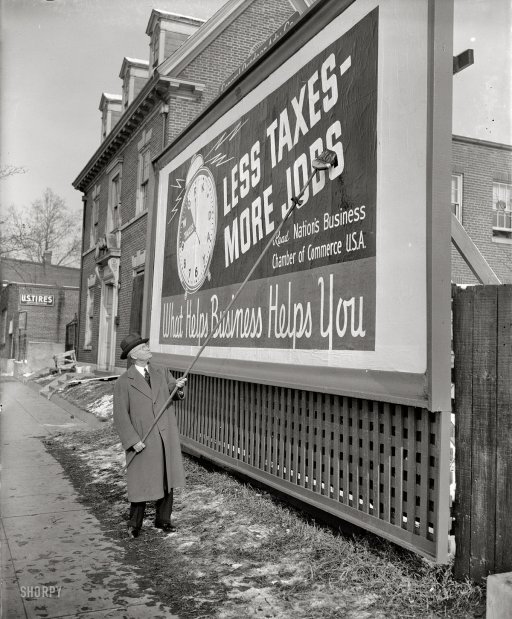
Harris&Ewing Less taxes, more jobs, US Chamber of Commerce campaign 1939

ht Raúl Ilargi Meijer atThe Automatic Earth


Tuesday, April 5, 2016

Ambassador Chas W. Freeman, Jr. — Killing the US Republic — and Empire


Excellent analysis by an old hand.

Consortium News
Killing the US Republic — and Empire
Ambassador Chas W. Freeman, Jr. (USFS, Ret.) | senior fellow at the Watson Institute for International and Public Affairs


Wednesday, June 10, 2015

Kevin Kruse — How Big Business Invented the Theology of 'Christian Libertarianism' and the Gospel of Free Markets


Lesson in American history.
In a 1939 address to the US Chamber of Commerce, H.W. Prentis of the Armstrong Cork Company proposed the way forward. “Economic facts are important, but they will never check the virus of collectivism,” he warned; “the only antidote is a revival of American patriotism and religious faith.” Prentis’ speech thrilled the Chamber and boardrooms across America. Soon propelled to NAM’s presidency, he continued to tell corporate leaders to get religion. His 1940 presidential address, promoted heavily in the Wall Street Journal and broadcast live on both ABC and CBS radio, promised that business’s salvation lay in “a strengthening of the spiritual concept that underlies our American way of life.”
Accordingly, corporate America began marketing a new fusion of faith, freedom and free enterprise. These values had been conflated before, of course, but in the early 1940s they manifested in a decidedly new form. Previously, when Americans thought about the relationship between religion, politics and business, they gave little thought to the role of the national state, largely because it was so small it gave little thought to any of them. But now that the federal government had grown so significantly, corporate leaders sought to convince Americans that the New Deal threatened not only the economic freedoms of business leaders, but the religious and political freedoms of ordinary citizens as well. They worked tirelessly throughout the 1940s and 1950s to advance a new ideology that one observer aptly anointed “Christian libertarianism.”
Initially, businessmen outsourced this campaign to an unlikely set of champions: ministers. Though this decision seemed unorthodox, the logic was laid out clearly in private. “Recent polls indicate that America’s clergymen are a powerful influence in determining the thinking and acting of the people in the economic realm,” noted one organizer, and so business leaders should “enlist large numbers of clergymen” to “act as minutemen, carrying the message upon all proper occasions throughout their several communities.”....
With this generous funding, ministers in these organizations spread the arguments of Christian libertarianism. “I hold,” Reverend Fifield asserted, “that the blessings of capitalism come from God. A system that provides so much for the common good and happiness must flourish under the favor of the Almighty.” But concern for the “common good” was uncommon in their arguments, which tended instead to emphasize the values of individualism. In their telling, Christianity and capitalism were indistinguishable on this issue: both systems rested on the fundamental belief that an individual would rise or fall on his or her own merit alone. Just as the saintly ascended to Heaven and sinners fell to Hell, the worthy rose to riches while the wretched were resigned to the poorhouse.
Any political system that meddled with this divinely prescribed order of things was nothing less than a “pagan” abomination. Indeed, they argued, the welfare state stood in direct opposition to the Ten Commandments. “We emphasize the interdependence of freedom and Christianity,” the Christian Freedom Foundation announced in its founding statement. “When the First Commandment ‘Thou shalt have no other Gods before me’ is violated and the state is exalted to take the place of God as the highest authority over the actions of man, freedom is suppressed. Conversely, Christianity can thrive only where human beings live under a system of free institutions and government by the people.” The welfare state, a CFF member argued elsewhere, violated the eighth and tenth commandments by encouraging the poor to covet what the wealthy had and “forcibly taking the wealth of the more enterprising citizens for distribution to others.” And because it spread scurrilous rumors about the rich and made extravagant promises to the poor that it could never deliver, the New Deal violated the ninth commandment’s injunction against bearing false witness, too....
AlterNet
How Big Business Invented the Theology of 'Christian Libertarianism' and the Gospel of Free Markets
Kevin Kruse, Alternet

Monday, January 6, 2014

Paul Rosenberg — From Nixon to Paul Ryan: How right-wing radicals deceive America

By shifting the spectrum of debate, here's how America's rightward march has been normalized throughout history
From Nixon to Reagan to Gingrich to Bush to Paul Ryan and Chris Christie today, leaders who’ve shifted America to the right have been aided by moderating misrepresentations. In the case of Reagan, it was not just the man, but conservatism itself that received the flattering reinterpretation. That was a difference that mattered; it goes to the heart of why Reagan is the American right’s touchstone. But the more general process of misrepresenting and reinterpreting increasingly radical ideological figures as if they were normal, everyday pragmatic problem-solvers is one that’s been a repeated leitmotif in America’s political trajectory since Richard Nixon’s political resurrection in 1968.
As Elias Isquith wrote here after Christie’s reelection, Christie is not the next great moderate hope, he’s just very good at executing what Blake Zeff identified as the GOP’s blue-state playbook, breaking with red-state conservative orthodoxy on a few secondary issues. But it takes more than a column or two to expose the emperor’s new clothes. For the moment, George Washington Bridgegate notwithstanding, Christie remains the GOP’s best hope of winning the White House in 2016, largely because he’s so good at the game that Isquith pointed out, orchestrating his own misrepresentation as a mainstream political figure. What’s more, battling against 2016 GOP rivals will only make it more difficult and more important to see beyond the illusions to what Christie is actually doing. That’s why is helps to look backward to similar figures in the past, and how they managed to so successfully deceive. And it’s not just Christie. Paul Ryan’s role in shaping GOP budget politics — and all the attendant economic fantasizing — provides another key reason why we need a far better grasp of the process of normalizing reactionary radicalism.