These early humans were using tar to make tools long before Homo sapiens did.
Beginning of technology.
These early humans were using tar to make tools long before Homo sapiens did.
Anthropologist Peter Turchin's "Ages of Discord" provides a crucial decoder ring for Trump-era social strife.
“The American polity today has a lot in common with the Antebellum America of the 1850s; with Ancien Régime France on the eve of the French Revolution; with Stuart England during the 1630s; and innumerable other historical societies,” Turchin writes. “However, unlike historical societies, we are in a unique position to take steps that could allow us to escape the worst. Societal breakdown and ensuing waves of violence can be avoided by collective, cooperative action.”….
“Structural‐demographic theory represents complex (state‐level) human societies as systems with three main compartments (the general population, the elites, and the state) interacting with each other and with sociopolitical instability via a web of nonlinear feedbacks,” Turchin writes. Their relationship, as described and measured in the theory, is summarized in this figure:
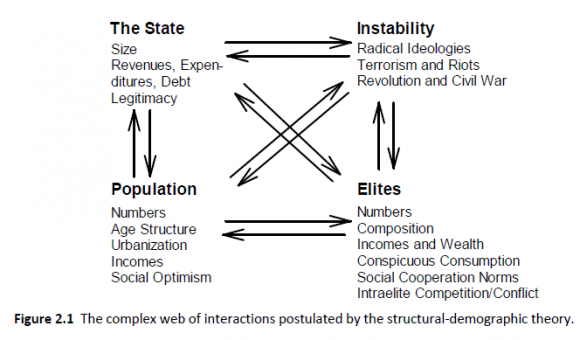
“Ages of Discord” also tests this theory against the example of American history, with special attention to turning points in different trends, which show a remarkable degree of coherence.
One table lists 29 proxies representing 15 variables, all but one of which — life expectancy — reversed direction within about a decade of 1970. These include three proxies of labor oversupply; two of economic and health well-being; three of social well-being and economic inequality; two of elite overproduction, intra-elite competition and intra-elite cooperation; three of cooperation and equity; and one of intra-elite fragmentation, patriotism, state legitimacy, state capacity and sociopolitical instability.
In short, Turchin finds that it wasn’t just similar social trends that changed together; trends from every aspect of the model changed direction around the same time.
For hundreds of thousands of years humans lived in hunter-gatherer societies, eating wild plants and animals. Inequality in these groups is thought to have been very low, with evidence suggesting food and other resources were shared equally between all individuals. In fact, in thehunter-gatherer societies that still exist today we see that all individuals have a say in group decision making. Although some individuals may act as leaders in the sense of guiding discussions, they cannot force others to follow them.
But it seems that with the beginning of agriculture around 10,000 years ago, this changed. An elite class began to monopolise resources and were able to command the labour of others to do things, such as build monuments in their honour. So how was it that egalitarian societies, where all men were equal, transitioned into hierarchical societies where despots reigned?...How early "anarcho-capitalism" may have led to stratified hierarchical society based on ownership and control.
Complex human societies, including our own, are fragile. They are held together by an invisible web of mutual trust and social cooperation. This web can fray easily, resulting in a wave of political instability, internal conflict and, sometimes, outright social collapse.
Analysis of past societies shows that these destabilizing historical trends develop slowly, last many decades, and are slow to subside.
The Roman Empire, Imperial China and medieval and early-modern England and France suffered such cycles, to cite a few examples. In the U.S., the last long period of instability began in the 1850s and lasted through the Gilded Age and the “violent 1910s.”
We now see the same forces in the contemporary U.S. Of about 30 detailed indicators I developed for tracing these historical cycles (reflecting popular well-being, inequality, social cooperation and its inverse, polarization and conflict), almost all have been moving in the wrong direction in the last three decades.
The roots of the current American predicament go back to the 1970s, when wages of workers stopped keeping pace with their productivity. The two curves diverged: Productivity continued to rise, as wages stagnated. The “great divergence” between the fortunes of the top 1 percent and the other 99 percent is much discussed, yet its implications for long-term political disorder are underappreciated. Battles such as the recent government shutdown are only one manifestation of what is likely to be a decade-long period....Bloomberg
Debt has been weaponized “pretty much continually” for the last four or five millennia by “people who have access to the ability to make credit,” anthropologist, Occupy activist and anarchist David Graeber said on the “Keiser Report” TV show in late April.
“This is the great social crisis of antiquity,” he continued. “If you go back to people like Aristotle, Hammurabi, Confucius—when they imagined the great social crisis, weaponized debt was what they had in mind. That this tiny percentage of the population would essentially enslave everybody else. They would start losing their flocks, their fields, eventually they would have to start selling members of their family or even themselves into slavery. And the way I always put it—if Aristotle were alive today, he would probably see the distinction between being so deeply in debt that you have to sell yourself to work for others and being so deeply in debt that you have to rent yourself to work for others as something of a legalistic distinction.”Truthdig
Mises: "The fundamental facts that brought about cooperation, society, and civilization and transformed the animal man into a human being are the facts that work performed under the division of labor is more productive than isolated work and that man’s reason is capable of recognizing this truth. But for these facts men would have forever remained deadly foes of one another, irreconcilable rivals in their endeavors to secure a portion of the scarce supply of means of sustenance provided by nature. Each man would have been forced to view all other men as his enemies; his craving for the satisfaction of his own appetites would have brought him into an implacable conflict with all his neighbors. No sympathy could possibly develop under such a state of affairs.”
Joe Henrich and his colleagues are shaking the foundations of psychology and economics—and hoping to change the way human behavior and culture is understood.AlterNet

