Showing posts with label social unrest. Show all posts

Tuesday, December 3, 2019

Romaric Godin — Social crises, crises of Democracy, neoliberalism in crisis

The connection could well be found in the great crisis the world entered in 2007–2008. Beyond what most observers remember—the “Great Crash” that followed the collapse of Lehman Brothers on September 15, 2008—the crisis is much deeper and persists to the present day. Because it is not a simple financial or economic crisis: it is rather the crisis of a mode of managing capitalism; that is, neoliberalism, which is based on putting the state at the service of capital, the financialization of the economy, and the commodification of society.
Like the crises of the 1930s or 1970s, the current crisis profoundly challenges the contemporary functioning of capitalism. Such crises are often long and accompanied by periods of unrest. As the historian Adam Tooze has shown in The Deluge (2014), the disruption of capitalism began not with the 1929 crash but rather during the World War I and was not actually resolved until after World War II. As for neoliberalism, it only came fully into being in the 1990s, 20 years after the previous paradigm had gone into crisis.
Even today’s crisis has been prolonged and deepened as neoliberalism struggles to avert its own demise. But in seeking to survive, it is pushing the world into the abyss. Of course, neoliberalism survived the shock of 2008 and even emerged from 2010 strong enough to present “solutions” such as global fiscal austerity and “structural reforms” aimed at destroying any remaining protection for workers and the most precarious. But by seeking to remain dominant, neoliberalism has further deepened its own crisis....
Even if growth-rate differentials should bring emerging economies in closer sync with those of so-called advanced countries and thus reduce inequalities at the global level, inequalities within nations are widening more than ever. This was the conclusion reached by the economist Branko Milanović in Global Inequalities (2016), who foresaw the return of the question of social class. Thus it is a resurgence of class struggle that we are now witnessing at the global level....
Neoliberalism is helpless. Locked in its logic of extractivism and fictional growth, it clutches onto phantoms: the “trickle-down theory,” the Laffer curve, or the Coase Theorem, which holds that issues of distributive justice must be kept separate from economic reality. It does so thanks to another of its salient features: the “management” of democracy, whereby the economic sphere must not be subjected to democratic decision-making but must be preserved from the “”feelings” of the crowd or, to use President Emmanuel Macron’s notorious phrase, “unfortunate passions” (passions tristes). But such segregation is less and less possible as inequalities deepen and the climate crisis becomes more acute. After five decades of managed democracy, people are demanding that their own emergencies be addressed instead of those of “markets” or “investors.”
The current crisis of neoliberalism has three aspects: an ecological crisis, a social crisis, and a democratic crisis. The current economic system is unable to respond to these three profound sources of discontent. Faced with an ecological emergency, it puts forward market solutions and fiscal repression of consumption by the weakest. In the face of social and democratic demands, its response is indifference. In fact, responding to such demands would require a profound change in the economic paradigm.…
Addressing the climate crisis would require a complete reorientation of investments and an end to basing the economy solely on real estate and financial bubbles. This would imply a complete overhaul of the monetary system. The seeds of such a transformation are shown in the Green New Deal that has been proposed in the United States, which has struck fear among neoliberal economists, because if the legislation is enacted the climate transition would no longer entail weakening the working class but acting in concert with them. By ensuring a massive redistribution of resources to the detriment of the richest, the more modest classes could achieve better livelihoods without destroying the planet. Finally, greater popular participation could assure that such decisions are not made for the benefit of the richest and for capital, but in the common interest. This is exactly what neoliberalism has always rejected: this ability of democracy to “change the economic deal”—precisely what the world needs today....
Second leg down? And is that a good thing, sweeping out the old and preparing for the new. Or are are looking at a replay of the French Revolution, with blood in the streets? Or a fascistic crackdown?

These are just a few excerpts. The whole post is reading in full. This is the overarching social, political and economic issue of our times that is taking place in a historical dialectic dominated by a conflict among traditionalism, liberalism, fascism, and communism, all of which include a range of variety and which may overlap each other as well. Quite a mix.

Dollars & Sense
Social crises, crises of Democracy, neoliberalism in crisis
Romaric Godin

The original version of this article in French appeared in Mediapart (mediapart.fr) on October 21, 2019. It was translated by Fred Murphy.

Saturday, October 26, 2019

Chile: The poster boy of neoliberalism who fell from grace — Branko Milanovic

It is not common for an OECD county to shoot and kill 16 people in two days of socially motivated riots. (Perhaps only Turkey, in its unending wars against the Kurdish guerilla, comes close to that level of violence.) This is however what Chilean government, the poster child of neoliberalism and transition to democracy, did last week in the beginning of protests that do not show the signs of subsiding despite cosmetic reforms proposed by President Sebastian Piñera.

The fall from grace of Chile is symptomatic of worldwide trends that reveal the damages causes by neoliberal policies over the past thirty years, from privatizations in Eastern Europe and Russia to the global financial crisis to the Euro-related austerity....
Global Inequality
Chile: The poster boy of neoliberalism who fell from grace
Branko Milanovic | Visiting Presidential Professor at City University of New York Graduate Center and senior scholar at the Luxembourg Income Study (LIS), and formerly lead economist in the World Bank's research department and senior associate at Carnegie Endowment for International Peace

See also

FAIR
The Revolution Isn’t Being Televised - Media uninterested in protest movements around the world
Alan MacLeod

Tuesday, October 22, 2019

How Economic Concentration and Crony Capitalism Led to the Chaos in Chile — Daniel Matamala

The signals of unrest in Chile mounted for years amid corruption scandals, rising inequality, and new monopolies. The tax increase on public transport that sparked the protests was only the final straw.
ProMarket — The blog of the Stigler Center at the University of Chicago Booth School of Business
How Economic Concentration and Crony Capitalism Led to the Chaos in Chile
Daniel Matamala | Host of 360 and CNN Prime at CNN Chile

Sunday, September 1, 2019

Zero Hedge — "Burn With Us" - Protesters Clash With Riot Police At Hong Kong Airport Amid Surge Of Violence


This is no longer marketable as a non-violent protest. It is turning into open revolt. The Chinese leadership is unlikely to put up with this escalation indefinitely, only long enough for the protestors to discredit themselves. The West is unlikely to intervene directly, and imposing more sanctions won't matter much either. The decision seems to have been taken to decouple. 

In the long run, this bodes ill for Hong Kong. It will be replaced by similar facilities and operation on the mainland, and that is already in the works. How does that affect Hong Kong real estate, some of the most expensive in the world?

Zero Hedge
"Burn With Us" - Protesters Clash With Riot Police At Hong Kong Airport Amid Surge Of Violence
Tyler Durden

Wednesday, August 21, 2019

Bill Mitchell — The rich are getting richer in Australia while the rest of us mark time

Only a short blog post today – in terms of actual researched content. Plenty of announcements and news though, a cartoon, and some great music. I have been meaning to write about the household income and wealth data that the ABS released in July, which showed that real income and wealth growth over a significant period for low income families has been close to zero, while the top 20 per cent have enjoyed rather massive gains. These trends are unsustainable. A nation cannot continually be distributing income to the top earners who spend less overall while starving the lower income cohorts of income growth. A nation cannot also continually create wealth accumulation opportunities for the richest while the rest go backwards. These trends generate spending crises, asset bubbles and social instability. That is what is emerging in Australia at present.
While Bill's analysis in this post is Aussie-centric, the rationale is applicable to the whole neoliberal world. It's basically what neoliberalism is about. The contemporary difference is that now the domestic populations of the neoliberal nations are being colonized as well. Even some of the top tier that are receiving most of the benefits are getting squeamish, realizing that an unsustainable process cannot go on forever and that eventually the bill will come due.

Bill Mitchell – billy blog
The rich are getting richer in Australia while the rest of us mark time
Bill Mitchell | Professor in Economics and Director of the Centre of Full Employment and Equity (CofFEE), at University of Newcastle, NSW, Australia

Wednesday, April 17, 2019

Christian Stöcker — The Kids Aren't Nearly Angry Enough

The school children who have been protesting to stop climate change every Friday have understood a basic truth: They are being betrayed. By politicians. By business leaders. And by an entire generation of denialists.
I would add "yet" to "the kids aren't nearly angry enough." It's coming. It took a long time for the growing rage about the Vietnam to surface in the media.

Spiegel Online
The Kids Aren't Nearly Angry Enough
A Commentary By Christian Stöcker

Saturday, February 2, 2019

Vanessa Beeley — Civilians in Police Crosshairs as France Adopts Totalitarian Tactics to Squash Yellow Vests

The insanity of Macron supporting the “uprising” in Venezuela while sanctioning vicious reprisals against his own people at home is glaringly obvious to all but Macron and his backers....
MintPress News
Civilians in Police Crosshairs as France Adopts Totalitarian Tactics to Squash Yellow Vests
Vanessa Beeley

Monday, January 14, 2019

Sophie Law — French riot police are now using semi-automatic weapons with live ammunition against Yellow Vest protestors as Macron's law and order crisis spirals


The story is widespread on social media but the Daily Mail is the only corporate medium that a search turns up a day later. News suppression?

On Twitter. Click the link for a video.

Wednesday, January 2, 2019

D. Sadaati — Workers' Strikes in Iran: This Time it is Different


According to the Western narrative, the "Iranian people" are opposing "the Islamic dictatorship." This article tells a different story.

The Western media will not tell you, but the workers' protests in Iran are similar to the Yellow Vests in France, which is spreading internationally. Workers are getting fed up with capitalism as usual and are demanding socio-economic justice.

Longish, but it tells the story in some detail. Nothing about this being a political protest against the Islamic government as the Western media represent it.

Interestingly, though, the MEK, which the US is putting forward as a replacement for the current regime after "regime change," has socialist and communist roots. Of course, the other option in the West is brining back the Shah's family to rule. Contemporary Iranians have not forgotten the repression they experienced under the rule of the Shah and his secret police.

Libcom — Internationalist Communist Tendency's blog
Workers' Strikes in Iran: This Time it is Different
D. Sadaati

Thursday, December 13, 2018

Rémy Herrera — Cops in France brutalize high school students who join Yellow Vest protests


I would be skeptical of this if I had not witnessed it in France and the United States in the past.

In fact sort of behavior has a name in law enforcement and criminal justice. It's called "punitive" enforcement. On the one hand, it is mindset of some that join law enforcement, and it is also a result of a punitive culture in some departments that is at least condoned by superiors and supervisors.

So, there are two factors operative. One is sadistic disposition, and the other is control through fear and intimidation.

In liberal society, these are generally considered signs of fascism.

Thursday, March 29, 2018

Asher Schechter — “Globalization Has Contributed to Tearing Societies Apart”

In an interview with ProMarket, Harvard economist Dani Rodrik explained where globalization went wrong, how trade agreements serve rent-seeking by politically well-connected firms, and why the only solution to the rise of political populism is an economic populism that reimagines the institutions of capitalism.
There it is.

The options are overhaul or replacement. Of course, the capitalist elite will never get this, and populism will continue to rise and challenge the status quo.

As this process accelerates, the capitalist elite will rely the age-old remedy for domestic dysfunction— war — which focuses the entire attention of nations on survival.

promarket.org
“Globalization Has Contributed to Tearing Societies Apart”
Asher Schechter

Monday, February 5, 2018

Argentina's President Macri Withdraws Neoliberal Reforms Due to Massive Resistance — Gregory Wilpert interviews Atilio Boron

Prof. Atilio Boron analyzes the situation in Argentina, where President Macri is pushing drastic neoliberal reforms against widespread resistance from unions and social movements. Sec. of State Rex Tillerson visits to give Macri backing and to urge anti-Venezuela sanctions....
Misleading title. The MO of the neoliberals is to push ahead as hard as possible, then pause when resistance rises, and push ahead again when it dies down.
Well, you know, the Macri government is very...proxy of the US government.
TRNN
Argentina's President Macri Withdraws Neoliberal Reforms Due to Massive Resistance
Gregory Wilpert interviews Atilio Boron, Senior Researcher of the National Council of Scientific Research, Emeritus Professor of the University of Buenos Aires, and Professor at the National University of Avellaned

see also

Max Blumenthal: US is Arming Neo-Nazis in Ukraine
Aaron Maté interviews Max Blumenthal

Friday, March 3, 2017

Brooke Seipel — Scranton YMCA stops showing 24-hour news after political fights erupt


"Only in America."
A YMCA in Scranton, Pa., has stopped screening 24-hour news stations on its gym televisions after arguments over politics nearly led to a physical altercation, NBC reported.
The Hill
Brooke Seipel

Tuesday, February 21, 2017

Anonymous — Paris On Brink Of Civil War’ Warns Le Pen – Media Blackout


May explain Le Pen's rise in the polls.

Security and order are the highest priority of government and when government seems to be failing, the tendency is toward greater authoritarianism.

Anonymous
‘Paris On Brink Of Civil War’ Warns Le Pen – Media Blackout

UPDATE: The Anonymous post has been taken down. Here is another link.

Saturday, December 10, 2016

Wolfgang Streeck: the German economist calling time on capitalism


Streeck adds another voice to Stauss & Howe, and Ravi Batra.

It would be a mistake to see the current dissatisfaction of the 99% as only inequality of income and wealth, which the high earners and people high net worth write off to envy, as much as inequality of opportunity and the rise of unearned privilege that recalls the feudal era. 

Streeck believes that this is explosive and the people in charge are clueless not only about what to do about it, other than social repression, but are clueless about what is happening. As the scenario unfolds, they are in deep psychological denial and intellectually paralyzed.

The Guardian
Wolfgang Streeck: the German economist calling time on capitalism
Aditya Chakrabortty, senior economics commentator for the Guardian

Tuesday, October 18, 2016

Graham E. Fuller — Capitalism Is Not a Moral Virtue, It’s Like Fire


Is Graham E. Fuller following in the footsteps of PCR and Mike Lofgren? More of the elite seem to be realizing that this is not working.

Graham E. Fuller
Capitalism Is Not a Moral Virtue, It’s Like Fire
Graham E. Fuller, former senior CIA official

Saturday, October 1, 2016

Paul Rosenberg — Breaking point: America approaching a period of disintegration, argues anthropologist Peter Turchin

Anthropologist Peter Turchin's "Ages of Discord" provides a crucial decoder ring for Trump-era social strife.
The American polity today has a lot in common with the Antebellum America of the 1850s; with Ancien Régime France on the eve of the French Revolution; with Stuart England during the 1630s; and innumerable other historical societies,” Turchin writes. “However, unlike historical societies, we are in a unique position to take steps that could allow us to escape the worst. Societal breakdown and ensuing waves of violence can be avoided by collective, cooperative action.”….
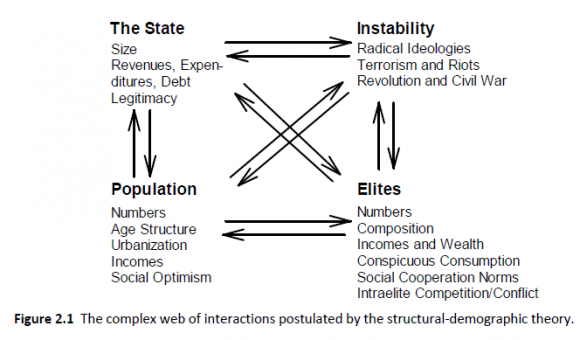
“Structural‐demographic theory represents complex (state‐level) human societies as systems with three main compartments (the general population, the elites, and the state) interacting with each other and with sociopolitical instability via a web of nonlinear feedbacks,” Turchin writes. Their relationship, as described and measured in the theory, is summarized in this figure:
“Ages of Discord” also tests this theory against the example of American history, with special attention to turning points in different trends, which show a remarkable degree of coherence.
One table lists 29 proxies representing 15 variables, all but one of which — life expectancy — reversed direction within about a decade of 1970. These include three proxies of labor oversupply; two of economic and health well-being; three of social well-being and economic inequality; two of elite overproduction, intra-elite competition and intra-elite cooperation; three of cooperation and equity; and one of intra-elite fragmentation, patriotism, state legitimacy, state capacity and sociopolitical instability.

In short, Turchin finds that it wasn’t just similar social trends that changed together; trends from every aspect of the model changed direction around the same time.

Wednesday, September 21, 2016

Laura Tyson and Anu Madgavkar — The Great Income Stagnation

Stagnating or falling real incomes do not just act as a brake on consumption demand and GDP growth; they also fuel social and political discontent, as citizens lose confidence in existing economic structures.
Project Syndicate
The Great Income Stagnation
Laura Tyson, former chair of the US President's Council of Economic Advisers, is a professor at the Haas School of Business at the University of California, Berkeley, a senior adviser at the Rock Creek Group, and a member of the World Economic Forum Global Agenda Council on Gender Parity, and Anu Madgavkar is a McKinsey Global Institute partner.

Friday, July 15, 2016

James Petras — Brexit: A Workers’ Response to Oligarchs, Bankers, Flunkies and Scabs


Brexit as an EU smackdown, or as the CIA would say "blowback."

James Petras Website
Brexit: A Workers’ Response to Oligarchs, Bankers, Flunkies and Scabs
James Petras | Professor (Emeritus) of Sociology at Binghamton University in Binghamton, New York and adjunct professor at Saint Mary's University, Halifax, Nova Scotia