Showing posts with label economic geography. Show all posts

Tuesday, January 29, 2019

Bill Mitchell — The conflicting concepts of cosmopolitan within Europe – Part 1

In the past week, the UK Guardian readers were confronted with the on-going scandal of wealthy British politicians and ‘peers’ receiving massive European Union subsidies under the Common Agricultural Policy (CAP). The article (January 27, 2019) – Peers and MPs receiving millions in EU farm subsidies – recounted the familiar tale –“Dozens of MPs and peers, including some with vast inherited wealth, own or manage farms that collectively have received millions of pounds in European Union subsidies”.
The story is not new and this scandal is just a reflection of the way in which the development of the European Union has contradicted the idealism that the Europhile Left associate with ‘Europe’.
As an aside, it would be telling, one imagines to map the EU payments (and well-paid job holdings) with Brexit support – one would conjecture a strong negative correlation.
This is a two-or-three part mini-series on the evolution of concepts of ‘cosmopolitanism’ in the European context. It is part of work I am doing for the next book Thomas Fazi and I hope to publish by the end of the year.
In this blog post, I introduce the conflict that is inherent in the European Union, and the way the Europhile Left has been seduced by a concept of cosmopolitanism that bears not relevance in the reality of modern Europe....
Bill branches out widely from MMT to encompass political economy, economic sociology, , economic geography, political theory, the EU and EU politics, the Left (such as it is) and more, exhibiting an awesome command of the material.

I have added some paragraphing.

Bill Mitchell – billy blog
The conflicting concepts of cosmopolitan within Europe – Part 1
Bill Mitchell | Professor in Economics and Director of the Centre of Full Employment and Equity (CofFEE), at University of Newcastle, NSW, Australia

Sunday, March 4, 2018

Diane Coyle — Economies in space and time


This is a book review, but it is also a short summary of economic geography. For example, David Harvey is geographer that applies Marxian economics to geography, even though many likely think of him as being an economist.

Geography is important, but most macroeconomists don't know much about it because it has not been integrated into the curriculum, so economists don't study it. Same with history. But economics is very much influenced by location (space) and period (time).
There’s a section of Economic Geography: A Critical Introduction by Trevor Barnes and Brett Christophers about the richness of border zones – not physical ones as these tend to be quite the opposite when it comes to economic activity, but intellectual.
Interdisciplinarity has been a buzzword for a long time, and immensely hard to achieve within conventional academic structures. But perhaps its moment has come. At any rate, the number of in-principle interdisciplinary research centres is increasing (including the new Institute for Public Policy at Cambridge, which I join tomorrow). Perhaps more important, more and more people appreciate that solving pressing challenges – ageing, the consequences of climate change, trade wars, technological change – requires multiple social science, humanities and scientific perspectives.
Besides, I’ve always found the borders of economics interesting, including economic geography. The gap between economists who do geography and geographers who think about the economy has perhaps been narrowing in recent times.
Diane Coyle also make an interesting observation about economics and evolution, although she doesn't explicitly identify it as such. It is worth noting.
We economists do have a habit of presenting as marvellous new insights things other disciplines have known for ages, albeit wrapped in some nice econometrics. However – and inevitably there are some frictions in this process of inter-disciplinary engagement – it’s bemusing-to-painful to see how economics is perceived. The book describes (mainstream) economics as being only about constrained optimisation, which is the kind of reductionist statement an economist might make (and anyway, constrained optimisation under conditions of asymmetric information is everywhere in nature). It also defines the economy and economics as being essentially about ‘materiality’, material resources. Surely this can’t be literally intended? But in that case I’m not sure what this means.
This observation can be greatly expanded.

There is a difference between restricting assumptions for modeling simplification and ontological reductionism that takes absence as indicative of non-existence. For example, quality is often eliminated from scientific modeling for methodological convenience, but it does not follow from this that quality either doesn't exist, is trivial, or is unimportant in a larger context.

The Enlightened Economist
Economies in space and time
Diane Coyle | freelance economist and a former advisor to the UK Treasury. She is a member of the UK Competition Commission and is acting Chairman of the BBC Trust, the governing body of the British Broadcasting Corporation

Tuesday, February 16, 2016

Must read — Joel Kotkin: We Now Join the U.S. Class War Already in Progress


Must read. Demographics is the real basis of political economy as well as politics.

New Geography
We Now Join the U.S. Class War Already in Progress
Joel Kotkin | executive editor of NewGeography.com, the Roger Hobbs Distinguished Fellow in Urban Studies at Chapman University, and executive director of the Houston-based Center for Opportunity Urbanism

Saturday, February 6, 2016

Sputnik International — Putting Russia on the Map: Stratfor CEO's Analysis

In an attempt to draw up a strategic portrait of Russia and to understand President Putin’s "long-term intentions in Europe,” former US chief intelligence officer and founder and CEO of the private intelligence corporation Stratfor, George Friedman, has created ten maps designed to illustrate “Russia’s difficult position since the Soviet Union collapsed.”
However, his research has produced some completely unexpected results.
“Many people think of maps in terms of their basic purpose: showing a country’s geography and topography. But maps can speak to all dimensions — political, military, and economic,” Friedman writes in his article for the New York-based magazine Business Insider.
“In fact, they are the first place to start thinking about a country’s strategy, which can reveal factors that are otherwise not obvious.”….

Russia, he says, is “more united than divided and derives power from the strength that comes from overcoming difficulty.”
With regards to Russia, he says it “isn’t prosperity that binds the country together, but a shared idealized vision of and loyalty toward Mother Russia. And in this sense, there is a deep chasm between both Europe and the United States (which use prosperity as a justification for loyalty) and Russia (for whom loyalty derives from the power of the state and the inherent definition of being Russian).”
“This support for the Russian nation remains powerful, despite the existence of diverse ethnic groups throughout the country,” he finally concludes.
Expecting economic pressure on Russia to result in political collapse as it would in the West is questionable. It seems to be based on wishful thinking and projection.

Saturday, February 21, 2015

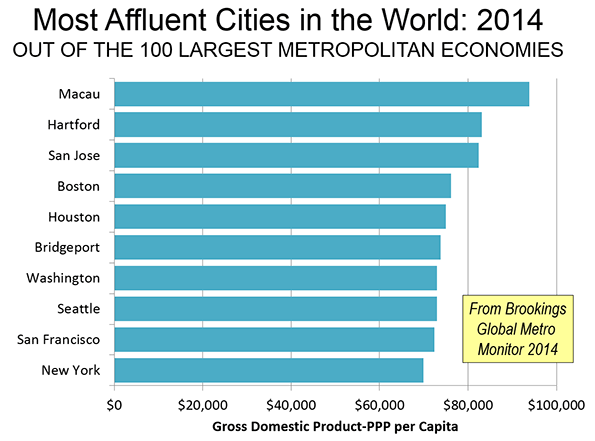
New Geography — 10 Most Affluent Cities In The World: Macau And Hartford Top The List

Two in Connecticut — Hartford and Bridgeport, and two in California — San Jose and San Francisco. California is a huge state, Connecticut is a tiny one, in fact almost tiny. Driving time to the north-south and east-west borders of Connecticut is a matter of hours. Same with Massachusetts, where Boston is located.

New Geography
Wendell Cox

Thursday, June 19, 2014

Joel Kotkin and Michael Shires — America's New Industrial Boomtowns

Whether America is on the path to a sustainable industrial expansion or is just seeing a weak bounce back has been widely debated, but the recent numbers are impressive. Since 2010 the U.S. has added 647,000 manufacturing jobs. New energy finds have led to the construction and expansion of pipelines and refineries, and has sparked foreign industrial investment reflecting electricity costs that are now well below those in Europe or East Asia. Besides Houston, also ranking high on our big cities list are two other energy towns, No. 5 Oklahoma City and No. 10 Ft. Worth, Texas. Our mid-sized cities list is led by Lafayette, La., with nearby Baton Rouge in 11th place.
Evangelists of the “information economy” may think that industrial jobs are passé, as epitomized by a recent Slate article that recommended that working-class people from places like Detroit should move to areas like Silicon Valley or Boston where they can make money cutting the hair and walking the dogs of high-tech magnates. But the notion that U.S. manufacturing is doomed, and that the jobs are of lower quality than those in high-tech centers, is largely bogus; even in Silicon Valley the majority of new projected jobs are expected to pay under $50,000 annually. In contrast manufacturers pay above-average wages, in some cases due to unionization, but in many others because of the increasing sophisticated skills required by today’s factories.
Although we will likely never see a boom in factory employment on the scale experienced in the last century, the demand for blue-collar skills is projected to increase in future years. Among all professions for non-college graduates, manufacturing skills are most in demand, according to a study by Express Employment Professionals. By 2020, according to BCG and the Bureau of Labor Statistics, the nation could face a shortfall of around 875,000 machinists, welders, industrial-machinery operators, and other highly skilled manufacturing professionals.
Newgeography.com
America's New Industrial Boomtowns
Joel Kotkin and Michael Shires