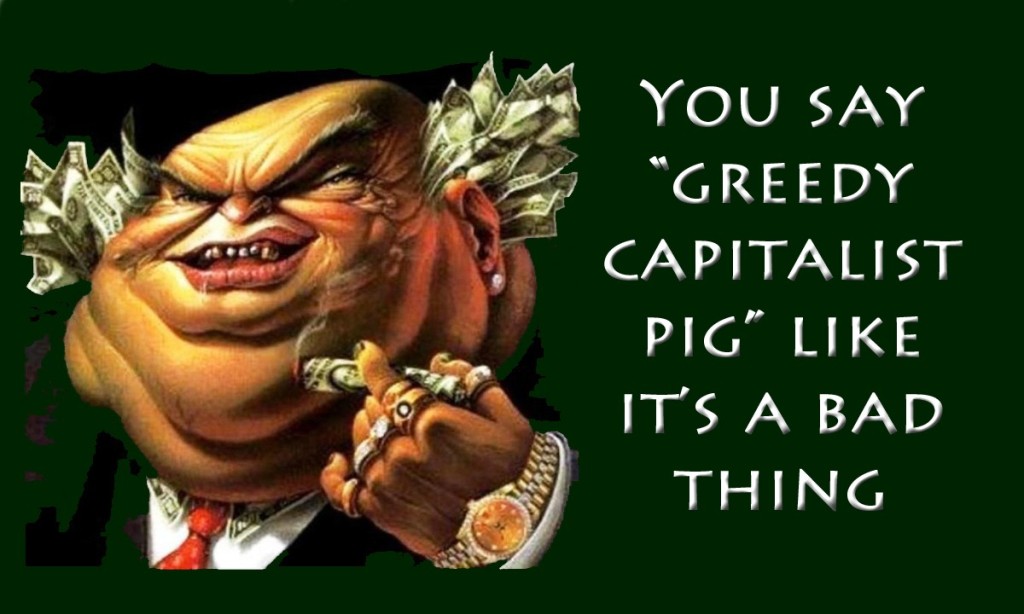
In the aftermath of the stock market crash of 1987, the New York Times headlined an editorial “Ban Greed? No: Harness It,” It continued: “Perhaps the most important idea here is the need to distinguish between motive and consequence. Derivative securities attract the greedy the way raw meat attracts piranhas. But so what? Private greed can lead to public good. The sensible goal for securities regulation is to channel selfish behavior, not thwart it.”Magical thinking that leads to the liberal paradox of reconciling social, political and economic liberalism, or to put it another way, reconciling homo economicus with homo socialis.
The Times, surely unwittingly, was channeling the 18th century philosopher David Hume: “Political writers have established it as a maxim, that in contriving any system of government . . . every man ought to be supposed to be a knave and to have no other end, in all his actions, than his private interest. By this interest we must govern him, and, by means of it, make him, notwithstanding his insatiable avarice and ambition, cooperate to public good.”…
The idea that base motives could be harnessed for the public good is what I term economic alchemy. And in Hume’s time it was definitely a new way of thinking about how society could be governed.…
From there, it was a short step to thinking that while ethical reasoning and concern for others should inform one’s actions as a family member or citizen; the same did not go for shopping or making a living.
Evonomics
How the Deadly Sin of Avarice Was Rehabilitated as Self Interest
Samuel Bowles
Samuel Bowles, is at the Santa Fe Institute, recently published The Moral Economy: Why good incentives are no substitute for good citizens and is one of the authors of The Economy, a free online introduction to economics by the CORE Project, He also wrote Microeconomics: Behavior, Institutions and Evolution, and with Herbert Gintis, A cooperative species: Human reciprocity and its evolution.Here are a couple of relevant quotes from Keynes:
When the accumulation of wealth is no longer of high social importance, there will be great changes in the code of morals.We shall be able to rid ourselves of many of the pseudo-moral principles which have hag-ridden us for two hundred years, by which we have exalted some of the most distasteful of human qualities into the position of the highest virtues. We shall be able to afford to dare to assess the money-motive at its true value. The love of money as a possession — as distinguished from the love of money as a means to the enjoyments and realities of life — will be recognised for what it is, a somewhat disgusting morbidity, one of those semi-criminal, semi-pathological propensities which one hands over with a shudder to the specialists in mental disease…
But beware! The time for all this is not yet. For at least another hundred years we must pretend to ourselves and to everyone that fair is foul and foul is fair; for foul is useful and fair is not. Avarice and usury and precaution must be our godsfor a little longer still. For only they can lead us out of the tunnel of economic necessity into daylight.—as quoted in "Keynes and the Ethics of Capitalism" by Robert Skidelsy
The day is not far off when the economic problem will take the back seat where it belongs, and the arena of the heart and the head will be occupied or reoccupied, by our real problems — the problems of life and of human relations, of creation and behaviour and religion.— First Annual Report of the Arts Council (1945-1946)Attributed to Keynes:
Capitalism is “the astonishing belief that the nastiest motives of the nastiest men somehow or other work for the best results in the best of all possible worlds.”— Attributed by Sir George Schuster, Christianity and human relations in industry (1951), p. 109
Recent variant: Capitalism is the astounding belief that the most wickedest of men will do the most wickedest of things for the greatest good of everyone.— As quoted in Moving Forward: Programme for a Participatory Economy (2000) by Michael Albert, p. 128