Showing posts with label growth models. Show all posts

Monday, May 18, 2015

Sandwichman — Denial, Then and Now: "Is the End of the World at Hand?" "Is the Economic System Self-Adjusting?"


Of course the economic system is self-adjusting if you model on assumptions that yield this result. The question is the degree to which the model corresponds with reality. This is what distinguishes science from formal disciplines like logic and mathematics on one hand, and the creation of fictional worlds on the other. If a model's assumptions are not sufficiently realistic, the likelihood of that is low that the model will be very representational other than as a caricature.

The problem with what generally passes for economics is based on assumptions of classical liberalism that don't hold in the real world and likely never could be instituted with the necessary rigor to make the world conform to the model. But that doesn't stop economists from using policy arguments based these assumptions to make the world match the model. That's engineering and not science. Moreover, it is bad engineering because engineering is based on science rather than science on engineering. Time to 'fess up and get real.
"I would like to say why I think that the Doomsday Models are bad science and therefore bad guides to public policy," -- Robert M. Solow, 1973
 1973 was 42 years ago and 42 just happens to be the answer "to Life, the Universe and Everything," according to Deep Thought in Douglas Adams's Hitchhiker's Guide to the Universe. When challenged, the computer replied that he had "checked it very thoroughly and that quite definitely is the answer. I think the problem, to be quite honest with you, is that you’ve never actually known what the question is."

Sandwichman — Mathiness and Growthiness

The fundamental reason why we cannot do without dialectical concepts is that actuality, at least as seen by the human mind, continuously changes qualitatively. … —Nicholas Georgescu-Roegen, "Methods in Economic Science"
Like I've been sayin' in those same words.  And quality is more important in life than quantity.
In a 1981 commentary on Georgescu-Roegen's paper, Salim Rashid defended economists' persistence in undialectical methods as lying "not in their failure to appreciate the importance of dialectical logic, but in the institutional structure within which they live and work."
I would say this in terms of dialectical reasoning versus institutional arrangements in that dialectical reasoning incorporates institutional arrangements along with many other relevant factors in taking a holistic (systems) approach. Institutional arrangements are norms that generate priorities that can be analyzed quantitatively to a degree. But institutions are fundamentally qualitative, based on an organizational culture for example.

They follow dialectical logic, as Bill Black has been documenting regarding the behavior of the officers of TBTF banks. It is perfectly rational dialectically to pursue control fraud in an unregulated and unsupervised criminogenic environment where the stakes are huge and the potential for being caught, let alone punished, is small.

Conventional economists missed this, am most are still blissfully unaware of it, because they assumed away criminogenic environments, resultantly predictable based on historical precedent, in their chiefly quantitive approach based on restrictive assumptions, for example, in this case an overly restrictive definition of rationality and interest that rules the issue out. Subsequently, Fed chair (hence regulator in chief) Alan Greenspan later admitted his "mistake" after the horses had left the barn.

Sandwichman always write good stuff. If you are not following him, this is a good one to read if you are at all interested in the critique of conventional economics. It goes much fur there than a critique of Paul Romer's view of mathiness.

Econospeak
Mathiness and Growthiness
Sandwichman

Saturday, May 16, 2015

Brad DeLong — Noah Smith, Paul Romer, "Mathiness", and Baking the Politics into the Microfoundations...


Brad DeLong explains what Paul Romer's recent paper is about. It's a smackdown of ideological economics directed at the Chicago School (George Stigler, Robert Lucas, etc.) Are key neoclassical assumptions "innocent" sophistry based on a Noble Lie? Or is it the Big Lie?

Grasping Reality
Noah Smith, Paul Romer, "Mathiness", and Baking the Politics into the Microfoundations...
Brad DeLong | Professor of Economics, UCAL Berkeley

Sunday, September 7, 2014

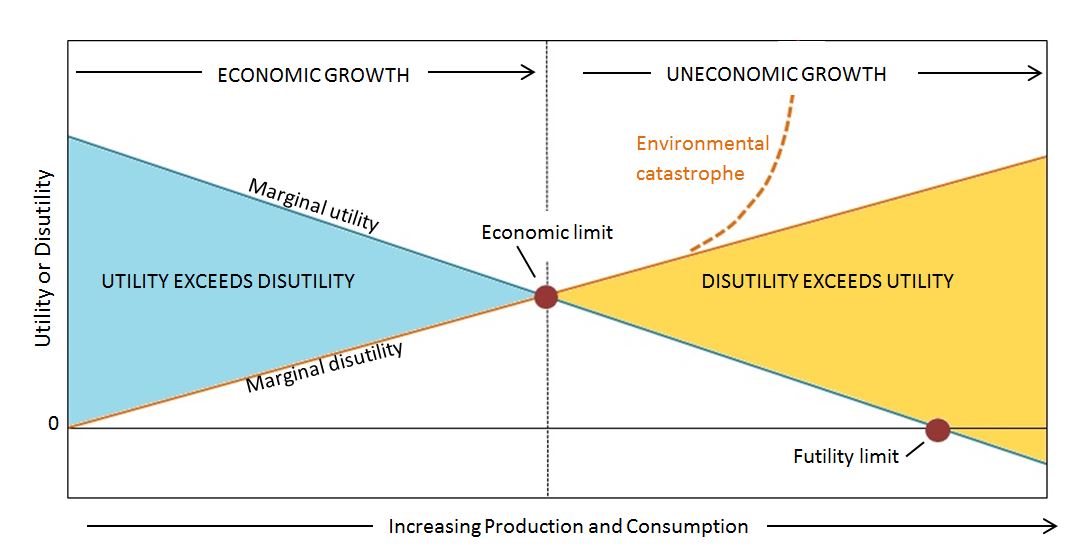
Herman Daly — Three Limits to Growth


From the diagram we can distinguish three concepts of limits to growth. 

1. The “futility limit” occurs when marginal utility of production falls to zero.… 
2. The “ecological catastrophe limit” is represented by a sharp increase to the vertical of the marginal cost curve.… 
3. The “economic limit” is defined by marginal cost equal to marginal benefit and the consequent maximization of net benefit.… 
From the graph it is evident that increasing production and consumption is rightly called economic growth only up to the economic limit. Beyond that point it becomes uneconomic growth because it increases costs by more than benefits, making us poorer, not richer. Unfortunately it seems that we perversely continue to call it economic growth! Indeed, you will not find the term “uneconomic growth” in any textbook in macroeconomics. Any increase in real GDP is called “economic growth” even if it increases costs faster than benefits.
Casse
Three Limits to Growth
Herman Daly | Emeritus Professor, University of Maryland, School of Public Policy