Showing posts with label economic growth. Show all posts

Wednesday, January 2, 2019

Timothy Taylor — Macaulay on Economic Progress, 100 Years Before Keynes

Economists have long been fascinated by a 1930 essay written by John Maynard Keynes called "Economic Possibilities for Our Grandchildren" (available various places like here and here). Writing in the opening storms of what would become the Great Depression, Keynes maintained that the main issues facing the economy in the long run was an adjustment to ongoing technological progress. He wrote: "We are suffering, not from the rheumatics of old age, but from the growing-pains of over-rapid changes, from the painfulness of readjustment between one economic period and another." He added: "I would predict that the standard of life in progressive countries one hundred years hence will be between four and eight times as high as it is to-day. There would be nothing surprising in this even in the light of our present knowledge. It would not be foolish to contemplate the possibility of afar greater progress still."
That growth projection may sound crazily optimistic. But as I pointed out here, it assumes only an average annual growth rate of 1.5-2.0% per year. Seemingly slow annual rates of growth, sustained over a century, are a powerful force.
Perhaps it is well-known among the cognoscenti that Thomas Babington Macaulay, the British historian, essayist, and politician, made essentially the same claim about the power of long-run economic growth in 1830, exactly 100 years before the essay by Keynes. But I had not known it until a few weeks ago. So I'll share with you some of the Macaulay's commentary, which appeared in an 1930 review essay about "Southey's Colloquies on Society" in the Edinburgh Review. I quote here from the version of the article available at the always-useful Library of Economics and Liberty website...
Conversable Economist
Macaulay on Economic Progress, 100 Years Before Keynes
Timothy Taylor | Managing editor of the Journal of Economic Perspectives, based at Macalester College in St. Paul, Minnesota

Wednesday, September 12, 2018

Chris Hamilton — The End Of Growth Among "Haves" Dooms Growth Among "Haves" & "Have Nots" Alike

The global economic system is premised on growth, not just any growth, but growth where it matters (economically). However, population growth (the foundation of economic growth) among the high and upper middle income nations of the world is rapidly winding down. As I have outlined previously, total births have been declining among the combined high/upper middle income nations since 1988 and now births are declining everywhere but among the low income nations of the world (HERE). Without growth among the importers of the world with the income, savings, and/or access to credit...there is no growth for exporters.
The high and upper middle income nations represent 49% of the worlds population but 91% of global GNI (gross national income) and 89% of total global energy consumption (as well as gross commodity consumption). The decades, or more properly, centuries of growth among these wealthier under 65 year old populations (that drove economic activity) will cease around 2022. All subsequent population growth will be among the 65+ year olds of the wealthier nations, particularly among the 75+yr/old population and the masses of the poor nations. The end of population growth and subsequent reversals in these wealthier nations is ushering in an era of economic and consumptive decline unlike the contemporary world has ever seen....
Unless the "haves" figure out that the way out is to make the "have-nots" also "haves" by using demand-side economics.

How likely is this?

Zero Hedge
The End Of Growth Among "Haves" Dooms Growth Among "Haves" & "Have Nots" Alike
Chris Hamilton via Econimica

Monday, August 7, 2017

Ann Saphir — Check your math, central banker says: less immigration equals less growth

Less than week after a U.S. President Donald Trump embraced legislation to reduce immigration, Minneapolis Federal Reserve Bank President Neel Kashkari urged residents of South Dakota to embrace newcomers instead.
"Just going to math, if a big source of economic growth is population growth, and your population growth slows, either because you restrict immigration or because you have fewer babies, your economic growth is going to slow," Kashkari said at the Rotary Club of Downtown Sioux Falls, responding to a question about a Trump-backed bill to cut legal immigration by 50 percent over the next 10 years. "Do we want economic growth, or not? That’s what it comes down to."

Kashkari not alone in seeing immigration as key to U.S. economic growth.

Dallas Fed President Robert Kaplan routinely points out that immigrants have historically boosted U.S. workforce growth, and therefore economic growth, and has warned that the crackdown on illegal immigration could hurt consumer spending. Fed Chair Janet Yellen told U.S. lawmakers earlier this year that slowing immigration could probably hurt growth....
And "everybody knows a rising tide lifts all boats." (snark)

Reuters
Check your math, central banker says: less immigration equals less growth
Ann Saphir

Tuesday, January 24, 2017

Lars P. Syll — Public debt and economic growth


Jaume Ventura & Joachim Voth quote:
Towering debts, rapidly rising taxes, constant and expensive wars, a debt burden surpassing 200% of GDP. What are the chances that a country with such characteristics would grow rapidly? Almost anyone would probably say ‘none’.
Lars P. Syll’s Blog
Public debt and economic growth
Lars P. Syll | Professor, Malmo University

Sunday, September 21, 2014

Peter Dorman — Why Paul Krugman Is Wrong about the Cost of Climate Protection, and Why it Matters

Who’s right, those who think that economic growth can’t coexist with protection of the climate, or Paul Krugman who says “saving the planet would be cheap and maybe even come free”? Alas, neither, but for different reasons.…
Econospeak
Why Paul Krugman Is Wrong about the Cost of Climate Protection, and Why it Matters
Peter Dorman, Professor of Political Economy, The Evergreen State College

Sunday, September 7, 2014

Herman Daly — Three Limits to Growth


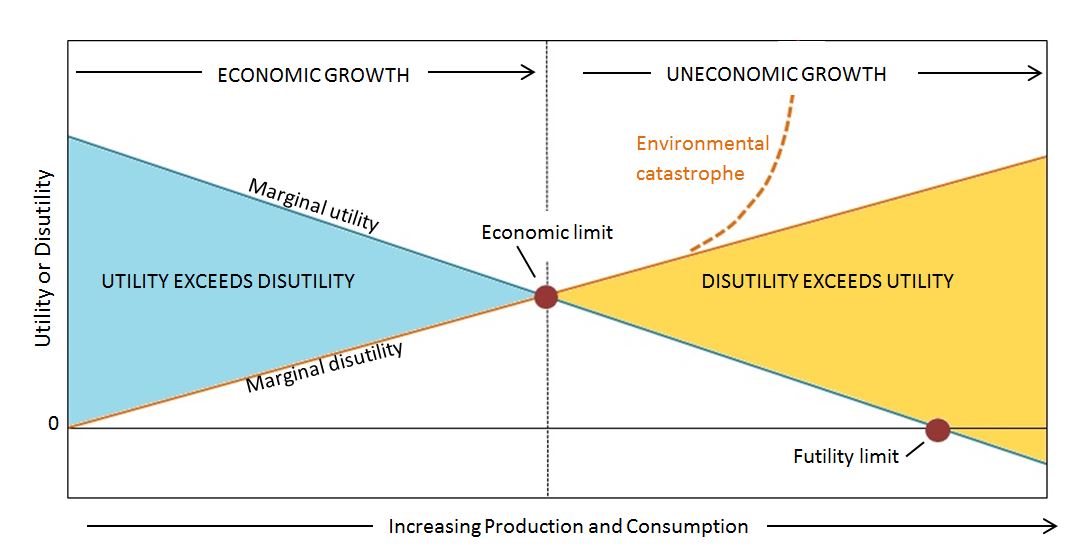
From the diagram we can distinguish three concepts of limits to growth. 

1. The “futility limit” occurs when marginal utility of production falls to zero.… 
2. The “ecological catastrophe limit” is represented by a sharp increase to the vertical of the marginal cost curve.… 
3. The “economic limit” is defined by marginal cost equal to marginal benefit and the consequent maximization of net benefit.… 
From the graph it is evident that increasing production and consumption is rightly called economic growth only up to the economic limit. Beyond that point it becomes uneconomic growth because it increases costs by more than benefits, making us poorer, not richer. Unfortunately it seems that we perversely continue to call it economic growth! Indeed, you will not find the term “uneconomic growth” in any textbook in macroeconomics. Any increase in real GDP is called “economic growth” even if it increases costs faster than benefits.
Casse
Three Limits to Growth
Herman Daly | Emeritus Professor, University of Maryland, School of Public Policy

Monday, March 24, 2014

Paying The Turkey, To Avoid Running Out Of Fiat :(

(Commentary posted by Roger Erickson)


Turkey ‘saved 442 billion lira’ with low rates
"The low interest rate environment of the past 11 years has saved Turkey from paying 442 billion Turkish Liras of additional cost ... "

[paid to itself?]

Maybe they need a Presidential pardon, so that they can go back to denominating ALL necessary transactions ... not just some of them? Let's just hope that they don't run out of public initiative before everything that needs to get done ... actually gets done. It'd be a shame for a whole nation to collapse, all for want of enough public fiat. (Ya just can't make this stuff up fast enough.)
'The low interest rate environment of the past 11 years has saved Turkey from paying 442 billion Turkish Liras of additional cost, Deputy Prime Minister Ali Babacan has said. 
 [Cost to whom, and paid to what recipient?]
“We [the ruling Justice and Development Party (AKP) government] have lowered interest rate spending and we provide services with the resources yielded from this,” Babacan said during a rally held for Rıza Gezer, AKP’s Etimesgut district candidate in Ankara on March 23. 
[BMHOTK! Parasitic fungi have nothing on bankers! In the hunt for more bizarre, opportunistic organism & cultural sub-types, it's surprising that ecologists don't study co-parasitism by bankers and de-co-regulators AND LOBBYISTS. :( ]
“We would have had to pay 442 quadrillion [billion in today’s currency] more, if the interest rate hadn’t declined over the past 11 years and the state would have continued to pay 66-percent interest rates,” he said. 
The AKP government has been vocally against high interest rates, which are blamed for hampering economic growth.
[It couldn't be their fiscal & tax policies, right?]
Prime Minister Recep Tayyip Erdoğan, who is also keen on maintaining economic growth ahead of an election cycle starting with the local elections on March 30, has been a vociferous opponent of higher borrowing costs, rallying against what he describes as an “interest rate lobby” of speculators seeking to stifle growth and undermine the economy.

The abundant liquidity environment that is supported by the United States Federal Reserve’s bond purchasing program and investors’ interest in emerging markets after the 2008 global crisis made the low interest rate policy sustainable. However, the analyst and the economy policy shapers of the government have been saying this era has come to an end with the Fed’s announcement of decision to cut its bond-buying that led to a huge emerging market sell-off. After resisting for months, the Central Bank of Turkey also hiked all of its key interest rates at the end of January." '
Emerging market sell-off? Who owns the assets of these countries, who's buying and who's selling  .... and WITH WHOSE PERMISSION?

Whatever. Just another day of breaking news from down the Rabbit Hole. Add Mad Turks to Mad Hatters. Or can someone just ask them to define "Economic Growth?" Or instead, just ban twitter. That'll fix it!


Friday, October 11, 2013

Bill Mitchell — Environmental Sustainability and Economic Growth

I am now using Friday’s blog space to provide draft versions of the Modern Monetary Theory textbook that I am writing with my colleague and friend Randy Wray. We expect to publish the text sometime early in 2014. Comments are always welcome. Remember this is a textbook aimed at undergraduate students and so the writing will be different from my usual blog free-for-all. Note also that the text I post is just the work I am doing by way of the first draft so the material posted will not represent the complete text. Further it will change once the two of us have edited it.

Today, I am continuing to add the sections in Chapter 25. So far we have done 25.1 and 25.2. I am jumping to 25.5 today.
Chapter 25 Recent Policy Debates
In this Chapter we consider the following policy debates:
▪ 25.1: Ageing, Social Security, and the Intergenerational Debate
▪ 25.2: Twin Deficits and Sustainability Of Budget Deficits
▪ 25.3: Fixed Versus Flexible Exchange Rates: Optimal Currency Areas, the Bancor, or Floating Rates?
▪ 25.4: Economic Growth: Demand or Supply Constrained?
▪ 25.5: Environmental Sustainability and Economic Growth
25.5 Environmental Sustainability and Economic Growth
Bill Mitchell – billy blog
Environmental Sustainability and Economic Growth
Bill Mitchell | Professor in Economics and Director of the Centre of Full Employment and Equity (CofFEE), at the Charles Darwin University, Northern Territory, Australia

Sunday, September 15, 2013

Jessica Schieder — The US Federal Deficit Continues to Shrink

The federal budget deficit has been plummeting in size over the last few years; however, judging from polls, most Americans do not know that – indeed, their concern over the deficit has grown even as the annual deficit has shrunk significantly. And it continues to do so: the Congressional Budget Office (CBO) estimated yesterday that the deficit for the first eleven months of this fiscal year fell $400 billion from the comparable period last year....

Despite the decreasing size of the deficit, 72 percent of Americans surveyed in January 2013 said they felt reducing the budget deficit should be a “top priority” for the president and Congress this year. In January 2009, only 53 percent of Americans said reducing the budget deficit should be a top priority. But back in 2009, the deficit was higher than it is now.... 
As Jamelle Bouie at The American Prospect put it: “Voters associate high deficits with poor economic performance—the public might say that it wants more action to lower the deficit, but what it means is that it wants Washington to improve the economy.”
The public has the causality backward. They see high deficits in recessions and think that it's the high deficits that are causing the recession.

Truthout
The US Federal Deficit Continues to Shrink
Jessica Schieder, Center for Effective Government | News Analysis

Tuesday, April 30, 2013

Guest post: And here's how the debt gets paid off!

Guest post by MNE reader, Ben Strubel.

“Perhaps the issue that causes the most confusion is the mechanism by which deficit spending now is “paid for” in the future.

Most people assume you “pay for” deficit spending the same way you do in your personal life. For instance when I go to the gas station and fill up my vehicle I always pay by credit card. The bank that issues the credit card effectively loans me money which I then use to pay the owner of the gas station.
So I just deficit spent $60. When the end of the month comes around I always pay off my bill in full so I’ll need to pay back the $60 the bank loaned to me via the credit card. If I go in debt now by $60 I will eventually need to pay it off and I will be using either money I have saved up or taking money from my future income.

Tuesday, September 4, 2012

Charles Eisenstein makes FT


Steven Keen also gets a shout out.

The Financial Times | Alphaville

Towards a steady-state economy?
Posted by Izabella Kaminska
(h/t Andy Blatchford via emial)

Friday, June 22, 2012

Cease, Forever, the Practice of Calling Fiat Currency Creation a Deficit.


It's currency creation that denominates any economic growth.

In another investors interview, Warren Mosler once again explains monetary operations beautifully. Pity his audience remains so small.

Early in the interview, Warren makes an overlooked point very succinctly.

Altering his phrase slightly, I'll put it this way:

It's "deficit" spending that supports any economic growth.

Please, let's all commit to saying that in a different format. See below.

Why is it that such a simple point is not universally recognized? We can put a man on the moon, but we can't understand something as simple as a fiat currency system?

Whatever new activities we the people are capable of creating, we're free to do. Then, we're free to record and adjust to our created growth by creating fiat bookkeeping.

What is fiat bookkeeping? Fiat currency.

No population can generate more people + more activity without creating more currency to denominate the newly created & highly organized transaction chains. That couldn't be more simple, or more clear.

JIT supply chains, logistics & economies are not possible without JIT creation of bookkeeping currency. We can't run out of RFID chips unless we choose to, nor can we run out of fiat currency ... unless we choose to limit our own capabilities.

So, we're back to semantics. Why is currency creation called "deficit" or "debt," when that use conflicts profoundly with other applications of those words?  Do we get fiat from somewhere else?  Can we run out of fiat?  Do we owe fiat to someone?  No, no & no.

It's the semantics that are our stumbling point, not static vs dynamic operations.

Cease, forever, the practice of calling fiat currency creation a deficit, or a debt.
We can't ease the cognitive tensions over this as long as we keep calling currency creation a deficit.

It's fiat currency creation that allows more transaction-chains to be denominated upon demand, thereby unleashing exploration of any & all options we can imagine.

If an aggregate can do something, and benefit from it, what on earth is the problem with recording the transactions involved, so everyone can adjust accordingly?

As individuals from John Law to Warren Mosler keep hinting, fiat currency supply is just another automatic stabilizer for an organized aggregate.

Please, let's all just say so, more bluntly, more often.

It's currency creation that denominates any economic growth.