Zero Hedge
Pentagon Fears Foreigners Will Buy Control Of US Defense Firms Amid Coronavirus Volatility
Tyler Durden
What we’re not encouraged to do is to criticize or even to question America’s vast military establishment and its enormous power, even though President Dwight D. Eisenhower warned us about that establishment in his famous farewell speech in 1961.
It’s high time we Americans listened to Ike as well as to J.W. Fulbright. Let’s give the latter a close listen, shall we?…
I stumbled across Senator J. William Fulbright’s 1970 book The Pentagon Propaganda Machine and, out of curiosity, bought it for the princely sum of five dollars. Now, talk about creepy. Fulbright, who left the Senate in 1974 and died in 1995, noted a phenomenon then that should ring a distinct bell today. Americans, he wrote, “have grown distressingly used to war.” He then added a line that still couldn’t be more up to date:
“Violence is our most important product.” Congress, he complained (and this, too, should ring a distinct bell in 2019), was shoveling money at the Pentagon “with virtually no questions asked,” while costly weapons systems were seen mainly “as a means of prosperity,” especially for the weapons makers of the military-industrial complex.
“Militarism has been creeping up on us,” he warned, and the American public, conditioned by endless crises and warnings of war, had grown numb, leaving “few, other than the young, [to] protest against what is happening.”This process has a name — "normaliztion." War and state-violence are becoming normalized in American society.
While Trump has too often accommodated this hive of neocons, his recent statements and repeated calls for cooperation with Russia and China demonstrate a sound push back which should be taken very seriously. In that Fox interview Trump said:Strategic Culture Foundation
“With all of everything that’s going on, and I’m not one that believes—you know, I’m not somebody that wants to go in to war, because war hurts economies, war kills people, most importantly—by far most importantly.”You know, in Syria, with the caliphate, so I wipe out 100 percent of the caliphate. That doesn’t mean you’re not going to have these crazy people who run around blowing up stores and blowing up things—these are seriously ill people. I don’t want to say, ‘Oh, they’re wiped,’ you know, ISIS. But, I wiped out 100 percent of the caliphate. I say, ‘I want to bring our troops back home.’ The place went crazy. You have people here in Washington, they never want to leave.”‘You know what I’ll do, I’ll leave a couple hundred soldiers behind,’ but if it was up to them, they’d bring thousands of soldiers in. Someday people will explain it, but you do have a group, and they call it the military-industrial complex. They never want to leave. They always want to fight.”Trump continued to explain his preference for economic over military solutions which is certainly in alignment with the Russia and Chinese approach in the Middle East....
President Donald Trump said on Thursday he did not think additional U.S. troops are needed in the Middle East to counter Iran, casting doubt on a Pentagon plan to bolster forces in the region.Reuters
Mysteriously, the promises given to President Mikhail Gorbachev by President George H. W. Bush, Prime Minister Margaret Thatcher, President Francois Mitterand, Chancellor Helmuth Kohl and their foreign ministers in 1990—not to expand NATO eastward; not to extend membership in the NATO alliance to former member states of the Warsaw Pact—were ignored. Why was this important strategic commitment made by NATO’s key leaders to President Gorbachev ignored?
Well, in the 1990s, the Russian threat was nonexistent and there was no reason to suppose it would return. In addition, President Clinton and the Senators who were nominally in charge of overseeing the conduct of U.S. Foreign and Security Policy were mesmerized by the prospects of being on the right side of history and campaign donations.
Given the voracious appetite for cash in Congress the defense industries were clearly interested in NATO expansion and found ways to advocate for it. Weapons sales to East European nations invited to join NATO promised huge profits. Bruce Jackson, a Lockheed vice president from 1993–2002, rushed to set up the Committee to Expand NATO and reportedly used contributions from defense companies to lobby Congress for NATO expansion.…The upshot.
After 2001, just about anything could be and was characterized as an existential threat to the American People: Islamist Terrorism or the Global Caliphate, China, Iran, Venezuela, Cuba, and, by 2012, a resurgent Russia. Defense budgets rose and U.S. Forces were now in Africa, the Mideast, Asia and Eastern Europe. By the time President Obama completed his first term Moscow concluded that Washington’s expansion of the NATO Alliance combined with its open-ended presence in Afghanistan and the Near East was really a coordinated plan to make Russia's strategic situation untenable.Now the US has to contend with an enemy that it created, Worse, Russia is the only enemy that now poses an existential threat to the US. Worse than that, US policy have driven the US and China into a strategic alliance. This is not only an existential through but also presents the challenge of land war in Asia that the NATO allies cannot win. This is the definition of folly. "Fools rush in where angels fear to read."
The report notes that the United States now faces five rising challenges—China, Russia, Iran, North Korea, and transnational terrorism—yet has fewer military forces than at any time since the end of World War II. “Simply put,” it observes, “the United States needs a larger force than it has today if it is to meet the objectives of the strategy.”...Message: The US needs to spend more on military — a lot more.
This year, the US has started to stress its intention of withdrawing from the 1987 INF Treaty not just because of Russia’s alleged non-compliance with it, but also because Asia has such delivery systems, particularly China. Donald Trump’s national security advisor, John Bolton, outlined Washington’s position during a recent visit to Moscow. The same message has previously been conveyed by the US president himself.…
Having announced the country’s unilateral withdrawal from the INF Treaty, Donald Trump’s administration is planning to enmesh both Europe and Asia in the new intermediate-range and shorter-range nuclear missiles that Washington decided to create a long time ago. Many countries around the world understand this perfectly. By deciding to terminate the INF Treaty, which previous US administrations have referred to as “a cornerstone of global stability”, America has clearly set itself two main objectives.
First, to significantly increase the level of America’s nuclear missile capabilities in global terms by creating a completely new strategic nuclear triad and modernising the country’s tactical nuclear weapons, the use of which in the first nuclear strike is indicated in a number of provisions amended by Donald Trump in the country’s nuclear strategy.
Second, to install its new ground-based intermediate-range and shorter-range mobile nuclear missiles in Japan and South Korea, which have been covered well in advance by America’s anti-missile shield.
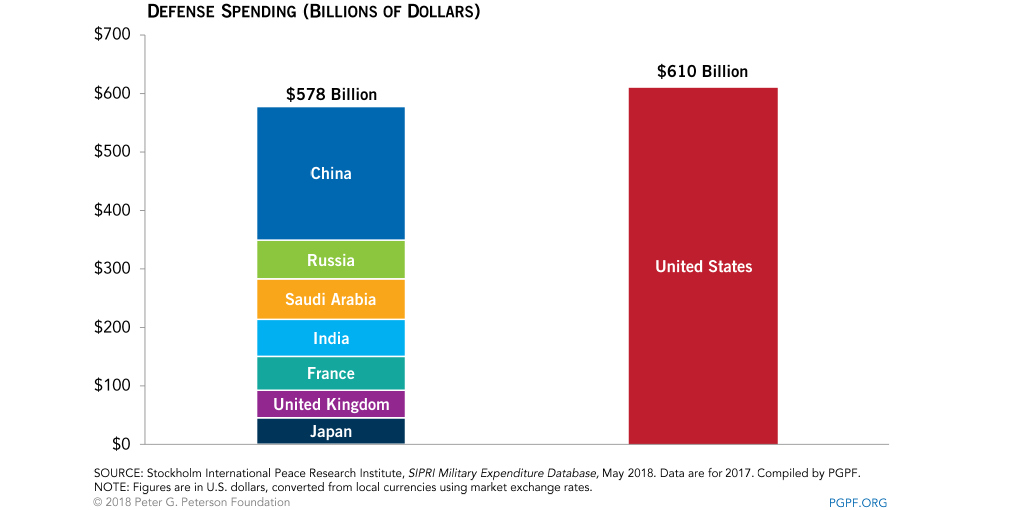
Worldwide military spending was slightly up over the last year, with the US amounting to more than a third (35%) of global military spending.AntiWar
The RS-28 [Sarmat] is far more than a follow-on to the aging R-36 [Satan] missile —it is, fundamentally, an entirely new weapon the likes of which the United States has never before seen. The “Sarmat” retains its impressive throw-weight while reducing its overall weight by nearly 50 percent by using advanced composite materials for the missile airframe and employing a new type of liquid-fuel propulsion system—the PDY-99 “pulse detonation” engine—that hyper-accelerates the RS-28 into orbit, reducing the infrared signature of the launch as well as the time available to American early-warning satellites to detect such a launch. The RS-28 is designed to either be armed with 10 750-kiloton independently targeted maneuvering warheads, each of which can destroy an American ICBM silo or launch control facility, or between 16 and 24 new hypersonic glide vehicles, each tipped with a 150-kiloton nuclear warhead, and likewise capable of taking out any hardened site on American soil. Either configuration provides Russia with the means to avoid launch detection, evade all missile defense systems, and destroy America’s land-based intercontinental ballistic missile (ICBM) nuclear force. In short, with the RS-28, Russia possesses a genuine first-strike capability that nullifies one third of America’s nuclear triad.
Contrary to Secretary Mattis’s dismissive commentary, the RS-28 does, in fact, fundamentally alter the strategic balance between Russia and the United States. Moreover, Mike Pompeo knows full well that the Russians are not bluffing. Both Mattis and Pompeo had been laboring under the false impression that Russia could not afford to field a follow-on to the R-36 missile, especially considering that that missile had been built in the Ukraine during Soviet times, and as such those capabilities were lost to Russian defense industry. The RS-28, however, is a reality—the Russians simply reconfigured their own indigenous missile production capability and will have at least 50 of the new missiles operational by 2020. It’s a reality that America’s leadership might want to factor into any future policy toward Moscow....
Cybersecurity firm Kaspersky Lab reportedly busted a major US military asset when it exposed a sophisticated cyber-espionage operation that targeted computer networks in the Middle East.
On March 9, the leading Russia-based cybersecurity company reported their research on a program it called Slingshot, which used a highly sophisticated approach to infect computers with malware through infected routers. The operation had targeted computers throughout the Middle East and some parts of Africa since at least 2012, and required a lot of money and expertise from its creators. A report by an industry news publication, CyberScoop, claims Slingshot was run by the Special Operations Command (SOCOM)....RT
Any claims that a specific piece of U.S. malware—in this case, Slingshot—was targeting only al-Qaeda or ISIS bad guys is disingenuous as well. The exploit on routers is hitting an entire region, infecting an untold number of innocent people. Internet cafés are said to have been hit in this, meaning everyone going into the cafes is at risk.
Former Aerospace Forces Commander and Russian Senate Defense Committee Chairman Viktor Bondarev says it would take at least 500 American anti-missile missiles to intercept a single Sarmat ICBM....
American effort said to lag Russia, ChinaAll this is top secret, so no one really knows, or will know unless the stuff get used. Let's hope that never happens.
“If you look at some of our peer competitors, China being one, the number of facilities that they’ve built to do hypersonics… surpasses the number we have in this country. It’s quickly surpassing it by 2 or 3 times. It is very clear that China has made this one of their national priorities. We need to do the same,” Walker told a press briefing.This is emerging as a serious problem for the US owing to the sheer size of China. The US is a big country by world standards but it is still dwarfed by China and India.
The Washington Post headlined on January 26th, “Trump plans to ask for $716 billion for national defense in 2019 — a major increase”, and reported that when President Trump had entered the White House in January 2017, the ‘Defense’ budget was $521 billion, but that President Trump will propose in his upcoming State-of-the-Union speech, a 2019 ‘Defense’ budget of $716 billion, which, if it becomes law, would mean a 37% increase, above Obama’s last Pentagon budget (for 2017).
This is in line with President Trump’s recently announced strategic change, away from Obama’s military budget, which was focused mainly against radical Islamic terrorism, now to target, instead, mainly Russia and China, and, secondarily, Iran and North Korea. As CBS News summarized on January 20th, “There is a major change in U.S. military strategy. On Friday [January 19th], more than 16 years after the 9/11 attacks, U.S. Defense Secretary Jim Mattis said terrorism is no longer the No. 1 priority. … Maintaining a military advantage over China and Russia is now Defense Secretary Mattis’ top priority.”Where is the money going to come from? (rhetorical question). Growth stimulated by the Trump tax cuts. (Trump economic team).
As we show in our recent research note ‘Blood and Oil in the Orient, Redux (2017)’, the Weapondollar-Petrodollar Coalition might no longer be in the Middle East driver’s seat. However, with the oil and armament companies, the region’s oil-exporting autocracies and various non-state groups all keen on seeing their oil incomes rise from record lows, the prospects of a new energy conflict, whether premeditated or coincidental, seem extremely high.More evidence suggestive that economics drives politics.
During a meeting of the Central Commission for Integrated Military and Civilian Development (CCIMCD) on Friday, Chinese President Xi Jinping stressed the importance “defense, science and industry” will play in the integration of the private sector and China’s military, according to an official release from Xinhua.…
“Defense science, technology and industry are key areas for integrated military and civilian development, and play a vital role in boosting the country’s innovation-driven development and supply-side structural reform,” read a Xinhua translation from a statement released after the meeting.
The commission adopted a plan for the development of “defense science, technology and industry” (as translated by Xinhua) during the period under the 13th five-year plan (2016-2020), as well as guidelines on advancing integrated military and civilian development in the areas.
I’m going to say it straight. The military industrial complex is a system of scandalous profligacy and inefficiency, the primary effect of which is not to make the USA (or other countries with similar MICs) any safer but rather to redistribute wealth out of the pockets of the general taxpayer and into the pockets of select constituencies (military personnel, defence contractors, and the like). It also largely beyond democratic control. The foundation of a liberal democratic system is accountability. But the MIC is not accountable. The large and more wasteful its failures, the more it is able to claim that it needs more money: smash up the Middle East and then the resulting disorder enables one to claim that the world is dangerous and one needs more funding; spend $190 billion failing to produce a workable missile defence system, and the fact that you don’t have a workable system justifies even more money in order to try to create one. And so on. In the world of military affairs, nothing is as rewarding as failure.Irrussianality

