Monday, November 25, 2013

PCC fifth assessment report: conclusions of the IPCC Working Group - presentation


View or download fifteen slide presentation in PDF

Prevention Web
IPCC fifth assessment report: conclusions of the IPCC Working Group I AR5, AR4, SREX and SRREN - presentation
(h/t Eric Ashelman via email)

Lars Syll — On neoliberalism and neoclassical economics

Oxford professor Simon Wren-Lewis had a post up yesterday commenting on traction gaining “attacks on mainstream economics”...
Ha-Joon Chang video (5 min) and a link to an essay by Lars.

On neoliberalism and neoclassical economics
Lars P. Syll | Professor, Malmo University


Warren Mosler on the role of government and the relationship of currency creation, employment and taxation.

Lifted from the comments at Bill Mitchell's billy blog

Good post, as always!
Let me add that I like to say it this way.
The purpose of taxation is to create unemployment as defined: people looking for paid work.
Govt does this to provision itself.
It taxes in something no one has- the $A- which creates sellers of real goods and services (unemployment) presumably so the govt. can then hire them to provision itself.
So what’s the point of creating more unemployed than the govt wants to hire? Or, said another way, what’s the point of creating the unemployed govt wants to hire and then not hiring them?
There is no point, of course, and wouldn’t be under by anyone who understood how it works.
Furthermore, the $A is a simple ‘tax credit’ as its only ultimate use is to pay taxes.
That is, when the govt spend a $A, that dollar is either
1. used to pay taxes and is lost to the economy, or
2. is not immediately used to pay taxes and remains outstanding until it is used.
The govt. allows those unused tax credits to be held in three forms- as actual cash, as cash balances at the reserve bank, or as balances in securities accounts at the reserve bank called Treasury securities.
The total of the three is the national debt.
The national debt is simply the total tax credits spent but not yet used to pay taxes.
And so the question of ‘how is it going to be paid back’ is entirely inapplicable!
So why does the economy need a deficit (tax credits spent and not yet used to pay taxes)?
Exactly as Bill says- to accommodate the desire to net save.
bottom line- unemployment is always and necessarily the evidence that the govt hasn’t spent enough to cover the need to pay taxes and the desire to save.
same thing, other way around- If the tax unemploys more people than the govt hired, it should cut the tax or hire (directly or indirectly) the rest of the unemployed.
Best!
Warren
http://www.moslereconomics.com
twitter @wbmosler

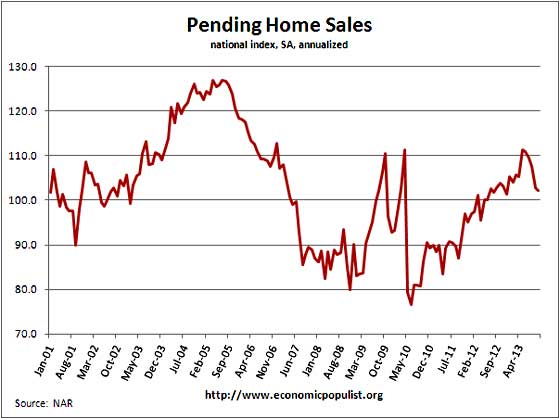
Robert Oak — Pending Homes Sales Point to Party Over


The Economic Populist
Pending Homes Sales Point to Party Over
Robert Oak

George Lakoff — The New York Times Uncovers Conservative Attacks and Then Prints One; Both Are on the Front Page

As the great linguist Charles Fillmore discovered in 1975, all words are cognitively defined relative to conceptual "frames" -- structures we all use to think all the time. Frames don't float in the air; they are neural circuits in our brains. Frames in politics are not neutral; they reflect an underlying value system. That means that language in politics is not neutral. Political words do not just pick out something in the world. They reflect value-based frames. If you successfully frame public discourse, you win the debate. 
A common neuroscience estimate is that about 98 percent of thought is unconscious and automatic, carried out by the neural system. Daniel Kahneman has since brought frame-based unconscious thought into the public arena in what he has called "System 1 thinking." Since frames carry value-based inferences with them, successfully framing public discourse means getting the public to adopt your values, and hence winning over the public by unconscious brain change, not by open discussion of the values inherent in the frames and the values that undergird the frames....
The reason that those of us in the cognitive and brain sciences write so passionately about framing issues is that unconscious thought and framing are not generally understood -- especially in progressive circles. Most progressives who went to college studied what is called Enlightenment reason, a theory of reason coming from Descartes around 1650 -- and which was historically important in 1650. The Cartesian theory of how reason works has since been largely disproved in the cognitive and brain sciences.
The Cartesian theory assumes that all thought is conscious, that it is literal (that is, it fits the world directly and uses no frame-based or metaphorical thought), that reason uses a form of mathematical logic (not frame-based logic or metaphorical logic), and that words are neutral and fit the world directly. Many liberal economists have been trained in this mode of thought and assume that the language used in economic theory is neutral and just fits the world as it is. They are usually not trained in frame semantics, cognitive linguistics, and related fields. The same is often true of liberal journalists as well. Both often miss the fact that conservatives have successfully reframed economic terms to fit their values, and that the economic terms in public discourse no longer mean what they do in economics classes.
Part of what the Cartesian theory of reason misses is the real brain mechanism that allows the conservative communication theory to be effective. By framing language to fit conservative values and by getting their framing of the language to dominate public debate, conservatives change the public's brains by the following mechanism. When a frame circuit is activated in the brain, its synapses are strengthened. This means that the probability of future activation is raised and probability of the frame becoming permanent in the brain is raised. Whenever a word defined by that frame is used, the frame is activated and strengthened. When conservatives successfully reframe a word in public discourse, that word activates conservative frames and with those frames, the conservative value system on which the frames are based. When progressives naively use conservatively reframed words, they help the conservative cause by strengthening the conservative value system in the brains of the public.
Liberals, in adhering to the old Cartesian theory of reason, will not be aware of their own unconscious values, will take then for granted, and will think that all they have to do is state the facts and the public will be convinced rationally. The facts are crucial, but they need to framed in moral terms to make moral sense and a moral impact....
The word at issue is "redistribution." The subject matter is the flow of wealth in the society and what it should be. This is a fundamentally moral issue, and the major political framings reflect two different moral views of democracy itself....
The Huffington Post
The New York Times Uncovers Conservative Attacks and Then Prints One; Both Are on the Front Page
George Lakoff | Goldman Distinguished Professor Of Cognitive Science and Linguistics at UC Berkeley

It used to be called "brainwashing" in the Fifties. Now it is called public relations and marketing & advertising.

Insane policy: Fed'l gov't makes a $41 billion profit on student loans

Question: What kind of government seeks to make a profit on money that it can issue freely and without limit and when doing so serves no public purpose?

Answer: The U.S. government, on the belief that it has no dollars and must, therefore, engage in profit seeking enterprise.

While some folks may be cheering this (maybe even some of our "leadership"), the fact of the matter is, it's categorically insane.

First off, those are profits that could have been earned by the private sector and, secondly, what good does it do to load your citizenry up on debt when the economy is not creating the jobs needed to pay those loans back?

There is no greater asset to any nation than a well educated citizenry, but apparently the powers that be, believe otherwise. They believe profits--in U.S. dollars--are more important.

DID ANYONE TELL THESE GENIUSES THAT THE GOVERNMENT CAN ISSUE DOLLARS WITHOUT LIMIT AND VIRTUALLY AT ZERO COST??

Total, fucking idiocy.

Peter Cooper — Planned Investment/Saving and Keynesian Causation

This is intended as an introductory post to explain the Keynesian (and Kaleckian) view of causation between planned investment and planned saving in particular, and planned injections and planned leakages in general. Initially, the argument is presented with reference to a simple two-sector income-expenditure model of a pure private economy. The model illustrates the Keynesian view that provided the economy is operating below full employment and there is idle capacity, planned investment generates planned saving via income adjustments rather than being financed by that saving. The second part of the post employs a four-sector model with government and external sectors included to draw out a couple of points emphasized by modern monetary theorists.
heteconomist
Planned Investment/Saving and Keynesian Causation
Peter Cooper


Dean Bakler — China's Central Bank Announces Job Creation Program for the United States

That may be a bit of an overstatement, but the comments from Yi Gang, a deputy governor at China's central bank, deserved much more attention than they received. According to Bloomberg, YI announced that the bank would no longer accumulate reserves since it does not believe it to be in China's interest. The implication is that China's currency will rise in value against the dollar and other major currencies....
CEPR
China's Central Bank Announces Job Creation Program for the United States
Dean Baker

The value of China's currency is set by the peg it chooses. Unless China also decides to relax the peg, the move will not necessarily affect the relative value of Chinese currency.

The decision "not to continue accumulating reserves" means that China will reduce its purchase of foreign government securities like US Treasuries. This would mean either reducing its surplus trade balance by increasing imports relative to exports or increasing foreign direct investment, which could raise employment in the country in which China was investing its trade surplus. The other way that China could reduce its external sector is by domestic rebalancing and shifting output to domestic use — Chinese workers working for themselves instead of foreigners.

So this move could but not necessarily benefit employment in countries that presently run a trade deficit with China.
 

Marc Saxer — What We Need To Learn From Neoliberal Discourse


More on framing.

Social Europe Journal
What We Need To Learn From Neoliberal Discourse
Marc Saxer | Director of the Friedrich-Ebert-Stiftung Bangkok office

See also Vivien A. Schmidt and Mark Thatcher, Why Are Neo-liberal Ideas So Resilient?
Neo-liberalism entails belief in competitive markets enhanced by global free trade and capital mobility, backed up by a pro-market, limited state that promotes labor market flexibility and seeks to reduce welfare dependence while marketizing the provision of public goods. The watchwords for such neo-liberalism are liberalization, privatization, deregulation, and delegation to non-majoritarian institutions such as ‘independent’ regulatory agencies and central banks. The touchstones highlight the importance of individual responsibility, the value of competition, and the centrality of market allocation. The neo-liberal mantra presents the state as the perennial problem, the market as the solution – even today, despite the fact that the crisis was caused by the markets, not the state.
So why, in light of the crisis, has there been no major shift in ideas, either back to the neo-Keynesianism that brought the postwar ‘Golden Era’ or forward to something new? How do we explain the fact that neo-liberalism continues to permeate how people think and talk about state and market? We propose five lines of analysis to explain such resilience: the flexibility of neo-liberalism’s core principles; the gaps between neo-liberal rhetoric and reality; the strength of neo-liberal discourse in debates; the power of interests in the strategic use of ideas; and the force of institutions in the embedding of neo-liberal ideas.

Media Strategies To Thwart Federal Oversight, And The Rise Of A Control Fraud Industrial Congressional Service Complex

(Commentary posted by Roger Erickson)

Move over MICC, a meaner dog's movin' in. It's purpose? To help the USA better target it's own foot. Indirectly, of course. There's big money in this industry, so it SEEMS better to not ask questions. Besides, if you do stop and think, you won't like what you perceive, and you'll never be happily ignorant again. Don't say you weren't warned.

Would your business like to have a professional Media Strategy to Thwart Federal Oversight? There are companies that specialize in this service ... regardless of the industry sector. Google terms like "Avoiding Federal Oversight" or "Hiding From Regulation" or even "Swaying Public Opinion" - or simply "Lobbying" ... and see what pops up. There are endless techniques for obscuring one's activities in plain sight, and methods for promoting the legality and/or utility of each of those methods. Who specializes in promoting public acceptance of any and all narrow-purpose methods - regardless of the net outcome?

Meet the CFICSC - which "ads" up to a Control Fraud Industrial Congressional Service Complex. Like banking, it's HQ has also traditionally been in NY city, although it keeps notable colonies in places from Hollywood to Miami, and every media outlet in between. That is the industry which is largely responsible for ensuring that justice remains blind ... and distracted too. If confused, divided and conquered sometimes follows - no matter  how often - do they have any responsibility to care? Maybe not as long as Swiss bank accounts remain secret, legal and even publically approved.

Dwight Eisenhower and his warning about the MICC? A piker! For decades before that, Edward Bernays and others had already been advising political parties to get good at propaganda, so that they could operate beneath the bounds of their own public regulations, and be hidden above the law. Of course, Bernays himself always claimed to be "shocked" that such techniques were continuously misused for significant profit extraction dedicated to narrow purposes - including his own income. C'est la Vie. Whaddya gonna do?

Nothing? Or something?

Let's get to the central question. Is unselective, self-manipulation of our own teams - instead of teamwork - really necessary for successful growth of a culture? Narrow competition by any & all system components to manipulate team resources may be a key method of capitalism. Yet a method does not address the ultimate purpose of capitalism, which has never existed in a vacuum. Excessive, uncoordinated pursuit of capitalism's methods absent alignment with evolving group strategies only produces mob behavior rather than organized culture. What would John Calvin and Max Weber think of today's interpretation of Bernay's Sauce as a "Calvinistic" way of further evolving "God's Work?" Clearly, a given method cannot define strategy or purpose. The word "capitalism" cannot adequately define tactics, strategy, goals and desired group outcomes simultaneously. The concepts vary too richly for description by one word.

Yet how do we make it more natural to select adaptively? Oh, just try enough interaction to generate affinity and feedback with all team members? Then see what outcome options pop up? That's what social species do, folks. That's what we do.

There are many who didn't see any adaptive logic when Bernays advised Central Planners to pursue unregulated efforts to manipulate rather than align team members. Yet today, many citizens still remain confused, and use their critical thinking skills only sporadically, if at all. For instance, one has to wonder why so many sports coaches are unthinking capitalists. There's no "I" in team, but apparently a few too many in unexamined capitalism! 

An unregulated collection of gangsters irrationally competing to manipulate one another produces only parasites consuming the decaying remains of their team, community or nation. Such mob outlooks can only produce a whole less than the sum of it's parts. Group success tracks a better way, but it requires a deliberate, informed policy choice.

Please remember that, next time you read an advertisement that targets YOU as nothing more than an irrational component ruled by herd instinct.
“The conscious and intelligent manipulation of the organized habits and opinions of the masses is an important element in democratic society. Those who manipulate this unseen mechanism of society constitute an invisible government which is the true ruling power of our country. ...We are governed, our minds are molded, our tastes formed, our ideas suggested, largely by men we have never heard of. This is a logical result of the way in which our democratic society is organized. Vast numbers of human beings must cooperate in this manner if they are to live together as a smoothly functioning society. ...In almost every act of our daily lives, whether in the sphere of politics or business, in our social conduct or our ethical thinking, we are dominated by the relatively small number of persons...who understand the mental processes and social patterns of the masses. It is they who pull the wires which control the public mind.
Mr. Invisible
How does that pull YOUR mind? As an alternative, there are 30-70 Trillion cells in the average human body, and they are NOT ruled by a few. Rather, their amazing, net agility - you - is a product of all your cells coordinating with all your cells. There is no Central Planner cell, or even a central committee. When agile teams work together, they accomplish truly amazing things. Bernays' version of this sauce has certainly gone rancid. In fact, it was toxic from the beginning. If used in food, Bernays' Sauce would have been outlawed, for failing all Clinical Trial testing.

Perhaps we really do need a more formal Civic Trial proof of concept, for all proposed policy changes randomly suggested by citizens. An Outcomes Impact Statement? Maybe that's how we the people may more quickly SELECT adaptation from cultural-auto-immune social diseases, or self-parasitism. Simply by making the effort to have all of us receive influences from all of us. Surely that is the foundation of an informed electorate?

Instead of attempting the oxymoron of a Centrally Planned mob rule, can the Unseen Affinity of a democracy's Middle Class stay continuously one step ahead of it's own, inevitable, fraud faction, and thereby rule itself more rather than less adaptively?

Only if we inform our electorate well enough to see through the anti-self-regulation advice of Ed Bernays, the Father of Control Fraud Protection Services.

My next Forex course is Dec 9 -13

My next Forex course will be Dec 9 - 13. One of my students called it the "Moneyball" of trading.

For more info or, to sign up, go here.

Sunday, November 24, 2013

Chomsky: Business Elites Are Waging a Brutal Class War in America

The business classes are constantly fighting a bitter class war to improve their power and diminish opposition.
AlterNet
Chomsky: Business Elites Are Waging a Brutal Class War in America
Noam Chomsky
Excerpt from the just released 2nd edition of Noam Chomsky’s OCCUPY: Class War, Rebellion and Solidarity, edited by Greg Ruggiero and published by Zuccotti Park Press. Chris Steele interviews Chomsky.

Ralph Nader — 21 Ways Canada's Single-Payer System Beats Obamacare

Canadian style single-payer healthcare is simple, affordable, comprehensive and universal—unlike the US's labyrinthine ACA
AlterNet
21 Ways Canada's Single-Payer System Beats Obamacare
Ralph Nader

Scott Kaufman — Chairman claims Nevada Libertarian Party ‘infested with idiots’ (via Raw Story )

Chairman claims Nevada Libertarian Party ‘infested with idiots’ (via Raw Story )
The Chairman of the Libertarian Party of Nevada (LPN), Joseph P. Silvestri, recently announced that he “need[s] a break” from the “knuckleheads” who run the LPN. “I have little hope that we shall see any quality activists lead the LPN this…

Michael Pettis — When are markets “rational”?

Last month’s award of the Nobel Price in economics set off a great deal of chortling because one of the three recipients, Eugene Fama, received the award for saying that markets are efficient at capital allocation and another, Robert Schiller, received the award for saying they are not....
To me, much of the argument about whether or not markets are efficient misses the point. There are conditions, it seems, under which markets seem to do a great job of managing risk, keeping the cost of capital reasonable, and allocating capital to its most productive use, and there are times when clearly this does not happen. The interesting question, in that case, becomes what are the conditions under which the former seems to occur.
Michael Pettis jumps into the fray.

China Financial Markets
When are markets “rational”?
Michael Pettis

Merijn Knibbe — Malinvaud on how USA economists increasingly dismissed measurement

One of the problems of the economics curriculum is that very little attention is paid to measurement. And indeed, academic economists generally know little about this as most measurement is carried out by specialized statistical institutes. What about the history of this regrettable situation? The French economist Malinvaud (and long time head of the French statistical institute INSEE) has a nice metric on how USA economists increasingly dismissed empirical economics (let alone actual measurement) and turned to a-empirical ´high theory´ littered will ill-defined variables instead:

Real-World Economics Review Blog
Malinvaud on how USA economists increasingly dismissed measurement
Merijn Knibbe

Lord Kelvin: “Science is measurement.”

Science is distinguished from philosophy and other speculative thought based on reasoning in that first principles are rejected in favor of empirically determinable assumptions as starting points and empirical testing of hypotheses is based on measurement of observables in accordance with rigorous experimental methodology. Thought experiments are only heuristic devices and cannot be taken as in anyway definitive scientifically. 

Is much of conventional economic modeling actually thought experiments masquerading as definitive scientifically? Is the result social, political, and economic speculation — "philosophy" — rather than science, whose results have an empirical warrant in addition to a logical pedigree in a deductive system based on assumptions?


Andy Sullivan — Tea Party Republicans Backed By Big Corporate Players Following Shutdown


Snake pit.

The Huffington Post
Tea Party Republicans Backed By Big Corporate Players Following Shutdown
Andy Sullivan | Reuters

Saturday, November 23, 2013

Robert Vienneau — On "Neoclassical Economics"


Definitions of "neoclassical economics."

Thought on Economics
On "Neoclassical Economics"
Robert Vienneau

Bill Mitchell — External economy considerations – Part 9

I am now using Friday’s blog space to provide draft versions of the Modern Monetary Theory textbook that I am writing with my colleague and friend Randy Wray. We expect to publish the text sometime in 2013. Our (very incomplete) textbook home page – Modern Monetary Theory and Practice – has draft chapters and contents etc in varying states of completion. Comments are always welcome. Note also that the text I post here is not intended to be a blog-style narrative but constitutes the drafting work I am doing – that is, the material posted will not represent the complete text. Further it will change as the drafting process evolves.

Chapter 21 Policy in an Open Economy: Exchange Rates, Balance of Payments, and Competitiveness
This material updates the work already done on Chapter 21 that appeared in the following blogs:
Today, I am just continuing filling in the gaps in the Chapter.
21.7 Currency crises
[CONTINUING THIS SECTION FROM LAST WEEK - PREVIOUS MATERIAL IN LAST POSTS LINKED ABOVE]
The South East Asian Debt Crisis 1997
Bill Mitchell – billy blog
External economy considerations – Part 9
Bill Mitchell | Professor in Economics and Director of the Centre of Full Employment and Equity (CofFEE), at the Charles Darwin University, Northern Territory, Australia

Mathew Forstater — Alan Watts got it. So did Alexander Del Mar

Alan Watts, best known for bringing Eastern philosophy to Western readers, had a better understanding of money than most economists. In an essay entitled “Wealth versus Money,” he writes that money is a unit of measurement, like acres measure units of land. You can run out of land, but you can’t run out of acres. Here’s the passage from his essay:
'It was just as if someone had come to work on building a house and…the boss had said, “Sorry, baby, but we can’t build today. No inches.” “Whaddya mean no inches? We got wood. We got metal. We even got tape measures.” “Yeah, but you don’t understand business. We been using too many inches and there’s just no more to go around.”'
This is similar to Alexander Del Mar’s distinction between a unit of measurement and the thing it measures. Del Mar wrote that, “Money is not pieces of merchandise any more than…minutes are pieces of clocks.” Or Warren Mosler’s admonition that money is how we “keep score,” and the idea that we can run out of money is as absurd as the idea that the scorekeeper in a football match can run out of “points”: Peyton Manning threw another touchdown pass? Sorry, no points left, we can’t increase the Broncos’ score!
Mathew Forstater
lifted from FaceBook

Great find!

JFK and Federal Budgetary Policy under the Authority of Gold


NEP yesterday, on the day that marked the 50th year since he died in a lawless act, had a nice excerpt from a commencement address at Yale by JFK from 1962.

Posted without commentary, it seems to be an excerpt that picked out some nice observations about fiscal policy by JFK.  Here is a copy of the full address at a UVa website.

I'd like to point out further context of the fiscal issues that JFK was talking about in light of the fact that in 1962 we were still a retrograde nation, populated by retrograde humans, both under the authority of the metal gold (Column 11, Number 79) the presence of which was still required in order to extinguish the external liabilities of our nation and this produced REAL effects for the nation not just financial effects.

Through the words of JFK here, we can see that the REAL loss of possession of mass measures of this metal by our nation was a major concern that influenced decisions by the policymakers of that time in our history.

The word "gold" appears 6 times in this speech.

Here are all 6 in local context:

Calhoun in 1804 and Taft in 1878 graduated into a world very different from ours today. They and their contemporaries spent entire careers stretching over 40 years in grappling with a few dramatic issues on which the Nation was sharply and emotionally divided, issues that occupied the attention of a generation at a time: the national bank, the disposal of the public lands, nullification or union, freedom or slavery, gold or silver.  [Ed: interesting here sees subjection to the metals as separate to human slavery... blind...] Today these old sweeping issues very largely have disappeared.
A well-known business journal this morning, as I journeyed to New Haven, raised the prospects that a further budget deficit would bring inflation and encourage the flow of gold. [Ed: this was a "bad" thing back then...]  We have had several budget deficits beginning with a $12 1/2 billion deficit in 1958, and it is true that in the fall of 1960 we had a gold dollar loss running at $5 billion annually.  [Ed: "gold dollar loss"... interesting.] This would seem to prove the case that a deficit produces inflation and that we lose gold, [Ed: a concern NOT present today thank God.] there was no inflation following the deficit of 1958 nor has there been inflation since then.
Our wholesale price index since 1958 has remained completely level in spite of several deficits, because the loss of gold has been due to other reasons: price instability, relative interest rates, relative export-import balances, national security expenditures—all the rest.
Let me give you a third and final example. At the World Bank meeting in September, a number of American bankers attending predicted to their European colleagues that because of the fiscal 1962 budget deficit, there would be a strong inflationary pressure on the dollar and a loss of gold. Their predictions of inflation were shared by many in business and helped push the market up. The recent reality of non-inflation helped bring it down. We have had no inflation because we have had other factors in our economy that have contributed to price stability.
So we can see that the fiscal issues back then could not be discussed without demonstrating a serious concern for what REAL effects such policies may have had on our nations ability to retain mass measures of the metallic element gold.

This REAL concern is gone from the scene today, the nation has gained back its absolute fiscal authority, ours is no longer a retrograde nation; but unfortunately our policymakers remain retrograde humans.


Friday, November 22, 2013

Eric Zuesse — Why Chris Christie Is Edging Past Hillary Clinton For President


Looking like Christie is the big donor's pick for us in '16. The selling has already begun.

The Huffington Post
Why Chris Christie Is Edging Past Hillary Clinton For President
Eric Zuesse

David Ferguson — Report: Corporations use professional spies-for-hire to monitor and undermine nonprofits (via Raw Story )

Report: Corporations use professional spies-for-hire to monitor and undermine nonprofits (via Raw Story )
A newly released report from the watchdog group Essential Information alleges that powerful corporations spy on and sabotage the very nonprofit groups dedicated to keeping them in check. According to the report, titled “Spooky Business,” a global…

John Paulson finally stops buying gold. But he doesn't even know why.

Yesterday, billionaire hedge fund manager John Pauslon told his clients that he will not be adding anymore gold to his holdings. No wonder, Paulson has gotten slaughtereed in gold. And the reason he's not buying anymore is not because he has come to understand monetary operations, but because he's gotten so destroyed in gold that now he's gun shy. As a trader I've seen many other traders go through this, I know what it's all about.

Paulson is gun shy. He's been so brutalized in gold because of his simplistic, unsophisticated and ignorant views with respect to moentary policy and inflation that he can't touch another ounce.

Paulson should have listened to MMT. MMT got it right. MMT explained many, many, times that QE, interest rate setting, etc, only changes the composition of the financial assts held by the public, it does not put any new money into anyone's hands. Moreover, QE, with its strong interest income reducing effects, is more deflationary than inflationary.

John Paulson didn't understand this and he still doesn't. He's clueless. Maybe he takes his advice from another idiot by the name of Peter Schiff, who knows? But one thing is for sure, Paulson is, each and every day, looking more lucky than smart.

Guest Post: Ralph Musgrave — We're ruled by idiots like Larry Summers.


We're ruled by idiots, like Larry Summers.

Here's a sample of the idiocy: first, the Bank of England doesn't know what happened to the money it created so as to effect QE. Second, the drug and porn addicted head of the Co-op bank in the UK when asked what the total assets of his bank were, gave £3bn as the answer. In fact the correct figure was £47bn. Don't you just love it? Anyway, moving on to that supposedly important speech by Summers at the IMF a few days ago, he points out that the crises was caused by "imprudent lending". Yes, we all worked that out. But he doesn't tell us what the solution for that problem is. Though presumably he's not so totally dim as not to be aware of the solution: make banks hold more capital. But personally I prefer taking that further, as advocated by Laurence Kotlikoff, and as follows.

Kotlikoff's solution. Ban the blatantly fraudulent practice that banks have adopted for decades, namely making silly loans in the knowledge that the taxpayer will rescue banks (particularly the large ones) when the loans are silly enough. In other words adopt the system advocated by Kotlikoff under which depositors who want their bank to lend their money on so as to enable them to earn interest carry the full cost when loans go wrong. That would greatly concentrate the minds of depositor / lenders and lead to more responsible lending. Though those who particularly wanted to lend to risky borrowers would be free to do so, but they they'd carry the risk. Alternatively, under K's system, where a depositor wants 100% safety, then their money is kept in a 100% safe fashion: nothing is done with it, so it's not loaned on, and thus earns no interest. The result would be that it would be near impossible for a bank to suddenly fail, though it could perfectly well dwindle to nothing over a period of years. Plus any credit crunches would be far less volatile. But whether we impose bigger capital requirements on banks or take that further and go for K's solution, the effect would be deflationary: banks would lend less. So some sort of compensating and stimulatory measure would be required.

How do we impart stimulus? Let's scratch our heads. Well that's a big problem for Summers because he doesn't seem to know how to impart stimulus. As he puts it, "we may well need, in the years ahead, to think about how we manage an economy in which the zero nominal interest rate is a chronic and systemic inhibitor of economic activity, holding our economies back below their potential." The jaw of most MMTers will drop at that statement. The great Larry Summers doesn't know how to impart stimulus when interest rates are near zero. Well Larry, if you're listening, here's how to do it. Create fiat and spend it (and/or cut taxes). The fact of government creating money and spending it means more jobs in the usual public sector areas: education, the military, infrastructure creation , etc. And as to tax cuts, that induces households to spend more. Moreover, the latter policy boosts the net liquid paper assets of the private sector, which induces the private sector to spend. What do people do when they win a lottery? Unless you're mentally retarded or a senior economist who hangs out inside the Washington beltway, you'll know that when people win a lottery, they tend to spend a fair proportion of their winnings. Revelation of the century that, wasn't it? As Dean Baker put it, "In elite Washington circles, ignorance is a credential".

Ralph Musgrave

Econ Evolution Diagram

Here's a diagram to go with my previous post on selected highlights of recent economic history:

        Diagram: Evolution of Selected Economic Schools

Thanks for the comments and feedback on the previous post.  Obviously, this is not meant to be comprehensive or scientific.  Rather it's meant to show influences on MMT and the relationships among the various schools of economic thought that we most often discuss around here.  Any feedback or suggestions in that regard will be most welcome...

Thursday, November 21, 2013

UMKC student video — Direct Jobs Program


Direct Jobs Program
(h/t Stephanie Kelton at FB)

Pam Martens — Fed Minutes Reveal a Dangerous Power Grab by New York Fed

Just when it seemed one could no longer be shocked by the corruption, hubris and lack of accountability in the American financial system, along comes yesterday’s release of the Federal Reserve’s minutes for the October 29-30 meeting of its Federal Open Market Committee (FOMC).
While mainstream media focuses on what the minutes revealed about when the Fed might begin to reduce its monthly $85 billion in bond purchases, receiving scant attention is a brazen power grab boldly stated on page two of the eleven pages of minutes.
Back on October 31, wire services reported that the temporary dollar and foreign currency swap lines that had been put in place between central banks on a temporary basis during the financial crisis had been turned into standing arrangements.
The Associated Press explained the action as follows: “Six of the world’s leading central banks, including the U.S. Federal Reserve, say they will provide each other with ready supplies of their currencies on a standing basis, extending arrangements set up to steady the global financial system during post-2007 turbulence.”
In other words, without public deliberations, an action that was adopted as a temporary, emergency operation, now had become a permanent part of world finance – on the basis of minutes and details yet to be seen by Congress or the general public…..
It gets worse from here.

Yves Smith — The Skunk Party Manifesto


Yves is on a tear.
The best political system that money can buy is doing a great job for its customers and a lousy job for the rest of us.
Most Americans do not realize that they are on the losing end of a 40-year war against them. On August 23, 1971, former Nixon Supreme Court Justice Louis Powell circulated what came to be known as the Powell memo. It set forth a detailed program for reshaping American institutions and values to favor the interests of corporations over those of ordinary citizens. The success of this initiative has been so complete that it has not only rolled back many of the bulwarks created by the New Deal and the Great Society, but it is also in the process of pauperizing ordinary workers in order to increase record business profits even further. The fact that the campaign has also produced rampant political dysfunction, curtailed civil liberties and helped cement an out-of-control surveillance state is of perilous little concern to powerful elites as long as their plutocratic land-grab continues.
Naked Capitalism
The Skunk Party Manifesto
Yves Smith

Scott Sumner mentions Warren Mosler


Mike Sax points us to a Scott Sumner post commenting on Warren Mosler today.

Diary of a Republican Hater
Sumner and Warren Mosler on Forward Guidance
evilsax