Showing posts with label world economy. Show all posts

Wednesday, August 8, 2018

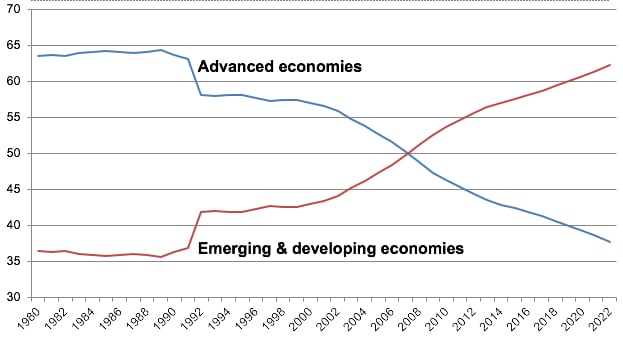
World Economic Forum — Emerging economies are now richer than the West

 Emerging and Developing Economies for the First Time Account for a Larger Share of World GDP or Global Output Than Developed Economies; A Point Surpassed After the 2008 Financial Crisis That Has Continued Apace (See Figure 1)....
How has this been achieved? Possessing good institutions is what economists have come to focus on and the spread of such institutions seems to have been key, as the father of New Institutional Economics predicted. The seminal work in this area was by Douglass North who was frustrated by neoclassical economic models that focused on measurable factors like workers and investment, with attempts to measuring technological progress, even though they could not fully explain why some economies grow well and others do not.

So, North took economics out of its comfort zone, which consisted of examining more easily measured inputs like labour and capital, and instead brought in politics, psychology, and strategy, as well as history, in order to understand why some countries succeed and others fail. He stressed that there was no reason why countries could not learn from more successful economies to better their own institutions. That finally happened in the 1990s....
This sort of imitation of good institutions and effective economic policies was as outlined by institutional economists such as Douglass North. It took the fall of the Berlin Wall, the rescue of India by the IMF in 1991 as well as China’s re-orientation towards the global economy in 1992 for these economies to look to adopt a new course. By emulating ‘best practice’ in other economies as well as opening up, which meant learning from more successful foreign companies, these countries have made tremendous progress as North would have expected. He would have approved of these economies looking more widely than just on capital or labour or technology in fashioning their growth policies.

North once remarked: “My pet peeve all through the last twenty years or thirty years has been the narrowness of economists, in fact of all social scientists, in not opening up whole new areas” (North et al. 2015: 9). And his ideas have brought us closer than ever before to answering the age-old question of how countries can become rich.
The take-away from Douglass North's work is not so much that capitalism is the superior system in the sense that conventional economics treats it as that Western approaches to socio-economic and political organization proved superior to other approaches. The issues are more complicated than the simplified models of conventional economics, with their restrictive assumptions that are ideologically based — e.g., maximization and equilibrium. North recognized that broader scope was required.

North adopted a different methodology that includes all factors he found to be relevant rather than seeking formal elegance but sacrificing empirical relevance. North was an institutional economist that specialized in development economics, and he worked in quantitative economic history (cliometrics), as well, which was needed for his empirical research.

World Economic Forum
Emerging economies are now richer than the West
In collaboration with VoxEU

Sunday, November 5, 2017

Jeff J. Brown — War between Anti-West and Eurangloland heating up fast

Wow, what a novel idea for the capitalist West. Do peaceful, mutually beneficial trade and exchanges together, without invasion, occupation, destruction, extraction and exploitation. Who would have thought?…
Hey, stand tall and be proud, Westerners. It’s what makes your plutocratic “democracy” and capitalism so great – for the handful of thieves running their vampire Ponzi scheme on your behalf – NOT (http://thesaker.is/on-the-meaning-of-the-word-democracy/).
No wonder the Chinese, Russians, Iranians and Co. are not exactly mesmerized by the West’s “Shining Capitalist Beacon on the Hill Exceptionalism” propaganda poppycock. That hocus pocus drug quit working a long time ago. In any case, they’re too busy building a better, fairer and more just 21st century for all of us.
Wow, what a novel idea. Who would have thought?
The Vineyard of the Saker
War between Anti-West and Eurangloland heating up fast
Jeff J. Brown

Monday, October 23, 2017

Simon Wren-Lewis — Dani Rodrik talks straight on trade


Short review of Dani Rodrik's latest book, Straight Talk on Trade: Ideas for a Sane World Economy.
In that sense the title of the book is rather misleading. Although it is discussed a lot, this is hardly just a book about trade. Indeed the subtitle “Ideas for a sane world economy” conveys a better picture of what it is about. The book is based on a collection of articles written for Project Syndicate and elsewhere, and occasionally the joins show. But that feeling quickly gets lost in a wealth of stimulating arguments and ideas that I defy anyone to find dull. This is a fascinating book to read, and I cannot think of anyone who would not learn a great deal from reading it.
It sounds like this book is in the right ball park, dealing with the global economy as a closed system in terms of the social, political and economic issues this involves owing to national boundaries and regional affiliations. Addressing these issues successfully is the challenge of the age in order to avoid dysfunction and conflict above all, but also to aim at distributed prosperity along with fostering political stability and promoting social harmony.

Mainly Macro
Dani Rodrik talks straight on trade
Simon Wren-Lewis | Professor of Economics, Oxford University

Wednesday, June 10, 2015

C.P. Chandrasekhar and Jayati Ghosh — Looking to the U.S.

All eyes are focused on the US economy and its performance. The explanations as to what motivates this are residual. With growth in China slowing, India’s economic performance disappointing, Japan still in recession and the uncertainty in Europe resulting from EU brinkmanship with respect to Greece, growth in the US seems to be the only immediate hope for the long awaited recovery from the six years of sluggishness that have followed the 2009 crisis. So, only the US can help.
What this means is that only the US has the capacity to absorb lagging demand globally by again becoming the world's marketplace and greatly expanding its trade deficit to accommodate net exporting counties.