Friday, August 16, 2013

Theresa Riley, Bill Moyers & Company — Wisconsin Democrat who infiltrated ALEC: ‘They don’t want people involved in the political process’

I'd be shocked it this were not already so well documented. But here is a first hand report by an "infiltrator" on the neoliberal mind in action.

Here's an illustration of their idea of representative democracy."
One guy I was talking to, who was from one of these right wing think tanks was saying we need to curb Obama’s reckless power with these administrative regulations, and he wanted a federal constitutional amendment saying Congress has to approve federal regulations. I said, I don’t think most people are going to want to amend the Constitution for that. I don’t think that ignites people. Maybe it does on the far right, but most people don’t really care about that. And he said, “Oh, well, you really don’t need people to do this. You just need control over the legislature and you need money, and we have both.”
That sentiment was underscored so many times to me, that they don’t want people involved in the political process, or in the policy process. And that seems to be the intent in a lot of ways: You have a think tank in every state and all they do is come up with these very, very regressive policies, you have corporations who are going to benefit so they fund it all, and then you have the legislators as your foot soldiers to carry out the tasks.
The best government that money can buy. And the best equipped security force to enforce it. The difference between fascism and communism is that fascism is corporate statism, and communism is corporate statism. Just a matter of emphasis. A neo-feudal elite are in control in both.
 I was really impressed by their infrastructure. I mean, we would never duplicate something like this on the left because, first of all, we would never take instructions from corporations, but the coordination that they have between these policy think tanks, the money and the legislators, in terms of just driving an agenda, it’s incredible. I’ve never seen anything like it. I’m fascinated by it because I’ve never seen anything like it from the left. I was the public policy director at Planned Parenthood, so I’m very familiar with building infrastructure. We did a lot of that in the state of Wisconsin. But we have nothing that I know of on the national front that connects all these things.
It is a well-oiled machine. They’re really organized, they’re really coordinated and they have the resources. And they’re not afraid to push it when they have the opportunities. Now they have 24 state legislatures that are Republican controlled and they have Republican governors. So they’ve had incredible success. They’ve had 71 bills introduced just this year that make it harder for most people who are injured to access the courts. We’ve certainly seen that here in Wisconsin. That was one of the first things that Walker did when he came in was push this tort reform through.
The Raw Story
Wisconsin Democrat who infiltrated ALEC: ‘They don’t want people involved in the political process’
Theresa Riley, Bill Moyers & Company


Them's Fightin' Words! (But Is There Any Fight Left In The Middle Class?)

Commentary by Roger Erickson

US Budget Deficit Down 37.6% Through July: CBO  (hat tip @Mattison13 Aug )

Rich lord's class war, poor people's infighting?

"Our electorate expends fiat first, and denominates it as fiat currency, then ... "

What's left, now or later, after selectively clawing back present AND FUTURE fiat currency - as taxes - per convoluted policy ... is (and will continue to be) promptly re-distributed from bottom to top.

Why? Just because! Because they can. What matters is whether enough is left, distributed among the Middle Class, to maintain an agile culture. Cultural and national agility depends on the quality of distributed decision-making, NOT on the absolute magnitude of liquidity, poorly distributed. There's no 1% in teamwork?

Upper Looting Class (ULC): "Well, they weren't USING it!" ["For anything we approve of. Nor WILL they - if we have any say in the matter."]

So what does the Middle Class think of what the ULC are doing with all OUR fiat & fiat currency - current and future? Are THEY using it for anything WE approve of? Will they ever do so - left to their own devices?  What if WE just alter OUR policy?

"That ain't gonna happen."
"Ah'll tell 'ya one thing. They ain't gettin' control of their current OR FUTURE fiat!"

Yes. Them is, indeed fightin' words.  

Time to fight fiat with fiat? They're convertible you know. Just in more and different ways than you've been told.

To be precise, it's not just that the ULC is hoarding existing fiat, they're also trying to cut off other's access to available future fiat. That can come from either static-vs-dynamic thinking, OR, entirely from jostling for position in the boat, regardless of where it's heading.

Family, clan & class competition is always 2-pronged, seeking to under-fund AND over-tax perceived competition, now and in the future.


Larx Syll — Latvia and Sweden — the ultimate Keynes killers? (video)

Some people seem to consider the case of Latvia the ultimate Keynes killer, showing that austerity policies suffice to get you out of deep recessions and not having to fall back on Keynesian stimulus.Hmm …What are the facts? Latvia today has a real GDP that still is far below its pre-crisis peak. Its unemployment rate is close to 15 %. Indeed an impressive success …
Latvia and Sweden — the ultimate Keynes killers? (video)
Lars P. Syll | Professor of Social Studies and Associate Professor of Economics, Malmo University
(h/t Ralph Musgrave via email)

A Domestic Army? - Or Just A MICC Run Amok, Drunk on Corn Policy & Ethanol Fraud?

Commentary by Roger Erickson

Why is it that economics has banned the F-word (fraud)? And the P-word as well? You know, the overwhelming effect of "policy?"

"You're building a domestic army here!" (hat tip Selva Tinnan)

Isn't this another sign of the USA's inability to adjust?

It's an interesting tape, that is generating lots of buzz. Yet does such rhetoric help?

Is there really any concerted,organized task behind domestic militarization?

Or, is it just a mindless result of a MICC-support policy run amok, seeking to sustain sales? Oh my gosh, I've used that dreaded P word again, and in a blog that's supposed to be about abstract, academic economics! Will no academics take me seriously again, after such a faux pas ... repeated?

Fraud! Policy! Fraud! Policy! Fraud! Policy! Fraud! Policy! Fraud! Policy!
(Must be a realism tic. I didn't know reality had any interest in compounding - at least in this country.)

Are there other aspects to consider? Well, here's another, random, anecdotal example in another area.

30 years back, we decided to grow more corn than ever in history. Policy! (Sorry, it's my new tic. It comes & goes.)

AFTERWARDS, people looked for what to do with it all. Slow adjustment?

Results included high-fructose corn syrup in comical places. FRAUD!

Then ethanol in most gasoline - FRAUD PLUS POLICY!! (Is there such a thing as a compounding tic? It may be contagious. Not sure if I caught this from society, or they caught if from my ancestors. It certainly seems to be a social, not just virtual syndrome. Had no idea these things could jump between individuals & whole societies. Scary.)

A corn tail wagging the national dog ... = a policy? Or a fraud. That is one question. The other is, which came first? The fraud or the policy? Either? Is any combination possible? Can they appear simultaneously? Apparently anywhere except in accepted economic literature & conversation!

Is the MICC just one variant of a deeper malaise? The FPSC?  Fraud-policy-social-complex? This may be getting too taboo to ignore. Intense social self-therapy may be required.

If we can't discuss those social variants within economics, where can we? Reality? I know, that seems SO distasteful. Next thing you know, abstract economists might stoop to discussing banking and currency operations! Is nothing sacred?

Yes, we may have to adjust, and start using the F&P words more often. At least intermittantly. Luckily, it doesn't seem to require full time attention. Maybe the only adjustment needed is creation of another Automatic Stabilizer. One that keeps economists far away from operational policy? Maybe ban it's use by frauds too, so they can't hide behind it while looting S&Ls, farming, TBTF banks ... and even Congress, Fed & Treasury, etc, etc. The list of components we as a whole have used the F&P combo to self-loot ... is amazingly long, and it's growing. We may have to fight one social tic with another social tic.* Like using cowpox to immunize against smallpox.

Anyway, back to comparing corn/ethanol and MICC/domestic-weaponry. Are we doing the same thing in both situations? Corn/booze/MICC/guns ... sounds both intoxicating and incendiary.  We're actually lucky that diabetes is an unanticipated side effect of high fructose corn syrup, and a natural brake on US activity rates? It does get complicated.

But what can we do? If fighting & obesity both dwindled ... who on earth would we & others sell all this stuff to? And those 2 topics are just the tip of the F&P_berg.

If we eventually had to, could we re-purpose both corn and the MICC? (Sorry, it's getting worse. I'll go wash my mouth out right after this.) How soon could we re-purpose them? Do we even know how to adjust any more? Look, how hard can it be? We might have to re-learn adjustment, but we could certainly figure it out, even if we had to start from scratch.

Fraud! Policy! Bullshit! Fraud! Policy! Bullshit!  - Off to my next therapy session. Ciao.

* Practice at logic may be a cure for the f-p social tic. And immunization with yet another tic-causing habit has been reported to work wonders. When viewing any combination of fraud and/or policy, if you practice mouthing "Bullshit!" - it seems to damp & control the F&P affinity. "Bullshit!" tic as immunization against the F&P social virus & resultant social tic? Citizens, socially immunize thyself, and thy country.


Thursday, August 15, 2013

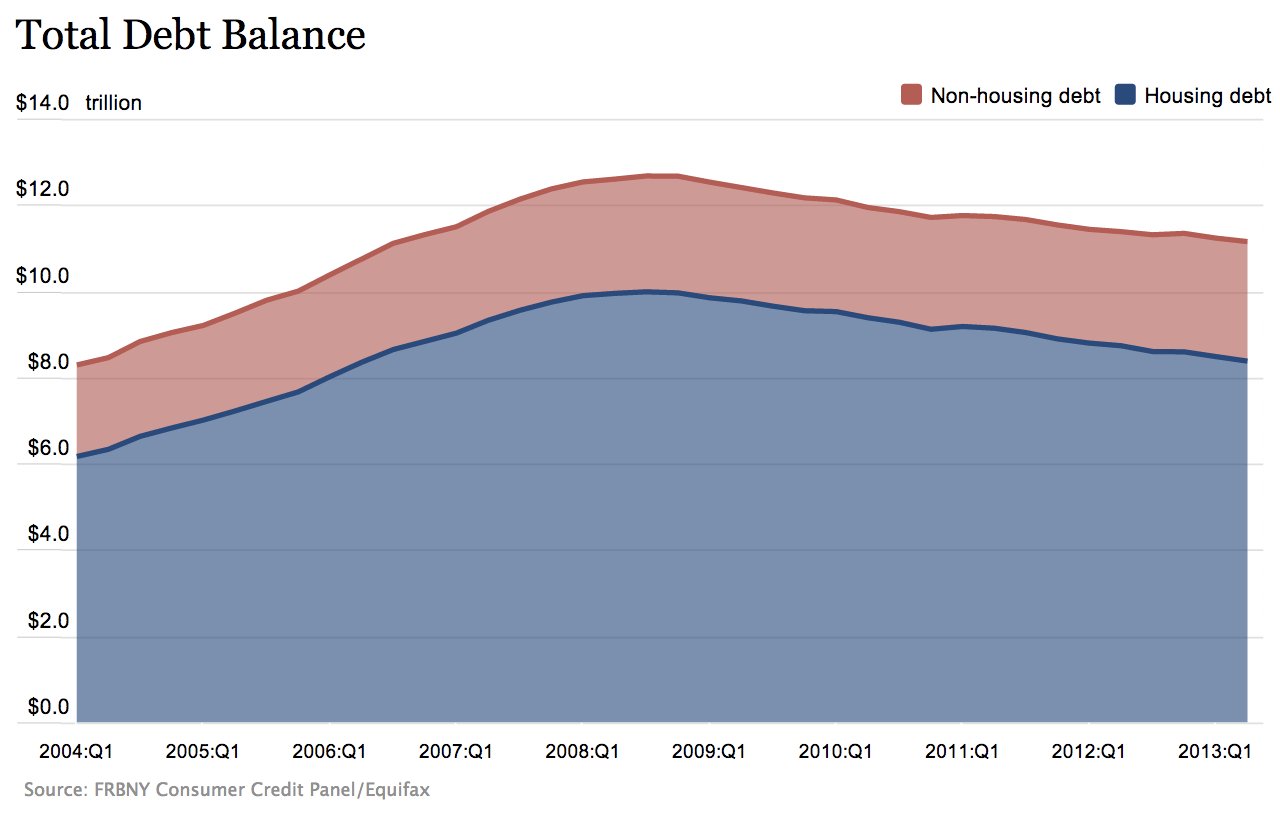
Mark Gongloff — Household Debt Is Still Too Damn High


The Huffington Post
Household Debt Is Still Too Damn High
Mark Gongloff
Household debt is still a big problem, but don't be confused: Government debt is not a problem. In fact, the government should be going deeper into debt now, while interest rates are still relatively low, to help generate demand while consumers continue to nurse themselves back to health.
Good for Mark. He gets it.


U.S. now has the highest income inequality in the developed world

Very ignominious achievement.

So how did America get so darn great at ratcheting open the chasm between the haves and have-nots? Thank the dynamic duo of Wall Street and Washington, which have been working so well together for the past few decades to make laws that favor banks. Turns out this Axis Of Making It Rain has also been making laws that favor the exorbitantly wealthy. Win-win. Unless you are poor, in which case: Sorry, be born to richer parents next time, maybe?


The higher the dot, the higher the income inequality.

Read rest of the story here.

Lars Syll — William Buiter on useless macroeconomic theories

Both the New Classical and New Keynesian complete markets macroeconomic theories not only did not allow questions about insolvency and illiquidity to be answered. They did not allow such questions to be asked....
Lars P. Syll's Blog
On useless macroeconomic theories
Quoting William Buiter

circuit — James Tobin on why deflation isn't a cure for unemployment

There's been a lot written lately on why the Pigou effect (i.e., increase in output and employment caused by an increase in consumption due to a rise in the real balances of wealth) isn't a foolproof way around the problem of the zero lower bound. It reminded me of these lines by James Tobin....
Fictional Reserve Barking
James Tobin on why deflation isn't a cure for unemployment
circuit

Why lower prices do not necessarily stimulate demand, and why it is likely they won't in Fisher debt-deflation.

Randy Wray — Banks Don’t Lend Reserves! Who Knew? MMT, That’s Who!

OK so it took almost four decades but finally the mainstream is waking up to the fact that banks do not “lend out” reserves (except to one another in the fed funds market). The whole “deposit multiplier” story that was taught in every American money and banking textbook is wrong. Always has been wrong.
(Just an aside: the mistake was largely an American deal. British students got to use Charles Goodhart’s text, which always got it right. But generations of Americans as well as foreigners who studied in America were misled by our textbooks.)
If our policymakers who art in Washington understood this, we would not have got QE. Or all the hyperinflation hyperventilating by those who fear that the trillions of dollars of excess reserves will get “lent out” and cause prices to go to the stratosphere.
Banks do not “use” reserves as the raw material for loan-making. Rather, they lend out their own deposits, which are created by keystrokes. Post Keynesians have been saying this since a seminal piece by Basil Moore was published in 1979 (and it is easy to find early precursors all the way back to the dawn of time–as I demonstrated in my 1990 book, Money and Credit in Capitalist Economies).
Economonitor — Great Leap Forward
Banks Don’t Lend Reserves! Who Knew? MMT, That’s Who!
L. Randall Wray | Professor of Economics, UMKC


Bill Morlin — 7,000 Gun-Loving "Patriots" Living in an Walled Citadel Built Around an Arms Factory in Idaho -- What Could Possibly Go Wrong?

Far-right gun enthusiasts say they are planning to build a walled city in northern Idaho for “Patriots” who love the Constitution and hate “liberals, Marxists and blue voters.”
Building their very own insane asylum? I feel safer knowing that many of the extreme nutters are clustering together out in nowhere.

AlterNet
7,000 Gun-Loving "Patriots" Living in an Walled Citadel Built Around an Arms Factory in Idaho -- What Could Possibly Go Wrong?
Bill Morlin | SPLC Intelligence Report

Jeff Cox — The really bad news behind the jobless claims drop

Weekly jobless claims have been on an inexorable path lower this summer. So have paychecks.
CNBC NetNet
The really bad news behind the jobless claims drop
Jeff Cox | Senior Writer

Economist Michal Kalecki's amazingly correct prediction

Most people know Polish economist Michal Kalecki for his "profit equation," which looks like this:

This simply stated that business profits were equal to the sum of capitalist consumption, investment, government deficits and net exports, minus worker savings.

Kalecki was a contemporary of Keynes and a supporter of his economic views, particulary, that government has the power to establish and maintain full employment via deficit spending.

But Kalecki believed that full employment would never be achieved and he gave his reason why in an article he published entitled, "Political Aspects of Full Employment." Basically, Kalecki said that the full employment delivered by Keynesian policy would eventually lead to a more assertive working class and weakening of the social position of business leaders, causing the elite to use their political power to force the displacement of the Keynesian policy even though profits would be higher than under a laissez faire system: The erosion of social prestige and political power would be unacceptable to the elites despite higher profits.

Boy, was he right!!!

Douglas Weldone — Political Economy Trumps Macroeconomics

It is worth remembering that many of supposed macroeconomic problems are not intractable, the problem is as much one of political economy as of economics. This lead me to think that policies that take into account the wider politicial economy environment – and seek to change it – are more likely to succeed that policies which rely on traditional macroeconomic tools.
TouchStone
Political Economy Trumps Macroeconomics
Douglas Weldone

Philip Mirowski — Fixing Old Markets With New Markets: the Origins and Practice of Neoliberalism

The interview was conducted by Nathan Tankus, a student and research assistant at the University of Ottawa. He is currently a Visiting Researcher at the Fields Institute.
Naked Capitalism
Fixing Old Markets With New Markets: the Origins and Practice of Neoliberalism
Philip Mirowski | Carl Koch Professor of Economics and the History and Philosophy of Science University of Notre Dame


Banksters Love Eric Holder

Commentary by Roger Erickson

You just couldn't make this stuff up.

FBI's 2010 Mortgage Fraud Report Reveals Why the Banksters Love Holder


How badly does an administration have to fail, before citizens take a serious interest in reforming it?


Wednesday, August 14, 2013

Arturo Garcia — ‘This is hypocrisy’: Sanjay Gupta tells Anderson Cooper about the federal medical marijuana patent

‘This is hypocrisy’: Sanjay Gupta tells Anderson Cooper about the federal medical marijuana patent (via Raw Story )
CNN contributor Dr. Sanjay Gupta followed up on his reversal of course regarding medical marijuana in an interview with Anderson Cooper on Tuesday by slamming federal policy regarding medical marijuana. “The U.S. holds a patent [on marijuana] on one…

Scott Sumner — America’s approaching multiracial nightmare


Scott Sumner posts from vacation in Bermuda.

Money Illusion
America’s approaching multiracial nightmare
Scott Sumner | Professor of Economics, Bentley University

Lynn Stuart Parramore — Did You Know the Deficit Is Shrinking? Most Americans Don't, Thanks to Shameless Deficit Hawk Propaganda

The deficit is down 37.6 percent for the first 10 months of 2013. But half of Americans think it’s growing.
AlterNet
Did You Know the Deficit Is Shrinking? Most Americans Don't, Thanks to Shameless Deficit Hawk Propaganda
Lynn Stuart Parramore

I thought Lynn Parramore got it. Not.


Robert Vienneau — Economists For The General Reader


I'm willing to bet that although most educated people know of Adam Smith, Karl Marx, and John Maynard Keynes, what think they know about them is marginally true at best, including most people in the media and even some economists with little exposure to history of economics.

Thoughts On Economics
Economists For The General Reader
Robert Vienneau

Magpie — Keynes and Hayek: Yin and Yang

Keynes and the Fabian "social democrats" (as Commenter 2 would have) were indeed elitists. Commenter 2 is right on that. Paul Samuelson, for instance, also said that Keynes (like Bertrand Russell) "was an elitist exponent of the middle classes" (see here)

In that sense, Keynes and the Fabian socialists were no different from "Hayek et al".

Whatever differences Hayek and Keynes had in a number of areas (and I am not implying these differences were unimportant), they both shared something fundamental: a belief that there is a natural order to society, a social hierarchy.

It just so happens that in said hierarchy, they and their peers were at the top; and the rest of us at the bottom. For them, that's how things are and that's how they should be.

Theirs is a hard job, but someone's got to do it...
Magpie's Asymmetric Warfare
Keynes and Hayek: Yin and Yang
Magpie


Robert Murphy smears me for a cheap laugh

Here's the full audio of his lesson. The MMT critique (and he goes after Mosler quite a bit) starts around 26 minutes in.

Paul Sheard — Repeat After Me: Banks Cannot And Do Not "Lend Out" Reserves

"Although the "money multiplier" view of central banking and credit creation is the dominant one, largely I would posit because its pedagogical attractiveness makes it a "dominant meme," other schools of thought have long existed in economics and have come to the fore more recently in the guise of "modern monetary theory (MMT)." See, for instance, Wynne Godley and Marc Lavoie, 2007: Monetary Economics: An Integrated Approach to Credit, Money, Income, Production and Wealth (Palgrave Macmillan); L. Randall Wray, 1998: Understanding Modern Money: The Key to Full Employment and Price Stability (Edgar Elgar); L. Randall Wray, 2012: Modern Monetary Theory: A Primer on Macroeconomics for Sovereign Monetary Systems (Palgrave Macmillan)". — endnotes, p. 12
Standard and Poor's — Ratings Direct
Repeat After Me: Banks Cannot And Do Not "Lend Out" Reserves
Paul Sheard | Chief Global Economist and Head of Global Economics and Research, New York
(h/t y in the comments)


Warren Mosler — Defining “Base Money” with floating fx- The Great Reframation

With fixed fx/convertible currency ‘base money’ doesn’t include govt secs as those obligations are claims on govt reserves (gold, fx, etc.), which are part of ‘national savings’ as defined.
However, with today’s floating fx/non convertible currency tsy secs (held outside of govt) are logically additions to ‘base money’, as the notion of a reduction of govt reserves (again, gold, fx, etc) is inapplicable to non convertible currency.
That is, with today’s floating fx, I define base money as currency in circulation + $ balances in Fed accounts. And $ balances in Fed accounts include both member bank ‘reserve accounts’ and ‘securities accounts’ (tsy secs). And to me, it’s also not wrong to include any other govt guaranteed debt as well, including agency paper, etc.
That is, with floating fx, ‘base money’ can logically be defined as the total net financial assets of the non govt sectors.
(Note, for example, that this means QE does not alter base money as thus defined, which further fits the observation that QE in today’s context is nothing more than a tax that removes interest income from the economy.)
And deficit reduction is the reduction in the addition of base money to the economy, with the predictable slowing effects as observed.
The point of this post is to ‘reframe’ govt deficit spending away from ‘going into debt’ as it would be with fixed fx, to ‘adding to base money’ as is the case with floating fx where net govt spending increase the economy’s holdings of govt liabilities, aka ‘tax credits’.
Feel free to distribute!
The Center of the Universe
Defining “Base Money” with floating fx- The Great Reframation
Warren Mosler

Synchronicity. I was just thinking about this recently and about to ask.

Trapped, Swinging Part-Way Between Nation & Individual? Stupid ... Like a Fox?

Commentary by Roger Erickson

This essay wanders a bit beyond the confines of economics, so I've placed it at the Open Operations blog.

We've Cleverly Trapped Ourselves, Swaying Part-Way Between Nation And Individual? Or Is That Stupid ... Like a Fox?

Probably better to place economics-oriented comments here. Especially if they're from Österreichian Ekonomists.


U2's Bono: “Capitalism takes more people out of poverty than aid”


Irish rocker Bono is perhaps striking a note slightly out of key here.  Story at the Independent blog here, that chronicles perhaps a change in Bono's thinking lately.  Excerpt from the article:
Just recently drawing upon his Christian faith (and possibly the economics influence of Professor Ayittey?), in a speech at Georgetown University, Bono altered his economic and political views and declared that only capitalism can end poverty.
“Aid is just a stopgap,” he said. “Commerce [and] entrepreneurial capitalism take more people out of poverty than aid. We need Africa to become an economic powerhouse.” 
C.S. Lewis well understood the fallacy and indeed evil of statism in addressing the pains and suffering of our world, and we welcome Bono’s new insights into the matter.
Boy, apparently quite a change for the guy that wrote the song Silver and Gold back in the 80's.
The warden said: "The exit is sold. If you want a way out, Silver and gold."
Captain and kings In the ships hold They came to collect Silver and gold Silver and gold...
Looks like he may have come around 180 degrees here and is associating with anti-statists and may be one of the few viewers of Larry Kudlow's show these days.

I agree with him here when he asserts that "aid is just a stopgap" I think this is correct thinking.  Peter Buffet's  recent secular NYT op-ed on charity as so-called "conscience laundering" comes to mind here.

But for him to look at so-called "Capitalism", a bygone concept germane in my view to the era of metallic monetary standards, for a solution to widespread poverty; and apparently associate with people who denounce the role of "the state" which is the only earthly human institution possessing the actual authority to enforce economic justice here on earth; makes me question his recent personal judgment here.

Well, the band has made a lot of "silver and gold" over the years...

Tuesday, August 13, 2013

We Can't Afford More/Faster/Better Schooling, Policing, Regulating & Job Creation? What's A Life Worth?

Commentary by Roger Erickson

Brandon Friedman @BFriedmanDC points out:

U.S. murder rates per 100,000 people in 2012 are totally psycho:
Detroit: 58.6 (google)
New Orleans: 52.2 (google)
Chicago: 18.6 (google)
BAGHDAD: 15.6

...

Physical murders are not the only thing totally psycho. According to Larry Summers and Barack Obama, we're "running out of fiat," and we REALLY CAN'T afford more/faster/better schooling, policing, regulating & job creation? What, indeed, is a lower class person's life worth to those two?

Is veteran Brandon implying that things might actually improve if we let Shias/Sunnis run Detroit, instead of Dems/GOP, and if we also outsourced management of New Orleans to the Kurds?  You have to wonder if that logic would hold for the Fed, FEMA and Treasury too - not to mention the SEC, CFTC & DoJ, Congress & Administration. Did any Islamic banks go under since 2008? 

Would Iraqis reinstate Glass-Steagall?

Which kinds of insurgents must we now counter? Those on Wall St, hoarding all the COIN? Or just the regular kind? Are we banking on accessory to murder?


Paul Krugman — When a Political Party Goes Off the Deep End


Harsh reality. Is the present situation reminiscent of 1860?

Truthout | Op-Ed
When a Political Party Goes Off the Deep End
Paul Krugman, Krugman & Co.

Candice Bernd — The Labor Movement Will Be Televised: "Strength in Union" Examines Past, Present, Future of US Labor Movement (video)

A new made-for-television documentary series aims to unpack the history of the labor movement in the United States in five one-hour episodes to combat anti-union propaganda at a time when union power is waning and collective-bargaining rights are under attack across the nation.
Legendary folk singer and activist Pete Seeger will help narrate the new series "Strength in Union," which tackles the history of the U.S. labor movement from its origins in the early Industrial Revolution to its historic struggles in incidents ranging from the battle with the Pinkertons, the Haymarket Riot in Chicago, the Triangle Shirtwaist Factory strike and fire, the Taft-Hartley Act, Reagan’s firing of the air traffic controllers in the '80s, and on to some of today's most important labor issues, including free-trade agreements and the effects of globalization on American unions....
The series is being produced by the Arete Living Arts Foundation and likely will air on PBS after post-production wraps up. Shooting is expected to be finished by the end of the year.
"I hope this will kind of push back against the right-wing propaganda that's really affecting people, especially in rural areas of America," Pink said.
Truthout | News
The Labor Movement Will Be Televised: "Strength in Union" Examines Past, Present, Future of US Labor Movement (video)
Candice Bernd

Will PBS air it in the present environment?


Henry A. Giroux — When Schools Become Dead Zones of the Imagination: A Critical Pedagogy Manifesto


Long but important post on education, critical thinking, creativity, and democracy v. neoliberalism and market-based education. I've excerpted the key elements for those who wish to cut to the chase.
Market-driven educational reforms, with their obsession with standardization, high-stakes testing, and punitive policies, also mimic a culture of cruelty that neoliberal policies produce in the wider society. They exhibit contempt for teachers and distrust of parents, repress creative teaching, destroy challenging and imaginative programs of study and treat students as mere inputs on an assembly line. Trust, imagination, creativity, and a respect for critical teaching and learning are thrown to the wind in the pursuit of profits and the proliferation of rigid, death-dealing accountability schemes. As John Tierney points out in his critique of corporate education reforms in The Atlantic, such approaches are not only oppressive - they are destined to fail....
Noam Chomsky gets it right in arguing that we are now in a general period of regression that extends far beyond impacting education alone. 15 This period of regression is marked by massive inequalities in wealth, income and power that are fueling a poverty and ecological crisis and undermining every basic public sphere central to both democracy and the culture and structures necessary for people to lead a life of dignity and political participation. 16 The burden of cruelty, repression and corruption has broken the back of democracy, however weak, in the United States. America is no longer a democracy, nor is it simply a plutocracy. It has become an authoritarian state steeped in violence and run by the commanding financial, cultural and political agents of corporate power. 17
Corporate sovereignty has replaced political sovereignty, and the state has become largely an adjunct of banking institutions and financial service industries. Addicted to “the political demobilization of the citizenry,” the corporate elite is waging a political backlash against all institutions that serve democracy and foster a culture of questioning, dialogue and dissent. 18 The apostles of neoliberalism are concerned primarily with turning public schools over to casino capitalism in order to transform them into places where all but the privileged children of the 1% can be disciplined and cleansed of any critical impulses. Instead of learning to become independent thinkers, they acquire the debilitating habits of what might be called a moral and political deficit disorder that renders them passive and obedient in the face of a society based on massive inequalities in power, wealth and income. The current powerful corporate-based un-reform movement is wedded to developing modes of governance, ideologies and pedagogies dedicated to constraining and stunting any possibility for developing among students those critical, creative, and collaborative forms of thought and action necessary for participating in a substantive democracy....
Students are taught only to care about themselves and to view any consideration for others as a liability, if not a pathology. Ethical concerns under these circumstances are represented as hindrances to be overcome. Narcissism along with an unchecked notion of individualism is the new normal....
The slavish enthusiasm of the cheerleaders for market-driven educational policies becomes particularly untenable morally and politically in light of the increasing number of scandals that have erupted around inflated test scores and other forms of cheating committed by advocates of high stakes testing and charter schools. 22 ....
Central to my argument is the assumption that politics is not only about power, but also, “has to do with political judgements and value choices,” 26 indicating that questions of civic education and critical pedagogy (learning how to become a skilled citizen) are central to the struggle over political agency and democracy. Critical pedagogy rejects the notion of students as passive containers who simply imbibe dead knowledge. Instead, it embraces forms of teaching that offer students the challenge to transform knowledge rather than simply “processing received knowledges.” 27 Under such circumstances, critical pedagogy becomes directive and intervenes on the side of producing a substantive democratic society. This is what makes critical pedagogy different from training. And it is precisely the failure to connect learning to its democratic functions and goals that provides rationales for pedagogical approaches that strip what it means to be educated from its critical and democratic possibilities.28....
As a moral and political project, pedagogy is crucial for creating the agents necessary to live in, govern and struggle for a radical democracy. Moreover, it is important to recognize how education and pedagogy are connected to and implicated in the production not only of specific agents, a particular view of the present and future, but also how knowledge, values and desires, and social relations are always implicated in power. Power and ideology permeate all aspects of education and become a valuable resource when critically engaged around issues that problematize the relationship between authority and freedom, ethics and knowledge, language and experience, reading texts differently, and exploring the dynamics of cultural power. Critical pedagogy address power as a relationship in which conditions are produced that allow students to engage in a culture of questioning, to raise and address urgent, disturbing questions about the society in which they live, and to define in part the questions that can be asked and the disciplinary borders that can be crossed.....
Critical pedagogy is a crucial antidote to the neoliberal attack on public education, but it must be accompanied and informed by radical political and social movements willing to make educational reform central to democratic change. 29 The struggle over public education is inextricably connected to a struggle against poverty, racism, violence, war, bloated defense budgets, a permanent warfare state, state sanctioned assassinations, torture, inequality, and a range of other injustices that reveal a shocking glimpse of what America has become and why it can no longer recognize itself through the moral and political visions and promises of a substantive democracy. And such a struggle demands both a change in consciousness and the building of social movements that are broad-based and global in their reach....
The struggle to reclaim public education as a democratic public sphere needs to challenge the regressive pedagogies, gated communities, and cultural and political war zones that now characterize much of contemporary America. These sites of terminal exclusion demand more than the spectacle of cruelty and violence used to energize the decadent cultural apparatuses of casino capitalism.....
Under neoliberalism, it has become more difficult to respond to the demands of the social contract, public good, and the social state, which have been pushed to the margins of society - viewed as both an encumbrance and a pathology. And yet such a difficulty must be overcome in the drive to reform public education. The struggle over public education is the most important struggle of the 21st century because it is one of the few public spheres left where questions can be asked, pedagogies developed, modes of agency constructed and desires mobilized, in which formative cultures can be developed that nourish critical thinking, dissent, civic literacy and social movements capable of struggling against those antidemocratic forces that are ushering in dark, savage and dire times. We are seeing glimpses of such a struggle in Chicago and other states as well as across the globe and we can only hope that such movements offer up not merely a new understanding of the relationship among pedagogy, politics, and democracy, but also one that infuses both the imagination and hope for a better world.
Truthout | Op-Ed
When Schools Become Dead Zones of the Imagination: A Critical Pedagogy Manifesto
Henry A. Giroux
 

INET — Mazzucato and Wray: Making Finance Work for Innovation (video)

This episode features Institute for New Economic Thinking grantees Mariana Mazzucato andRandall Wray, who are working together on an Institute grant on how to best finance the innovation we need in the 21st century.
Building on the seminal work of Joseph Schumpeter and Hyman Minsky, Institute for New Economic Thinking grantees Marianna Mazzucato and Randall Wray are bringing the disparate intellectual traditions of finance and innovation together in the search for insights about how finance might better serve the purpose of capital development. A key question in their exploration is whether financial innovations support value creation in the real economy or if they extract value from the real (productive) economy and, as a result, undermine the value creation and capital development process.
Wray and Mazzucato both have unique career trajectories for an economist. Wray came to economics relatively late in his academic career after studying psychology as an undergraduate, and Mazzucato studied history before finding the discipline. These diverse backgrounds have a strong influence on their research, as both Wray and Mazzucato approach economics as outsiders. Specifically, Wray’s perspective is informed by Minsky’s work on money and finance, while Mazzucato’s view is deeply influenced by Schumpeter’s thinking on innovation.
Together, they offer a unique perspective on the economics of innovation and on how well the financial sector is serving society. Is finance engaged in "creative destruction" or is it's speculation really a case of "destructive creation?" Watch the interview to see what they have to say!
INET
Mazzucato and Wray: Making Finance Work for Innovation (video)
L. Randall Wray | Professor of Economics, UMKC and Mariana Mazzucato, RM Phillips Professor of Science and Technology at the University of Sussex

So much for the myth that MMT downplays the role of private investment in the economy.