Showing posts with label Great Recession. Show all posts
Showing posts with label Great Recession. Show all posts
Thursday, January 18, 2018
Robert Skidelsky — How [Conventional] Economics Survived the Economic Crisis
How did conventional economics survive the crisis? Handwaving.
Criticism of Paul Krugman and New Keynesian economics, which is based on "rational behavior and market equilibrium as a baseline" (Krugman).
Skidelsky concludes, "Macroeconomics still needs to come up with a big new idea."
I would rephrase that as "a new big idea." Theories are based on a "big idea" that constitutes the architecture of the framework. Rationality and equilibrium isn't it.
Project Syndicate
How [Conventional] Economics Survived the Economic CrisisRobert Skidelsky | Professor Emeritus of Political Economy at Warwick University, fellow of the British Academy in history and economics, member of the British House of Lords, and author of a three-volume biography of John Maynard Keynes


Thursday, November 19, 2015
Dirk Ehnts — Income inequality and the Great Depression II
More than five years ago (actually, six) I had wondered whether it is a coincidence that inequality in the US hit a peak in 1929 and 2007. While I did not have time to follow-up on this with an academic paper, Christian Belabed of the IMK just did. Here is his abstract:econoblog 101
Income inequality and the Great Depression II
Dirk Ehnts | Lecturer at Bard College Berlin
Monday, April 6, 2015
Mikhail Khazin — The global recession will exceed the Great Depression by 2.5 times
Fort Russ
Khazin: The global recession will exceed the Great Depression by 2.5 times
Mikhail Khazin
Translated by Kristina Rus
Original in Russian: Mikhail Khazin | Izborsky Club
Tuesday, March 24, 2015
Robert Skidelsky — Messed-Up Macro
Model, model, who's got the (right) model?
Project Syndicate
Messed-Up Macro
Robert Skidelsky, Professor Emeritus of Political Economy at Warwick University and a fellow of the British Academy in history and economics, is a member of the British House of Lords
ht Brad DeLong
Project Syndicate
Messed-Up Macro
Robert Skidelsky, Professor Emeritus of Political Economy at Warwick University and a fellow of the British Academy in history and economics, is a member of the British House of Lords
ht Brad DeLong
Wednesday, September 10, 2014
Bill Mitchell — Can we really say the US economy is in recovery?
The latest US Federal Reserve Bank Bulletin – (Volume 100, No. 4) was released on September 4, 2014 and – Changes in U.S. Family Finances from 2010 to 2013: Evidence from the Survey of Consumer Finances provides a very deep insight into what has been going in America over the period since 2010 with some comparative data from 2007-2010. So we get a glimpse of what happened during the crisis period in family incomes and wealth holdings (by a number of different characteristics) and then see what has transpired during the so-called ‘recovery’. The results will lead you to question the extent to which using the term ‘recovery’ is meaningful. In the growth period 2010-13, only the top 3 per cent of the income distribution have enjoyed real income gains whereas the bottom 40 per cent have seen major real cuts. A similar story relates to changes in family wealth. The reality is the highest income earners are capturing the real income growth at the significant expense of the rest notwithstanding the overal decline in unemployment. It is a recipe for disaster – an increasingly unequal society where some cohorts have virtually no chance for upward mobility.Bill Mitchell – billy blog
Can we really say the US economy is in recovery?Bill Mitchell | Professor in Economics and Director of the Centre of Full Employment and Equity (CofFEE), at the Charles Darwin University, Northern Territory, Australia
Thursday, August 28, 2014
John J. Heldrich Center for Workforce Development Survey — Unhappy, Worried, and Pessimistic: Americans in the Aftermath of the Great Recession
The protracted and uneven recovery from the Great Recession has led most Americans to conclude that the U.S. economy has undergone a permanent change for the worse. Seven in ten now say the recession’s impact is permanent, up from half in 2009 when the recession officially ended. Much of this is rooted in direct experience. Fully one-quarter of the public says there has been a major decline in their quality of life owing to the recession, and 42 percent say they have less in salary and savings than when the recession began. Despite five years of recovery, sustained job growth, and reductions in the number of unemployed workers, Americans are not convinced that the economy is improving. Only one in three thinks the U.S. economy has gotten better in the last year and only one-quarter thinks it will improve next year. Moreover, just one in six Americans believe that job opportunities will be better for the next generation of workers, down from four in ten five years ago. These are some of the findings of a new survey conducted between July 24 and August 3, 2014 by the Heldrich Center with a nationally representative sample of 1,153 Americans.
John J. Heldrich Center for Workforce Development — Rutgers University
John J. Heldrich Center for Workforce Development — Rutgers University
Unhappy, Worried, and Pessimistic: Americans in the Aftermath of the Great Recession
Cliff Zukin, Ph.D., Carl Van Horn, Ph.D., and Allison Kopicki
Cliff Zukin, Ph.D., Carl Van Horn, Ph.D., and Allison Kopicki
Brad DeLong — When Do We Start Calling This “The Greater Depression”?
WCEG — The Equitablog
When Do We Start Calling This “The Greater Depression”?
Brad DeLong
Sunday, March 16, 2014
Yi Wen and Jing Wu — Withstanding Great Recession like China
Abstract
The Great Recession was characterized by two related phenomena: (i) a jobless recovery and (ii) a permanent drop in aggregate output. Data show that the United States, Europe, and even countries with lesser ties to the international Financial system have suffered large permanent losses in aggregate output and employment since the Financial crisis, despite unprecedented monetary injections.
However, the symptoms of the Great Recession were not observed in China, despite a 45% permanent drop in its exports — one of the largest trade collapses in world history since the Great Depression. Our empirical analysis shows that China's success in escaping the Great Recession is attributable to its bold and powerful 4 trillion renminbi stimulus package launched in late 2008. We study the precise channels through which the stimulus programs work in China. We also construct a simple model to rationalize the dramatically different impacts of stimulus programs across countries.FRBSL Research Division Working Paper Series
Withstanding Great Recession like China
Yi Wen and Jing Wu
(h/t Barry Ritholtz at The Big Picture)
Fiscal trumps monetary.
Wednesday, October 2, 2013
Dirk Ehnts — Irving Fisher on the Great Depression
“Finally the Government stepped in and itself went deeply into debt with the banks. [Fisher]” Instead, the news today are rather showing us the opposite, as the NY Times reports in this headline:
U.S. Government Shuts Down in Budget Impasse
One wonders why politicians would actively sabotage the national economy and make the cake smaller. Either they are ignorant – but I hardly believe that – or there are some people who will gain and some that will lose from this. This is probably about distribution.Ya think?
Wednesday, September 11, 2013
The Global Crisis, A Recovery (?), And The Road Ahead: Interview With L. Randall Wray
I hope that all of you saw the very nice feature on Wynne Godley in the NYTimes:
It is about time he’s getting the notice he deserved. I just came across a juicy quote from Wynne:
Wynne Godley: “I want to say of neoclassical macroeconomics what I have sometimes said of certain kinds of fiction; I know that the world is not like that and I have no need to imagine that it is.”
Here’s an interview I recently gave to a Brazilian reporter.Economonitor — Great Leap Forward
The Global Crisis, A Recovery (?), And The Road Ahead: Interview With L. Randall Wray
L. Randall Wray | Professor of Economics, UMKC
The Godley quote sums up conventional economics as practiced by the economics establishment and also Austrian economics. It's modeling imaginary worlds that don't represent reality. Wishful thinking.
Thursday, August 22, 2013
Saturday, April 27, 2013
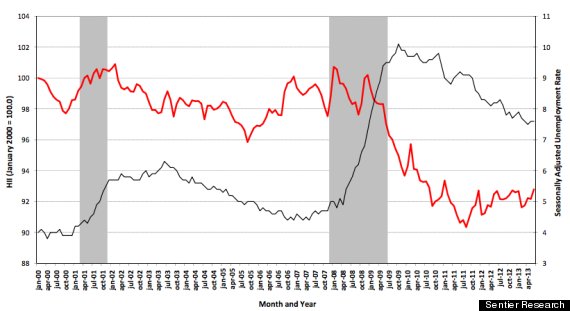
Barbara Garson — Down Is a Dangerous Direction — How the 40-Year "Long Recession" Led to the Great Recession
If you had to date the Great Recession, you might say it started in September 2008 when Lehman Brothers vaporized over a weekend and a massive mortgage-based Ponzi scheme began to go down. By 2008, however, the majority of American workers had already endured a 40-year decline in wages, security, and hope -- a Long Recession of their own.The Huffington Post
Down Is a Dangerous Direction — How the 40-Year "Long Recession" Led to the Great Recession
Barbara Garson | Author, 'Down the Up Escalator: How the 99% Live in the Great Recession'
(h/t Clonal in the comments)
Also KPFA Podcast: Barbara Garson with Richard D. Wolff
(download until May 10, 2013)
Sunday, April 14, 2013
Tim Duy — When Can We All Admit the Euro is an Economic Failure?
The last month of data flow from Europe is nothing short of depressing. It seems that the history of the Eurocrisis can be summed up as a repeated effort to snatch failure from the jaws of defeat. The Euro and the policy framework that supports it is now clearly inconsistent with anything but sustained recession....
Bottom Line: How high does unemployment need to rise, how much output needs to be lost, how much poverty must be endured before European policymakers realize that the policymakers see that the framework supporting the Euro politcally is an economic failure?Amen.
And the
Tim Duy's Fed Watch
When Can We All Admit the Euro is an Economic Failure?
Tim Duy
Monday, November 26, 2012
NBER's Edward N. Wolff — The Asset Price Meltdown and the Wealth of the Middle Class
I find that median wealth plummeted over the years 2007 to 2010, and by 2010 was at its lowest level since 1969. The inequality of net worth, after almost two decades of little movement, was up sharply from 2007 to 2010. Relative indebtedness continued to expand from 2007 to 2010, particularly for the middle class, though the proximate causes were declining net worth and income rather than an increase in absolute indebtedness. In fact, the average debt of the middle class actually fell in real terms by 25 percent. The sharp fall in median wealth and the rise in inequality in the late 2000s are traceable to the high leverage of middle class families in 2007 and the high share of homes in their portfolio. The racial and ethnic disparity in wealth holdings, after remaining more or less stable from 1983 to 2007, widened considerably between 2007 and 2010. Hispanics, in particular, got hammered by the Great Recession in terms of net worth and net equity in their homes. Households under age 45 also got pummeled by the Great Recession, as their relative and absolute wealth declined sharply from 2007 to 2010.The paper is behind a pay wall unless you have a key, but this abstract is probably enough to get the point across if you don't have need of the numbers.
National Bureau of Economic Research
The Asset Price Meltdown and the Wealth of the Middle Class
Edward N. Wolff
Friday, March 2, 2012
Peter Cooper — Public Spending Cuts in a Great Recession
Interest in modern monetary theory and related ideas continues to grow, which is great to see. The efforts of the academic modern monetary theorists and their fellow travelers and supporters continue to bring to light the economic challenges we face and the lies we are all up against. The thought that there will be readers who are relatively new to the approach reminds me that occasionally it is worth getting back to some of the basic insights. The purpose of this post is to illustrate a simple point. The simple point is that it is misguided to cut back public expenditure on services such as libraries, education, health services, and so on, as well as to slash welfare protections for those worst affected by the crisis, when private-sector activity is depressed. In a modern money system – one with a flexible exchange-rate fiat currency – financial affordability is not an issue. The government, as sovereign currency issuer, is not like a household.
The only sense in which affordability can be of concern to a sovereign currency issuer is in terms of real resources. In particular, if the available labor force became stretched to the limit, it might be hard to attract or retain sufficient staff to keep public libraries, schools, hospitals, and other publicly funded or subsidized social institutions operating at current levels without the measures being inflationary. At that point, the community would need to make a choice between cutting the provision of these services or raising taxes to free up resources currently utilized in the private sector. But if, instead, overall demand is weak, and unemployment is high, there is no need for generalized government spending cuts or tax increases, and to implement either would be foolish.
Read it at heteconomist.com
Public Spending Cuts in a Great Recession
by Peter Cooper
Tuesday, February 7, 2012
Today's crazy — John Taylor
John Taylor goes all in, even saying, "We [the US] could get into a situation like Greece, quite frankly."
Read it at Zero Hedge
Taylor Rule Founder Warns US Debt Could "Explode"
posted by Tyler Durden
Monday, February 6, 2012
Foreign Policy — How to Save the Global Economy: Hire Everybody
Measured by the length and depth of the downturn in global GDP, the current economic crisis is set to be even worse than that of the 1930s. As in the 1930s, governments in the United States and Europe must switch from doing the least they can get away with to avert immediate disaster to acting with enough commitment to the future that their citizens begin to believe in a brighter economic outlook. Above all, this means creating jobs -- perhaps even creating a modern equivalent of the Depression-era Works Progress Administration.
Read it at Foreign Policy
How to Save the Global Economy: Hire Everybody
By Diane Coyle
(h/t Dan Kervick)
Subscribe to:
Posts (Atom)