Showing posts with label capital controls. Show all posts

Tuesday, April 10, 2018

Bill Mitchell — The Left propaganda that the state is powerless – continues

When we published our latest book – Reclaiming the State: A Progressive Vision of Sovereignty for a Post-Neoliberal World – last September, Thomas Fazi and I approached the UK Guardian to see if they would publish an Op Ed by us summarising the main arguments presented in the book. We received no response. Pluto tell us that the book is one of their better sellers since it was published. And it is not as if the topic is irrelevant in the Guardian’s assessment. That is clear from the fact that on April 5, 2018, they published one of their ‘long read’ articles by Rana Dasgupta – The demise of the nation state – which is a direct refutation of the ideas advanced in our book. This ‘long read’ also falls into the same traps and analytical errors that we point out has besotted the Left side of politics since the 1970s. The article is clearly part of the Guardian’s agenda to appear progressive but, in fact, be anything of the sort. As I have noted previously, the Guardian seems content to publish a torrent of anti-Brexit articles and criticisms of Jeremy Corbyn rather than provide any semblance of balance.
In the US, we call them "limousine liberals" and "latté liberals." They pretend to be progressives on the side of the people, but their real mission is to support the power elite in their push for transnational corporate totalitarianism in the name of "liberalism" and "Western values." The fact is that they are fascists. Fascism is aligned with capital being the chief political factor. In a representative democracy, this occurs through corruption of the political process and state capture. Is the Guardian in the category of promoting this?

Bill Mitchell – billy blog
The Left propaganda that the state is powerless – continues
Bill Mitchell | Professor in Economics and Director of the Centre of Full Employment and Equity (CofFEE), at University of Newcastle, NSW, Australia

Wednesday, February 14, 2018

Daniela Gabor — MMT Meets Rey’s Dilemma: A Balance Sheet View Of Capital Flight (Coming Soon To An Em Country Near You)

Recently, a colleague emailed with the following set of questions: ‘a balance sheet approach to defending currencies. Do you know literature that explains in detail the globally interlocking balance sheets between central banks, commercial banks and what happens when a national government has to defend its currency? What is the role of national and foreign reserves and how do they travel these balance sheets in the process of trying to defend a currency? I came back to this question when discussing the Swedish fight to defend the Dollar-pegged Krona in the early 90s and the promise of MMT? Most particularly we wondered to what extent national governments can just issue Krona and use them to buy foreign reserves or what sets the limits exactly to this attempt?' 
My MMT friends do have answers to these questions (and they do spend a lot of time defending MMT from critiques that it doesnt consider balance of payment constraints to monetary sovereignty). I thought I would answer these questions a la Minsky, with balance sheets, since that’s how I teach my undegrad students about exchange rate management in emerging/developing countries. I teach by setting those questions within the broader conversations about global liquidity, global financial cycles and Rey’s dilemma – independent monetary policy is only possible if countries manage capital flows (capital controls)....
Critical Macro Finance

MMT Meets Rey’s Dilemma: A Balance Sheet View Of Capital Flight (Coming Soon To An Em Country Near You)
Daniela Gabor | Professor of Economics and Macro-Finance, University of West England Bristol

Monday, October 9, 2017

Bill Mitchell — Prime Minister Corbyn should have no fears from global capital markets


Bill addresses many issues in this post that MMT economists don't ordinarily focus on like capital markets, capital flows, capital flight, capital controls, and exchange rate depreciation. Since most progressives don't understand the background and dynamics they generally get sucked into commonly deployed neoliberal traps. Bill shows how they don't need to.

Bill Mitchell – billy blog
Prime Minister Corbyn should have no fears from global capital markets
Bill Mitchell | Professor in Economics and Director of the Centre of Full Employment and Equity (CofFEE), at University of Newcastle, NSW, Australia

Tuesday, April 25, 2017

Pedro Nicolaci da Costa — There’s a reason poor countries feel they've lost control of their economies

The increasing integration of global markets and economies, in addition to new technologies that help accelerate the transmission of financial shocks from one region to another, is making it trickier for so-called emerging countries to manage their banking systems.
A surge in dollar-denominated bonds in developing economies, and their dependence of the vagaries of the richest nations, leave policymakers in areas like Latin America, Africa and Asia in difficult, if not entirely untenable positions, according to the International Monetary Fund’s latest report on global financial stability. Currency markets are particularly vulnerable and volatile....

Monday, January 2, 2017

Zero Hedge — Yuan Dumps, Bitcoin Jumps As China Researchers Suggest "One-Off Devaluation" & Capital ControlsYuan Dumps, Bitcoin Jumps As China Researchers Suggest "One-Off Devaluation" & Capital Controls


Float that sucker. What are you waiting for?

Bite the bullet like Russia did and it was not the end of the world for them. The ruble stabilized relatively quickly and the Chinese economy is way larger than Russia's and not a victim of Dutch disease either.

Sunday, December 18, 2016

Reuters — As yuan weakens, Chinese rush to open foreign currency accounts

Zhang Yuting lives and works in Shanghai, has only visited the United States once, and rarely needs to use foreign currency. But that hasn’t stopped the 29-year-old accountant from putting a slice of her bank savings into the greenback.
She is not alone. In the first 11 months of 2016, official figures show that foreign currency bank deposits owned by Chinese households rose by almost 32 percent, propelled by the yuan's recent fall to eight-year lows against the dollar.
The rapid rise - almost four times the growth rate for total deposits in the yuan and other currencies as recorded in central bank data – comes at a time when the yuan is under intense pressure from capital outflows. The outflows are partially a result of concerns that the yuan is going to weaken further as U.S. interest rates rise, and because of lingering concerns about the health of the Chinese economy.
Reuters
As yuan weakens, Chinese rush to open foreign currency accounts 
Winni Zhou and John Ruwitch | SHANGHAI

Wednesday, July 6, 2016

Bill Mitchell — Why capital controls should be part of a progressive policy

I am in the final stages of completing the manuscript for my next book (this one with co-author, Italian journalist Thomas Fazi) which traces the way the Left fell prey to what we call the globalisation myth and started to believe that the state had withered and was powerless in the face of the transnational movements of goods and services and capital flows. Accordingly, social democratic politicians frequently opine that national economic policy must be acceptable to the global financial markets and compromise the well-being of their citizens as a result. In Part 3 of the book, which we are now working on, we aim to present a ‘Progressive Manifesto’ to guide policy design and policy choices for progressive governments. We also hope that the ‘Manifesto’ will empower community groups by demonstrating that the TINA mantra, where these alleged goals of the amorphous global financial markets are prioritised over real goals like full employment, renewable energy and revitalised manufacturing sectors is bereft and a range of policy options, now taboo in this neo-liberal world, are available. Today, I discuss capital controls….
Bill Mitchell – billy blog
Why capital controls should be part of a progressive policy
Bill Mitchell | Professor in Economics and Director of the Centre of Full Employment and Equity (CofFEE), at University of Newcastle, NSW, Australia

Tuesday, May 31, 2016

Bill Mitchell – Iceland proves the nation state is alive and well


Important. The intersection of the political and the economic, and the predominance of the political under national sovereignty. The internationalist left ignore this at its peril, especially in a world of transnational corporatism. Bill also discusses the situation in Iceland in relation to the recent IMF paper, Neo-liberalism: Oversold?

Bill Mitchell – billy blog
Iceland proves the nation state is alive and well
Bill Mitchell | Professor in Economics and Director of the Centre of Full Employment and Equity (CofFEE), at University of Newcastle, NSW, Australia

Sunday, February 7, 2016

Jacques Sapir — Russia and Global Finance

The shaping of economic reactions by globalized finance
The result of these different factors is well known. The ruble has taken quite a beating since late summer 2014. But, this has not been the direct driver for the recession Russia is experiencing. The real driver was the reaction of the Central Bank. And here we could argue well that the Central Bank policy was self-destructing. A large part of the current recession has been created by Central Bank actions and definitely not by Western sanctions or oil prices fall. We are then to precisely figure the Central Bank reaction to the inflationary bout induced by the fall of the rouble we discussed above. The Central Bank of Russia is committed to an “inflation targeting” policy[8]. Wise or unwise[9], and we don’t think it is wise as much is to be said about the so-called “inflation targeting” policy[10], it’s a fact. The CBR will then increase its interest rates every time inflationary pressures are seen coming.
But the story doesn’t end here. If the ruble depreciation is taking a fast dive, the Central Bank will increase much its rates to “crush” speculation, as it has be seen in December 2014 when the CBR raised its primary rates to 17%. Here again it was a blatant mistake, but here again it’s a fact. High interest rates have never prevented speculation on any currency in the world[11]. It was too true for the ruble.
But the dramatic increase of interest rates had a very negative impact on the economy. To sum up a drop in oil prices is creating a very adverse financial environment for households and enterprises alike. Household are reducing (or more precisely containing) their debts linked to consumption and enterprises are reducing investments. This parallel reduction in investment and consumption had and still is having a very negative influence on economic activity.…

It’s obvious than introducing some forms of capital controls could have done a better job. It is to be known that even the IMF now recommends capital controls in some specific situations[12] as it is now well acknowledged that strong exchange rates fluctuations could be extremely disruptive for the economy[13]. Some Russian authors have advocated such a move[14], and the debate is still going on[15]
The introduction of such a system could allow Russia to develop a strong industrial sector to provide both the internal market and the export market too without interference from the globalized finance. This was the strategy adopted by a number of East-Asian countries[16], but also by France between 1945 and 1975[17]. Such a development doesn’t imply to stop developing the commodity sector. Actually, the oil and gaz sector could become major consumer of Russian manufactured goods and help to develop a high-tech sector.
The main issue here is more how to ensure the development of manufactured goods without compromising the production of commodities. It is not just a problem of developing new productions but also one of changing the whole structure of Russian industry as a significant number of new enterprises are to be created to develop these new productions, and their development is challenging an industry used to rely on large integrated groups.
It is true to say that the Russian government has put a priority on the development of a modern manufacturing sector for years. But, when the Ukrainian crisis began to shape international relations Russia has not broken with its traditional model. To some extent the crisis in international relations has the direct effect to make the change of model both an absolute necessity. But, in the same time, this crisis was making it a very hard undertaking. So far Russia is still caught in the middle of a kind of new “transition”, but time is running short.…
These excerpts focus on the central bank. The post analyzes the Russian economy and financial system in greater depth, showing that the issue is really not economic but financial, with finance bound up in global finance to the detriment of Russia, and by implication other countries other than the Atlanticists that control global finance under the dollar system.

Sapir is one of the few people in the West I have encountered to recognize that the Central Bank of Russia is the chief problem. The heterodox wing of Russian economists knows this and has been lobbying for a change in policy. This crisis presents a perfect opportunity for restructuring but that requires domestic financing. The Central Bank of Russia is being an obstacle instead of facilitating restructuring as the issuer of the ruble.

This analysis reveals the pressing need to get MMT materials translated into other languages and more widely distributed.

RussEurope
Russia and Global Finance
Jacques Sapir

Friday, December 11, 2015

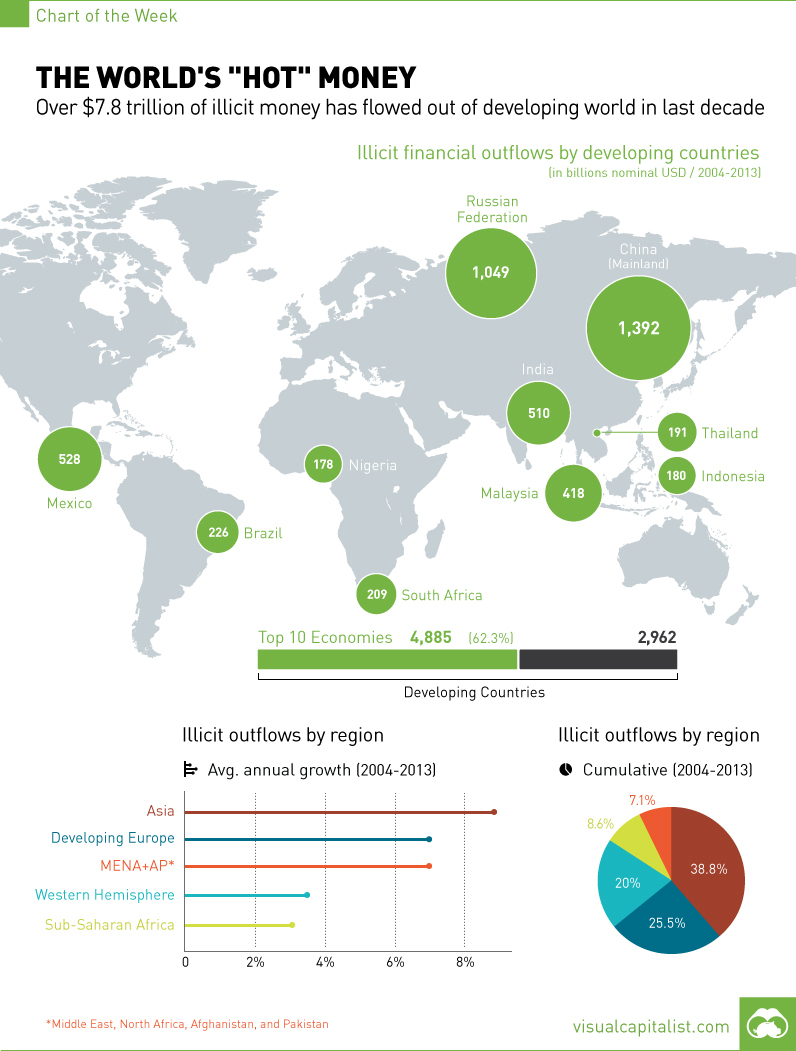
Visual Capitalist — The World’s “Hot” Money [Chart]


How does this “hot” money leave these countries [illegally]? Global Financial Integrity has calculated that 83% of illicit financial flows are due to what it calls “trade misinvoicing”.
Visual Capitalist
The World’s “Hot” Money [Chart]
Jeff Desjardins


Saturday, September 5, 2015

Kenneth Rogoff — The Art of Capital Flight


China has capital controls to prevent free flow of capital to prevent selling Chinese assets and buying foreign assets. Capital controls are difficult to enforce.

Project Syndicate
The Art of Capital Flight
Kenneth Rogoff | Professor of Economics and Public Policy at Harvard University, recipient of the 2011 Deutsche Bank Prize in Financial Economics, and formerly the chief economist of the International Monetary Fund (2001 to 2003)

Sunday, June 28, 2015

Greek banks to stay shut on Monday. Capital controls imposed!

And they're sticking with the euro, which will be worthless very soon!


Euro opens...crashing! Down 150 pips (1.3%)

EURUSD getting crushed right now as prospect of Greek banks not opening tomorrow/implementation of capital controls.


ARE YOU TRADING FOREX???

Get my Forex trading course videos here. Only $250. There's big money to be made in the Euro's collapse!


I'm back from vacation and the news is even more depressing than when I left. But I "called" all of this.


Just came back from a week's vacation in Florida and I had a great time, but now I am back in this shit weather of New York City. I am really starting to hate it here, but I digress.

During my vacation I barely kept up with the markets and the news; especially the news because it's pretty much almost all bad and I didn't want any buzz kill to wreck my good time.

But, alas, I am back and scanning the media again and of course there is the Greece situation right out there in the forefront and it's really sad and depressing as all hell.


I'll start by taking some credit for predicting all this, to a "t."

Right from the election of Syriza and even before with the comments of then candidate, Alexis Tsipras, followed by the appointment of Varoufakis as Finance Minister, I said that Greece would cave to the Troika; that the last remaining wealth of the public would be stripped away and looted to pay the ransom that the banksters demanded.

Today we see that really accelerating to its final conclusion with the Greek government looking to shut banks and impose capital controls Monday morning.  (i.e. steal all the remaining cash.)

Now this is really sad and depressing on so many levels. It's depressing due to the weakness of Tsipras and the Greek government, which like so many others that have delivered false promises (Obama) and sold the people out on day one.

It's sad and depressing because of the callous and gluttonous voracity of the financial mafia who will stop at nothing and want everything despite their ineptitude and their orgies of destruction, which seemingly cannot be stopped.

It's sad and depressing on the loss of Greek sovereignty and the crushing down of the world's oldest democracy; of the crushing of democracy in general, universally, no matter how old and the sheer criminality of it.

Worst of all, however, it's sad and depressing due to the fact that we are witnessing THE MODEL that will be applied by the neoliberal criminals on the rest of us all over the world.

Make no mistake: the actions being forced upon Greece are meant to be a lesson to us all: that's what's coming our way unless we submit to the demands of this mafia and the corrupt governments they control (yes, the U.S. included, which may be most corrupt) and the lackeys who do their bidding and the law enforcement goons that fill their prisons with those who protest or refuse to submit and the armies they unleash--overt and covert--to plunder the wealth of nations.

This is the path via which, the general citizenry will be conquered, taken, enslaved, subjugated and consumed in every which way possible and it is under way as we speak and there is really nothing we can do about it.

Say good bye to Greece. Say good bye to Democracy. Say good by to us all and the way of life we have known.

On a bittersweet note there is one final irony to all this even though it's just a sort of mini, micro, "unintended consequences" thing, but at least it's something we can take a little solace in (or, better yet, make money in). That is, the vaunted euro, the thing that caused much of this misery--indeed, the thing that was CREATED EXPRESSLY as a vehicle so that the elites could steal--will go down in flames, perhaps collapsing to near-valueless in some months or at most a couple of years.

I feel sorry for the Greek people, who have been pleading for an end to austerity for so long and who have put false hope in disingenuous or timid leaders. The truth is, they have been so deluded they have not seen the poisonous nature of this currency and have not understood that it was really their mortal enemy, a Trojan Horse, all along.

For whatever reason, maybe past history of corruption under the drachma or, the inflation that the corruption seemingly always brought, the Greeks did not want to go back to the drachma. In the end I predict they will be begging for the drachma; it'll be their savior from the euro.

Make no mistake: the euro is going down. To zero, perhaps. To say the euro is getting harder to get is folly. Under the current arrangement, which necessitates that an elite few must figuratively and literally kill off everyone else for their corrupt gang to survive, and to have a currency based on this, basically means that the currency--the euro--is intrinsically worthless.

Thursday, March 12, 2015

Dani Rodrik — Global Capital Heads for the Frontier

Nonetheless, at the IMF and in advanced countries, the prevailing view remains that capital controls are a last resort – to be used only after conventional macroeconomic and financial policies have been exhausted. Free capital mobility continues to be the ultimate goal, even if some countries may have to take their time getting there. 
There are two problems with this view. First, as advocates of capital mobility tirelessly point out, countries must fulfill a long list of prerequisites before they can benefit from financial globalization. These include the protection of property rights, effective contract enforcement, eradication of corruption, enhanced transparency and financial information, sound corporate governance, monetary and fiscal stability, debt sustainability, market-determined exchange rates, high-quality financial regulation, and prudential supervision. In other words, a policy aimed at enabling growth in developing countries requires first-world institutions before it can work..
The second problem concerns the possibility that capital inflows may be harmful to growth, even if we leave aside concerns about financial fragility. Advocates of capital mobility assume that poor economies have lots of profitable investment opportunities that are not being exploited because of a shortage of investible funds. Let capital come in, they argue, and investment and growth will take off....
In such a world, treating capital controls as the last resort, always and everywhere, has little rationale; indeed, it merely fetishizes financial globalization. The world needs case-by-case, hardheaded pragmatism, recognizing that capital controls sometimes deserve a prominent place.
Project Syndicate
Global Capital Heads for the Frontier
Dani Rodrik | Professor of Social Science at the Institute for Advanced Study, Princeton, New Jersey

Friday, February 13, 2015

Mark Gilbert — Currency Wars Have a Nuclear Option

If rate cuts and currency-market interventions don’t do the job, capital controls -- the introduction of taxes and prohibitions to regulate the flow of money into and out of a nation -- may creep higher up the agenda of increasingly desperate central banks. 
Three years ago, the International Monetary Fund softened its strict opposition to such strategies, conceding that "in certain circumstances, capital flow management measures can be useful," with the caveat that "they should not, however, substitute for warranted macroeconomic adjustment."
Further sign of a breakdown of the neoliberal order? The big boys love neoliberalism until it hurts them.

Bloomberg View
Currency Wars Have a Nuclear Option
Mark Gilbert, Bloomberg
ht/ Yves Smith at Naked Capitalism

Sunday, February 23, 2014

Brian Romanchuk — Why Rich Countries Should Float Their Currencies

This article provides more depth to some comments I made in"MMT and Constraints". I explain why developed countries should allow their currencies to float, which is the policy stance advocated by Modern Monetary Theory (MMT). It is probably a good idea for developing countries to float their currencies as well, but they face inherently difficult policy problems that I do not know enough about to comment on. The implication of advocating a free-floating currency is that I do not see the "external constraint" as being a serious issue, or at least an issue that policy makers can hope to do anything useful about.

In that previous article, I made some quick comments in response to an assertion by Thomas Palley that the "foreign exchange market constraint" is very important for countries other than the United States. Since he did not explain that assertion, I was unable to offer a very detailed criticism. My response was too short, and drew some comments. I expand my explanation here.

I will first explain why I do not think that there is a significant external behavioural constraint on policy makers; but an accounting constraint obviously exists.

I will also note that what I am writing is my opinion, and does not necessarily reflect the views of the economists who developed MMT. I think that poorer countries face some difficulties with free-floating currencies, a view with which they may not agree.
Bond Economics
Why Rich Countries Should Float Their Currencies
Brian Romanchuk

Wednesday, February 19, 2014

Adair Turner — "In Praise of Capital Market Fragmentation"

Financial liberalization was lauded because it enabled capital to flow to where it would be used most productively, increasing national and global growth.

But empirical support for the benefits of capital-account liberalization is weak. The most successful development stories in economic history – Japan and South Korea – featured significant domestic financial repression and capital controls, which accompanied several decades of rapid growth.

Likewise, most cross-country studies have found no evidence that capital-account liberalization is good for growth. As the economist Jagdish Bhagwati pointed out 16 years ago in his article “The Capital Myth,” there are fundamental differences between trade in widgets and trade in dollars. The case for liberalizing trade in goods and services is strong; the case for complete capital-account liberalization is not.

One reason is that many modern financial flows do not play the useful role in capital allocation that economic theory assumes....
And yet, despite the growing evidence to the contrary, the assumption that all capital flows are beneficial has proved remarkably resilient. That reflects the power not only of vested interests but also of established ideas. Empirical falsification of a prevailing orthodoxy is disturbing. Even economists who find no evidence that capital-account liberalization boosts growth often feel obliged to stress that “further analysis” might at last reveal the benefits that free-market theory suggests must exist.

It is time to stop looking for these non-existent benefits, and to distinguish among different categories of capital flows. Some are valuable, but some are potentially harmful....
In the past, policymakers have been at pains to stress that no such fragmentation will be allowed. But we need to be blunt: Free flows of short-term debt can result in capital misallocation and harmful instability. When it comes to global capital markets, fragmentation can be a good thing.
Social Europe Journal
"In Praise of Capital Market Fragmentation"
Adair Turner


Adair Turner