Showing posts with label development economics. Show all posts

Thursday, February 27, 2020

Ndongo Samba Sylla – What does MMT have to Offer Developing Nations?

According to its main authors, MMT is not “ultimately” about money. Money is just a prerequisite for addressing the more important issue of mobilizing domestic resources for the full employment of the labour force and other public endeavours....
Good introductory article.

Brave New World
Ndongo Samba Sylla – What does MMT have to Offer Developing Nations?
Ndongo Samba Sylla | Research and Programme Manager for the Rosa Luxemburg Foundation

Wednesday, November 20, 2019

Andrew Batson — Capacity to transform


Important. Andrew Batson summarizes Charles Kindleberger's insight into development in terms of ability to transform the economy — what promotes it and what hinders it.

Neoclassical economics assumes flexibility among the factors of production and also flexibility within them, resulting in immediate response to economic "laws," e.g., based on natural market forces that automatically generate spontaneous order (general equilibrium).

However, economic forces are not independent of social and political factors in society. Neoclassical assumptions generate an idealistic model that doesn't necessarily correspond to actual conditions. As a result there are market failures and idle resources.

There are different rates of transformational capacity and reasons for them. Charles Kindleberger considered them.

Andrew Batson's Blog
Capacity to transform
Andrew Batson

Thursday, November 14, 2019

The plight of late industrializers: what if peasants do not want to move to cities? — Branko Milanovic


A very interesting post.

The author fails to discuss the the situation with China, however, perhaps owing to limited scope.  The Chinese situation is interesting in that prior to Deng's reforms, China was a country dominated by poor peasants. The way that the contemporary Chinese government is dealing this is is building cities and requiring people to move to them. There is apparently not much resistance owing to the extreme poverty of the countryside. This was inevitable in the move to industrialized agriculture, where peasant labor was made grossly inefficient.

Something similar happened in the US fairly recently. The industrialization of agriculture all but eliminated the family farm as a viable income source owing to efficiencies of scale and technology.

Global Inequality
The plight of late industrializers: what if peasants do not want to move to cities?
Branko Milanovic | Visiting Presidential Professor at City University of New York Graduate Center and senior scholar at the Luxembourg Income Study (LIS), and formerly lead economist in the World Bank's research department and senior associate at Carnegie Endowment for International Peace

Tuesday, October 15, 2019

A Nobel for the Randomistas — Peter Dorman

I don’t think anyone was surprised by this year’s “Nobel” prize in economics, which went to three American-based specialists in the design of on-the-ground experiments in low income countries, Abhijit Banerjee, Esther Duflo and Michael Kremer. I think the award has merit, but it is important to keep in mind the severe limitations of the work being honored....
On balance, I think it’s fine that this prize honors experimentalism, but we shouldn’t lose sight of the larger picture. Using experimental methods to incorporate more learning in program administration should be standard practice; perhaps some day it will be. But the big problems in poverty and oppression are too complex and encompassing to be reduced to experimental bits, and there is no substitute for theoretical analysis and a willingness to take chances with large-scale collective.

Micro approach versus macro. Conclusions cannot be extended beyond the scope and scale of the model, no matter how well-designed the experiment may be. Development economics assumes a large scale context. According to Peter Dorman, the work for which the prize was awarded does not deal with  the hard problem of development economics.

We want to avoid the damned if you do and damned if you don't bias, which Peter Dorman seeks to do. The experimental method lies at the basis of scientific method and should be used where it fits. But it doesn't fit everywhere and a shoehorns and girdles should not be used to make it fit either.

The other issue is with randomization, which Lars Syll has pursued in depth at his blog over the years. It's not a straightforward in social science as it is in natural science owing to the subject matter.

Angry Bear
A Nobel for the Randomistas
Peter Dorman | Professor of Political Economy, The Evergreen State College

See also

Oxfam Blogs — From Poverty to Power
The Randomistas just won the Nobel Economics prize. Here’s why RCTs aren’t a magic bullet.
Duncan Green, strategic adviser for Oxfam GB

Sunday, September 1, 2019

Going to extremes — Diane Coyle


Review of Extreme Economies: from Akita in Japan to Santiago in Chile, from Glasgow to Kinshasa by Richard Davies.
Davies picks this up in the conclusion: “The biggest gap in economics is the way it completely ignores social capital.” This is why our Bennett Institute Wealth Economy team is exploring the measurement of social capital. Economics doesn’t entirely ignore it – it gets lables such as ‘institutions’ or ‘goodwill’ – but is treated as a black box at best. So I agree with the book that economics will have more to offer the world if we measure and understand better the “subtler and more human aspects of income and wealth.”
The Enlightened Economist
Going to extremes
Diane Coyle | freelance economist and a former advisor to the UK Treasury. She is a member of the UK Competition Commission and is acting Chairman of the BBC Trust, the governing body of the British Broadcasting Corporation

Wednesday, July 3, 2019

If innovators can solve India's problems, they can save the world. Here's why. — Nikhil Malhotra

India is a country of contrasts. It is home to a $160 billion tech services industry, while also buffeted by environmental and social challenges - and this makes it fertile ground for globally scalable, tech-driven solutions....
World Economic Forum
If innovators can solve India's problems, they can save the world. Here's why.
Nikhil Malhotra

Tuesday, April 30, 2019

Matias Vernengo — Structural Change in China and India: External Sustainability and the Middle-Income Trap

AbstractThis paper focuses on the different development strategies of China and India, particularly regarding the role of manufacturing and services, for long-run productivity growth, external competitiveness and financial fragility. The findings appear to support the argument that productivity improvements in manufacturing drive productivity improvements in other sectors. They also substantiate previous findings that the Indian services-led growth trajectory has had limited success in transferring surplus labor from agriculture to other sectors. Furthermore, the trajectories have affected the export performances of the two countries with the Indian trade balance and current account revealing persistent deficits, compared to China's surpluses. The paper also argues that the way in which India has sought to sustain these deficits entails elements of financial fragility, and that the Chinese struggles with the internationalization of the renminbi also imply a possibility of financial instability.
Naked Keynesianism
Structural Change in China and India: External Sustainability and the Middle-Income Trap
Matias Vernengo | Associate Professor of Economics, Bucknell University

Sunday, January 13, 2019

Bill Mitchell — There is no internal MMT rift on trade or development

I was going to write about Jamaica today but this topic emerged that I thought I should deal with before I write about the home of reggae. In fact, some of the material is input into a reasoned discussion about Jamaica so it logically precedes it. With the increasing profile of Modern Monetary Theory (MMT), social media activists are wont to talk about MMT in various ways that, in many cases, do not bear resemblance to our work. But that doesn’t stop them claiming things about what we have written or said and then proceeding to say how this is a ‘big problem’ with MMT that they cannot accept. Then their own local commentators chime in reinforcing the point. It is obvious that the original writer hasn’t read our work or if they have they haven’t grasped it (including the nuance and subtlety) but still feels privileged to hold themselves out as experts to wax lyrical about the technical flaws in the said work. This gets amplified by the responses from the readership who have probably read even less – to the point that we end up with MMT being constructed as something ridiculous and foreign to its original. Sort of like start by saying you are discussing 2, call it 3 and say it equals 4. It is a problem because it confounds people and also gives those who oppose our work ways to further misrepresent it in the public debate....
This is an important post with many links to Bill's previous posts on the subject.

There are two considerations that Bill omits specific mention of in this post that are covered by his extensive critique of neoliberalism throughout his work.

The first is the imposition of neocolonialism, e.g, through the IMF. While Bill mention the IMF by name, he doesn't not mention colonialism, although Fadhel Kaboub does in post that Bill cites. Neoliberalism, neo-imperialism and neocolonialism are primary factors affecting development economics especially, and international trade as well.

The second is the use of economic warfare to impose neoliberalism and its correlates, neo-imperialism and neocolonialism, e.g., through economic sanctions and political means. International trade cannot be separated entirely from social and political factors, even though the economic aspects can be discussed independently as an exercise. But in the real world, many extra-economic factors supervene in the case of geopolitics and geostrategy, with international economic and financial policy having been weaponized by the US in particular.

While these non-economic factors are not specifically the concern of MMT, understanding of MMT can be useful in developing policy to counter neoliberal attack and hybrid warfare.

Bill Mitchell – billy blog
There is no internal MMT rift on trade or development
Bill Mitchell | Professor in Economics and Director of the Centre of Full Employment and Equity (CofFEE), at University of Newcastle, NSW, Australia

See also

Bill Mitchell – billy blog
The mindless and myopic nature of neoliberalism
Bill Mitchell | Professor in Economics and Director of the Centre of Full Employment and Equity (CofFEE), at University of Newcastle, NSW, Australia
Thursday, December 13, 2018

Justin Podur — Why It’s So Hard for Most Countries to be Economically Independent from the West

The structures of the global economy present challenges to any country or political party that wants to try to break out of U.S. hegemony. Even for countries as big and with as much potential as Brazil or Egypt, countries that have experienced waves of relative independence, the inertia of these economic structures helps send them back into old patterns of extraction and debt. In this moment of right-wing resurgence it is hard to imagine political movements arising with plans to push off the weight of the economic past. But that weight cannot be ignored.
Colonialism and path dependence. I would say that this is one of a number of factors. Whether they can be reduced to a single factor or even a few factors remains to be seen. However, this seems to be one of the key factors.

The post focuses on Brazil.

Naked Capitalism
Why It’s So Hard for Most Countries to be Economically Independent from the West
Justin Podur | Associate Professor of Environmental Studies at York University, Canada

Thursday, December 6, 2018

Álvarez & Gahn — Economic Development in the 21st Century: A Review

What drives economic development? What is the nature of the external constraints that developing economies face? What is the role of industrial policy and the central banks in the development process? These were the core questions that were posed in the recent webinar series on Development in the 21st Century, organized by the Economic Development working group of the Young Scholars Initiative (YSI). These four meetings were particularly oriented towards examining notions such as distribution, patterns of specialization, industrial policies and balance of payment constraints. The discussion of such phenomena is especially important in a context of deep academic divides regarding the drivers of economic development....

Developing Economics
Economic Development in the 21st Century: A Review
Ramiro Eugenio Álvarez (University of Siena) and Santiago José Gahn (Roma Tre University)

Tuesday, December 4, 2018

Bill Mitchell — Inclusive growth means poverty reduction and declining income inequality

I am doing some work on the way technology can be chosen to maximise employment in the pursuit of advancing general well-being. This is in the context of some work I am doing on advancing what is known as ‘relative pro-poor growth’ strategies in Africa via employment creation programs and draws on my earlier work in South Africa on the Expanded Public Works Program. In the current work, I have been assessing ways in which the Labour Intensive Public Works program in Ghana has been deployed to serve this purpose. The problem one confronts when working as a development economist in less well-off nations is that the institutional bias promoted by the IMF and the World Bank is towards advancing, at best, what we term ‘absolute pro-poor growth’. But that sort of agenda typically fails to strengthen other aspects of a strong civil society because it is almost always accompanied by rising inequality which continues to concentrate power and influence at the top and leads to resources being disproportionately expropriated by the wealthy (and usually foreign) classes. Institutions such as democracy, justice, law and order and causes such as environmental sustainability are then compromised....
Bill Mitchell – billy blog
Inclusive growth means poverty reduction and declining income inequality
Bill Mitchell | Professor in Economics and Director of the Centre of Full Employment and Equity (CofFEE), at University of Newcastle, NSW, Australia

See also

Could this possibly be the result of natural spontaneous order resulting from market competition and personal initiative so that everyone receives their just deserts based on their productivity? Or is the result of asymmetry and bias? If the later how does that arise. Is it solely the result of government as some claim, or it is owing to the asymmetrical power that increasing wealth as ownership of real and financial assets conveys?

Michael Roberts Blog
The top 1% own 48% of all global personal wealth; 10% own 85%
Michael Roberts

Friday, November 30, 2018

Zhang Jun — China Deserves its Economic Success

In 1995, the late economist Gustav Ranis wrote that, “If there is one key to developmental success, it is avoiding the encrustation of ideas,” which is achieved through policymakers' “ever-increasing reliance on the responsiveness of large numbers of dispersed decision-makers.” That description suits China perfectly.
Agility.
Zhang Jun | Dean of the School of Economics at Fudan University and Director of the China Center for Economic Studies, a Shanghai-based think-tank

Monday, November 26, 2018

Andrew Sheng and Xiao Geng — China’s Four Traps


An issue with this analysis as I see it is that it is based on a Western approach to economics and finance that is not applicable to China as a socialists country with its own development path.

The first point they make is this:
The first is the middle-income trap. With a per capitaannual income of around $9,000, China remains significantly below the threshold for high-income status, set at around $12,000-$13,000 by the World Bank. Only a few countries in history have managed this leap during the last half-century....
The problem with this approach is, one, using aggregates where value is expressed in terms of USD rather than real value. The analysis should include standard of living and distribution, as well as purchasing power parity, to be meaningful.

The second point is:
Second, China may become ensnared in the so-called Thucydides Trap…
Reverse logic. The US is becoming ensnared in the Thucydides Trap by its own choice to pursue global hegemony, which makes China not only a competitor but also a threat. China will have to deal with this reality and it is doing so. This will entail greater military spending which is stimulative economically, increases attention in R&D and innovation, and encourages dual-use development of technology.

The third point they mention is:
The third potential trap is what Joseph Nye calls the Kindleberger Trap. Charles Kindleberger, an architect of the Marshall Plan, blamed the breakdown of the international order in the 1930s on America’s failure to match its provision of global public goods to its new geopolitical status as the world’s dominant power. If China does the same, according to Nye, chaos could erupt again, especially at a time when the US is withdrawing from global leadership.
As a socialist country, China is committed to public investment both domestically and abroad and its record so far is somewhat spectacular. China is also proposing a socialist socio-economic and political system that is capable of surpassing the capitalist West and is also suggesting its adoption to other developing countries in place of the neoliberal, neo-imperialist and neocolonialist alternative the West is offering.

Their fourth and final point is:
Finally, there is the climate-change trap. High-income countries in general, and great powers in particular, consume a disproportionately large share of resources.
The Chinese leadership is already committed to this, while the US elite is opposed to it.

So I would say that the article is misdirected. The US and West should be paying attention to these points. China already is.

Project Syndicate
China’s Four Traps
Andrew Sheng, Distinguished Fellow of the Asia Global Institute at the University of Hong Kong, a member of the UNEP Advisory Council on Sustainable Finance, former chairman of the Hong Kong Securities and Futures Commission, and currently an adjunct professor at Tsinghua University in Beijing; and Xiao Geng, President of the Hong Kong Institution for International Finance, and professor at Peking University HSBC Business School and at the University of Hong Kong's Faculty of Business and Economics

See also
A blue-collar wave is rising in China — and buoying Xi Jinping.
In most countries, a slowing economy and a sinking stock market would put some heat on politicians. Not in China. A working class that numbers more than 400 million has President Xi’s back.
Under his presidency, China’s economic policies are favoring workers more than at any other time in recent decades....
Bloomberg
China Blue-Collar Wave Strengthens Xi’s G-20 Hand
Shuli Ren | Bloomberg Opinion columnist covering Asian markets. She previously wrote on markets for Barron's, following a career as an investment banker, and is a CFA charterholder

Tuesday, October 23, 2018

Timothy Taylor — The Remarkable Fall in Global Poverty


There's a problem here in this analysis. It ignores the informal economy, much of which is not monetized. The push of capitalism is to monetize it. 

The problem arises in comparing quality of life before and after monetization. The people appear to be wealthier and to receive more income, but their quality of life may be much, much lower, since they no longer have access to the resources and processes they had previous to monetization and capitalization (privatization). It's like saying that enclosure of the commons made those who lived off the commons wealthier.

 It's just nonsense that only economists would be blinkered enough to fall for. They need to get out of the ivory tower, put away their axioms, and study history, economic anthropology and economic sociology. Studying Marx and Engels, Veblen, Polyanyi, etc., would also be a step forward for them.

Poverty cannot be adequately measured in monetary terms. It can only be measured in terms of quality of life and access to real resources.

Conversable Economist
The Remarkable Fall in Global Poverty
Timothy Taylor | Managing editor of the Journal of Economic Perspectives, based at Macalester College in St. Paul, Minnesota

Sunday, September 23, 2018

David Fields — Imperialism in the 21st Century

With respect to to this post, readers might be interested in a long set of follow-up debates below. h/t Patrick Bond, whose contribution was just published here at Human Geography.
David Harvey Denies Imperialism
In a major critique of David Harvey’s work, the radical political economist John Smith takes on Harvey’s claim that the “East” is now exploiting the “West,” a statement, he argues, that is backed up by nothing more than his authority. Harvey could not be more wrong, or about a bigger issue. The root of Harvey’s error is his denial that the global shift of production to low-wage countries represents a major deepening of imperialist exploitation….
Short summaries of moments in an ongoing debate over neo-imperialism.

Radical Political Economy
Imperialism in the 21st Century
David Fields

Wednesday, August 8, 2018

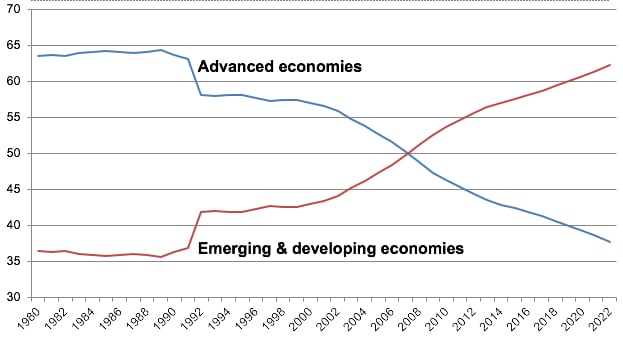
World Economic Forum — Emerging economies are now richer than the West

 Emerging and Developing Economies for the First Time Account for a Larger Share of World GDP or Global Output Than Developed Economies; A Point Surpassed After the 2008 Financial Crisis That Has Continued Apace (See Figure 1)....
How has this been achieved? Possessing good institutions is what economists have come to focus on and the spread of such institutions seems to have been key, as the father of New Institutional Economics predicted. The seminal work in this area was by Douglass North who was frustrated by neoclassical economic models that focused on measurable factors like workers and investment, with attempts to measuring technological progress, even though they could not fully explain why some economies grow well and others do not.

So, North took economics out of its comfort zone, which consisted of examining more easily measured inputs like labour and capital, and instead brought in politics, psychology, and strategy, as well as history, in order to understand why some countries succeed and others fail. He stressed that there was no reason why countries could not learn from more successful economies to better their own institutions. That finally happened in the 1990s....
This sort of imitation of good institutions and effective economic policies was as outlined by institutional economists such as Douglass North. It took the fall of the Berlin Wall, the rescue of India by the IMF in 1991 as well as China’s re-orientation towards the global economy in 1992 for these economies to look to adopt a new course. By emulating ‘best practice’ in other economies as well as opening up, which meant learning from more successful foreign companies, these countries have made tremendous progress as North would have expected. He would have approved of these economies looking more widely than just on capital or labour or technology in fashioning their growth policies.

North once remarked: “My pet peeve all through the last twenty years or thirty years has been the narrowness of economists, in fact of all social scientists, in not opening up whole new areas” (North et al. 2015: 9). And his ideas have brought us closer than ever before to answering the age-old question of how countries can become rich.
The take-away from Douglass North's work is not so much that capitalism is the superior system in the sense that conventional economics treats it as that Western approaches to socio-economic and political organization proved superior to other approaches. The issues are more complicated than the simplified models of conventional economics, with their restrictive assumptions that are ideologically based — e.g., maximization and equilibrium. North recognized that broader scope was required.

North adopted a different methodology that includes all factors he found to be relevant rather than seeking formal elegance but sacrificing empirical relevance. North was an institutional economist that specialized in development economics, and he worked in quantitative economic history (cliometrics), as well, which was needed for his empirical research.

World Economic Forum
Emerging economies are now richer than the West
In collaboration with VoxEU