Showing posts with label Global North v. Global South. Show all posts

Sunday, August 4, 2019

Attack on Iran would be an attack on Russia — Pepe Escobar

Russia is meticulously advancing Eurasian chessboard moves that should be observed in conjunction, as Moscow proposes to the Global South an approach diametrically opposed to Western sanctions, threats and economic war. Here are three recent examples....
Asia Times
Attack on Iran would be an attack on Russia
Pepe Escobar

Tuesday, August 21, 2018

Alastair Crooke — The Metaphysics to Our Present Global Anguish

Clearly, from the very outset, Trump has been “perceived by the globalist neo-liberal order as a mortal danger to the system which has enriched them” Jatras observes. The big question that Jatras poses in the wake of these events, is how could such collective hysteria have blossomed in to such visceral hostility, that parts of the ‘Anglo’ establishment are ready to intensify hostilities toward Russia – even to the point of risking “a catastrophic, uncontainable [nuclear] conflict”. How is it that the élite’s passion ‘to save globalism’ is so completely overwhelming that it demands their risking human extinction? Jatras suggests that we are dealing here with hugely powerful psychic impulses....
These millenarian revolutionaries - exponents of the new Scientism, who hoped to force a shattering discontinuity in history (through which the flaws of human society would be excised from the body politic) - were, in the last resort, nothing other than secular representatives of the apocalyptic Judaic and Christian myth.
The American millenarian ‘myth’, then and now, was (and is), rooted in the fervent belief in the Manifest Destiny of the United States, ‘the New Jerusalem’, to represent humanity’s best hope for a utopian future. This belief in a special destiny has been reflected in a conviction that the United States must lead – or more properly, has the duty to coerce - mankind toward that future.
The secular crusades.

Reading the piece through, and I recommend doing so, it is difficult not to draw the obvious parallels.

As I have been saying, we are witnessing the clash between liberalism and traditionalism. It is explosive, since it involves the most deeply held values and ideas, and there are seemingly incompatible.

Alexander Dugin deals with this in The Fourth Political Theory. He holds that the first three and liberalism, fascism and communism. Liberalism has defeated the fascism and communism, which are moribund but not yet dead. Now liberalism is confronting traditionalism, and the outcome is already war, where traditionalists are defending their territory.

Islam viewing this as the new crusade, a view reinforced by G. W. Bush's use of the term. This "crusade" even has a name and number and a Wikipedia article"
However, particularly in predominantly Muslim parts of the world, the term crusade produces the same sort of negative reaction as the term jihad does in much of the West.
The US is now actively engaged in banning Confucius Institutes sponsored by the PRC, the purpose of which is teach about Chinese culture and provide instruction in Mandarin.

Many traditionalists, particularly, in Eastern Orthodox countries view this conflict as one between traditionalism and liberalism, with liberalism promoting moral and cultural degeneracy, as well as between their Orthodox faith and Western Christianity, both Roman Catholicism and Protestantism.

"Psychic" indeed. And maybe psychotic?

Strategic Culture Foundation
The Metaphysics to Our Present Global Anguish
Alastair Crooke | founder and director of the Conflicts Forum, and former British diplomat and senior figure in British intelligence and in European Union diplomacy

Wednesday, August 8, 2018

World Economic Forum — Emerging economies are now richer than the West

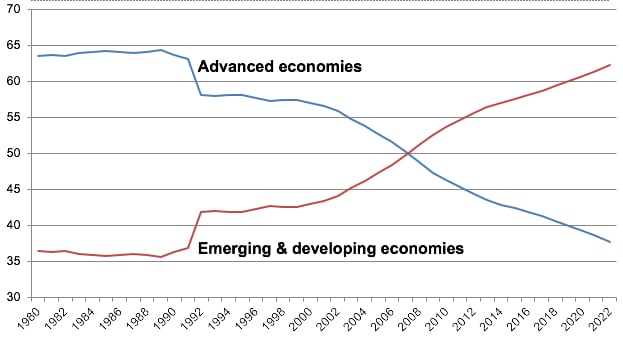
 Emerging and Developing Economies for the First Time Account for a Larger Share of World GDP or Global Output Than Developed Economies; A Point Surpassed After the 2008 Financial Crisis That Has Continued Apace (See Figure 1)....
How has this been achieved? Possessing good institutions is what economists have come to focus on and the spread of such institutions seems to have been key, as the father of New Institutional Economics predicted. The seminal work in this area was by Douglass North who was frustrated by neoclassical economic models that focused on measurable factors like workers and investment, with attempts to measuring technological progress, even though they could not fully explain why some economies grow well and others do not.

So, North took economics out of its comfort zone, which consisted of examining more easily measured inputs like labour and capital, and instead brought in politics, psychology, and strategy, as well as history, in order to understand why some countries succeed and others fail. He stressed that there was no reason why countries could not learn from more successful economies to better their own institutions. That finally happened in the 1990s....
This sort of imitation of good institutions and effective economic policies was as outlined by institutional economists such as Douglass North. It took the fall of the Berlin Wall, the rescue of India by the IMF in 1991 as well as China’s re-orientation towards the global economy in 1992 for these economies to look to adopt a new course. By emulating ‘best practice’ in other economies as well as opening up, which meant learning from more successful foreign companies, these countries have made tremendous progress as North would have expected. He would have approved of these economies looking more widely than just on capital or labour or technology in fashioning their growth policies.

North once remarked: “My pet peeve all through the last twenty years or thirty years has been the narrowness of economists, in fact of all social scientists, in not opening up whole new areas” (North et al. 2015: 9). And his ideas have brought us closer than ever before to answering the age-old question of how countries can become rich.
The take-away from Douglass North's work is not so much that capitalism is the superior system in the sense that conventional economics treats it as that Western approaches to socio-economic and political organization proved superior to other approaches. The issues are more complicated than the simplified models of conventional economics, with their restrictive assumptions that are ideologically based — e.g., maximization and equilibrium. North recognized that broader scope was required.

North adopted a different methodology that includes all factors he found to be relevant rather than seeking formal elegance but sacrificing empirical relevance. North was an institutional economist that specialized in development economics, and he worked in quantitative economic history (cliometrics), as well, which was needed for his empirical research.

World Economic Forum
Emerging economies are now richer than the West
In collaboration with VoxEU