Showing posts with label efficiency. Show all posts

Sunday, October 27, 2019

Nikkei Asian Review misleading headline? "Pay with your face: 100m Chinese switch from smartphones"


Apparently misleading headline at Nikkei. There is nothing in the article that reflects what the headline asserts. To the contrary, in the last paragraph the article states the opposite.
The situation in China apparently heralds an era of ubiquitous facial recognition, when greater tech-supported convenience comes at the cost of privacy. In China, however, the name of the game is "ease to use." There is no particularly strident criticism in the country, at least for now, about the use of the software by the government or companies.…
But most people read only the headlines, and if they read the body at all, it's not past the first couple of paragraphs. So this is used as a tool in narrative control.

Where the switch in smartphones is occurring is away from foreign brands to domestic brands for patriotic reasons but also reflecting the rise in quality of domestic products to a level that competes with the big name brands from abroad.

Moreover, there is a tradeoff between privacy and efficiency. There is also a tradeoff between privacy and access. China is pretty up front about this and privacy takes a seat to the rear of the bus.

In the liberal countries, a lot of lip-service is paid to privacy, and choice in making the tradeoffs, while the intelligence services are working behind the scenes to gain total information access, and according to Edward Snowden were doing quite well at the time he blew the whistle on it, not that he was the only one either.

The question is how much privacy is even possible in a technologically advanced society where information is a major factor in power and wealth.

Nikkei Asian Review
Pay with your face: 100m Chinese switch from smartphones —Facial recognition technology spreads rapidly at the expense of privacy
Takashi Kawakami And Yusuke Hinata, Nikkei staff writers

Monday, July 31, 2017

Sputnik International — The Circular Economy That Could Save Countries Thousands, Reduce Waste

Unilever, Renault, Google and Nike are some of the companies that have begun moving towards a circular business model.

It's not just businesses that are adopting these strategies, cities are also looking at how they can drastically cut waste.
London, Amsterdam and Paris are all looking at how they can shift from a circular economy, hoping to reuse products, parts and materials which produce no waste and pollution, and use fewer new resources and energy.
Sputnik International
The Circular Economy That Could Save Countries Thousands, Reduce Waste

Sunday, March 5, 2017

Amir Fleischmann — The Myth of the Fiscal Conservative

Austerity measures don’t actually save money. But they do disempower workers. Which is why governments pursue them in the first place.

Jacobin
The Myth of the Fiscal Conservative
Amir Fleischmann

Monday, July 18, 2016

Bill Mitchell — Towards a progressive concept of efficiency – Part 1

Before I present the second part of my discussion about the relevance of re-nationalisation to what I would call a truly progressive policy agenda, we have to take a step backward. I note after the first part – Brexit signals that a new policy paradigm is required including re-nationalisation – there were a few comments posted (and many more E-mails received – apparently readers are happier berating me personally rather than putting their ideas out in the public domain) that I was advocating a return to the ‘bad’ old days of nationalisation where cronyism, inefficiency and trade union bastardry were the norm. The obvious next point was – how can I claim that is progressive and part of the future. In this two part blog (the second part will come tomorrow), I offer a framework for assessing these claims. Today’s blog foscuses on the neo-liberal vision of efficiency and reveals how narrow and biased towards private profit it is. In Part 2 (tomorrow) I will present the progressive vision and how it conditions the way we think of efficiency. Once we break out of the neo-liberal constructs and refocus our attention on Society rather than the individual then the way we appraise policy options also changes – it becomes enriched with new possibilities and understandings. We enter the progressive world and leave behind the austerity nightmare that neo-liberalism has created. We are then able to see how our old conceptions of nationalised industries or public sector job creation are tainted with these neo-liberal biases. And we are then able to see how policy initiatives that invoke scorn from the conservatives and many so-called modern progressives (obsessed with post modern constructs) have a vital role to play in a truly progressive manifesto. I split the discussion into two parts because the blogs are too long as they are.

This blog is part of Part 3 of next book (with co-author, Italian journalist Thomas Fazi), which is nearing completion. Part 3 will present what we are calling a ‘Progressive Manifesto’ to guide policy design and policy choices for governments that are struggling to see a way beyond the neo-liberal macroeconomics which we posit blights any hope of mounting a progressive agenda.
We also hope that the ‘Manifesto’ will empower community groups by demonstrating that the TINA mantra, where these alleged goals of the amorphous global financial markets are prioritised over real goals like full employment, renewable energy and revitalised manufacturing sectors is bereft and a range of policy options, now taboo in this neo-liberal world, are available.…
Bill Mitchell – billy blog
Towards a progressive concept of efficiency – Part 1
Bill Mitchell | Professor in Economics and Director of the Centre of Full Employment and Equity (CofFEE), at University of Newcastle, NSW, Australia

Thursday, June 25, 2015

Jason Smith — Nick Rowe shows us the prior


Good one from Jason today.

Information Transfer Economics
Nick Rowe shows us the prior
Jason Smith

Chris Dillow — Managerialism vs innovation


Is creativity no longer an option that increases efficiency and effectiveness of real resources in the long run but also but necessary in a complex adaptive society faced with emergent challenges some of which are existential? Sir Ken Robinson thinks so. R. Buckminster (Bucky) Fuller thought so.

One of the key rationale for libertarianism of both left and right is freedom to explore, which is a necessary condition for development and expression of creativity. Some even so far as to hold that creativity is a key feature of human nature and the ability to develop creativity is a natural right. Those deprived of that right risk failure to become truly human.

This is a key argument against the wages system as being a form of slavery that treats humans as less than human in treating labor as other commodities exchanged for money in commodity markets. It is also a deep critique of the class system in that it prevents all classes from expressing the potential of their species nature owing to the conditions under which people live. See Marx's theory of alienation and Marx's theory of human nature

As a life scientist, Roger Erickson is constantly emphasizing the significance of adaptive rate and return on coordination for a complex adaptive system to meet and exceed the challenges of emergence. Broadly speaking, creativity is a necessary condition for this, and incubating creativity is therefore of the highest priority.

The most significant matter is that since creativity is natural, nothing needs to be added. Rather, the obstacles just need to be removed. This can be accomplished through enlightened approaches to education and management that prioritize the important rather than mistaking the trivial for the important.

Stumbling and Mumbling
Managerialism vs innovation
Chris Dillow | Investors Chronicle

Thursday, April 9, 2015

Michael Porter — Why Social Progress Matters

Economic growth has lifted hundreds of millions of people out of poverty and improved the lives of many more over the last half-century. Yet it is increasingly evident that a model of human development based on economic progress alone is incomplete. A society which fails to address basic human needs, equip citizens to improve their quality of life, protect the environment, and provide opportunity for many of its citizens is not succeeding. Inclusive growth requires both economic and social progress....
Economics is about efficiency of means and policy is about effectiveness of means to achieve prioritized and integrated objectives. An economy is the material life-support system for a society. The economy exists for the society and not vice versa.

Project Syndicate
Why Social Progress Matters
Michael Porter | Professor at Harvard Business Schoo and chairman of the Advisory Board to the Social Progress Imperative.

Thursday, December 11, 2014

Dani Rodrik — Good and Bad Inequality

In the pantheon of economic theories, the tradeoff between equality and efficiency used to occupy an exalted position. The American economist Arthur Okun, whose classic work on the topic is called Equality and Efficiency: The Big Tradeoff, believed that public policies revolved around managing the tension between those two values.… 
The belief that boosting equality requires sacrificing economic efficiency is grounded in one of the most cherished ideas in economics: incentives. Firms and individuals need the prospect of higher incomes to save, invest, work hard, and innovate. If taxation of profitable firms and rich households blunts those prospects, the result is reduced effort and lower economic growth.… 
In recent years, however, neither economic theory nor empirical evidence has been kind to the presumed tradeoff. Economists have produced new arguments showing why good economic performance is not only compatible with distributive fairness, but may even demand it.… 
Economics is a science that can claim to have uncovered few, if any, universal truths. Like almost everything else in social life, the relationship between equality and economic performance is likely to be contingent rather than fixed, depending on the deeper causes of inequality and many mediating factors. So the emerging new consensus on the harmful effects of inequality is as likely to mislead as the old one was.… 
It is good that economists no longer regard the equality-efficiency tradeoff as an iron law. We should not invert the error and conclude that greater equality and better economic performance always go together. After all, there really is only one universal truth in economics: It depends.
Economists like to compare a limited number of variables in order to discover patterns in an otherwise jumbled and confusing context of events. Economists especially like identifying patterns that can be expressed in terms of an independent variable and dependent variable. By assigning different quantitative values to the independent variable, the effect on the dependent variable can be expressed neatly as the result of a mathematical function.

This method requires a imposing level of abstraction using qualifying assumptions such as cet. par. This approach is the basis of the claim that economic behavior can be viewed in terms of "tradeoffs" that reveal the degree to which one thing must be sacrificed in order to gain the advantage of another that stand in inverse relationship. Opportunity cost is key to the economic notion of rationality based on utility maximization that underlies conventional economic, for example. Other tradeoffs operate similarly.

The "it depends" relates to the actual context that is independent of the stylization for modeling convenience and remains operative. This stylization assumes a homogenous background, which is a huge simplification in an economy embedded in a society as a complex system under uncertainty functioning as a network with a web of feedback loops.

The question is whether any can "iron laws" emerge from such a procedure?

Project Syndicate
Good and Bad Inequality
Dani Rodrik | Professor of Social Science at the Institute for Advanced Study, Princeton, New Jersey

Thursday, August 28, 2014

Izabella Kaminska — The tribute and organisation theory of value – Part 1, Part 2, Part 3

From Part 3:
In this tribute series, I’ve been trying to get people to stop thinking about money in the abstract or intrinsic value sense.
My proposition instead is that money is about muscle. Always has been and always will be. Riches are the product of the authority or gravitas that affords you well being, a.k.a wealth. A muscle, of course, being a biological machine which optimizes energy efficiently so as to create power with.
 
But by muscle, I don’t necessarily only mean brute force. I mean all systems that are better organised than other systems and thus stronger and more capable of enforcing their will or alternatively of creating value. Whether that means they are better at collecting favours due, cultivating the land, confiscating assets directly or manipulating you into doing what they want, doesn’t really matter. What matters is that they are just better at doing it. 
Not to say that reciprocity doesn’t encourage value creation but simply that when it happens it’s mostly incentivized by a need to join forces so as to organise against a stronger enemy, whether that enemy is a stronger person, a nation or nature itself. 
Dizzynomics

Tuesday, April 8, 2014

Guy Numa — Charles Babbage and the History of Innovative Thinking


Good summary of the contributions of Charles Babbage to economics. His work also had far-reaching consequences in business and business theory. He can be viewed as one of the founders of modern market capitalism based on efficiency.

INET Blog
Charles Babbage and the History of Innovative Thinking
Guy Numa

Monday, April 7, 2014

Josh Hendrickson — What is Fair?


Josh Hendrickson weighs in on Piketty.

Notice how his argument assumes methodological individualism based on ontological individualism that ignores that human being are situated in society, culture, and institutions, so that individual action is entirely free of social influence. Which is absurd from the point of view of the life sciences, social sciences, history, and psychology.

I am not picking on Professor Hendrickson here, since he does not put this forward as his own view personally. Rather, he presents it as how economists think about these things.

These economists whom he mentions appear to be without a clue about how life actually works in the real world outside their heads. I remember the day when this was said about philosophers, but now economists have taken it over.


The Everyday Economist
What is Fair?
Josh Hendrickson | Assistant Professor of Economics, University of Mississippi


Thursday, April 3, 2014

Philip Pilkington — Marginalist Microeconomics: The Path to Totalitarian Tyranny

Fortunately the totalitarian tendencies of marginalist microeconomics are kept in check in Western democracies to a very large extent. But one can imagine the social chaos that might be unleashed were a government ever to get in that allowed to microeconomists free-reign. Given the opportunity — especially by an authoritarian government — their attempts to impose their bizarre notions of rationality on the population could quickly turn into something out of a dystopian science-fiction novel.

Of course, the microeconomists will say that I’m misrepresenting them and that their doctrines are based on the idea of individual choice. This is entirely untrue, of course, because, as I have written before, in marginalist economics people are nothing but calculating machines — not actual decision-makers. But then, tyranny always comes selling itself as the path to greater freedom, now doesn’t it? And the harbingers of this tyranny often come wearing the frocks of the scientist and insisting on the ‘total objectivity’ of the evils that they do.

Marginalism is another name for neoclassical economics. It pretends to be descriptive, but it is normative and prescriptive — not so much science as ethics, and bad ethics at that, where "efficiency" is the criterion of good. The way to efficiency is by reducing waste, and "waste" is defined as anything that does not meet the criterion of being "rational" in terms of pursuit of maximum utility.

Saturday, January 25, 2014

Rob Urie — Technology and Economic Imperialism

The oft called ‘knowledge’ economy brought into being in the ‘developed’ West in the 1990s is composed of several industries that are broadly related but also quite specific unto themselves– artificial intelligence, telecommunications, finance, information technology and digital commerce- the Internet. More broadly, these can be divided into ‘finance’— Wall Street, insurance and real estate; and ‘technology,’ modes and methods of operational interaction with the world. One branch of these technologies in particular, the algorithmic ‘intelligent’ technology of computing tied together through global telecommunications infrastructure, is widely considered by Western economists to be a second ‘industrial age,’ a group of innovations that revolutionized the way the world ‘works.’ The development and growth of these industries was coincident with the revival of the political economy of neo-liberalism and the return of finance capitalism in its most intrusive and destructive forms. And finance— Wall Street, played a prominent role in inserting these new technologies into global political economy.
Finance and information technology are ‘Cartesian’ capitalism reconstituted in its purest form, the form, function and facilitation of the ‘rational’ interaction of ‘economic man’ with ‘the world’ of capitalist theory. Finance is the ‘fluid’ of capitalism, the Aristotelian ether that unites commerce and suspends it in a body of metaphysical equivalence, the ‘this equals that’ that facilitates the aggregation of claims on ‘the world.’ The ‘intelligence’ of ‘intelligent’ machines is algorithmic, the product of instructions written in mathematical languages to be operationally efficient, the reconstitution of ‘time is money’ into machine action. Not coincidentally, finance and technology are the twin ‘explanations’ offered by capitalist economists for the stupendous fortunes suddenly found in the pockets and bank accounts of a group of actual persons so small it could barely fill an island of modest size. And to be clear, these fortunes are ‘claims’ in the sense they are socially circumscribed rather than ‘possessed,’ aggregations of contracts, representations and rights that depend on social accedence for their ‘value.’
The typical frame of ‘technology’ in Western economics is as method / mode of economic ‘efficiency’ in capitalist production. Opponents of technology are ‘Luddites,’ labor displaced by technology whose blame is ‘misplaced’ because making more from less— economic efficiency, makes ‘the world’ better off. The ‘tradeoff’ offered is that this displaced labor can now buy lower priced goods made possible through ‘technology.’ And if the new found absence of a paycheck hinders those directly displaced from reaping economic benefit then the economic ‘system’ is argued to benefit. Finance, ‘money,’ is the fluid and metric of equivalence here, the object of ‘system’ that renders irrelevant whose pocket it ends up in. The fact of displacement is its own proof, the backward induction that technology found the right target. This theoretical sleight of hand is wholly circular—economic efficiency made possible through technology benefits the economic system, labor displaced by technology is part of this economic system and therefore displaced labor benefits from being displaced....
Counterpoint
Technology and Economic Imperialism
Rob Urie

Thursday, August 29, 2013

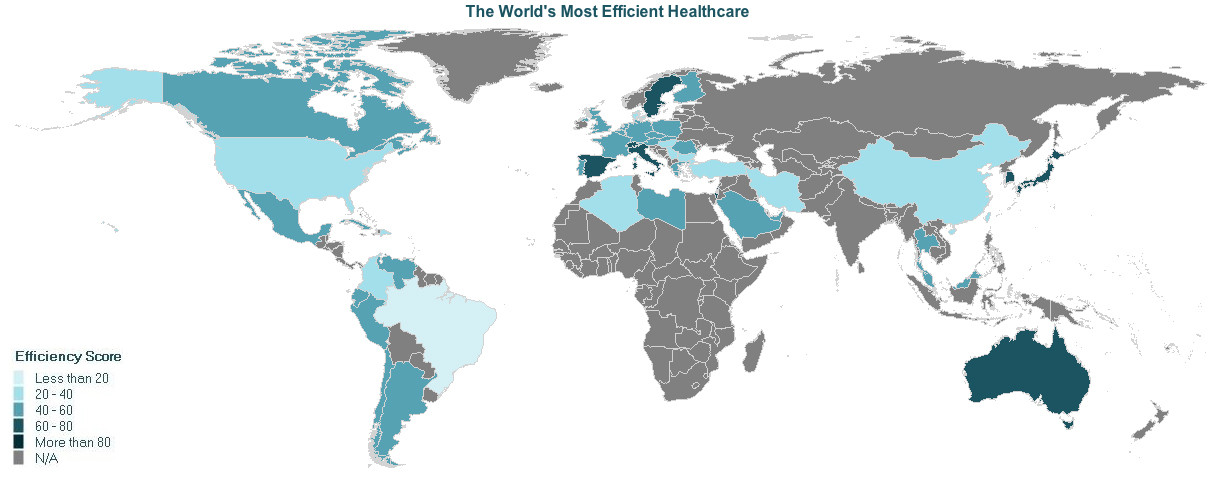
Kavitha A. Davidson — The Most Efficient Healthcare Systems In The World (INFOGRAPHICS)


The Huffington Post
The Most Efficient Healthcare Systems In The World (INFOGRAPHICS)
Kavitha A. Davidson
It's remarkable how low America places in healthcare efficiency: among the 48 countries included in the Bloomberg study, the U.S. ranks 46th, outpacing just Serbia and Brazil. Once that sinks in, try this one on for size: the U.S. ranks worse than China, Algeria, and Iran.
But the sheer numbers are really what's humbling about this list: the U.S. ranks second in healthcare cost per capita ($8,608), only to be outspent by Switzerland ($9,121) -- which, for the record, boasts a top-10 healthcare system in terms of efficiency. Furthermore, the U.S. is tops in terms of healthcare cost relative to GDP, with 17.2 percent of the country's wealth spent on medical care for every American. 
In other words, the world's richest country spends more of its money on healthcare while getting less than almost every other nation in return.


Thursday, July 18, 2013

Noah Smith — How normal people see macroeconomics

Most of the time, econ bloggers and columnists write as if we were speaking to an audience that has taken a few econ classes. But the more widely read our posts and columns become, the more our real audiences fail to fit this ideal. Most people who read us are smart and educated. But smart and educated non-economists ("normal people", if you will) see econ - and especially macro - in fundamentally different ways from economists.

I've been thinking about these differences for a while, and I've reached two major conclusions:

1. Normal people see macro as inherently political.

2. Normal people see macro as being mostly about redistribution rather than about efficiency....
The result is that public discussions of macro, on the blogs and elsewhere, usually break down into tribal camps, and thinkers are often seen more as tribal champions than as technocratic advisors or sources of intellectually interesting ideas. Many people see the "-isms" of macro - "New Keyneisanism", "New Classicalism", etc. - as political advocacy rather than as dispassionate scientific attempts to explain the world around us....
What do you think?
Noahpinion
How normal people see macroeconomics
Noah Smith

As a non-economist, what I see is economists advocating macro positions that advance their own political agenda. The fact is that macroeconomics is used to justify policy alternatives and economists of different political persuasions disagree and that disagreement is almost perfectly predictable based on past performance.

I am not alone in this and this is likely the major reason that non-economists see macro as essentially political.

Secondly, I have a terminal degree in philosophy, and a lot of what philosopher do is examine arguments and the context in which they are embedded. What a person accustomed to logical analysis looks to is assumptions, key terms, method, and conclusions. Based on this, it is immediately apparent that the conclusions of economists are based on the choice of assumptions, key terms, and method, which are chosen to justify the preferred conclusions.

It is also immediately obvious that the subject matter is so complex that no model can forecast the future with any degree of high probability, let alone virtual certainty. Yet, many economists offer their conclusions as if certainly true, deduced from highly complicated mathematical models that only experts can penetrate. This looks a lot like medieval scholastic debates over theology that were only conducted in Latin in order to exclude the common person. When they are caught out, like Rogoff and Reinhart, they come up with lame excuses that are easily fielded by opponents.

When many economists do address "normal people," it is often with what looks like a lot of hand waving, dismissing opponent's arguments as obtuse and not worth responding to. But this turns out to be based on their own assumptions, definitions, and methods, which are often the subject of attack. This is just circular reasoning or evasion. Typical is that the opponent lacks a model, which on inspection means that the opponent is using a different method and the opponent is attacking the apologist's method as inappropriate.

When virtually all the major conventional economists missed the global financial crisis and major institutions were assuring the public that everything was fine until the meltdown, then normal people, including the Queen of England, began asking how this could be. After all these were the experts advising "the masters of the universe." This was the high priesthood of the religion of progress based on efficiency.

The answer came back that the models are not constructed in a way that could foresee this. As result, a lot of people began getting interested in finding out how major macroeconomists could have been so wrong, especially when they were the people giving policy advise to political decision-makers.

Then, post-crisis, normal people saw the policy choices that were adopted leading to increasing inequality, saving large corporations from failure with enormous bailouts and extension of "forbearance," when normal people had been told that the basic rule of capitalism was risk and market accountability  They also saw that the privileged class was not being held to the same standard as normal people, so that the privileged class was doing exceptionally well through the crisis while normal people were bearing the brunt of it through liquidation, unemployment, and a decline in real wage.

Economists generally represent what they are doing as positive science and economics as non-normative and amoral. This is supposed to result in a value-free approach. But what became egregiously apparent to normal people was that economists did not consider power relationships, looked at rent-seeking as productive, and had no idea of the Ponzi finance that had progressed to the to the point of control fraud and criminogenic environments. In addition they did not consider social costs and externalities to be economic costs at all. In other words, they were either clueless, or else fronting for a privileged class bent on maximizing its own utility at the expense of other classes — you know, the normal people.

Apparently macroeconomists missed this?

Monday, June 24, 2013

Peter Radford — Human capital – The knowledge dimension

People like Tyler Cowan, for example, predict a diminished trajectory for GDP growth because our economy is not innovating as well as it once did. According to Cowan, our latest inventions have a far smaller impact on future wealth creation than did those of a century ago. This conclusion feeds into his standard right wing cry for freeing up enterprise and the reduction of social entitlement programs. He says we cannot afford those programs because of the diminished future, and if we want to move the growth curve back upwards we need to reduce government controls.
But my narrative produces a different interpretation: the cause of our diminished future resides in the private sector’s single minded pursuit of profit being extracted from efficiency rather than from innovation. We have succeeded mightily in squeezing profits from our current set of ideas. But at the cost of thinking about and finding the innovations that build the future.
We have become overly bureaucratic, technocratic, and reliant on primary knowledge.
I think the Golden Age of Human Capital is yet to come. The age of problem solving, that is. Not the age of rote learning.
Real-World Economics Review Blog
Human capital – The knowledge dimension
Peter Radford

Peter Radford's analysis is interesting to compare with Joseph Schumpeter in Capitalism, Socialism and Democracy. Schumpeter saw the failure of capitalism based on economic liberalism and its replacement by social democracy as coming from the decline of entrepreneurship and innovation. His work is dated in that the context and changed greatly so the path that Schumpeter predicted based on then current trend has shifted considerably.

The path that Peter Radford describes is characterized by a push for efficiency and cost-cutting over innovation and entrepreneurship. This has become the driving force in US business. While Radford foresees a resurgence of innovation and entrepreneurship, the evidence is thin. Instead what we are seeing is the social reaction that Schumpter foresaw, but for different reasons. 

It is not government responding to popular desire that is causing the shift away from innovation and entrepreneurship, but rather it is the current business model based on efficiency that is resulting in social unrest and a call for greater social democracy to deal with the effects of inequality, which the wealthy and powerful brush off as class envy if they are even aware of it, being isolated in a bubble.

Friday, April 19, 2013

Daron Acemoglu and James Robinson — Pirate Democracy?

In our discussion of Berber society, we discovered that the Berber’s of the High Atlas Mountains democratically elected secular political leaders and even practiced a form of checks and balances by rotating the office in strict order across clans.
Another fascinating case of unlikely democracy is 18th century pirates. You might have imagined that a tough pirate like Bartholomew Roberts would have bullied and tyrannized his way to power. Not quite. In fact he needed a campaign manager “Lord” Dennis who entreated the crew
"who by his Counsel and Bravery seems best able to defend this Commonwealth, and ward us from the Dangers and Tempests of an unstable Element, and the fatal Consequences of Anarchy"
Answer: Roberts.
Instead of grabbing power, Roberts was elected on the basis of one-pirate-one-vote.
Why Nations Fail
Pirate Democracy?
Daron Acemoglu, Killian Professor of Economics at MIT, and James Robinson, David Florence Professor of Government at Harvard University


Thursday, January 31, 2013

Graham Barnes — Money and Sustainability – The Missing Link: Review


Graham Barnes reviews Money and Sustainability: The Missing Link by Bernard Lietaer, Christian Arnsperger, Sally Goerner and Stefan Brunnhuber. Opposes public or private monopoly of currency, similar to free banking in order to increase resilience by adding redundancy which admittedly is accomplished by trading off efficiency.

Feasta
Money and Sustainability – The Missing Link: Review
Graham Barnes

Sunday, December 30, 2012

Chris Dillow — The Costs Of Hierarchy

Experimental evidence shows that hierarchical organization is more inefficient than generally realized.
Ernst Fehr and colleagues got subjects to play an authority-delegation game, in which subjects were divided into principals and agents, and then asked to work on selecting projects with varying payoffs. They made two important discoveries.
First, subordinates put in less effort than you'd expect rational income maximizers to; depending on the treatment, up to half put in no effort at all, even though this was almost never the income-maximizing option....

Secondly, Fehr and colleagues say:
We find a strong behavioral bias among principals to retain authority against their pecuniary interests and often to the disadvantage of both the principal and the agent.
Stumbling and Mumbling
The Costs Of Hierarchy
Chris Dillow | Investors Chronicle

These findings are actually surprising to some "experts"?