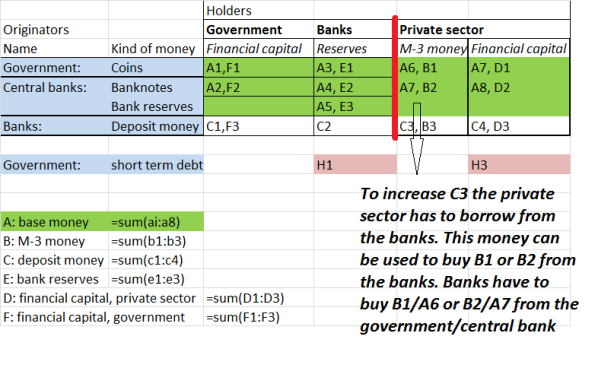
With fixed fx/convertible currency ‘base money’ doesn’t include govt secs as those obligations are claims on govt reserves (gold, fx, etc.), which are part of ‘national savings’ as defined.
However, with today’s floating fx/non convertible currency tsy secs (held outside of govt) are logically additions to ‘base money’, as the notion of a reduction of govt reserves (again, gold, fx, etc) is inapplicable to non convertible currency.
That is, with today’s floating fx, I define base money as currency in circulation + $ balances in Fed accounts. And $ balances in Fed accounts include both member bank ‘reserve accounts’ and ‘securities accounts’ (tsy secs). And to me, it’s also not wrong to include any other govt guaranteed debt as well, including agency paper, etc.
That is, with floating fx, ‘base money’ can logically be defined as the total net financial assets of the non govt sectors.
(Note, for example, that this means QE does not alter base money as thus defined, which further fits the observation that QE in today’s context is nothing more than a tax that removes interest income from the economy.)
And deficit reduction is the reduction in the addition of base money to the economy, with the predictable slowing effects as observed.
The point of this post is to ‘reframe’ govt deficit spending away from ‘going into debt’ as it would be with fixed fx, to ‘adding to base money’ as is the case with floating fx where net govt spending increase the economy’s holdings of govt liabilities, aka ‘tax credits’.
Feel free to distribute!The Center of the Universe
Defining “Base Money” with floating fx- The Great Reframation
Warren Mosler
Synchronicity. I was just thinking about this recently and about to ask.