Fresh Economic Thinking
Decent criticisms of economics? Here are 111 of them.
Cameron K. Murray
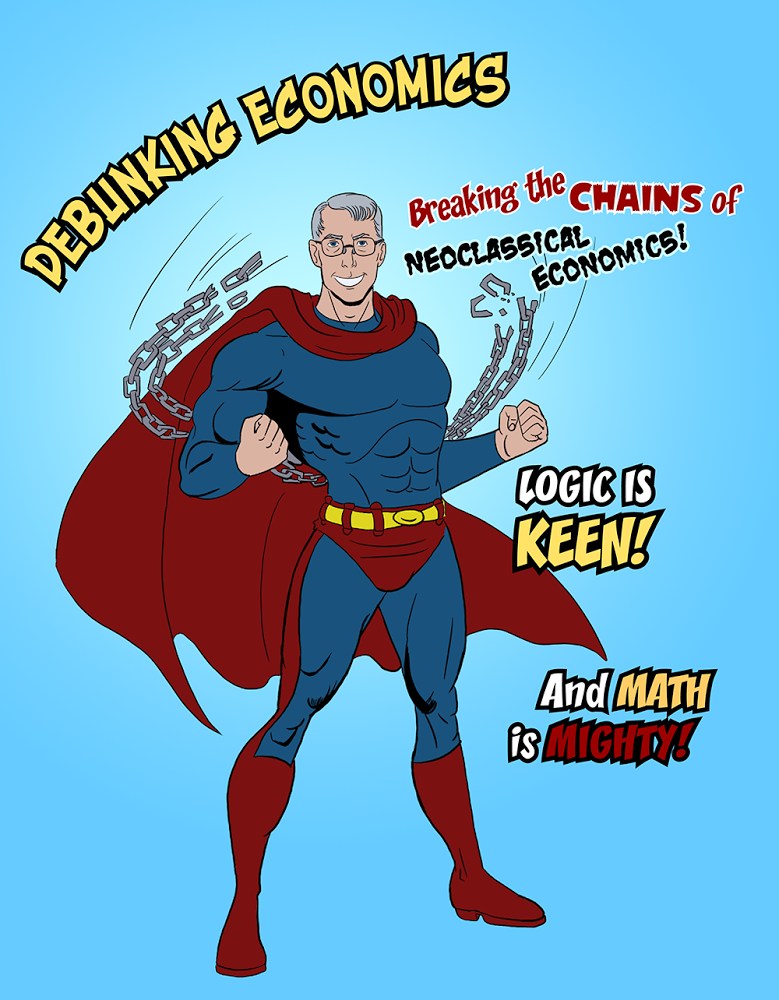
Yves here. While the impetus for Steve Keen’s post is the ECB’s latest pretense that it can and is doing something to combat deflation, he provides an excellent and short debunking of two widespread misconceptions about money and banking. The first myth is the money multiplier and the second is that reserves are the basis for bank lending.Naked Capitalism
1. Economics was originally called 'political economy'
2. The Nobel Prize in Economics is not a real Nobel Prize
3. There is no single economic theory that can explain Singapore's economy
4. Britain and the US invented protectionism, not free trade
5. Free trade first spread mostly through un-free means
6. It was arch-conservative Otto von Bismarck who introduced the first welfare state in the world
7. Capitalism did best between the 1950s and the 1970s, an era of high regulation and high taxes
8. The internet was invented by the US government, not Silicon Valley
9. Before tax and welfare spending, Germany and Belgium are more unequal than the US
11. The 'lazy' Greeks are the hardest working people in the rich world after South Koreans
12. Switzerland and Singapore are not living off banking and tourism alone
13. Most poor people don't live in poor countriesThe World Post
I have just accepted an offer to become Head of the School of Economics, History and Politics at Kingston University in London. I will take up the appointment in time for the Autumn term, which starts on September 23rd.Steve Keen's DebtWatch
Kingston will respond positively to calls from students for genuine reform of economics education—like those made by the Post-Crash Economics Society in Manchester, and the International Student Initiative for Pluralism in Economics (which was launched only days ago)....
Pareto efficiency is a minimal notion of efficiency and does not necessarily result in a socially desirable distribution of resources: it makes no statement about equality, or the overall well-being of a society.If it were known at the time, Pareto optimality would have used to defend the ownership of human capital in the debate that culminated in the US Civil War and Emancipation Proclamation. This has been estimated to be the largest destruction of capital that occurred simultaneously until that time. The agricultural economy of the South was devastated and along with the culture, making some much worse off by making others better off. Economically it was a disaster; ethically, socially and politically, it was the right thing to do. While contemporary inequality does not rise to that level of inequity and iniquity, it is a similarly significant, indeed serious, issue ethically, socially and politically, and, it can be argued, also economically.
Now to the big enchilada which I did not mention in my post because it would have confused an already difficult subject matter. Absent imperfect competition, price and nominal wage rigidity, and other market failures, the so-called new Keynesian model delivers Pareto optimal outcomes. In my view, the notion of making Pareto optimality the benchmark for describing and discussing capitalist economies is silly. Yet from the moment one enters an economics classroom that is the frame through which theoretical thinking is forced. The economist who tries to offer another theoretical frame and stands in the way of that juggernaut will be excommunicated by the mainstream.Touché.
No need for change, boys and girls: mainstream economics has everything under control. We missed the crisis just because we failed to observe the shenanigans in the shadow banking system. Once we realised our observational errors, we had all the necessary tools and knew what to do (oh, and what the rebels said would happen didn't anyway, so there!).
As usual, Krugman’s reasoning is neat, plausible, and wrong. The main reason that mainstream economics survived the challenge of the Global Financial Crisis is not because of its strength, but because of its irrelevance.Business Spectator
The real culprits....Reviving Economics — Dedicated to dismantling the Ivory Tower and attempting, in some small way, to help revive the social science of economics.
...are the mainstream economists who continue to tell outdated or just flatly wrong tales about how our economy actually functions. In the sense that many politicians take their cue from these economists, it's actually economists that are then to blame for our political problems. The $1 trillion platinum coin can solve our economic problem, but it can't solve the political problem that has been created. That takes something more than money.
Not only did the global financial crisis catch the vast majority of economists completely unawares, they instead expected tranquil and even buoyant times just as the biggest economic crisis since the Great Depression began. My favourite such observation is from the OECD‘s Economic Outlook for June 2007—in which the Chief Economist suggested that, “the current economic situation is in many ways better than what we have experienced in years . . . Our central forecast remains indeed quite benign.” But there are countless other such utterly wrong prognostications about the economy, from the profession that is supposed to be the font of wisdom on the economy.Those “in the know” understand that this is not an isolated failing. The Neoclassical model that dominates economics today is riven with logical and empirical fallacies. If economics were a real science, it would have long ago been overthrown and replaced by something more realistic.Yet at least 90% of academic economists believe in this model, as do almost all economists working in government and private industry. Left to their own devices, they will continue thinking that this model does describe the economy as the real economy falls deeper and deeper into a crisis, even though their model says that this can’t even happen.Since economics has failed to clean out its own intellectual stable, it will be the public that finally forces reform upon it – as once-supporters like Anatole Kaletsky of The Times calls for “a revolution in economic thought” and George Soros funds an Institute for New Economic Thinking. With luck, in a decade or two, a more realistic approach to economics might emerge. But in the meantime, here’s a simple guide for the public: Anything the vast majority of economists believe is likely to be wrong.
...Since capital is destroyed when trade is liberalised, the watertight argument that trade necessarily improves material welfare springs a leak. If economics were a real science, this real-world complication to Ricardo’s argument would be considered, but it has never been seriously addressed.These and many other failings that explain why, when Dani Rodrik took a careful look at the empirical record of trade liberalisation, he found that it had frequently reduced material welfare rather than increasing it. Writing back in 2001, he summarised his findings for Foreign Policy magazine with the statement that:“Advocates of global economic integration hold out utopian visions of the prosperity that developing countries will reap if they open their borders to commerce and capital. This hollow promise diverts poor nations’ attention and resources from the key domestic innovations needed to spur economic growth.”As an economist who has specialised in dissecting the empirical claims for the role of free trade, Rodrik has the might of the majority of the profession against him. As noted above, that’s a good rule of thumb that Rodrik is right.

