Showing posts with label explore. Show all posts

Wednesday, July 22, 2015

Where Are The Statesmen (& Women) Who Can "JUST SAY NO!" ?

   (Commentary posted by Roger Erickson)

An ex-senator, a former CIA officer, and an Iraqi mogul lobby Congress for a private army, led by Saddam’s officers, to take on the terrorists that have trampled America’s proxies.

What could go wrong?

Wasn't ISIS started by, and is still led by, Saddam's officers? You can't make this up.

Create 2 sides, & sell weapons to both? That sounds rather familiar.

Twerks fur mi!

Where indeed are the Statesmen who can "Just Say No!" ?

And, ahem, the Stateswomen?

What happened to an ounce of prevention? Not profitable enough? Just think how little a microgram of prevention would have cost, back when we had the options of not overthrowing yet another government, to, you know, prevent an audit of some corporations shady bookkeeping.

Revolutions are always justified, but invasions and rebellions alike are always betrayed ... before they're even finished?

A reminder: Fiat currency operations are NOT about individuals making personal gains in the stock market. It's about making people aware of aggregate options worth exploring.
"How do you get people to explore their options."
Personal or aggregate.

In a conversation years ago, Warren Mosler asked me: "How do you get people to explore their options."  That was a killer question that stopped me in my tracks, and honestly, I've been researching it ever since. And, the answer is: that much is actually known, most of it is actively ignored, it's not formally taught in K-12 schools, and the task gets bigger every year ... and harder, every day that we neglect it. What is known is subtle, trivially easy, not immediately profitable, but is the actual key to sustaining short term, medium term and long term cultural evolution. It's all about an ounce of preventive preparation avoiding the spiraling repair costs associated with narrow, get-rich-quick schemes.

To repeat an old message. MMT is not economics. Rather, it is a description of pragmatic fiat currency operations, which COULD be applied to fiscal and monetary policy, if there were even a few more pragmatic people left in the USA.


Monday, January 12, 2015

What Was At Stake, And Ultimately Lost ... From Within. Are We Seeing The Demise Of CONTEXT NOMADS?

   (Commentary posted by Roger Erickson)


Have you ever come to recognize a people's failure to adapt, and lead themselves?

That observation can be made in more than one current setting.

In fact, it's a widespread & unmet challenge among literally billions of humans.

Here's just one of many, illustrative examples.
Andy:
"Unrelated Bill, but perhaps you will allow me to recommend a wonderful documentary and, in my view, a valuable historical record about the Miners strike in Britain in 1984-85. It’s called

It looks at the strike from the miners’ perspective and that of their wives and crystalizes the battle (literally) between the State and organized workers plus what was at stake, and ultimately lost."

That's from a comment at: While Europe debates a placebo the disaster deepens

What is an observer of these - and many more examples - to conclude?

First, perhaps, that this all ties together rather simply. Our major difficulty is orienting so many people to the nuance of emerging group context. Organizing & re-organizing on this scale poses a novel recruitment task requiring new methods plus learning how best to wield them after they're invented. The herding cats metaphor applies as never before.

Second, that regardless of which & how many details are discussed, these are all rather straightforward failures to organize & re-organize any & all methods ... as context changes. That's certainly one general conclusion.

Our biggest problem seems to be our own, aggregate lethargy, mostly a cognitive lethargy. We're simply getting in our own way. No single challenge we hear people lamenting is in of itself in the least bit daunting. Our ancestors would howl with laughter watching us - once they sorted out the unfamiliar but un-daunting context.

Why? Because, none of our present stories are conceptually different from previous sad endings, such as the self-programmed demise of the Greenland Vikings, not to mention countless other stories of prior human challenges, successes and failures. We've come all this way, and now suddenly billions of homo sapiens can no longer execute staging, linking & sequencing of more group agility? That really is comical, as well as tragic.

Humans used to be good at change. In the past several hundred thousand years, we spread all over the entire globe in multiple waves - incredibly quickly - as NOMADS.  And along the way we quite incidentally diversified any & all of our methods AT WILL, as we became many different cultures, and even formed and recombined different subspecies!

Any ancient nomad could do this! Before breakfast. Without breaking a sweat.

Go anywhere and be anything ... in 2 generations. That's what we've always done. Call it the "Traveling Entrepreneur Task."

In fact our kids ... when we leave them alone ... can still do this with ease.

So what happened to too many of our present adults, in so many different settings? We're no longer geographic nomads, but since other aspects of context keep changing, we always were - and remain - Context Nomads.

Why are too many of our adults just sitting down and refusing to keep changing, even as the rest of the human troop (including their own descendants) go on exploring the next context?

Our primate ancestors came out of Africa and went everywhere. Now we honor them by refusing to keep going, by exiting the past & present ... and exploring new dimensions of cultural reorganization and evolution?

For shame.

Sayonara, old folks sitting down on the path. You're history. Do your descendants a favor, and quit urging them to hunker down with you, and abandon Nomadism.

No rapidly changing methods, no survival.

It's a wonderful, always changing world. Our aggregate options are expanding exponentially. And it's a shame that so many people can't find joy in simply exploring it AND all it's changes.

Tuesday, October 14, 2014

Is Economics, As Well As Most Other Policy Management Theory, Tragically, Comically Overrated?

   (Commentary posted by Roger Erickson)

Ya think? :(


Is there a recipe cookbook for cultural and economic policy evolution? :)


Just Do The Little Things That Make It Harder For All Citizens, Everywhere, To Work At Cross-Purposes?

Bill Mitchell: Available Operations ... Are Not The Same As Initial, Past, Current & Eventual Use.

(Commentary posted by Roger Erickson)


MMT – lacks a political economy?
What was the phrase?
First they ignore available operations, then they laugh at the idea of exploring options, then they fight to constrain aggregate options ... then the aggregate survives.
With inspiration from Gandhi, as well as evolutionary history. , where natural SELECTION = Outcomes Based Training & Education (same thing).


Monday, September 15, 2014

Perceived Injustices Are Meaningless Without Context ... Surviving Reality Requires Continuous Exploration of Response Options

(Commentary posted by Roger Erickson.)


Injustice?


This one misses the point, even if technically plausible. Better to define optimal tuning options, rather than ONLY define current injustices.

Problem? The rich are given, and are hoarding, immobilized, an outsize proportion of present fiat?

Suggested alternative? Why bother confiscating it? Just alter the ratio of feeding it (excessive hoarding) vs feeding dynamically distributed fiat. The huge hoards of unused fiat would wither as fast as they accumulated - or become irrelevant.

Why? Because today's net public fiat is always dwarfed by tomorrow's. It's been unstoppable for 4.5 Billion years!

How Public Initiative (fiat) used is NOT. That depends entirely upon the quality (including tempo) of OUR distributed decision-making.

Here's a suggestion. Participate, yourself, in defining your own local and your own country's distributed options.

If you don't, some deranged economist will!

And that will only constrain the rate of exploring our cultural options.

Then you'll have to deal with the PRINCIPLE OF PRIOR PLAUSIBILITY, where an initial hypothesis builds outsized institutional momentum, SOLELY for lack of early opposition or alternatives. The statistics of phenotypic persistence dictate cultural agility. If we want to adjust quickly, then we have to end some cultural habits as fast as we start other ones ... or be far more selective about which ones we start!

Hence Leonardo's famous maxim.
"It is easier to resist at the beginning than at the end." Leonardo da Vinci
He might just as easily have said "be selective," rather than just "resist."
And an immediate corollary?
"Democracy works better when practiced every minute, instead of trying to repair it every four years."  RGE :)
Call it the "Broken Democracy" approach. :( The prize to keep our eyes on is our own, constantly increasing Cultural Adaptive Rate. That's the best way to prevent the crime of innocent fraud.


ps: If we question the adaptive value of human fat, why don't we question the cultural utility of obese wallets that immobilizes people in gated communities? A fatty liver is bad for personal health. A fatty wallet is bad for cultural health. Anything beyond 0.1% having fatty wallets is an epidemic of unhealthy demand leakages, i.e., sloth.

(effects of liver cirrhosis)


Stages of cultural damage?
  From healthy culture (distributed decision-making)
  To cultural financial fibrosis? (bought politicians; "yellow" NeoCons)
  And on to cultural liquidity cirrhosis? (free tradeforeign adventures?)

Any artists care to illustrate a cirrhotic Wall St. poisoning American policy agility?


Monday, June 2, 2014

Increasing Labor Productivity Is Not A Problem - It's A Benefit To Be Leveraged

(Commentary posted by Roger Erickson)


Looking Closer At More Causes of Current Economic Inequality

Mitchell's context-specific points echo my own systemic conclusion.

Historically, any improvements in productivity only freed distributed populations to explore even more distributed innovations.

(No one person domesticated crops, circumnavigated the globe, created nuclear power or sent people to the moon. Persistent teamwork did. And that return-on-coordination always completely swamps all other returns. There's no competition.)

Traditionally, we accepted all productivity improvements and just immediately set our sights higher - or at least that's what we used to do. Now our biggest failure seems to be a failure to set worthy challenges for ourselves. Face it. We're bored, and resorting to hoarding existing assets instead of going after bigger and insanely greater assets.

In social species, more distributed innovations just allow us to immediately set bigger/better/leaner aggregate goals & achievements. Why aren't we doing that?

As aggregate production steadily rises, it's amazing that we're again seeing the rise of unprecedented personal hoarding.

Ye Olde Analogy is generals hoarding all the advanced weapons from the distributed soldiers, and still thinking that they are securely protected by a functioning army. History has always shown that to be a losing strategy, and one long past pointless.

A social species either distributes all available tools, teachings & responsibilities ASAP ... or it wastes it's greatest leverage, unused.


Tuesday, May 27, 2014

We're All Studying The Wrong Things

   (Commentary posted by Roger Erickson)


Or at least too much isolated detail, and too little context.

What'd Walter Shewhart say? "Data is meaningless without context."
Take our aggregate fiscal policy ... please!

The details in this essay by Bill Mitchell are depressingly astounding.

How Two Nations That Drove The Renaissance Eventually Joined At The Hip And Then Purposely Shot Both of Their Own Feet

I'll mention just one. "France was determined to stop Germany ever invading it again."

So, armed with that fixation, France ended up guaranteeing that German export industries would invade France, armed with THEIR fixation on a pegged Fx. And now they profess surprise.
Have A Steady Stream Of Changing Contexts
And Won't Explore Them Without Prejudice?*
Humans have been "Context Nomads" since before we were modern humans. Given that long habit, it is simply amazing that countries with such a history of brilliant physiologists, physicists and chemists can't figure out the rudimentary demands of the dynamic system we call a currency supply.

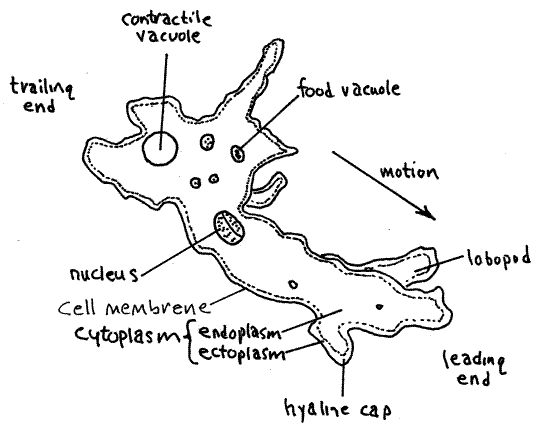
For heaven's sake! Amoebas figured this out a billion years ago! Even bacteria did. Just follow the damn operations, and keep them going, and evolving?

What should we be studying? How to systematically control the frictions that cause entire human cultures to take one giant step backward for every two aggregate steps forward.

Otherwise, how do we manufacture adaptive Public Purpose? Not just randomly diverted consent?


* We are Context Nomads: human nomads migrating through contexts with UNPREDICTABLE characteristics. Just explore without prejudice? Life is no more difficult than Kindergarten, where we first learn OBT&E


Thursday, May 1, 2014

Can't Make This Up. Hoover & Roosevelt as DoppleKabukiGangers

   (Commentary posted by Roger Erickson.)


- Roosevelt adviser Marriner Eccles, on the campaign of 1932
and
The fight that just won’t die.
It was all an accident?

Roosevelt eventually unintentionally DID what Hoover originally? intended, but wouldn't/couldn't/didn't get DONE in time to matter?

In retrospect, it seems clear that as nations and populations grow, that their fundamental operations must be re-organized, as a function of sheer scale alone, if not context. "Experts" such as Hoover can easily do more harm than good by unnecessarily opposing required change that they don't understand, while "beginners" like FDR can do tremendous good simply by having the courage to allow change, regardless of whether they understand it.

There is a fundamental difference between understanding process, and understanding process change - and especially rate of change.

Above all else, we need our entire range of people & personalities to have more humility, so that they can embrace and explore the potential of our constantly increasing diversity?
Have aggregate options, will explore!
That should be on our national business card.

Ever faster change, from grandparents to parents to grandchildren, is something we all have to embrace, if that generational cycle is going to continue unconstrained.

This Hoover/FDR tantrum may be a great lesson on intentions, adjustments and allowances, where both players come away looking better than all originally thought, but for reasons entirely different than ALL initially presumed! :)

History is never what we're actually told?

There's a fundamental difference between a tactical officer, and a LEADER willing and able to let tacticians operate?

It takes a different kind of leader, for every scale (and tempo) of policy development?


Monday, March 3, 2014

Neoclassical Economic Theory Has Done Nothing More Than Serve Ideological Ends, And Is More Concerned With Justifying Capitalism Than Analyzing It.

   (Commentary posted by Roger Erickson)


That is a complete & colossal failure of the entire field by arrogant complacency, if nothing else.

No amount of studies by economists will make a dent in this problem. Every referral to any economist whatsoever - as an authoritative reference - only extends the slavery of policy to economic theory.

Non economists have to simply decide what they want to use economic theory for - and quit deferring to economists.

It's a simple, operational question. Let reality be the judge, and let economists write books about what just evolved, AFTER it does.

To generate evolution, we have to explore emerging options, and discover which unpredictable permutations do and don't increase our Adaptive Rate.

As usual, the theory will slowly follow emerging operations.

Until then, please quit hanging on the words of these shamans & self-avowed priests that call themselves economists. They're a victim of their own religion, but we don't have to be.

It simply does not matter WHAT any economist anywhere says. What matters is why whole populations listen too much to their propaganda, and divert themselves from exploring their own options.

Put down the frigging text book. Look around, and in the mirror too.

You want proof?  Consider this.  
"For the Big Probability Event so loved the universe that - for 13.7 Trillion Years - it did NOT send economics."
That's a tool we invented, to repetitively shoot ourselves in the MiddleClass with. Apparently, only because it'll feel so good when we stop using it. :(

A theory, after all, is always and only just a bit of imagination, to eventually be proven wrong by trial and error exploration of our expanding options.


Saturday, February 2, 2013

Imagine That. You Have the Option To.

commentary by Roger Erickson

3D Photography?

Imagine even more. Imagine visualizing not just geophaphic space. That's only our 3 dimensions of physical movement.

Imagine visualizing "options space," and all the N-dimensions of cultural re-configuration open to us.

Now THAT is mind blowing.

And what about options for our children and grandchildren?  How many options are we preparing them to quickly explore?

If we let them extend a little more imagination practice, and more distributed liquidity, our children could be doing amazing things with all their group capabilities and the infinitely nested options worth exploring - instead of arguing over the pathetically inane things we still keep OUR potentially brilliant minds tied up arguing over.

Reader John of PA writes:

"Imagine what you will see and be able to do in the next 20 years, it will be mind boggling.

NEXT GENERATION PHOTOGRAPHY
This is absolutely incredible.
Note it is not just 360. It is 360 at every latitude...try going up or down.

360-degree pictures . . . next generation photography
Try not to get dizzy!

You can also look straight up and down.
Click on the pictures below and when they come up, click again and drag your mouse in any direction and the picture will give you a 360-degree view. Amazing Photography."


PICTURE NUMBER 1

PICTURE NUMBER 2

PICTURE NUMBER 3

PICTURE NUMBER 4

PICTURE NUMBER 5

    ....

[Never mind that. How many economists does it take to keep a nation gazing at it's group navel? Does that remind you of the number of angels dancing on pinheads?]

Can I get some witness options? In any permutation?

Group Option Number 1: [please write or comment]
Group Option Number 2: [please write or comment]
Group Option Number 3: [please write or comment]
Group Option Number 4: [please write or comment]
Group Option Number 5: [please write or comment]


Thursday, October 11, 2012

Why the Paralyzing Fear Over Exploring Options?


Here's a curious update.  The inscrutable secret to the evolving universe is no longer "64" but rather "welcome the symbiosis going on behind the curtain."

Why?  First, Warren Mosler famously sums up nearly everything by asking "How do you get people to explore their options?"

Historically, the answer is "Let their kids and grandchildren outrun their Luddite parents."  As Max Planck and countless others have observed, paradigms change as cemetery plots get filled.

The obvious corollary, summarized by people as diverse as Clausewitz, Wallace & Darwin, is that "tempo" counts, and that surviving species or groups are those who manage to further accelerate adaptive rate, not just adaptations. Overwhelming evidence suggests that the race to accelerate adaptive rate is what tunes everything about complex systems, down to the lifespan of their regenerated, recombinant components (e.g. us).

If any and all forms of recombination constitute the answer - whether quantum, chemical, molecular, sexual or cultural-recombination - then why all the sturm and drang over change? How did the most advanced culture in known history come to be paralyzed with fear over something as trivially welcome as extra spare time, aka "Unemployment?" Here are just a very few of countless examples - choosing some of the more interesting ones.

Unemployment In A World Without Jobs

Robots will steal your job, but that’s OK: how to survive the economic collapse and be happy

Future of Work: Custom Printed Bodies and the End of the 9-to-5 Job

Are you only worried about the Luddites momentarily surrounding your house, occupying your republic, and uselessly constraining your options? Or are you actually seriously worried about what humans could possible do with additional free time and accumulating resources?  The only proper response is to ask your maturing kids & grandchildren how worried they are, as they politely back away and vote with their feet. As situations change, new adaptations in recombinant systems arise from starting points about 5 layers beneath the surface of the existing processes. It's called "selection" - and it's how adaptive systems explore their infinite cloud of emerging options.  That demand for selection constitutes their Traveling Entrepreneur Task.  Don't fret, it's always been this way. Our kids & grandkids will effortlessly move on to explore the NEW OPTIONS exposed as they're freed from our OLD CONSTRAINTS.

I'll post the same symbiosis comment here that was posted to the Seeking Alpha story.

***

For Pete's sake! Coolies & muleskinners once rioted because the auto was going to un-employ workers providing other means of local transportation.

20 years later no one remembered what all the sturm & drang was about.

Those that find better things to do with their time will have a job. Those earliest to see better things for people to do, will be in policy positions.

How's that different from anything in the past? Only the details and scale or organization change.

Can you imagine the first eukaryotic cell, 3 billion years ago, arguing with it's distributed workforce of molecules & organelles?

Molecular Workforce: "If we allow those robotic mitochondria in, to automate all oxidation & electron transfer, then we'll all be out of a job. It'll be different this time! DOWN WITH SYMBIOSIS!!!"

History: "Sure was different, alright, but not along the dimensions you imagined. Now we have orders of magnitude more and more diverse 'workers' in millions of species - and whole ecologies - that none of us could have possibly imagined. Get over it."

The story of evolution is non-stop return on coordination.

It's not like it wasn't always this way. The tools invented the last 3.5 billions years allowed selection of the species & cultures existing today.

Ergo, those human cultures & nations that figure out cheaper/faster/better ways to do MORE with emerging tools ... will survive.

The Luddites won't - one way or another.

Will Rogers nailed it pretty well. Virtually sitting in the road will only get your current avatar 'dissed & ignored .. nowadays by a virtual robot truck. :)

Bottom of this rabbit hole is a simple truth. Human capital is more valuable than any other form of capital. It's better to horde coordination capabilities rather than any static commodity.

Yes, we as a people currently show worrying signs of doing nothing with our commodity assets than keeping our compatriots from using them in innovative ways. We explicitly discussed 2000 years ago that the Midas Touch only kills. Obviously, we knew that implicitly over 100,000 years ago, or we wouldn't have become an increasingly social species.  Not to worry.  Our kids & grandchildren will forget our limitations as fast as we allow both ourselves and - increasingly, the lagging adaptive rate of our customs - to populate cemetaries, real or virtual.

Yes, how we educate our youth is where we'll burden or accelerate their ability to explore their emerging options. OpenSource innovation looks like one of our few rays of sunshine at present.  Forget standardized Luddite testing, get your kids more practice at group coordination.   Americans used to have a "can-do" attitude.  We've simply exchanged it for a "can-not" message from faux economists denying the existance of public fiat.  You know the answer:  coordinate, then ask the faux economists "whose your Employer now?"


Wednesday, July 11, 2012

Pretty Much What I've Been Saying - A "Gold Std" is Distracting Bullshit


Living Cells Show How to Fix the Financial System

Although this is pretty superficial. They had to dumb it down for Bloomberg audiences.

Basic message is that developing systems repeatedly adapt by connecting everything to everything, and then settling into the simplest system-state that allows agile net responses to a given situation or context. In biology it's called "ontogeny" and goes on through a process of sexually recombinant replicas.

The first trick for a given culture, market or system of any sort, is to add enough instrumentation to automatically TRIGGER reconnecting everything to everything - as fast or faster than contexts change.  Then, once each highly plastic system-state is achieved, the next trick is to to automatically TRIGGER rapid re-settling to yet another new state, complete with endless hacks too complex & context specific to bother replicating. We refer to the second process as the dead-end of "maturity."  It's always easy for an outside observer to see what SHOULD occur, but something entirely different for a complex system to actually initiate & execute re-equilibration fast enough to matter.

The real race is always to make more "tunable" systems, not to say what they should do. What to do is the easy part. How to actually "get'r done", fast enough, is all that really matters. Adaptation = a system that automatically triggers it's own re-organization, fast enough to keep up with changing context.

In Warren Mosler's words, "How do you get people to explore their options?" That's the key. The options almost don't matter. Developing teams & populations that will aggressively explore whatever group options come along is - in practice - all that matters.