Showing posts with label loans. Show all posts

Sunday, June 15, 2014

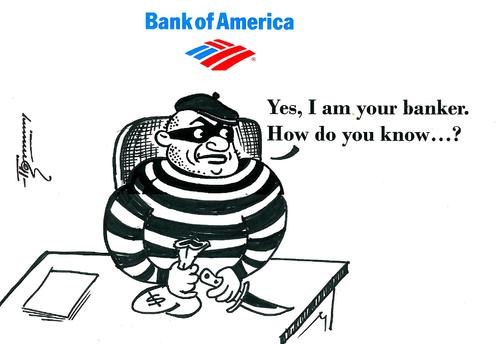
Bank America Analysts. Incompetents, Or Outright Liars? I'm Guessing Both.

   (Commentary posted by Roger Erickson)


"The PBOC is [acting] through selective cuts in the reserve-requirement - the portion of of deposits that banks need to keep in reserve, rather than lending out ... the Bank of America analysts said in a report"


Seriously. They said that with a poker face that was either straight, or just ignorant, or indicative of racketeering.

At what point do we just throw in the turban, give up on this electorate, and try Islamic banking? It can't possibly be as corrupt AND dumb, simultaneously ... can it?*

If we're going to practice kabuki banking, why stop there? Say, here's an idea. How about we just require banks to declare fiat reserves, so that they won't run out of the public fiat that they're tasked with reporting to the Federal Reserve? If they can't run out of our fiat to "loan" out, that would also remove the need to bother with fiat credit ratings, and make Liar's Loans fully fiat as well? Fraudulent form over adaptive function would be complete!

PT Barnum would likely approve. It'd be worth the price of admission just to watch that bill sail through Congress. :( Heck, even Alice in Wonderland would probably approve. Plus, "capitalists" could get the popcorn concession for the comedy show. In capitalist theory, we'd all win by most losing.


* It once seemed like a good idea to have all students learn the fundamentals of finance by age 10, but NOT if BOA & the American Banking Association are allowed to control the indoctrination, er ... "curriculum" - or whatever they call their obsolete, gold-std program. If we followed their lead, the DoD would also return to using flintlock muskets and a sailboat navy, and "policy agility" would disappear from our vocabulary, not just our  reality.


Tuesday, June 4, 2013

Dan Kervick — Do Banks Create Money from Thin Air?

It is sometimes said that commercial banks in our modern monetary system create money “from thin air”.  While there is truth in this metaphorical claim, the metaphor can also be seriously misleading, and leads some to attribute powers to commercial banks that are actually retained by the government alone under our system.  It is worth trying to get clear about all this.
New Economic Perspectives

Do Banks Create Money from Thin Air?
Dan Kervick

Tuesday, February 19, 2013

JKH — ‘Loans Create Deposits’ – in Context

Introduction
Loans create deposits. We’ve heard it many times now. But how well is it understood? The phrase is typically invoked accurately, in conjunction with a rejection of the ‘money multiplier’ fable found in economic textbooks. From an operational perspective, banks do not “lend reserves” to their non-bank customers. “Loans create deposits’ is an operation in endogenous money. And where central banks impose a level of required reserves based on deposits, the timing of the demand for and supply of reserves in respect of such a requirement follows the creation of the deposit – it does not precede it. The money multiplier story is bunk. And ‘loans create deposits’ is correct as an observation.
Nevertheless, there is a larger context for deposits, which includes their fate after they have been created. Deposits are used to repay loans, resulting in the ‘death’ of both loan and deposit. But there is more. As part of the birth/death analogy, there is the lifetime of loans and deposits to consider. This sequence of birth, life, and death in total may be helpful in putting ‘loans create deposits’ into a broader context. There is potential for confusion if ‘loans create deposits’ is embraced too enthusiastically as the defining characteristic, without considering the full life cycle of loans and deposits. Indeed, we shall see further below that ‘deposits fund loans’ is as true as ‘loans create deposits’ and that there is no contradiction between these two things.
Monetary Realism
‘Loans Create Deposits’ – in Context
JKH
(h/t Kevin Fathi via email)

Money & banking 101. Very clear step by step exposition of what goes on in contemporary banking wrt to institutional arrangements, how the accounting works, and what the institutional implications are. A chief implication is that bank money involves risk and banking is therefore an exercise in risk management to great degree.


Monday, October 15, 2012

Loan growth is losing momentum

Looks like lending is starting to lose momentum. This chart suggests momentum peaked back in June. Could be a sign that the economy is slowing and will continue to slow.

Thursday, August 16, 2012

The Chicago Plan Revisited - by the IMF

commentary by Roger Erickson

An IMF working paper is suggesting "100% reserve backing for deposits."

??

How, exactly, can one have 100% reserve backing for deposits in a fiat regime?

First, deposits are already FDIC insured (given, up to a limit).

Second, why bother with "reserves" (whatever they mean by that term)? We're already have the case that loans create deposits, and trigger corresponding changes in "bank-reserves."

Unless I'm totally confused, these IMF authors seem very confused. Orthodox economics seems to get curiouser & curiouser all the time. They could start by at least defining what they mean by "reserves." They seem to be mixing metaphors, which inevitably leads to irrational policy advice.  Broken semantics and monetary policy don't belong in the same mix.

The Chicago Plan Revisited http://www.imf.org/external/pubs/ft/wp/2012/wp12202.pdf
http://www.imf.org/external/pubs/cat/longres.aspx?sk=26178.0

Jaromir Benes & Michael Kumhof. August 01, 2012
Summary: At the height of the Great Depression a number of leading U.S. economists advanced a proposal for monetary reform that became known as the Chicago Plan. It envisaged the separation of the monetary and credit functions of the banking system, by requiring 100% reserve backing for deposits. Irving Fisher (1936) claimed the following advantages for this plan: (1) Much better control of a major source of business cycle fluctuations, sudden increases and contractions of bank credit and of the supply of bank-created money. (2) Complete elimination of bank runs. (3) Dramatic reduction of the (net) public debt. (4) Dramatic reduction of private debt, as money creation no longer requires simultaneous debt creation. We study these claims by embedding a comprehensive and carefully calibrated model of the banking system in a DSGE model of the U.S. economy. We find support for all four of Fisher's claims. Furthermore, output gains approach 10 percent, and steady state inflation can drop to zero without posing problems for the conduct of monetary policy.


Disclaimer: This Working Paper should not be reported as representing the views of the IMF. The views expressed in this Working Paper are those of the author(s) and do not necessarily represent those of the IMF or IMF policy. Working Papers describe research in progress by the author(s) and are published to elicit comments and to further debate


Monday, June 25, 2012

Warren Mosler on "deposits create reserves"

From comments at The Center of the Universe
Y Reply:
June 25th, 2012 at 10:18 am
Warren,
“the fed allows it’s member banks- it’s designated agents- to ‘create’ reserve balances within the regulatory framework.
This framework includes reserve requirements as well as extensive regulation on what type of loans/assets are allowed and not allowed. So if a bank creates a loan/deposit/reserves it’s done so within the regulatory framework as a agent of government.”
- When you say the fed allows its member banks to ‘create’ reserve balances, do you mean the fed allows member banks to become ‘overdrawn’? Why do you put ‘create’ in speech marks?
Could you clarify specifically what you mean in detail when you say member banks ‘create’ reserve balances?
thanks!
Warren Mosler Reply:
June 25th, 2012 at 10:52 am
Bank deposits are the accounting record of the liability associated with loans.
So when a bank lends you $100 they might at the same time enter the number ’100′ into your checking account.
But the loan didn’t do the entering of the 100 into your account per se. The 100 liability is the accounting record of the loan.
liabilities are accounting records off assets, etc.
When you account for something you don’t exactly ‘create’ it the way the word ‘create’ is generally understood-
making something out of something else, etc.
What I mean by allowing banks to create reserves is that regulation allows banks to make loans and corresponding deposits that it will accept for payment of taxes recognizing that they are allowing that bank to incur a reserve deficiency in the case of reserve requirements. Additionally, when the Fed ‘clears a check’ it’s allowing the possibility of the account debited to be overdrawn which is also the possibility of a loan from the Fed.

Thursday, April 5, 2012

John Carney — What Really Constrains Bank Lending


Must read. John lays out very clearly the kinds of cost banks need to figure in making loans.

As John observes, although banks can make loans that create deposits without having to have reserves or deposits to do so, it cannot just hand out money willy-nilly and stay in business — unless it is TBTF, that is.

Read it at CNBC NetNet
What Really Constrains Bank Lending
by John Carney | Senior Editor

Thursday, February 9, 2012

Tuesday, October 25, 2011

Bank loans surge as government spending slows


Followers of MMT understand that government deficits add to non-government (private sector) income and savings. That means high and rising deficits tends to cool credit demand because private sector balance sheets are getting healthier.

On the other hand, a slowdown in deficit spending tends to do the opposite: it DRAINS income and savings thus causing credit demand to rise in order to compensate for that loss in income and savings.

The chart below is quite eye-opening. It shows a very strong correlation between government spending and private credit creation. Bank loans have begun to grow since the slowdown in net government spending that started back in March-April of this year. And when net government spending went negative year-over-year in July, bank lending absolutely took off.

The private sector is now tapping credit as the government begins to step out of the economy. Unfortunately, this will not be a repeat of 2004 - 2007, where we had a credit boom, because credit conditions are, generally, much tighter now. And with unemployment high, the ability to get credit and service that credit is poor, so this credit cycle can collapse very quickly.