Showing posts with label social fabric. Show all posts

Tuesday, April 4, 2017

Allison J. Pugh — What Happens at Home When People Can’t Depend on Stable Work

My research, involving men and women who experience varying levels of job insecurity, suggests that the dampening expectations they have for employer commitment requires them to moderate the kinds of feelings they allow themselves to have in the event of a layoff. This is especially true for less-educated workers, who are most likely to say they could lose their jobs in the next year.…
So when we talk about work today, we have to talk about it in the context of an unrequited contract, our collective acquiescence to the notion that work can no longer be counted on....
Wake-up from a sociologist. The psychological impact of job insecurity can be devastating, as is shown in health and suicide statistics such as cited by Anne Case and Angus Deaton.

JG to the rescue.

Harvard Business Review
What Happens at Home When People Can’t Depend on Stable Work
Allison J. Pugh is a sociologist at the University of Virginia and a 2016-17 Fellow at the Center for Advanced Study in the Behavioral Sciences, as well as a 2016-17 American Council of Learned Societies Fellow

Sunday, January 15, 2017

Matthew Harrington — Survey: People’s Trust Has Declined in Business, Media, Government, and NGOs

Despite broad distrust of business, there are high expectations for business to do more — a potential opening to turn the tide of public opinion. Three-quarters of people agreed that “a company can take specific actions that both increase profits and improve the economic and social conditions in the community where it operates.” According to our respondents, the best ways business can build trust in a better future are to pay fair wages, offer better benefits, and create more jobs. The fastest ways businesses can erode trust are to bribe government officials, pay outsize compensation to senior management, and avoid taxes.…
The recent collapse of trust in government and media should serve as a powerful lesson to business of what can happen when institutions become disconnected from the interests and opinions of the people they serve. Executives have been warned — their customers and the population at large will be watching closely....
Harvard Business Review
Survey: People’s Trust Has Declined in Business, Media, Government, and NGOs
Matthew Harrington | global chief operating officer of Edelman, a global communications marketing firm

Saturday, October 1, 2016

Paul Rosenberg — Breaking point: America approaching a period of disintegration, argues anthropologist Peter Turchin

Anthropologist Peter Turchin's "Ages of Discord" provides a crucial decoder ring for Trump-era social strife.
The American polity today has a lot in common with the Antebellum America of the 1850s; with Ancien Régime France on the eve of the French Revolution; with Stuart England during the 1630s; and innumerable other historical societies,” Turchin writes. “However, unlike historical societies, we are in a unique position to take steps that could allow us to escape the worst. Societal breakdown and ensuing waves of violence can be avoided by collective, cooperative action.”….
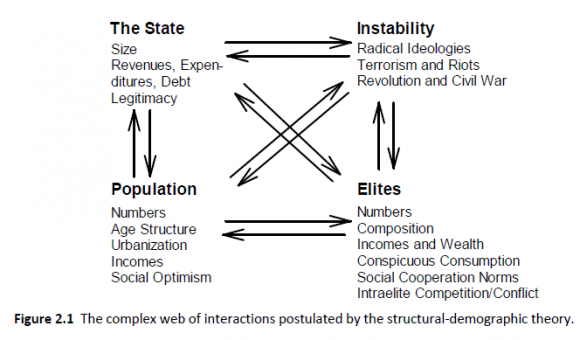
“Structural‐demographic theory represents complex (state‐level) human societies as systems with three main compartments (the general population, the elites, and the state) interacting with each other and with sociopolitical instability via a web of nonlinear feedbacks,” Turchin writes. Their relationship, as described and measured in the theory, is summarized in this figure:
“Ages of Discord” also tests this theory against the example of American history, with special attention to turning points in different trends, which show a remarkable degree of coherence.
One table lists 29 proxies representing 15 variables, all but one of which — life expectancy — reversed direction within about a decade of 1970. These include three proxies of labor oversupply; two of economic and health well-being; three of social well-being and economic inequality; two of elite overproduction, intra-elite competition and intra-elite cooperation; three of cooperation and equity; and one of intra-elite fragmentation, patriotism, state legitimacy, state capacity and sociopolitical instability.

In short, Turchin finds that it wasn’t just similar social trends that changed together; trends from every aspect of the model changed direction around the same time.

Tuesday, May 10, 2016

Szu Ping Chan — Growth crisis threatens European social fabric, warns monetary chief


Yep. 

And fraying social fabric leads to social dysfunction and political unrest. This is not simply an economic problem and world leaders need to wake up to it. Trump, Sanders and Corbyn are just the beginning, and the Right is already rising on the Continent.

The Telegraph
Growth crisis threatens European social fabric, warns monetary chief
Szu Ping Chan, Business reporter

Sunday, April 26, 2015

Analyze Greece — Ögmundur Jónasson: Social Justice Is The Key For A Left Government

Tackling a serious economic crisis is difficult for all governments, whether they are left wing or right wing. It is important for everybody to be aware of this, politicians and voters alike. 
There is, however, a fundamental difference between the right and the left in this respect: Their objective is not the same. Of course politicians in general want to succeed in their endeavour to get their country out of serious trouble but they tend to evaluate the situation differently. This depends on their political conviction. Left wing, socially responsible forces, above all want to preserve, if not strengthen the social fabric of society – the welfare system - while the right wing under such circumstances is likely to use the crisis for system change, i.e. to marketise and privatise the system.
Disaster capitalism versus progressive reform.

Analyze Greece
Ögmundur Jónasson: Social Justice Is The Key For A Left Government (January 28, 2015)
ht Jan Milch
Icelandic politician Ögmundur Jónasson (born 17 July 1948), was the former Health and Interior Minister for the Icelandic left government between 2009-2013. He has been active in various grass-root activities, a prolific commentator and public speaker. As minister, he gained international attention in connection with three issues. First, he proposed measures designed to protect children from the harms of violent pornography as part of his broader support for human rights and women’s rights. Secondly, he rejected a plan by Chinese business tycoon, Mr. Huang Nubo, to purchase a huge tract of land in the North East of Iceland attracting much geopolitical and media attention. Thirdly, he refused all cooperation with FBI agents who arrived in Iceland in 2011 —on the pretext of investigating an impending hacking attack on Icelandic government computers— and directed them to leave the country because he believed that they were, in fact, engaged in a broader swoop to gather intelligence on WikiLeaks in trying to frame its founder Julian Assange.

Saturday, November 8, 2014

Roman Krznaric — The one thing that could save the world: Why we need empathy now more than ever

The passion versus reason dichotomy is bogus. They are inextricably linked in brain function.
As the cognitive linguist George Lakoff puts it, “Empathy is at the heart of real rationality, because it goes to the heart of our values, which are the basis of our sense of justice. Empathy is the reason we have the principles of freedom and fairness, which are necessary components of justice.”
Empathy is the affective component of apprehension of universality, as invariance is the cognitive basis of it. Equal rights are based on the feeling of oneness with others as members of the same species and the knowledge that beyond individual differences there is an invariant aspect of humanity as shared nature. While everyone is unique as an individual, all are the same as persons who are equal before the law and possess equal rights.

Salon
The one thing that could save the world: Why we need empathy now more than ever
Roman Krznaric

Vladimir Putin got this right.
In an unexpected remark Friday, the Russian president spoke of the “meaning of life,” saying that for him “in general” it is love that matters.
Briefly digressing from politics, Putin ventured a philiosophical observation that “multifaceted” love is the basis of all actions and the essence of being.
"The meaning of our whole life and existence is love," Putin told his audience at the 15th Congress of the Russian Geographical Society. "It is love for the family, for the children, for the motherland. This is a multifaceted phenomenon; it lies at heart of any of our behaviors."
RT, Putin: ‘Love is the meaning of life’

Spiritual maturity is determined by the universality of one's love. An expanded heart encompasses all.


Wednesday, August 20, 2014

Marshall Auerback — Higher GDP Growth Does Not Equate To Greater Social Well-Being And Happiness

For rich, developing, and transition countries, whether pooled or analyzed separately, there is no time series evidence that a higher economic growth rate increases the rate of improvement in life satisfaction. Doubling the rate of economic growth does not double the increase in life satisfaction; rather, the evidence is that it has no significant effect at all.
If there is any less developed country for which one would expect a positive impact of economic growth on SWB it is China, whose growth since 1990 from an initially very low value has been at the highest rate ever recorded, a four fold multiplication of real GDP per capita in two decades (Heston, Summers, and Aten 2012). Household appliances such as refrigerators and washing machines – quite rare in 1990 – are now commonplace in urban areas. Color television sets currently average over one per household. By 2008, almost one in ten urban households owned a car and China had become the world’s leading automobile producer, according to the OECD.
Yet, the combined evidence from six separate surveys is that life satisfaction in China has not improved, and, if anything, may have declined somewhat, according to Richard Easterlin, a Professor Emeritus at USC, who has made a lifetime study of the phenomenon…. 
Macrobits by Marshall Auerback
Higher GDP Growth Does Not Equate To Greater Social Well-Being And Happiness
Marshall Auerback
While psychologists have long used surveys of reported well-being to study happiness, economists only recently ventured into this arena. Early economists and philosophers, ranging from Aristotle to Bentham, Mill, and Smith, incorporated the pursuit of happiness in their work. Yet, as economics grew more rigorous and quantitative, more parsimonious definitions of welfare took hold. Utility was taken to depend only on income as mediated by individual choices or preferences within a rational individual’s monetary budget constraint. 
Even within a more orthodox framework, focusing purely on income can miss key elements of welfare. People have different preferences for material and non-material goods. They may choose a lower-paying but more personally rewarding job, for example. They are nonetheless acting to maximize utility in a classically Walrasian sense. 
The study of happiness or subjective well-being is part of a more general move in economics that challenges these narrow assumptions. The introduction of bounded rationality and the establishment of behavioural economics, for example, have opened new lines of research. Happiness economics – which represents one new direction – relies on more expansive notions of utility and welfare, including interdependent utility functions, procedural utility, and the interaction between rational and non-rational influences in determining economic behaviour.…

Monday, December 9, 2013

Bill Mitchell — The Job Guarantee is a progressive vehicle for change

In my search for new terminology and descriptors I am no longer going to use “minimum wage” to describe the wage that a currency-issuing government should pay when implementing a Job Guarantee (JG). In the past I have written that to avoid disturbing private sector wage structure and to ensure the JG is consistent with stable inflation, the JG wage rate is best set at the minimum wage level. I have also indicated that the minimum wage should not be determined by the capacity to pay of the private sector, but should, rather be an expression of the aspiration of the society of the lowest acceptable standard of living. My view is that any private operators who cannot “afford” to pay the minimum should exit the economy. I also have proposed that the JG wage should be supplemented with a wide range of social wage expenditures, including adequate levels of public education, health, child care, and access to legal aid.
Finally, I have stressed for many years that the JG does not replace conventional use of fiscal policy to achieve appropriate social and economic outcomes. In general, the JG would be accompanied by higher levels of public sector spending on public goods and infrastructure. I have written several times, in various outlets (academic, Op Ed, blog), that I see the JG as part of a fundamental transformative agenda to broaden the concept of work and to allow all people to receive a dignified and appropriate access to the distribution system. That message doesn’t seem to get through. So from now on the JG wage will be referred to as the living wage. Further, recent discussions of the JG reveal that commentators who criticise it do so from a standpoint of ignorance – a problem that is engendered by the blogosphere, which should be a liberating force, but in my view seems to unfortunately spawn narrow-mindedness and an anti-intellectual approach to policy debates.

Bill Mitchell – billy blog
The Job Guarantee is a progressive vehicle for change
Bill Mitchell | Professor in Economics and Director of the Centre of Full Employment and Equity (CofFEE), at the Charles Darwin University, Northern Territory, Australia

Wednesday, December 4, 2013

Travis Gettys — Obama cites Pope Francis to attack income inequality and call for minimum wage increase (via Raw Story )

Obama cites Pope Francis to attack income inequality and call for minimum wage increase (via Raw Story )
Conservatives angered by Pope Francis’ recent attacks on capitalism and wealth inequality aren’t going to like hearing President Barack Obama’s approval of them. The president said Wednesday that growing income inequality had “frayed” the…