Showing posts with label Amazon. Show all posts

Thursday, July 25, 2019

Reuters — Treasury's Mnuchin says Amazon 'destroyed' U.S. retail sector

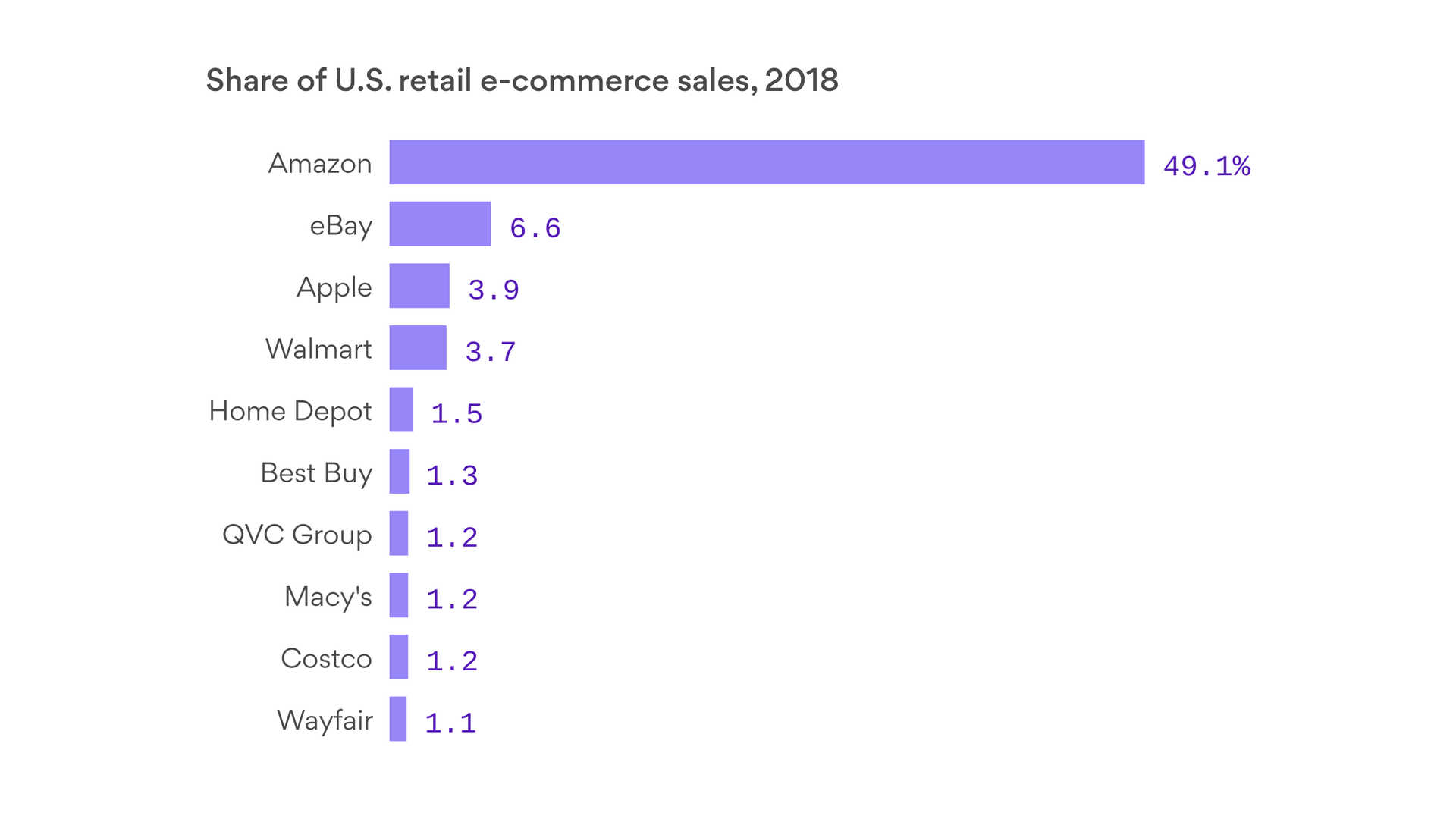
“If you look at Amazon, although they’re certain benefits to it, they’ve destroyed the retail industry across the United States,” Mnuchin told CNBC. “I don’t have an opinion other than I think it’s absolutely right the attorney general is looking into these issues and I look forward to listening to his recommendations to the president.”
Are we finally going to start talking about anti-trust, which. incidentally, was at the heart of US progressivism historically.

Reuters
Treasury's Mnuchin says Amazon 'destroyed' U.S. retail sector

Monday, February 11, 2019

Jerri-Lynn Scofield — India Forces Amazon to Choose Between Operating e-Commerce Platform and Selling Goods on that Platform

This is equivalent to anti-trust in a platform economy. On the other hand, economic liberals will charge that it is government interference in free markets and free trade.
India’s not exactly breaking new ground here with it restriction. As antitrust expert Lina Khan noted in a February tweet: “[T]his sort of structural separation has been a key principle in US competition policy. For example, Congress in 1906 passed a law prohibiting railroads from transporting goods they owned.”
Khan continued:

We applied a similar rule to TV networks, telecom carriers, banks. There’s good reason to debate whether structural separations should apply to digital monopolies. But framing the rule as highly invasive or exotic misunderstands our own history (& success) applying it.
Khan’s the author of an influential paper in the Yale Law Journal on Amazon, Amazon’s Antitrust Paradox, and has a paper forthcoming in the Columbia Law Review on structural separations, The Separation of Platforms and Commerce.…
This is key in a platform economy, which is now one of the key factors in building out the Digital Age. The obvious danger is increase of market concentration and therefore of monopoly and monopsony power as owners of digital platforms control their markets and supply chains.

Great wealth in the digital age has come not from ownership of land, factories, chains, or financial institutions but rather digital platforms, first hardware and software systems and service provision, and now distribution platforms.

Of course, this is not new. Firms have always attempted to gain market power through horizontal and vertical integration "for efficiency," but this amplifies economies of scale and creates the potential for erecting gateways. Previous anti-trust legislation has eventually been brought forward to address this.

Hopefully, India will set a precedent, but the neoliberal US will oppose it vigorously as a form of protectionism that contradicts the spirit of free markets and free trade.

The US experience is troubling, however. First, retail giants like Walmart devastated small retailers and "mom & pop stores" across the country and then ecommerce, with the proliferation of platforms it brought, made it difficult for smaller sellers to compete with the giants on the Internet.

Secondly, owing to capital intensity, concentration and dominance of a few platforms increased their market power and enabled rent extraction as competition dwindled.

There's a name for this, monopoly capital. And the antidote is anti-trust as a means for decreasing concentration and increasing competition.

Naked Capitalism

Tuesday, October 2, 2018

Caitlin Johnstone — Bezos Bows To Pressure On $15/hr. Keep Pressuring Him. Keep Pressuring Them All.


You heard this already but Caitlin Johnstone reminds us that this is only a token rather than a change of heart. Don't let down the guard or put the pitchforks away just yet. It ain't over by long shot.
Don’t turn our fate over to depraved oligarchs for the price of a few dimes. Keep pushing these sociopathic bastards. Keep pushing them right off the stage.
Caitlin Johnstone — Rogue Journalist
Bezos Bows To Pressure On $15/hr. Keep Pressuring Him. Keep Pressuring Them All.
Caitlin Johnstone

Sunday, March 18, 2018

Jason Del Ray — Amazon is creating a health care company with the help of Warren Buffett and JPMorgan Chase

Warren Buffett’s Berkshire Hathaway and JPMorgan Chase are working with the e-commerce giant.
Game-changer?

Recode
ht Brad DeLong at Grasping Reality

See also
The e-commerce giant is muscling its way into a number of businesses that banks have long dominated.
American Banker
How Amazon is shaking up financial services
Keven Wack

Thursday, February 1, 2018

Tuesday, November 21, 2017

Corporate Statism grows in the US?

Executive Chairman of Google’s parent company Alphabet, Eric Schmidt, says Google will “engineer” specific algorithms for RT and Sputnik to make their articles less prominent on the search engine’s news delivery services.
Alex Christoforou
Amazon launches a cloud service for US intelligence agencies
  • The introduction of the AWS Secret Region for the U.S. intelligence community comes six years after Amazon announced a cloud data center region for public-sector customers.
  • U.S. government agencies with sufficient secret-level access and contracts will also be able to use the new region.
CNBC

Wednesday, October 11, 2017

Xinhua — Alibaba tops Amazon as biggest e-commerce company


Milestones
Chinese e-commerce giant Alibaba surpassed its U.S. counterpart Amazon as the world's biggest e-commerce company Tuesday as the Hangzhou-based company reached the threshold of 470 billion U.S. dollars in market value.…
Alibaba's net profit jumped 96 percent to more than 2.1 billion dollars year-on-year in the first fiscal quarter ending June, beating market expectations.
Moreover, the number of active buyers on Alibaba's retail platform climbed to 466 million, accounting for about one third of the Chinese population.
And China is still a poor country.

Ecns.cn
Alibaba tops Amazon as biggest e-commerce companyXinhua

Saturday, August 12, 2017

Andre Damon — Defense Secretary “Mad Dog” Mattis visits Google and Amazon

The censorship algorithms rolled out by Google no doubt figured prominently in Mattis’ discussions with tech executives. The nominal purpose of his visit, however, was to integrate Silicon Valley firms even more closely into the booming and lucrative business of waging war.
On Thursday, Mattis met with Amazon CEO Jeff Bezos at the tech giant’s headquarters in Seattle.
On Friday, he spoke at the headquarters of Defense Innovation Unit Experimental (DUIX), a Defense Department unit located two miles from the Google campus in Mountain View, California. Among the unit’s advisors is Eric Schmidt, the chairman of Google’s parent company, Alphabet.
Mattis said the Pentagon’s partnership with Silicon Valley via DUIX would make the US military “more lethal and more effective” than ever before. DUIX awards military technology contracts to US hi-tech firms.
The operation has already awarded more than $100 million in contracts for 45 pilot projects in areas such as artificial intelligence, autonomous machines and outer space. Its web page encourages technology firms to “tap into a $100+ billion market.”
The entrepreneurial state at work.

Here's on project:
Even more important to the Pentagon than the utility of the tech giants in waging war abroad is the use of their communication infrastructure to shape public opinion and block the expression of antiwar and oppositional sentiment. A major player in this sphere is a think tank called Jigsaw, a subsidiary of Google’s parent company, Alphabet. Jigsaw is headed by Jared Cohen, a former State Department advisor to both Condoleezza Rice and Hillary Clinton.
Jigsaw’s most prominent project is a web commenting censorship system called “Perspective API,” which it calls “a new tool for web publishers to identify toxic comments that can undermine a civil exchange of ideas.”
Developed in cooperation with major US newspapers, Jigsaw has already been implemented to flag comments for deletion in the New York Timescomments section. This week, WikiLeaks noted that a comment containing the language “The CIA armed Islamists in Syria, killing thousands” would be flagged as 66 percent “toxic” by Perspective API. A comment declaring that “the US government is wonderful” is labeled zero percent “toxic,” while “the US government is corrupt” is flagged as 71 percent “toxic.”…
The goal: Control of the population through control of the narrative.
In a study titled “Social media, the vital ground: Can we hold it?” published in April, the Army War College noted, “The impact of social media on the media environment has been widely recognized, as has the ability of extremist and adversarial organizations to exploit the media to publicize their cause, spread their propaganda, and recruit vulnerable individuals.”
It went on to conclude that “Social media will increasingly have a direct impact on virtually all aspects of military operations in the 21st century,” and that the military had to expand its control over social media, “in particular, its use in deception and Psychological Operations (PSYOPS).”
Control over online communication will become increasingly significant amid what one Defense Department report published last month warned was an “increasing chasm between governments and their governed over the basic right to rule.”
That report concluded, “Today, all states are experiencing a precipitous decline in their authority, influence, reach and common attraction,” as populations are presented with “myriad alternative sources of political alignment or allegiance.”
Yet another report, published last year, warned that growing international antagonisms were leading to an intensifying crisis of “social order.”
It concluded that states “now all wrestle with one another over competing interests while standing on quicksand—threatened” not only by national rivals, but by “the fragile and restive social order they themselves rest on.”
As the danger of a major new war mounts, free and unfettered access to information becomes increasingly vital to the mobilization of the working class in opposition to the war plans of the capitalist ruling elite. We call on all our readers to share WSWS articles on social media and sign up to join the fight against Google’s censorship of the Internet.
WSWS
Defense Secretary “Mad Dog” Mattis visits Google and Amazon
Andre Damon

See also

Insurge Intelligence
How the CIA made Google

Why Google made the NSA
Nafeez Ahmed
Jan 22, 2015

Business Insider
14 cutting edge firms funded by the CIA

Paul Szoldra
Sep. 21, 2016


Wednesday, June 21, 2017

Cate Cadell — Amazon’s grocery push playing catch up with Chinese e-commerce giants

As Amazon.com Inc <AMZN.O> looks to swallow U.S. grocery chain Whole Foods, China’s tech giants are already digesting hefty bricks-and-mortar deals, taking the lead in the battle to transform supermarket shopping with big data and better supply chains.

China’s Alibaba Group Holding <BABA.N> and JD.com Inc <JD.O> have invested heavily in offline retail – bricks-and-mortar stores – in recent years to complement their online offerings.

With their ready-made payment and social media platforms to lure shoppers, Alibaba and JD.com have helped China become the world’s largest online grocery market, far ahead of the United States.

This early lead, cemented by densely populated urban areas and cheap labor, could be key as retailers and tech firms race to boost margins on low-cost consumer goods by reinventing supply chains with big data analytics.

“China is already the largest online grocery market in terms of value in the world so it’s really advanced in terms of scale,” said Nick Miles, London-based head of Asia Pacific for food and grocery industry research body IGD....
One America News
Amazon’s grocery push playing catch up with Chinese e-commerce giants
Cate Cadell

Tuesday, June 20, 2017

Joel Kotkin — Amazon Eats Up Whole Foods As The New Masters Of The Universe Plunder America

“We must make our choice. We may have democracy, or we may have wealth concentrated in the hands of a few, but we can’t have both.” —Justice Louis Brandeis
The rise of monopoly, monopsony, oligarchy, plutonomy, and government capture, spelling the death of a moribund republic in which corruption at the top has been legalized in the name of the "free market," which supposedly is a necessary condition for democracy.

A problem with late-stage capitalism is the economies of scale leads to concentration of capital in the hands of fewer and fewer, reducing competition, while a foundation assumption of a free market system is perfect competition. Owing to this internal contradiction, capitalism destroys itself and turns into corporate statism. Neoliberalism is a political theory of global corporate totalitarianism.

New Geography
Joel Kotkin | executive editor of NewGeography.com, Roger Hobbs Distinguished Fellow in Urban Studies at Chapman University. and executive director of the Houston-based Center for Opportunity Urbanism

Friday, June 16, 2017

Matt Stoller — America’s Amazon Problem


The objective of the tech industry is monopolization. The answer to it is anti-trust legislation and strict enforcement.
There is only one force that can stop Amazon from organizing and regulating basically all American retail commerce — our democratic institutions and our political system. We the people.

Bezos knows Amazon is a political enterprise at this point. The day before he announced his company’s attempt to buy this supermarket chain, he released a request on Twitter to have people offer ideas for where he can direct charity money. That is the kind of public relations undertaken by political leaders. And Amazon put out an ad for a Ph.D. economist-cum-lobbyist “to educate regulators and policy makers about the fundamentally procompetitive focus of Amazon’s businesses.” And he has put political fixers, like Ivanka Trump’s lawyer and ex-Clinton administration officer Jamie Gorelick, on his board of directors. He also bought The Washington Post.
However, Amazon is not the only offender.

The tech industry is not only disruptive technology but it is presenting fresh challenges to regulation in the public interest.

On the other hand, other companies are not going to rollover. Walmart is already awakening to the threat that Amazon poses for their business model. But thus far, Walmart has not developed a competitive tech game to challenge or even hold off Amazon.

Meanwhile, Sears is reeling on the ropes.

But Montgomery Ward (Wards.com) is trying to make a comeback.

Huffington Post
America’s Amazon Problem
Matt Stoller | Fellow at the Open Markets program, New America Foundation

Monday, December 8, 2014

David Holmes — After fighting all year with Amazon, Hachette partners with Gumroad to sell books directly to readers

The virtues of competition.
So how worried should iTunes and Amazon be of sites like Gumroad? 
“I think with iTunes, Amazon, and these players, they’ve done amazing things at pioneering digital distribution at scale,” says Ryan Delk, who does Growth for Gumroad and led this partnership. “[But] I don’t think by any means that innovation in the digital distribution space is over.” 
While Gumroad is well-suited to small, unsigned artists, it’s increasingly grabbing the attention of more established acts, like Eminem, Ryan Leslie, and now Hachette, which is arguably its most significant partnership yet. But as Gumroad strikes deals with more old media gatekeepers like record labels or publishers, what’s to stop it from becoming like Spotify or Pandora — in other words, just another cog in an industry that constantly screws over creators? 
Delk says Gumroad will be careful to choose partners that share its creator-first mentality — and Hachette has already proven its pro-artist bonafides by fighting one of the most powerful companies in the US to protect its authors’ livelihoods. 
“In all these industries whether it’s music or publishing, [labels and publishers] all play a very vital role,” Delk says. “Part of why we’re looking at Hachette is that they’re really really excited about helping their artists make more money.” 
Changing media distribution models on a large scale won’t happen overnight. There are entrenched interests — both on the platform side with iTunes and Amazon and on the production with record labels and publishing companies — that won’t back down easily. 
But by striking deals like the Hachette partnership, wherein platforms, publishers, and creators can collaborate on distribution and still all get paid a fair amount, Gumroad is slowly shaping the future of creative industries. And for the first time in many years, that future looks pretty bright.
Pando Daily
After fighting all year with Amazon, Hachette partners with Gumroad to sell books directly to readers
David Holmes

Tuesday, November 4, 2014

Matthew Zeitlin — Alibaba Sells More Than Twice As Much Amazon And eBay Combined


Enter the dragon.
The Chinese e-commerce site is just huge, with 307 million customers in the last year. Its Taobao mobile app has more users than the population of Texas.
Buzz Feed News
Alibaba Sells More Than Twice As Much Amazon And eBay Combined
Matthew Zeitlin

Friday, May 23, 2014

Kevin Drum — Amazon's War Against Book Publishers Goes Into Nuclear Territory


This is so technologically naive as to be embarrassing.


Secondly, ecommerce is tremendously competitive and Amazon may be the gorilla in the room now but the game is far from over.


Jeff Bezos is "psychopathically competitive," according to Drum. So were Bill Gates and Steve Jobs when computers were the hot new product. So were Andrew Carnegie, Thomas Edison, John D. Rockefeller. So were the Rothschilds. Etc. That's capitalism. So is politics. So is war. That's life at the present level of collective consciousness.


Technology has the potential to change that drastically through decentralization and niche markets that serve specialized needs and targeted wants. Amazon doesn't have a lock on either tablets or e-readers. Moreover, Amazon is locked in competition with Apple Store on one hand, and on the other, there are independent venues like Smashwords.

Mother Jones
Amazon's War Against Book Publishers Goes Into Nuclear Territory 
Kevin Drum