Showing posts with label IS-LM. Show all posts
Showing posts with label IS-LM. Show all posts
Tuesday, December 20, 2016
Lars P. Syll — The non-existence of Paul Krugman’s ‘Keynes/Hicks macroeconomic theory’
Paul Krugman = Not Keynes and Not Hicks.
Lars P. Syll’s Blog
The non-existence of Paul Krugman’s ‘Keynes/Hicks macroeconomic theory’
Lars P. Syll | Professor, Malmo University


Tuesday, September 6, 2016
Lars P. Syll — Hicks’ misrepresentation of Keynes — the Wicksellian connection
Having read my post on Krugman and Hicks’ IS-LM misrepresentation of Keynes’ theory, professor Jan Kregel kindly sent an unpublished article he wrote back in 1984 — The Importance of Choosing a Model: Hicks vs. Keynes on Money, Interest and Prices — in which it is argued that Hicks’ particular presentation of Keynes’ theory and choice of model was “crucial to its destruction”….Lars P. Syll’s Blog
Hicks’ misrepresentation of Keynes — the Wicksellian connection
Lars P. Syll | Professor, Malmo University
Tuesday, June 21, 2016
Sandwichman — The Iatrogenic and Incoherent "Theory" of Flexibility
Sandwichman hits it out of the park. Contains some choice references.
EconoSpeak
The Iatrogenic and Incoherent "Theory" of Flexibility
Sandwichman
Thursday, May 26, 2016
Kimball Corson — A Note on Liquidity Preference
Short summary of the liquidity trap.
Wandering the Oceans: SailBlogs
A Note on Liquidity Preference
Kimball Corson
Friday, November 13, 2015
David Glasner — Thinking about Interest and Irving Fisher
Uneasy Money
Thinking about Interest and Irving Fisher
David Glasner | Economist at the Federal Trade Commission
Sunday, October 25, 2015
Lars P. Syll — Did Keynes ‘accept’ the IS-LM model?
The post mentions that Keynes provided his own summary in a 1937 paper. Here's a link to download it.
Lars P. Syll’s Blog
Did Keynes ‘accept’ the IS-LM model?
Lars P. Syll | Professor, Malmo University
Lars P. Syll’s Blog
Did Keynes ‘accept’ the IS-LM model?
Lars P. Syll | Professor, Malmo University
Sunday, October 11, 2015
Simon Wren-Lewis — One reason why monetary policy is preferred by New Keynesians
Mainly Macro
One reason why monetary policy is preferred by New Keynesians
Simon Wren-Lewis | Professor of Economics, Oxford University
Tuesday, May 19, 2015
Roger Farmer — Thought for the Day: Animal Spirits as a New Fundamental
In IS-LM models there is always something in the background shifting the IS curve. What is it?Roger Farmer's Economic Window
In my view that 'something' is Keynes' animal spirits that we should add to our models as a new fundamental.
Even apart from the instability due to speculation, there is the instability due to the characteristic of human nature that a large proportion of our positive activities depend on spontaneous optimism rather than on a mathematical expectation, whether moral or hedonistic or economic. Most, probably, of our decisions to do something positive, the full consequences of which will be drawn out over many days to come, can only be taken as a result of animal spirits — of a spontaneous urge to action rather than inaction, and not as the outcome of a weighted average of quantitative benefits multiplied by quantitative probabilities. Enterprise only pretends to itself to be mainly actuated by the statements in its own prospectus, however candid and sincere. Only a little more than an expedition to the South Pole, is it based on an exact calculation of benefits to come. Thus if the animal spirits are dimmed and the spontaneous optimism falters, leaving us to depend on nothing but a mathematical expectation, enterprise will fade and die; — though fears of loss may have a basis no more reasonable than hopes of profit had before.
It is safe to say that enterprise which depends on hopes stretching into the future benefits the community as a whole. But individual initiative will only be adequate when reasonable calculation is supplemented and supported by animal spirits, so that the thought of ultimate loss which often overtakes pioneers, as experience undoubtedly tells us and them, is put aside as a healthy man puts aside the expectation of death.
This means, unfortunately, not only that slumps and depressions are exaggerated in degree, but that economic prosperity is excessively dependent on a political and social atmosphere which is congenial to the average business man. If the fear of a Labour Government or a New Deal depresses enterprise, this need not be the result either of a reasonable calculation or of a plot with political intent; — it is the mere consequence of upsetting the delicate balance of spontaneous optimism. In estimating the prospects of investment, we must have regard, therefore, to the nerves and hysteria and even the digestions and reactions to the weather of those upon whose spontaneous activity it largely depends.
We should not conclude from this that everything depends on waves of irrational psychology. On the contrary, the state of long-term expectation is often steady, and, even when it is not, the other factors exert their compensating effects. We are merely reminding ourselves that human decisions affecting the future, whether personal or political or economic, cannot depend on strict mathematical expectation, since the basis for making such calculations does not exist; and that it is our innate urge to activity which makes the wheels go round, our rational selves choosing between the alternatives as best we are able, calculating where we can, but often falling back for our motive on whim or sentiment or chance.
Friday, September 12, 2014
Matias Vernengo — Krugman is actually right on ISLM and Minsky
I tend to disagree a lot with Krugman, at least on theoretical issues. His brand of Keynesianism supposes that the system doesn't work because of imperfections. For him, the current slow recovery is due to the fact that the natural rate of interest is basically negative and you cannot use monetary policy to stimulate the economy (see critique of this here). However, on his recent debate with Lars Syll (and here; Brad De Long also posted here), a post-Keynesian, with whom I probably share a more radical interpretation of Keynes and its relevance for economic theory, Krugman seems to get things right.Naked Keynesianism
Krugman is actually right on ISLM and Minsky
Matias Vernengo | Associate Professor of Economics, University of Utah
It seems to me that there are two senses of "equilibrium" in play —
1) the neoclassical view of a single long run equilibrium in which all factors are in equilibrium, hence involuntary unemployment is impossible in the long run, and
2) the Keynesian view in which multiple equilibria are possible with differing use of the factors, so that long run unemployment is possible. The former view is that perfect markets are efficient, whereas the later view is that perfect markets exist only as a i Platonic deal and that confusing the ideal with the real overlooks the conditions of the real following upon uncertainty on one hand and the effect of cultural conventions and institutional arrangements on the other.
The third view is that economies are inherently unstable so the concept of equilibrium does not apply, although the level instability can be addressed institutionally and through policy.
As far as deciding definitely what Keynes held is probably an interminable debate that will never be resolved to the satisfaction of all parties. This is the story of interpretation in other fields.The debate is worth having to clarify both the history and the issues, and possibly to discover something new.
It seems to me that there are two senses of "equilibrium" in play —
1) the neoclassical view of a single long run equilibrium in which all factors are in equilibrium, hence involuntary unemployment is impossible in the long run, and
2) the Keynesian view in which multiple equilibria are possible with differing use of the factors, so that long run unemployment is possible. The former view is that perfect markets are efficient, whereas the later view is that perfect markets exist only as a i Platonic deal and that confusing the ideal with the real overlooks the conditions of the real following upon uncertainty on one hand and the effect of cultural conventions and institutional arrangements on the other.
The third view is that economies are inherently unstable so the concept of equilibrium does not apply, although the level instability can be addressed institutionally and through policy.
As far as deciding definitely what Keynes held is probably an interminable debate that will never be resolved to the satisfaction of all parties. This is the story of interpretation in other fields.The debate is worth having to clarify both the history and the issues, and possibly to discover something new.
Lars P. Syll — Krugman & DeLong are still wrong on Minsky and IS-LM
Esteemed colleagues Paul Krugman and Brad DeLong were not exactly überjoyed over my post Minsky on the IS-LM obfuscation, where I was quoting Hyman Minsky’s critique of the Hicksian IS-LM interpretation of Keynes. I have to confess that I’m equally unimpressed by the Krugman-DeLong retort.…Lars P. Syll’s Blog
Krugman & DeLong are still wrong on Minsky and IS-LM
Lars P. Syll | Professor, Malmo University
Tuesday, June 24, 2014
Lord Keynes — Keynes’ Letters to John Hicks and IS-LM
So Keynes did have reservations about the model’s ability to incorporate expectations, and also about loanable funds theory.Social Democracy For The 21St Century: A Post Keynesian Perspective
Keynes’ Letters to John Hicks and IS-LM
Lord Keynes
Monday, June 23, 2014
Matias Vernengo — ISLM, ISMP, DSGE and other models
Matias Vernengo begs to differ, holding that ISLM (and its variants) is one of the most useful economic models with respect to explaining policy and that Keynes endorsed it. For example, ISLM can be modified to ISMP to take into account a policy rate.
Naked Keynesianism
ISLM, ISMP, DSGE and other models
Matias Vernengo | Associate Professor of Economics, University of Utah
Sunday, June 22, 2014
Lars P. Syll — Did Keynes accept the IS-LM model?
Six reasons why not.
Lars Syll's Blog
Did Keynes accept the IS-LM model?
Lars P. Syll | Professor, Malmo University
Thursday, March 27, 2014
Philip Pilkington — Krugman Uses ISLM to Proclaim Looming Fiscal Crisis, Denounces Those Who Don’t Use ISLM
Phil takes down Paul Krugman as a faux-liberal and an economist with a poor record at prediction.
Fixing the Economists
Krugman Uses ISLM to Proclaim Looming Fiscal Crisis, Denounces Those Who Don’t Use ISLM
Philip Pilkington
Merijn Knibbe — Using the IS-LM model by adding institutional ‘detail’ (1 graph)
Real-World Economics Review Blog
Using the IS-LM model by adding institutional ‘detail’ (1 graph)
Merijn Knibbe
Wednesday, March 26, 2014
Edward Lambert — Institutionalist Economics did not come up short
There are two fundamental types of conceptual model used to express theoretical assumptions: the first is mathematical and the second is conceptual.
Conceptual models have generally fared better than the mathematical ones with respect to policy for a variety of reasons, the basic one being that they can handle more kinds and orders of variables that are relevant, both quantitative and qualitative. Evidence? Keynes and the New Deal.
Krugman is specifically throwing Keynes under the bus? Or does Krugman think that the IS-LM model captures the essence of the General Theory?
Of course, monetarists will say that Keynesianism broke down with stagflation and monetarism repaired the lacuna with its math-based analysis — that showed that what happened in the financial crisis was impossible, or at least highly unlikely.
Those taking a broader view warned otherwise. Like those influenced by Minsky's analysis.
What amazes me is that monetarists think that the policy rate is the single lever that moves the entire economy, which is neatly depicted in the IS-LM model.
Tuesday, March 25, 2014
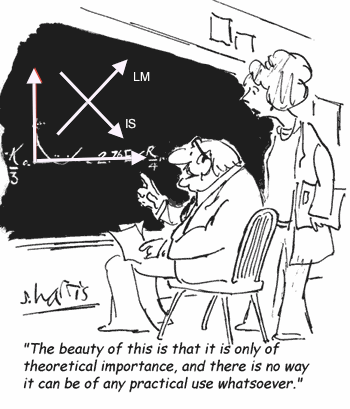
Lars P. Syll — IS-LM vs. Minsky
Lars P. Syll | Professor, Malmo University
Important in terms of philosophy of science, philosophy of social science, and philosophy of economics, which examine assumptions about subject matter and methodology, as well as the meaning of key terminology in which assumptions are imbedded. Keyes was well aware of these issues that conventional economics avoids or ignores because it makes the scientific enterprise much more tenuous and less amenable to precise measurement owing to complexity and emergence that involve ontological and epistemological uncertainty. As physicist Mark Buchanan has pointed out, this affects natural science as well as life and social science, but life and social science much more owing to adaptability, and social science even more owing to reflexivity, feedback, and learning.
A fundamental issue is essentialism versus contextualism, and structuralism versus functionalism. Essentialism and structuralism assume a level of invariance and regularity that can be determined precisely, independently of context and function. Contextualism and functionalism assume that knowledge of invariance is often much more limited and that essentialists and structuralists are deceived by generalizing from simple cases that are only special cases. Moreover, they see the most significant issues being contextually determined by function rather than being determined by underlying patterns that humans can discern and model mathematically.
Then there is the difference between quantity and quality. Science is essentially quantitative and the arts and humanities essentially qualitative. However, it would be a fallacy of the excluded middle to picture this dichotomy as black and white, either-or. Cognitive science has discovered that quantity and quality are both embedded deeply in the functioning of the brain to the degree that it is not possible to completely disentangle them. Scientific method was developed to overcome the vagaries of subjectivity, but there is a limit to the degree of objectivity that humans are able to obtain through it. Whenever we peer deeply enough into the given, we find ourselves looking back at us.
Keynes summarizes the problem in the Treatise of Probability, exemplified in a quote that Lars provides in the post.
A fundamental issue is essentialism versus contextualism, and structuralism versus functionalism. Essentialism and structuralism assume a level of invariance and regularity that can be determined precisely, independently of context and function. Contextualism and functionalism assume that knowledge of invariance is often much more limited and that essentialists and structuralists are deceived by generalizing from simple cases that are only special cases. Moreover, they see the most significant issues being contextually determined by function rather than being determined by underlying patterns that humans can discern and model mathematically.
Then there is the difference between quantity and quality. Science is essentially quantitative and the arts and humanities essentially qualitative. However, it would be a fallacy of the excluded middle to picture this dichotomy as black and white, either-or. Cognitive science has discovered that quantity and quality are both embedded deeply in the functioning of the brain to the degree that it is not possible to completely disentangle them. Scientific method was developed to overcome the vagaries of subjectivity, but there is a limit to the degree of objectivity that humans are able to obtain through it. Whenever we peer deeply enough into the given, we find ourselves looking back at us.
Keynes summarizes the problem in the Treatise of Probability, exemplified in a quote that Lars provides in the post.
The kind of fundamental assumption about the character of material laws, on which scientists appear commonly to act, seems to me to be [that] the system of the material universe must consist of bodies … such that each of them exercises its own separate, independent, and invariable effect, a change of the total state being compounded of a number of separate changes each of which is solely due to a separate portion of the preceding state … Yet there might well be quite different laws for wholes of different degrees of complexity, and laws of connection between complexes which could not be stated in terms of laws connecting individual parts … If different wholes were subject to different laws qua wholes and not simply on account of and in proportion to the differences of their parts, knowledge of a part could not lead, it would seem, even to presumptive or probable knowledge as to its association with other parts … In my judgment, the practical usefulness of those modes of inference … on which the boasted knowledge of modern science depends, can only exist … if the universe of phenomena does in fact present those peculiar characteristics of atomism and limited variety which appears more and more clearly as the ultimate result to which material science is tending.
A fundamental assumption is that of atomism as an extreme version of methodological individualism in which the elements of a system determine the behavior of the system based on the invariance their types of relationship, all of which are knowable and quantifiable as "laws of nature." This is essentially the Positivist point of view that views unified science as built on atomistic physics. So it is not surprising to find conventional economics modeled in terms of this metaphor.
General systems theory, complexity theory, evolutionary theory and consciousness studies call that view into question as being not scientific but rather an ideological and methodological assumption that is unrealistic.
Tuesday, December 3, 2013
Lars P. Syll — What’s wrong with IS-LM?
Yesterday David Fields — ofNaked Keynesianism — wondered what was my position on the fact that some heterodox economists would consider the IS-LM framework “to still be relevant if given enough flexibility without neoclassical synthesized elements.”
I will sure come back on this when time admits a more thorough analysis, but let me start by giving at least a tentative answer — focusing on where I think IS-LM doesn’t adequately reflect the width and depth of Keynes’s insights on the workings of modern market economies.What’s wrong with IS-LM?
Lars P. Syll | Professor, Malmo University
Monday, December 2, 2013
Matias Vernengo — ISLM: a further explanation and a defense
The problem with mainstream theory is the notion of a natural rate, which is based on the principle of substitution which allows for 'factors of production' to be fully utilized. These are the problems that Keynes, by negating the idea of a natural rate, and Sraffa, by showing the logical problems of the principle of substitution, undermined. An ISLM without the natural rate is not only possible, but actually reasonably good as a tool for analyzing real economies.Naked Keynesianism
ISLM: a further explanation and a defense
Matias Vernengo | Associate Professor of Economics, University of Utah
Tuesday, November 5, 2013
Steve Keen — Paul Krugman: “IS-LM (with endogenous money)”
Huh? “extended IS-LM (with endogenous money)”??? Paul has of course exposited on and promoted IS-LM many times in the past. But “with endogenous money”? Normally this is something he has derided. In the past, his perspective has been “IS-LM with Loanable Funds”, not “with Endogenous Money”.Steve Keen's Debtwatch
“IS-LM (with endogenous money)”
Steve Keen
Subscribe to:
Posts (Atom)