Television viewers casually flipped on CNN yesterday, saw this segment sketching out the various nuclear destruction scenarios under consideration, and thought to themselves: "All is going well with US foreign policy" https://t.co/qVfiYMjQcw
— Michael Tracey (@mtracey) October 4, 2022
Showing posts with label Russia. Show all posts
Showing posts with label Russia. Show all posts
Tuesday, October 4, 2022
Retired US general says US should consider a nuclear strike on Russia. These people are INSANE!
These people are really insane. I mean, they are talking about this casually now.


Monday, August 22, 2022
Russia thinks US will default on its debt. LOLOLOL!!!!
When you have idiots like this at the top of your leadership?? (Yes, we have them, too.)
Russia's done. It's a f*ckng clown show over there. It's like they're praying now for something totally unrelated to get them out of the mess they created.
I hope Ukraine kicks their ass.
(If you are still listening to Martyanov, Macgregor and Ritter you are nuts.
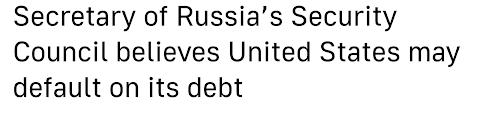
-Nikolai Patrushev
Sunday, August 14, 2022
Ukraine takes out key Russian supply bridge. Russia looks increasingly impotent.
What's Scott Ritter, Andre Maryanov, Col Douglas MacGregor going to say about this?
Russia's air defense is totally absent. Western arms supply is making a big impact.
WTF are the Russians doing?
Ukraine takes out key bridge, "destroying" Russia's plans for south advancement.
Wednesday, December 22, 2021
Wednesday, April 21, 2021
Monday, March 23, 2020
WAR ON THE TOILET PAPER FRONT — RUSSIA’S TISSUE BATTLES SWEDES, TURKS, AMERICANS—John Helmer
Dances with Bears
WAR ON THE TOILET PAPER FRONT — RUSSIA’S TISSUE BATTLES SWEDES, TURKS, AMERICANS
John Helmer
Saturday, November 23, 2019
PUTIN: US’ Attempts to Undermine Economic Growth of Russia, China — Drago Bosnic
The [Wolfowitz] doctrine announces the U.S.'s status as the world’s only remaining superpower following the collapse of the Soviet Union at the end of the Cold War and proclaims its main objective to be retaining that status.Wikipedia/Wolfowitz Doctrine
Our first objective is to prevent the re-emergence of a new rival, either on the territory of the former Soviet Union or elsewhere, that poses a threat on the order of that posed formerly by the Soviet Union. This is a dominant consideration underlying the new regional defense strategy and requires that we endeavor to prevent any hostile power from dominating a region whose resources would, under consolidated control, be sufficient to generate global power.
Fort Russ
PUTIN: US’ Attempts to Undermine Economic Growth of Russia, China
Monday, November 11, 2019
Sputnik — Putin Explains Why Russia Can Afford to Spend Less on Defence
The real expenditure, however, is not in nominal terms but with respect to allocation of real resources that are scarce, most significantly, knowledge and skill. Russia has established dominance in technological innovation in weapons development and manufacture. This requires investment in education and R&D.
Sputnik International
Putin Explains Why Russia Can Afford to Spend Less on Defence
See also
But this doesn't include related commitment, such as the arms industry, covert operations, etc. Some of those figures are classified. Moreover, it is impossible to tell what level of resources is being committed to black operations.
Finally, none of this is really germane to assessing power capability. The author has a degree in conflict resolution and apparently no background or training in military science. The question is not much much but how effective. For example, power projection is more costly than defense.
The US military and NATO is about force projection. China and Russia's militaries are orient toward national defense. In their case, asymmetry advantage lies in neutralizing potential adversaries' through technological weapons, like hypersonic missiles, electronic warfare, and cyber warfare.
It's not how many bucks, or even how much equipment, but rather the bang for the buck.
Based on this both China and Russia are modern military powers capable defending themselves against attack and protecting their periphery through denial of access. On the cheap.
Sputnik International
Putin Explains Why Russia Can Afford to Spend Less on Defence
See also
Between 2000 and 2016, while the Chinese economy averaged official annual growth rates around 7-8 percent, the PLA’s budget grew even faster at 10 percent. Despite that, the PLA’s current roughly $200 billion dollar budget totals less than one-third of U.S. defense spending. However, China pays much lower costs for hardware and personnel because of China’s “latecomer advantage” as the DIA report explains:
“China has routinely adopted the best and most effective platforms found in foreign militaries through direct purchase, retrofits, or theft of intellectual property. By doing so, China has been able to focus on expediting its military modernization at a small fraction of the original cost.”
Prominent examples include China’s aircraft carriers and its J-11 jet fighters.
By 2017, Chinese defense spending growth declined to 5-7%percent and the PLA shed 300,000 personnel, bringing it down to 2 million-strong—still the largest armed force on the planet. This transition sought to remodel the PLA into a leaner, more flexible force suited for fast-paced modern warfare.…Actually, the nominal expenditure is lower than the US owing to differences in const. However, the cost in terms of real resources is the same. Real resources that are committed to military use, including exports, are not available for use in the domestic economy. So the cost in real resources per capita would have to be figured as real terms rather than in monetary terms. For example, China's military commitment of personnel is 2 million out of a billion people and that the US is one million out of 300 some million. The US is committing significantly more per capita to its armed services.
But this doesn't include related commitment, such as the arms industry, covert operations, etc. Some of those figures are classified. Moreover, it is impossible to tell what level of resources is being committed to black operations.
Finally, none of this is really germane to assessing power capability. The author has a degree in conflict resolution and apparently no background or training in military science. The question is not much much but how effective. For example, power projection is more costly than defense.
The US military and NATO is about force projection. China and Russia's militaries are orient toward national defense. In their case, asymmetry advantage lies in neutralizing potential adversaries' through technological weapons, like hypersonic missiles, electronic warfare, and cyber warfare.
It's not how many bucks, or even how much equipment, but rather the bang for the buck.
Based on this both China and Russia are modern military powers capable defending themselves against attack and protecting their periphery through denial of access. On the cheap.
The National Interest
Sebastien Roblin
Wednesday, November 6, 2019
India’s RCEP Refusal, Russia’s Eurasian Vision, and Next Week’s BRICS Summit — Andrew Korybko
Andrew Korybko is more pessimistic than Pepe Escobar on this. I think he may be a bit too pessimistic. India's strategic alignment is a balancing act for the government in power. India has along history of playing the US and Russia against each other for its own advantage. The really big issue is the relationship of India and China, traditional enemies that are still locked in various disputes over boundaries. Here again, India is using the US as a hedge with respect to China.
Getting the Eurasian alignment right, both in the East and relative to the West is going to occupy the next several decades at least, and the Modi government is not going to be around that long to deal with it. So we will see.
India, Russia and China are wily players, focused on national interest, which includes regional peace, world peace, and a prospering global market to which they have access. But that all have domestic issues also, and these limit international flexibility. Hovering over this process is a Western hegemony led by the US that doesn't want to lose global dominance after having it for half a millennium.
GlobalResearch
India’s RCEP Refusal, Russia’s Eurasian Vision, and Next Week’s BRICS Summit
Andrew Korybko
China’s growing presence on the Russian market and what it means for the European Union — Alicia García-Herrero and Jianwei Xu
Russia doesn’t just look West, it looks East – and increasingly so. China’s economy has developed very rapidly over the past two decades, becoming the world’s largest exporter from a low base. Its goods have flooded Russia, eating into the EU’s export share. The changing global environment has helped re-orient Russia’s economic relationships eastwards, especially towards China. Chinese-Russian ties are also developing in the context of China’s massive Belt and Road Initiative.
This raises the question of the extent to which China might be able to displace the EU in Russia, in terms of trade, investment and lending. In a Bruegel working paper (written with the support of the EU Russia Expert Network on Foreign Policy), we assessed the deepening of Russia’s economic ties with China and what this might mean for the EU.
The data sheds light on some key issues EU policymakers should pay attention to. Since 2002, the EU’s share of Russia’s imports has dropped from 53% to about 40%, while China’s share has risen from less than 3% to 21%. Therefore, the EU still dominates, but what China exports is changing – and that should also give cause for concern. The share of domestic content in the goods China sells to the world has been increasing, and Chinese exports are increasingly substituting EU exports on the Russian market, especially in capital-intensive sectors. Notable overlaps are vehicles, industrial machinery, electronics and metal components.…Bruegel
China’s growing presence on the Russian market and what it means for the European Union
Alicia García-Herrero and Jianwei Xu
Alicia García-Herrero and Jianwei Xu
Friday, November 1, 2019
Friday, October 25, 2019
Vladimir Putin signed dozens of MOUs with African countries this week but can’t match China — Joe Penney
By the time the inaugural Russia-Africa Summit closed on Thursday afternoon in Sochi, Russia, president Vladimir Putin and his administration had signed dozens of memorandums of understanding (MOU) and other agreements with the African countries that attended.
The agreements include military cooperation, agricultural development, biotechnology, and oil and gas. They range from the minor, like Democratic Republic of Congo’s deal to sign data storage software, to more ambitious, like Ethiopia’s plan to build two 12,000 MW nuclear reactors.
Overall, Russia made big pledges across the two days in its effort to reestablish itself as a premier power on the continent and challenge China’s trade dominance. Russian trade with Africa has more than tripled to $18 billion in the past nine years, and Putin stated in his opening address that he wants to double that figure in the next five years.…
But it’s unclear how Russia’s commitments will measure up when put up against the China’s deep foray into Africa especially over the last two decades.
China’s last Africa summit FOCAC, held in Beijing in September 2018, made ambitious promises and followed through on them, fortifying the Asian giant’s place as Africa’s biggest trading partner at $204 billion annually.
President Xi Jinping committed to $60 billion to back development projects and said China will also exempt some poorer nations from debt, increase imports from Africa, support the building of the continental free trade area, and give scholarships to young Africans....
But Russia’s economy, with a GDP of $1.57 trillion, can’t realistically compete with a Chinese economy more than seven times that size, and it remains to be seen how many of the MOUs it signed in Sochi will pan out....Quartz
Thursday, October 24, 2019
FAKE NEWS. ABC shows Turks slaughtering Kurds – actually a mad minute at a US gun range. But, whatever, an honest mistake that anyone could make....Russia Observer
RUSSIAN FEDERATION SITREP 24 OCTOBER 2019
Patrick Armstrong
Friday, September 6, 2019
Awara — The Government and Business Approve New Steps to Improve Business Climate in Russia
The Plan of the Ministry of Economic Development for the Transformation of the Business Climate Was Supplemented with New Measures Vladimir Putin set an ambitious goal for the Ministry of Economic Development: by 2024, Russia should rise to 20th in the World Bank’s Doing Business rating (now our country occupies 31st place out of 190)....Russia and China have managed economies along with market-based economies. This is proving to be be a good balance between hierarchical technocracy and economic liberalism. Planning is working for both countries, seemingly contradicting the argument of economic liberals that any government "intrusion" is inefficient and reduces outcomes. At the same time, economic liberals also generally oppose direct democracy as "rabble rule," opting instead for what amounts to political illiberalism, which is what "bourgeois liberalism" really is as the dominance of the ownership-managerial class.
Thursday, September 5, 2019
Welcome to the Indo-Russia maritime Silk Road — Pepe Escobar
As energy or trade corridors, the fact is both Chennai-Vladivostok and Belt and Road spell out Eurasia integration. India in this particular case will profit from Russian resources traveling all the way from the Arctic and the Russian Far East, while Russia will profit from more Indian energy companies investing in the Russian Far East.
The fine-print details of the Russia-China “comprehensive strategic partnership” as well as Russia’s push for Greater Eurasia were also discussed at length in Vladivostok. A crucial factor is that as well as China, Russia and India have made sure their trade and economic relationship with Iran – a key node of the ongoing, complex Eurasian integration project – remains.Poking Uncle Sam in the eye. How will he react?
Most of all, Russia and India reaffirmed an essential commitment since BRICS was set up over a decade ago. They will continue to “promote a system of mutual transactions in national currencies,” bypassing the US dollar.
One can easily imagine how this will go down among Washington sectors bent on luring India into the Trump administration’s Indo-Pacific strategy, which is a de facto China containment mechanism.Asia Times
Welcome to the Indo-Russia maritime Silk Road
Pepe Escobar
Wednesday, September 4, 2019
Monday, September 2, 2019
Russia’s Turn to the East and the New Geopolitical World — Timofei Bordachev
This week, Vladivostok, Russia is hosting the 5th Eastern Economic Forum (EEF), an event which is the largest of its kind in terms of attendance, which will attract Russia’s top politicians and their Asian counterparts. This year, the forum will be attended by the heads of state and government of India, Malaysia, Mongolia and Japan, who will participate in a panel discussion alongside Russian President Vladimir Putin. The forum is unique in that it is a product of the new Russia, rather than the legacy of Russia’s experience attempting to foster international cooperation during the 1990s, like St. Petersburg’s International Economic Forum. It was created from scratch precisely as an instrument to accelerate openness and integrate Russia into the economic, political and civilizational space of Asia, the world's most densely populated region, where Russia is an important player due to its vast possessions in the Pacific Ocean.Going where the people are and the emerging market is located.
Valdai Analytics
Russia’s Turn to the East and the New Geopolitical World
Timofei Bordachev
Tuesday, August 13, 2019
Now They Are Talking — Andrei Martyanov
Cultural paradigms and national models.
Andrei Martyanov doesn't go into how the US is trying to impose its traditional cultural paradigm and it contemporary national neoliberal model on the rest of the world in an imperial fashion and how this is not going to work, but he alludes to it in the its assumption is the basis of his post. He focuses here on the incompatibility of the Russian and Chinese cultural paradigms and their respective national models as incompatible.
I have written previously on many occasions about how this clash between traditionalism and liberalism is the dominant force in the Zeitgeist of this historical moment of time. This is not adequately captured by the notion of thesis, antithesis and synthesis, which is a facile approach to the historical dialectic developed initially by Hegel and Marx. It has to be analyzed now in light of contemporary knowledge about the behavior of complex adaptive system, including synergy, reflexivity and emergence. This is and will be different in various locales, e.g., regions and nations, as well as sub-systems within them.
Now They Are Talking.
Andrei Martyanov
Relevant.
The economic mainstream is biased: who’d have thought it?
Richard Murphy | Professor of Practice in International Political Economy at City University, London; Director of Tax Research UK; non-executive director of Cambridge Econometrics, and a member of the Progressive Economy Forum
Sunday, August 11, 2019
How Tehran fits into Russia-China strategy — Pepe Escobar
Complex doesn’t even begin to describe the positioning of Iran-Russia in the geopolitical chessboard. What’s clear in our current, volatile moment is that they’re partners, as I previously reported. Although not strategic partners, as in the Russia-China tie-up, Russia-China-Iran remain the crucial triad in the ongoing, multi-layered, long-term Eurasia integration process.
A few days after our Asia Times report, an article – based on “senior sources close to the Iranian regime” and crammed with fear-mongering, baseless accusations of corruption and outright ignorance about key military issues – claimed that Russia would turn the Iranian ports of Bandar Abbas and Chabahar into forward military bases complete with submarines, Spetsnaz special forces and Su-57 fighter jets, thus applying a “stranglehold” to the Persian Gulf.
For starters, “senior sources close to the Iranian regime” would never reveal such sensitive national-security details, much less to Anglo-American foreign media. In my own case, even though I have made several visits to Iran while consistently reporting on Iran for Asia Times, and even though authorities at myriad levels know where I’m coming from, I have not managed to get answers from Islamic Revolutionary Guard Corps generals to 16 detailed questions I sent nearly a month ago. According to my interlocutors, these are deemed “too sensitive” and, yes, a matter of national security.
Predictably, the report was fully debunked....Asia Times
How Tehran fits into Russia-China strategy
Pepe Escobar
Moon of Alabama — No, There Will Be No Russian Base In Iran
A somewhat weird report published at Oilprice.com claims that Russia will station troops, ships and fighter jets in Iran. The piece was reproduced at Yahoo.com and Zerohedge even as it is obviously bonkers....Moon of Alabama
No, There Will Be No Russian Base In Iran
Subscribe to:
Posts (Atom)