Showing posts with label aggregate options. Show all posts

Saturday, June 27, 2015

Navel-Gazing vs Exploring Aggregate Options. A Metaphor. The Paleolithic Aggregate_Brain Diet.

   (Commentary posted by Roger Erickson)

I this what "nature intended?" Or, like capitalism, is EVERYTHING we come across just a statistical blip in the path of "Context Nomads" .... and "nature" didn't give us any instruction other than to survive (even ourselves)?

That brings up an analogy.
The Paleolithic Aggregate_Brain* Diet

To avoid you know what.

This is just one part of a bigger spectrum of tasks: ... HOW do we get people to KEEP exploring their (personal PLUS aggregate) options?

Hint, adequately provision the components (individuals) AND exhort them to do something other than just brainlessly over-consume whatever they initially market to one another.

Beginning minds start out over-consuming, yet growing minds soon graduate to lean exploration of insanely exhilarating options (personal plus aggregate).

Here's a quick example, below, featuring another review of evidence for human adaptation to low-grain diets (any combo of veggies/fruits/meats, plus occasional seeds thrown in).

Current uber-capitalists won't like this either, since they "don't do nuance".

Note that this data is curated & promoted by the USA NIH NCBI - National Center for Biotechnology Information. Think of it as analogous to Fed_Data, for Public Health, not economic data.

Comparison with ancestral diets suggests dense acellular carbohydrates promote an inflammatory microbiota, and may be the primary dietary cause of leptin resistance and obesity
Ian Spreadbury, GIDRU WingKingston General Hospital76 Stuart StreetKingston, Ontario K7L 2V7, Canada(613) 549-6666 x6520is15@queensu.ca
My synopsis (for those intimidated by non-economic, discipline-specific jargon):

Sure, grains/milk/cheese let large populations of humans occupy nutrient-poor regions, yet such high-density nutrients need never be eaten in more than micro quantities.
Note: I'd emphasize LOW-GRAIN, not no-grain. Even foragers find whole grains periodically.  
This fits into the general story of over-utilization.
We no longer know how little we need .... even while advertisements exhort us to over-use EVERY form of food (& other commodities, even fiat IOU numerals themselves).
Face it. Humans everywhere are bored. Not just Americans. There's more to life than consuming random stuff that advertisers ("pushers") encourage one another to over-consume. That covers more than just food.
What minimum food supply will get humans to the moon? How about to Mars? 
... 
How about to the future?
Analogously, what dynamically right-sized-commodity-supply will get homo sapiens to the future?

It's worth asking every 10-yr old worldwide these questions, so that they're primed to be interested in SOMETHING besides just over-consuming ... i.e., uselessly hoarding ... like the Koch brothers, or Warren Buffett, or all sociopaths, er, "billionaires."


Of course we can go somewhere from here. Where?

Just where advertisers suggest?

Or something beyond current imaginations? Surely there's no point in limiting ourselves. Instead, let's adequately provision our grandchildren, and overweight them with aggregate options, not just fat cells or hoarded public fiat.

Ever see an advertiser advertising tomorrow? Or just what feebly small amount they can imagine today? The difference is bigger than our Output Gap, it's our grandchildren's Options Gap.

This is, after all, just one of many necessary but not sufficient steps to take. Every human could and probably should, by age 10, grasp the Anti-Hypocritic Oath: "First, Do No Harm, Personal OR Aggregate." There are plenty of subsequent challenges, and we don't want to get in the way of all of those, current or as yet unrecognized.


Sure we've found ways to fix that. And we've also found ways to go too far. 


Can't we just fix that too? You'd think so, if more of us would only think, more often ... about how little matters, long term, ... instead of mindlessly spouting advertising to one another, without thinking ... and listening to advertising, again without thinking.


* For those with un-exercised imaginations, the intelligence of a "brain" depends on the organized inter-connections of all the neurons it contains (developed by practice). A GroupBrain depends on the patterns of discourse exercised among all the citizens of that group. Capiche? Imagine if Americans knew more of what Americans know to matter. That requires group practice, to whittle down how little matters to successive, fleeting contexts. We can only get there by selecting to practice, enough, on an aggregate scale.

Thursday, June 4, 2015

Local AND Aggregate Rationality. It's About A Whole That Is Greater Than The Sum Of It's Parts, Folks.

(Commentary posted by Roger Erickson)
Individuals not clear on the Paradox of Aggregate Thrift argue that it's perfectly rational for any individuals anywhere, no matter their aggregate context, to seek personal savings as a solution to their retirement needs.

Yes, that may seem rational, but it's not rational enough, by a mile!

If the cells in our body had such a definition of rational ... we call them rogue adipose cells, or even cancers.
Once aggregate investment falls short of the demand leakages ... the boom cycle ends in another bust.
(And yes, for those new to semantics, aggregate financial savings is called a "deficit in fiat" ONLY in narrow accountants jargon.)

Yet everyone also knows that it's not enough to act on what's ONLY locally rational. Personal, local, regional and aggregate rationality all matter, in everything we do, or we wouldn't call ourselves a social species! A modern culture formed by a social species requires that the sum of all local+aggregate rationalities be greater than the sum of it's respective parts. And that's just the 1st step. It's the ante for even being in the cultural competition game.

We're never acting alone, and we all know it. Everyone is interconnected to those we have affinity for ... and responsibility for.
Somehow, our current training & education is failing to scale that affinity and responsibility past the primitive state of NeoLiberalism.
We're failing to keep our aggregate from unraveling and dissociating.
Why? And how? Distraction, I'd guess. Wealth breeds complacency and narrowing tunnel vision, until the next train comes down the track. Learning well comes down to teaching well ... to aggregate context, not arcane tests minus context.

If we don't do a better job of teaching emerging citizens how to optimize the optimal sum of personal savings PLUS aggregate options ... the only thing we'll accelerate is our Output Gap and our cultural demise.


Tuesday, March 24, 2015

The Deeper Meaning Of Entrepreneurism ... Aggregate-Entrepreurism

(Commentary posted by Roger Erickson)


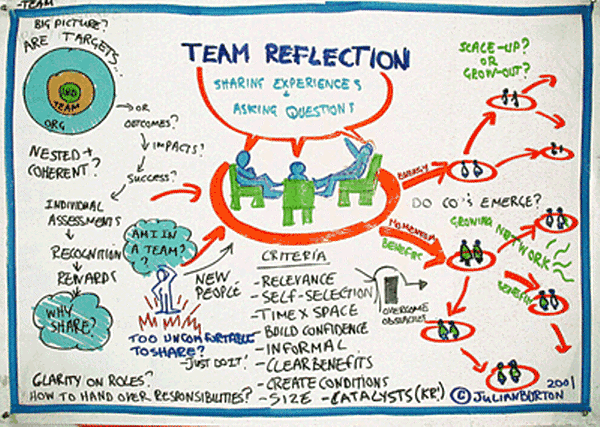
If a collection of cells (you) can act entrepreneurially, why can't a collection of 330 million citizens act as a team? They can? How? How often WILL they? And why not all of the time, or at least more often than we have been cooperating recently?

How do we get our nation to explore it's aggregate options?

First, recruit an electorate to recognize and explore their BIGGEST options? Please tell me, if you know where to start, and how to do that. Clearly, there are many options. How do we most productively explore those aggregate options?

Now THAT is an interesting topic!

How can a RAIDLY EXPANDING auto-catalytic aggregate continuously reform both its internal-feedback sensing AND external-scouting strategies to constantly re-extract adaptive, aggregate context modeling from its (exponentially expanding? factorially expanding?) "option space?" (More plainly, simply explore its rapidly expanding options.)

Why, that would make us an Entrepreneurial Aggregate! That would be a whole far greater than just the sum of our individual entrepreneurs, "entrepreneurially" sequestering resources back and forth FROM one another! :(

This is truly the "Evolving Aggregate's Task." In fact, it's quite obviously every aggregate's #1 task, by far.

Making aggregate option explorations a snap? Now that would be exciting. Much more so than just trivial tactical tasks.

That's obviously what happens when agile teams explore contexts. It's the most important task facing national aggregates, and probably the most neglected. That's what Context Nomads do, and we are all Context Nomads, all the time, whether we know it or not.

The deeper meaning of entrepreneurism is to occasionally turn away from frictions and sequestering existing resources FROM one another, to the rarely practiced activity of exploring aggregate options for creating not just more resources ... but actually creating a pool of resources another order of magnitude larger than what we could previously access. Total teamwork? What a mundane, but ignored, concept! :(

The simple truth is that we as an aggregate are always capable of creating more wealth than any of us can currently imagine. Yet instead, for spurious reasons, we spend most of our time hoarding what we've already got ... FROM one another, instead of optimally provisioning our most valuable asset, our aggregate teammates! That is embarrassingly dumb, and the opposite of being entrepreneurs.

How much of available aggregate information do we need, in order to perceive emerging, aggregate context? Not as much as we initially imagine. It's clearly a matter of data-sampling methods and context-modeling methods and option-exploration methods. Surely that's not to hard to practice, aka, between wars, not just during world wars?

A method to simplify pictures makes chemistry calculations a snap

We actually have mathematicians patenting algorithms for extracting data images from complex data sets.

Why patent? Exactly so we can constrain the adoption rate of the application of the advanced method just invented, for narrow vs aggregate gain. And thereby slow our aggregate adaptive rate? Do tell! When is too much of one method (patent protection) too much to bother with as an aggregate? When it's time to adjust, can we DISCERN when to make aggregate adjustments fast enough to keep from harming our aggregate selves? Do we have ways to even sense that, soon enough to matter? Or only long after the damage has been done?

And why slow the population penetration of new inventions at all? Do we really know what we are doing? Is too soon ever too soon?

Since those two tolerance limits change, how do we stay safely between them, and pursue that moving target?

Our application of our emerging knowledge parsing methodology is too timid.

Our emerging methods are too useful to be limited ONLY to compartively trivial applications such as medical imaging or molecular modeling.

What about modeling our own cultural context, and our our aggregate adaptive rate?


Really? What if we tried being an effective NATION? What would motivate us to try that? I mean, something other than another war?

No one person can supply adequate answers, but we can start asking more challenging questions of one another.


Sunday, March 16, 2014

Creating And Utilizing New, Unpredictably Subtle Cultural Infrastructure

   (Commentary posted by Roger Erickson)


The Luddite-fallacy, this is both hilariously relevant, and hilariously ironic.

If "technological change is accelerating" ..... then it just means that our aggregate options are accelerating even faster.

They are, after all, two sides of the same coin (another example of yet another type of SECTORAL BALANCES).

The only thing that is NOT accelerating, is our distributed awareness of our own, distributed options, AND our standard process for successfully exploring our aggregate options.

Is this a natural, "tunable" cycle? Whenever a population gets wealthier, it gets more distracted, or non-selective, or complacent (out of practice), before it can regain and extend motivation?

Just as anything that grows, has to get clumsier, before it can regain and extend agility? Systemic adjustments must always chase, not precede or synchronize with, net change - including organic growth, and all the new inter-dependencies that any net growth triggers.

How SOON does a growing system regain & extend adaptive rate? Or how closely it does it track it's unpredictable survival path? That's a function of how much infrastructure it builds out, and how much it PRACTICES at building and using more, more distributed, and more selectively tuned ... physical AND cultural infrastructure?

Surely the next stage in evolving human cultures will involve social mutations that create new methods (including "jobs") for keeping growing populations more adaptively agile ... presumably by creating and utilizing new, unpredictably subtle, cultural (not just physical) infrastructure.

Meanwhile, we're systemically ignoring the obvious? Another sectoral balance - between individual unemployment and distributed options.