Showing posts with label financial crises. Show all posts

Wednesday, November 6, 2019

George A. Akerlof — What They Were Thinking Then: The Consequences for Macroeconomics during the Past 60 Years

This article begins with a review of the two main textbook approaches that had evolved by the early 1960s to incorporate the musings of Keynes: the Keynesian cross from Samuelson’s (1948) introductory textbook and the complete, well fleshed-out model in Gardner Ackley’s (1961) advanced macro textbook. This Keynesian- neoclassical synthesis followed a pattern set by Hicks (1937) by focusing on certain elements of Keynes, while setting aside others. Some potential weaknesses of the specific approach in these models were, at least vaguely, sensed at the time. For example, Hicks had, at least obliquely, mentioned the neglect of inflation expecta- tions. In other cases, the model left out topics that Keynes had treated as important, such as the dangers of financial crises and the role of social norms in wage bargaining, and what these topics implied about the potential importance of multiple equilibria in macroeconomic outcomes. However, the Keynesian-neoclassical synthesis of the 1960s was flexible enough that it encouraged a large body of work. The article will show that this work was based on a style that I call “one-deviation-at-a-timism” (a phrase adapted from Caballero 2010). As I will demonstrate, one-deviation-at-a-time constraints have had real consequences for macroeconomics. For example, they have resulted in lack of attention to financial crashes as a macro topic; they have also resulted in the omission of plausible models with very different core conclusions regarding the effectiveness of macro stabilization.
My concerns can be expressed in the terminology of Thomas Kuhn (1962). What was the dominant paradigm for macroeconomics in the early 1960s? What were its vulnerabilities? What was the resistance to addressing these vulnerabilities? Do these vulnerabilities still remain? I shall address these questions regarding the field of macroeconomics from two intertwined perspectives: my perception of what they were thinking as I began graduate school at MIT in 1962, and my view as I look back on the developments in macroeconomics over the past 57 years.
Journal of Economic Perspectives
What They Were Thinking Then: The Consequences for Macroeconomics during the Past 60 Years
George A. Akerlof

Wednesday, July 17, 2019

The External Sector And Financial Crises — Brian Romanchuk

If we look at the full history of financial crises around the world, one could argue that crises related to external debt and/or fixed exchange rates are dominant. Such crises could represent an entire chapter of this book. However, I will only offer a brief overview of the subject. From the perspective of recession forecasting, the addition of a fixed exchange rate regime adds a new wrinkle to analysis: at what point will the peg fail, causing a crisis? As I will discuss below, this is quite different than an analysis of the domestic economy, which one might hope is amenable to something resembling econometric analysis....
Bond Economics
The External Sector And Financial Crises
Brian Romanchuk

Wednesday, November 14, 2018

Brian Romanchuk — The Financial Instruments Associated With Crises

This article is a continuation of previous comments on financial crises, with two lines of discussion. The first is a bit of a primer, explaining why I and other commentators associate financial crises with a buildup of private debt. The second part discusses the main problem with associating crises with private debt buildups: growth in debt stocks is by itself not enough to trigger a crisis. The catch is a variant of the efficient markets hypothesis: if we could easily forecast crises, it would be easy to outperform markets. However, other market participants are trying to do the same thing.…
Private sector financial crises are associated with private debt buildup. Unfortunately, we cannot expect simple rules based on debt growth to be able to accurately predict such crises.

Wednesday, May 30, 2018

Brian Romanchuk — Book Review: Prosperity For All

Professor Roger E. A. Farmer has written Prosperity For All: How to Prevent Financial Crises, in which he lays out the case for creating a sovereign wealth fund whose objective is to stabilise financial markets. If we can eliminate financial crises, we can avoid the rise in unemployment that results. Although that is an interesting concept, I was highly skeptical about the idea before I read the book -- and my skepticism remains after reading it. Instead, the discussion of macro theory within the book is why it is of interest.
Bond Economics
Book Review: Prosperity For All
Brian Romanchuk

Thursday, November 9, 2017

Carlos da Silva Costa — Opening remarks - "Conference on Financial Stability"

Opening remarks by Mr Carlos da Silva Costa, Governor of the Bank of Portugal, at the Bank of Portugal Conference on Financial Stability, Lisbon, 17 October 2017.
Bank of International Settlements
Carlos da Silva Costa: Opening remarks - "Conference on Financial Stability"

Sunday, September 10, 2017

Yilmaz Akyüz — The Asian financial crisis: lessons learned and unlearned

Asian economies are commended for improving their external balances and building self-insurance by accumulating large amounts of reserves. However, whether these would be sufficient to provide adequate protection against a reversal of capital flows is contentious. After the Asian crisis external vulnerability came to be assessed in terms of adequacy of reserves to meet short-term external dollar debt. However, short-term debt is not always the most important source of drain on reserves. Currencies can come under stress if there is a significant foreign presence in domestic markets and the capital account is open for residents. A rapid exit could create significant turbulence even though losses from declines in assets and currencies fall on foreign investors and mitigate the drain of reserves.
In all four Asian countries directly hit by the 1997 crisis, international reserves now meet short-term external dollar debt. But they do not always leave much room to accommodate a sizeable and sustained exit of foreigners from domestic markets and capital flight* by residents.
* "Capital flight" in an environment of free capital flow means selling the domestic currency in the foreign exchange market for a foreign currency and depositing this in foreign financial institutions. This depresses the exchange value of the domestic currency and lowers the price of the domestic assets being sold. In volume ("rushing for the door"), this puts pressure on domestic economies owing to existing commitments. It does not mean taking the domestic currency out of the country.

Oupblog
The Asian financial crisis: lessons learned and unlearned
Yilmaz Akyüz | former Director of Division on Globalization and Development Strategies at UNCTAD, principal author and head of the team preparing the Trade and Development Report, and coordinator of research support to the Group-of-24 in the IMF on International Monetary and Financial Issues

Wednesday, May 31, 2017

Jomo Kwame Sundaram — Why International Financial Crises?


Raises some good questions. 
The leading international monetary economist of the post-war period, Robert Triffin, described the post-1971 arrangements as amounting to a “non-system.” Now, with the international monetary system essentially the cumulative outcome of various, sometimes contradictory and ad hoc responses to new challenges, the need for coordination is all the more urgent.
Makes a case for more concerted action now that the world is operating under a "non-system." 

I would not call it a non-system but a highly flexible system that resist simple analysis. 

The gold standard for international settlement resulted in a system that was simpler to model, but it was much more brittle, which is a reason it broke down.

TripleCrisis
Why International Financial Crises?
Jomo Kwame Sundaram

Wednesday, May 11, 2016

Eric Tymoigne — Money and Banking Part 14: Financial Crises

While visiting the London School of Economics at the end of 2008, the Queen of England wondered “why did nobody notice it?” In doing so, she echoed a narrative that had been promoted among some prominent economists: the Great Recession (“it”) was an accident, a random extreme event and no one so it coming. This narrative is false. Quite of few economists saw it coming and it was not an accident. A previous post showed how different theoretical framework about financial crises lead to different regulatory responses. This post studies more carefully the mechanics of financial crises and how an economy gets there.…
New Economic Perspectives
Money and Banking Part 14: Financial Crises
Eric Tymoigne | Associate Professor of Economics at Lewis and Clark College, Portland, Oregon; and Research Associate at the Levy Economics Institute of Bard College

Wednesday, November 4, 2015

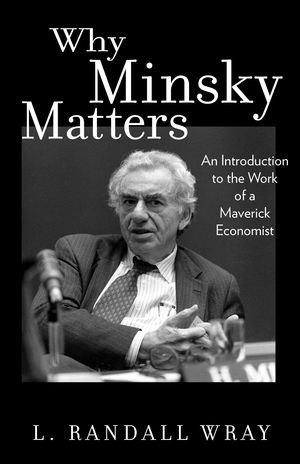
Michael Stephens — “Why Minsky Matters” Now Available


Randy Wray's latest. Looks like a must-read for economists, political scientists, and policy-makers. Perhaps this will be many more people's introduction to MMT. Very moderately priced, too. It should be a a big seller.

Multiplier Effect
“Why Minsky Matters” Now Available
Michael Stephens


Publisher's blurb:


Why Minsky Matters:
An Introduction to the Work of a Maverick Economist
L. Randall Wray

Hardcover | 2015 | $27.95 | £19.95 | ISBN: 9780691159126
288 pp. | 5 1/2 x 8 1/2

Add to Shopping Cart

eBook | ISBN: 9781400873494 |
Our eBook editions are available from these online vendors

Reviews | Table of Contents
Introduction[PDF]

Perhaps no economist was more vindicated by the global financial crisis than Hyman P. Minsky (1919–96). Although a handful of economists raised alarms as early as 2000, Minsky’s warnings began a half-century earlier, with writings that set out a compelling theory of financial instability. Yet even today he remains largely outside mainstream economics; few people have a good grasp of his writings, and fewer still understand their full importance. Why Minsky Matters makes the maverick economist’s critically valuable insights accessible to general readers for the first time. L. Randall Wray shows that by understanding Minsky we will not only see the next crisis coming but we might be able to act quickly enough to prevent it.

As Wray explains, Minsky’s most important idea is that "stability is destabilizing": to the degree that the economy achieves what looks to be robust and stable growth, it is setting up the conditions in which a crash becomes ever more likely. Before the financial crisis, mainstream economists pointed to much evidence that the economy was more stable, but their predictions were completely wrong because they disregarded Minsky’s insight. Wray also introduces Minsky’s significant work on money and banking, poverty and unemployment, and the evolution of capitalism, as well as his proposals for reforming the financial system and promoting economic stability.

A much-needed introduction to an economist whose ideas are more relevant than ever, Why Minsky Matters is essential reading for anyone who wants to understand why economic crises are becoming more frequent and severe—and what we can do about it.

L. Randall Wray is professor of economics at the University of Missouri, Kansas City, and senior scholar at the Levy Economics Institute of Bard College. He is the author of many books, including Modern Money Theory and Understanding Modern Money. He was a student and colleague of Hyman Minsky.

Reviews:

"An accessible introduction to the economist who saw the global financial crisis coming."--Bookseller Buyer’s Guide

Endorsements:

"Ever since the climax of the financial crisis in 2008–09, Hyman Minsky has become an iconic point of reference. Why Minsky Matters renders the authentic Minsky accessible to a wide readership for the first time. L. Randall Wray has a comprehensive grasp of Minsky’s thought, and the capacity to express it in a compact, highly readable fashion. This is a book of rare clarity, importance, and usefulness."--James K. Galbraith, author of The End of Normal: The Great Crisis and the Future of Growth

"Hyman Minsky is the most important economist since Keynes, yet it’s virtually impossible to find any books about him. Why Minsky Matters should be read not just by anyone who wants to understand Minsky, but anyone who wants to understand our economy. The reason, as L. Randall Wray makes obvious, is that Minsky does a better job of explaining the global financial crisis--and why it isn’t over yet--than anyone else. Everyone should read this book."--Michael Pettis, author of The Great Rebalancing: Trade, Conflict, and the Perilous Road Ahead for the World Economy
"Intelligent, accessible, and clear, Why Minsky Matters brings Minsky’s ideas to life and explains why they help us understand the world in which we live."--Steven M. Fazzari, coauthor of After the Great Recession

Table of Contents:
Preface vii
Introduction 1
1 Overview of Minsky’s Main Contributions 21
2 Where Did We Go Wrong? Macroeconomics and the Road Not Taken 47
3 Minsky’s Early Contributions: The Financial Instability Hypothesis 71
4 Minsky’s Views on Money and Banking 87
5 Minsky’s Approach to Poverty and Unemployment 109
6 Minsky and the Global Financial Crisis 137
7 Minsky and Financial Reform 163
8 Conclusion: Reforms to Promote Stability, Democracy, Security, and Equality 193
Notes 223
Further Reading 253
The Collected Writings of Hyman P. Minsky 257
Index 269

Thursday, September 11, 2014

Lars P. Syll — The Keynes-Minsky-Kindleberger theory of financial crises


Charles Kindleberger quote.

Lars P. Syll’s Blog
The Keynes-Minsky-Kindleberger theory of financial crises
Lars P. Syll | Professor, Malmo University

Tuesday, September 2, 2014

Claudio Borio — The international monetary and financial system: its Achilles heel and what to do about it


Free download
This essay argues that the Achilles heel of the international monetary and financial system is that it amplifies the "excess financial elasticity" of domestic policy regimes, ie it exacerbates their inability to prevent the build-up of financial imbalances, or outsize financial cycles, that lead to serious financial crises and macroeconomic dislocations. This excess financial elasticity view contrasts sharply with two more popular ones, which stress the failure of the system to prevent disruptive current account imbalances and its tendency to generate a structural shortage of safe assets - the "excess saving" and "excess demand for safe assets" views, respectively. In particular, the excess financial elasticity view highlights financial rather than current account imbalances and a persistent expansionary rather than contractionary bias in the system. The failure to adjust domestic policy regimes and their international interaction raises a number of risks: entrenching instability in the global system; returning to the modern-day equivalent of the divisive competitive devaluations of the interwar years; and, ultimately, triggering an epoch-defining seismic rupture in policy regimes, back to an era of trade and financial protectionism and, possibly, stagnation combined with inflation.
BIS
The international monetary and financial system: its Achilles heel and what to do about it
by Claudio Borio
Working Papers No 456
September 2014

Friday, November 15, 2013

Mark Buchanan — Actually, Economists Can Predict Financial Crises

Economists have long argued that they shouldn’t be expected to predict crises, such as the one that almost sank the global economy five years ago.
That depends on how you define the word “predict.”...
The answer is that predictions can be useful without being quite so precise. Scientists make valuable predictions all the time that have little to do with foreseeing the future, but develop our understanding of cause and effect....
In this sense of a causal relationship, quite a few people did foretell the financial crisis....
The challenge for economists is to find those indicators that can provide regulators with reliable early warnings of trouble....
One problem has been “physics envy” -- a longing for certainty and for beautiful, timeless equations that can wrap up economic reality in some final way. Economics is actually more like biology, with perpetual change and evolution at its core. This means we’ll have to go on discovering new ways to identify useful clues about emerging problems as finance changes and investors jump into new products and strategies. Perpetual adaptation is part of living in a complex world.
Bloomberg
Actually, Economists Can Predict Financial Crises
Mark Buchanan, theoretical physicist
(h/t Mark Thoma at Economist's View

Sunday, March 3, 2013

Clint Balinger — Towards A Pure State Theory Of Money, Prologue: A Note On Knapp & Innes

...although a great deal of the suboptimal performance (sustained unemployment, lack of investment in infrastructure, education, and healthcare) has been due to a failure to understand and apply readily implementable state money & functional finance insights, there has also been another major source of economic suffering, resulting from the non-state-money side of the economy. The worldwide private credit money system has caused untold suffering and misery for millions. This side of the equation must be integrated into any functional finance insights that arose from Knapp, Innes, and others....
Clint Balinger
Towards A Pure State Theory Of Money, Prologue: A Note On Knapp & Innes

Saturday, February 16, 2013

Frances Coppola — Productivity, savings and financial crises


Frances Coppola analyzes ECB Working Paper, "Booms and Systemic
Banking Crises" by Frederic Boissay, Fabrice Collard and Frank Smets (February 2013)

The ECB's paper makes a valiant attempt to fit the financial system into a DSGE model of the economy that previously ignored it. The maths is fearsome and I admit I skipped much of it. But they draw some important conclusions.

Very early in the paper they accept the prevailing wisdom that financial crises are endogenously determined - in other words, they happen as a consequence of behaviour within the system, not because of external shocks to it. Now this immediately causes a problem with the model. DSGE models work on the basis that shocks are exogenous - sort of like meteorite impacts on life on earth. But using the same analogy, an endogenous crisis would be CAUSED by the behaviour of life on earth. Attempting to use a DSGE model to explain the effects of the behaviour of humans on their own behaviour is enough to drive a serious economist to drink. Admittedly there are shocks in the model, but adverse ones are regarded as secondary and the causative positive supply-side shocks they postulate happen some time before the crisis itself. They cause the buildup of the behaviour that leads to the crisis, rather than the crisis itself. This I think is an important insight, and I commend the ECB economists for sticking to their guns despite the considerable difficulty in using a model that on the face of it looks inappropriate.
Coppola Comment
Productivity, savings and financial crises
Frances Coppola

Thursday, December 13, 2012

Fed Describes it's Responses to 100 Years of Financial Crises

commentary by Roger Erickson

[ps: has Congress published a working paper on 236 years of policy crises?]


Working Paper 2012-056A by Mark A. Carlson and David C. Wheelock


“It is the duty of the United States to provide a means by which the periodic panics which shake the American Republic and do it enormous injury shall be stopped.” −Robert L. Owen

We review the responses of the Federal Reserve to financial crises over the past 100 years. The authors of the Federal Reserve Act in 1913 created an institution that they hoped would prevent banking panics from occurring. When this original framework did not prevent the banking panics of the 1930s, Congress amended the Act and gave the Federal Reserve considerably greater powers to respond to financial crises. Over the subsequent decades, the Federal Reserve responded more aggressively when it perceived that there were threats to financial stability and ultimately to economic activity. We review some notable episodes and show how they anticipated in several respects the Federal Reserve’s responses to the financial crisis in 2007-2009. We also discuss some of the lessons that can be learned from these responses and some of the challenges that face a lender of last resort.

The founding of the Federal Reserve System in 1914 established the first official U.S. lender of last resort. Recurrent banking crises in the nineteenth and early twentieth centuries were widely viewed as evidence of defects in the U.S. banking system, including the absence of an official lender of last resort.

Panics had been met by ad hoc actions by bankers (from Nicholas Biddle to J.P. Morgan), Secretaries of the Treasury (e.g., Leslie Shaw), and private clearinghouses, but these actions did not obviously reduce the frequency or severity of the panics. The Fed’s founders sought to prevent panics from arising in the first place as well as provide a mechanism for limiting any crises that did occur.

To achieve this objective, the Fed’s founders desired to create an “asset-backed” currency whose supply was tied to the level of commercial activity rather than to the stock of government bonds held by banks, and establish reserve banks to hold the reserves of the banking system and to provide additional currency and reserves as needed by rediscounting commercial paper.


[RGE: To anyone other than economists, an "asset-backed currency" is an odd concept unless the asset in question is defined as the most valuable asset of all, the return-on-coordination. The "level of commercial activity" is a pale reference to the general concept of return-on-coordination - and one that leaves the essential distinction between static & dynamic value unclear. It's a mistake to use such an arbitrarily defined base for the unit of account meant to supply commercial liquidity nationwide. That choice constitutes an endless source of confusion, and mistakes waiting to happen. We could do far better today. Lets start by redefining the national currency as a monopoly unit automatically denominating any and all commercial transactions, NO MATTER HOW RAPIDLY NET COMMERCIAL ACTIVITY GROWS.  Nomisma?]

The Fed’s founders expected that discount window lending would be the principal means by which the Federal Reserve would serve as lender of last resort to the banking system. However, the founders gave the Fed other tools as well, notably the ability to invest in government securities and bankers acceptances, which subsequently were used to take lender of last resort actions as well as to implement monetary policy. ....