Showing posts with label prediction. Show all posts

Thursday, January 9, 2020

Lars P. Syl — Is economics — really — predictable?


There is a big difference between predicting and forecasting. Scientific theory is about causal explanation and prediction through formulating testable hypothesis that challenge the theory rigorously based on experimental evidence. Forecasting is making educated guesses based on limited and variable information information. The former applies chiefly to ergodic systems and the latter to non-ergodic, or if the system is actually ergodic, not enough it known about it to construct a rigorous causal explanation.

The ideal causal explanation is in terms of deterministic functions in which a rule applied to a single measurable input results invariably in a single measurable output. The debate over whether statistics can deliver on causal explanation is still raging, in light of the principle that correlation is not causation. For example, Einstein rejected that it could and continued to seek for a set of deterministic functions as the basis for causal explanation in physics, viewing QM as an admission of lingering ignorance about the laws of nature owing to QM being stochastic.

Libraries are full of tomes debating the details of this, but this is a rough outline to which most agree. Thus, forecasting can be "scientific" and even based on causal explanation, but it fails the test of prediction strictly speaking based on performance. The subject matter of the social sciences is more like the weather than planetary motion, and so the results are mixed. There is no ephemeris for economic cycles.

The question how sharp the line dividing prediction and forecasting may be, and this is a matter of argument since no set of criteria are universally agreed upon. Some conventional economists seek to categorize economics with the natural sciences rather than the social sciences, for example. Is that justifiable?

To understand Keynes, it is necessary to take his Treatise on Probability as a starting point.

Why is this important other than philosophically? Because humans are ideological and affected by presumptions as hidden assumptions. We tend to overestimate our level of knowledge, on one hand, and other the other, we inflate our degree of confidence.

To paraphrase Richard Feynman the purpose of science is to prevent us from fooling ourselves and we ourselves are the easiest people to fool (owing to cognitive-affective bias).

Lars P. Syll’s Blog
Is economics — really — predictable?
Lars P. Syll | Professor, Malmo University

Wednesday, April 18, 2018

Brian Romanchuk — Forecastability And Economic Modelling

When most people think about macroeconomics, what they want is the ability to forecast economic outcomes. However, economists' (of all stripes) reputation as forecasters is not particularly high. My view is that this is not too surprising: what we want forecasters to accomplish is probably impossible. (I am hardly the first person to note this, as variants of this idea go back at least to Keynes; I could not hope to offer a history of this idea.) However, I think if we want to approach macro theory formally, we need to formalise the notion that outcomes cannot be forecast, which means we need to define non-forecastability formally.
This article gives one potential definition of forecastability, and then applies the concept to a simple stock-flow consistent (SFC) model. It should be noted that these are my preliminary thoughts, and I believe that the definition will need to be refined.…
This is one of the key questions in philosophy of economics, as well as philosophy of science and philosophy of social science.

The purpose of science is to provide as general an explanation of data ("data" means "the given.") The data set is determined by the nature, scope and scale of the subject matter being explained. This is accomplished through modeling, both conceptual and mathematical.

Prediction comes in with respect to testing outcomes of theoretical models, using hypothesis the theory generates and carefully designing testing apparatus.

The difference between philosophical speculation based on reasoning and science is that scientific reasoning can be tested by subjecting hypotheses to disconfirmation, since a general statement (theory) is contradicted by a single false instance.

No amount of true instances can definitely confirm a general statement that is not a tautology and therefore empty of content about how things stand in the world. This is the case logically, even though we call theoretical assumptions that are well confirmed by hypothesis testing "scientific laws."

Science is always tentative on the next outcome unless it is established that all the factors involved are known to be true based on observation. A logical argument is sound if and only if the logical from is valid and the premises are true. Then the conclusion necessarily follows.

This implies that a great deal of that which is considered scientific is speculative. That is to say, it is not science but philosophy.

There is nothing wrong with philosophy. Not everything is explained by scientific reasoning. The questions involving key fundamentals of life and reality have not been answered using scientific reasoning. They are "the enduring questions" that are the domain of philosophy. When methods are developed to answer such questions using scientific reasoning, then they become the subject matter of science.

I don't wish to give the impression that fundamental issues in philosophical method are resolved. They are not for the simple logical reason of lack of criteria that are universally agreed up. But the above more or less summarizes what is generally accepted practice based on logic., even though there are issues in the foundations of logic, too.

Hopefully, Brian's post will contribute to getting economists thinking more  about the foundations of their field and doing this more carefully.

Bond Economics
Forecastability And Economic Modelling
Brian Romanchuk

See also
My point is merely that forecasting is not the same as modelling, nor the same as telling a good story.
Stumbling and Mumbling
On thin predictions
Chris Dillow | Investors Chronicle

See also
There are many arguments for the use of models in economics, including notions of rigor and transparency, or that models can help you to see relationships you otherwise might not have expected. I don’t wish to gainsay those, but I thought of another argument yesterday. Models are a way of indexing your thoughts. A model can tell you which are the core features of your argument and force you to give them names. You then can use those names to find what others have written about your topic and your mechanisms. In essence, you are expanding the division of labor in science more effectively by using models.
Austrian economists of typically better at examining the foundations of economics, probably since Mises and Hayek were philosophers. Austrian economists have also written at great about the foundations of liberalism as a social and political theory.

Marginal Revolution
Models as indexing, and the value of GoogleTyler Cowen | Holbert C. Harris Chair of Economics at George Mason University and serves as chairman and general director of the Mercatus Center

Tuesday, February 9, 2016

Sunday, April 19, 2015

Brian Romanchuk — Why Chartblogging Is Superior To Mainstream Macro

Orthodox-heterodox economic squabbling has once again erupted on the internet. As always, the mainstream argument is that their methodologies are superior because they are based on mathematical models. My main area of interest is the quantitative end of economics, so I do not pay too much attention to some of the purely literary approaches to economics. But even so, I believe that mathematical and statistical methods are being applied incorrectly by mainstream economists, and so whatever modelling advantage they have is largely illusionary. I illustrate this with a few examples, including an explanation why I believe the mainstream debate about the "natural rate" of interest is largely meaningless.…
Nice brief summary, not wonkish.

Bond Economics
Why Chartblogging Is Superior To Mainstream Macro
Brian Romanchuk

Friday, September 5, 2014

Unfortunately, The "Formulization" Of Other Disciplines Is Also Proceeding. Institutional Momentum vs Aggregate Adaptive Momentum.

   (Commentary posted by Roger Erickson)

(evolving hitching patterns in different size mule teams)

And you thought that NeoLiberalism in economics was bad!

Rebels in many professions are resisting our current period of systemic decline. Take DoD Personnel Doctrine. Please! Or law enforcement mis-training. Or mis-education in general.

And now we can add sociology. For example, the following paper strikes me as an infatuation with formulae, in this case computer modeling.  The article may make some people think (about SOMETHING), but it is functionally useless as a guide to practitioners of Democracy in the real world.
Conditions for the Emergence of Shared Norms in Populations with Incompatible Preferences
"By means of computer simulations, we study conditions ... "
Is it different this time? Have new tools made distributed logic* obsolete? No.

If there's a computer, there's programmed software. And if there's a software program, 99.999% of the time, there is still a presumed formula for handling a presumed static context.

The insidious, main outcome? Creeping acceptance of formulaic methods reinforces a VERY BAD HABIT. Namely, the naive, underlying belief that systems adapt by predictively reorganizing previously describable degrees of freedom, rather than by completely unpredictable & constantly changing sorting following repetitive trial and error. That sort of institutional momentum delays our endless pursuit of Outcomes Driven adjustments and prolongs wasteful wanderings in Ideologically Driven dead ends.

The simpler, more useful message was already and always known. There are no Cookbook Recipes for adapting and evolving - i.e., no formulae, and no reliable program to use. Our degrees of freedom grow faster than our knowledge, habits, methods and practice base.

Our only recourse is ceaseless expansion of distributed trial-&-error, and frantic selection from our own aggregate feedback. No new tool changes the fundamentals of evolution.

1) We always face new aggregate challenges and capabilities, both demanding and bestowing orders of magnitude more degrees of freedom than we currently perceive. Constant exploration is required.

2) We have zero predictive power, yet seemingly unlimited adaptive power.
We can leverage that adaptive power IF we industriously utilize our full distribution of feedback and analysis. Tempo matters. [None of us is as smart as all of us, or as quick thinking when it comes to aggregate context.]

3) How do we survive every new niche we drag ourselves into? We start trying many things, and then start finding out - ASAP! - what starts to work. In the process, we reshape and tune ongoing, distributed momentum, based on distributed feedback.

4) So please cease, forever, the habit of trying to predict unpredictable adaptive formulas beforehand, and in the process constraining the very distributed activity & feedback which we need to drive massively parallel SELECTION.

5) Preserve fundamentals AND evolve more variables. Constantly retune a GRADIENT involving re-standardizing carefully selected infrastructure, while simultaneously promoting active diversification near the outer edge of your evolving system. [To use a building analogy, consolidate nearer to the foundations, and ceaselessly innovate nearer to the top floors. Our spectrum of innovation must include highly conserved elements as well as increased variance in some elements, just for OUR system to evolve. While not letting innovation fall completely to zero anywhere. To survive, EVERYTHING in our system must change. Just not at the same rates everywhere.]

What we have here - 2014 in the USA - is a lull in an unceasing civil war to evolve.

One combatant is our own urge to rapidly over-adapt to transient context, leading to efficiency traps.

The other combatant is our own requirement and urge to re-orient to changing context, sometimes leading to complacency about transient contexts.

Survival, obviously, requires surviving today as well as endless different tomorrows - but never any of those in isolation.

[Then there is also the constant burden of the untrained zombi or deadweight element, which actively resists any and all change, and actually believes that sitting in the middle of the road isn't suicide. They're not on anyone's side. They're just in the way. If we stop our civil war and pay a bit more attention to education and training requirements, the zombies should soon become statistically insignificant.]

Clearly, we need transient efficiency on demand, plus resiliency on demand, not either in isolation.

Right now, we've hitched up half or more of our own team backwards! Some are demanding too much efficiency, and some are demanding too much resiliency. How do we actually get our swelling ranks of combatants to lubricate all the random frictions, and make recombinant love, not factional war?

Since a formula for solving one, static context can be optimized ... does that mean that EXTENSION OF THE SAME FORMULA can provide optimal solutions bridging multiple, different contexts?

No. Most grandparents learn that the hard way, yet most fail to adequately teach it to their kids. Hence - SO FAR! - most grandchildren must relearn many things that their grandparents learned, but didn't pass on as a permanently incorporated part of our expanding cultural toolkit.

Ok. Does that mean that ANY particular formula will work for the unending stream of different contexts we face? NO!!! We've also learned that too, by trial and error. 

You might say that the only formula that works for any system, is to permanently discount excessive belief in any PERVASIVE formula whatsoever. The only formula that's workable long term is to decline all formula except that of a shifting gradient of distributed innovation.

Slowly change foundations, while rapidly sifting through new experimental variables.

That's how we preserve our aggregate adaptive momentum, while varying it too.

Does this work? Yes. And we actually have a tremendous opportunity to increase our Aggregate Adaptive Rate! 

How? By remarkably subtle and simple tuning of our citizen-development methods. It's a given that all citizens will face new horizons that none can predict or specifically prepare for. The most valuable talent to practice is comfort and familiarity with embracing and extending NEW perspectives on our own aggregate and it's situation.

Practice at audacious innovation - not formulas - is what used to drive American Ingenuity.

There's a difference between Aggregate Adaptive Momentum, and Institutional Momentum, and the former always wins in the end.

There's no reason why most citizens can't learn all this by age 10. Unfortunately, we're not even trying to prepare them!

Summary. New tools and methods are:

a) always prompting us to slowly, recursively improve our highly preserved foundation or "logistic" formulae,

b) while also distracting us from practicing further aggregate innovation.

There's a required duality between foundation and exploration. We survive by coordinating, not consolidating those complementary activities.

Aggregate success means grandparents embracing the inventions of grandchildren PLUS challenging them to explore agile vs formulaic applications of new capabilities.

Youth or beginners start with Institutional Momentum in perceived static contexts, and must grow into perceiving Aggregate Adaptive Momentum in unpredictably evolving contexts.

Without adequate aggregate challenges to generate experience, new generations inevitably get stuck in Static Context outlooks, which reduce their Adaptive Rate.


Our current challenge is to invent AND USE subtly altered education and training methods which permanently capture and preserve a higher adaptive rate in yet a larger population.

Froebel seems to have come close to realizing that, 200+ years ago, and most disciples of Kindergarten promptly forgot it! Go figure.


* Casey Haskins defines logic as "using evidence to draw conclusions".
Evolving, distributed logic is therefore: "using accumulating, distributed evidence to draw NEW conclusions about always changing aggregate situations." Clearly there are multiple, simultaneous levels of logic, and the very concept of logic, like data, is meaningless without context.


Monday, March 24, 2014

Comment on France lifted from billyblog

Yanai from Paris says:
Sadly enough, what your blog predicted years ago has now come true in France: the far-right National Front has come out particularly high in the municipal polls taking place today. This is not to be underestimated as the National Front does not normally fare well in municipal elections, where the two-round system favours traditional parties like the Parti Socialiste or the conservatives. But worse is yet to come, according to every opinion poll, when the European elections take place at the end of May, the proportional system will help push the Front National to 25% of the ballot (if not beyond), thereby BECOMING THE FIRST PARTY OF FRENCH POLITICS.
Reading your narrative of the events which took place more than twenty years ago, I cannot help but think that things have not changed at all: mainstream politicians are ready to sacrifice their own people in the name of crazy beliefs or objectives: currency pegs, single market, European integration etc.
Twenty years since, and I cannot even say that we are stuck in the same quagmire: no growth, no perspective of growth, this is actually much worse!

Friday, March 21, 2014

Bill McBride — Update: Predicting the Next Recession


Bill McBride updates his forecast. All clear for "a few years," barring exogenous shock or policy error.

Calculated Risk
Update: Predicting the Next Recession
Bill McBride

Thursday, February 20, 2014

Randy Wray — Seeing “It” Coming: An Interview on the Global Financial Crisis and Euroland’s Fatal Flaw

I recently did an interview for the magazine “Synchrona Themata” (“Contemporary Issues”). The interview, which will appear in Greek, was conducted by Christos Pierros, doctoral student at the University of Athens Doctoral Program in Economics (UADPhilEcon). What follows is the English transcript

Multiplier Effect 

L. Randall Wray | Professor of Economics, University of Missouri at Kansas City

Friday, November 15, 2013

Mark Buchanan — Actually, Economists Can Predict Financial Crises

Economists have long argued that they shouldn’t be expected to predict crises, such as the one that almost sank the global economy five years ago.
That depends on how you define the word “predict.”...
The answer is that predictions can be useful without being quite so precise. Scientists make valuable predictions all the time that have little to do with foreseeing the future, but develop our understanding of cause and effect....
In this sense of a causal relationship, quite a few people did foretell the financial crisis....
The challenge for economists is to find those indicators that can provide regulators with reliable early warnings of trouble....
One problem has been “physics envy” -- a longing for certainty and for beautiful, timeless equations that can wrap up economic reality in some final way. Economics is actually more like biology, with perpetual change and evolution at its core. This means we’ll have to go on discovering new ways to identify useful clues about emerging problems as finance changes and investors jump into new products and strategies. Perpetual adaptation is part of living in a complex world.
Bloomberg
Actually, Economists Can Predict Financial Crises
Mark Buchanan, theoretical physicist
(h/t Mark Thoma at Economist's View

Saturday, November 9, 2013

Mike Sax — Sumner is at it Again After Latest Job Numbers

I guess it falls to me to have to respond as no other Keynesians of any stripe seem to want to take a whack. He's clearly all but begging for a response.
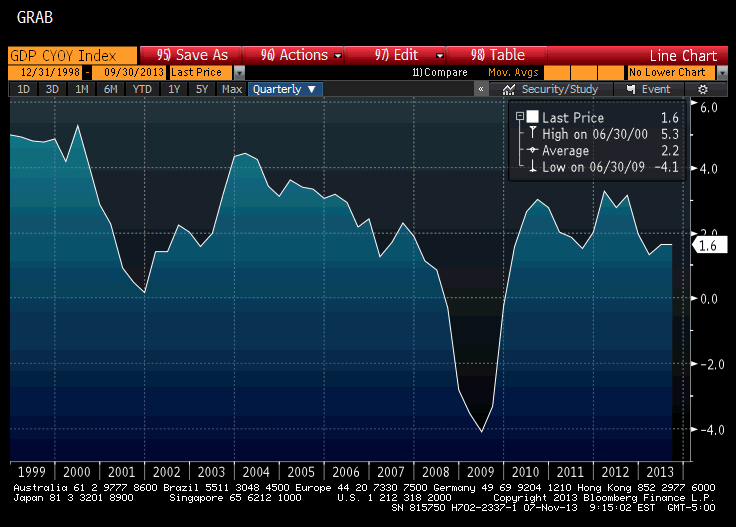
[Scott Sumner:] "Yesterday I reported that RGDP growth in 2013 was running ahead of the pace for 2012, using either the official figures or the new Philly Fed GDPplus estimates.
Today we received another strong jobs number, which means that employment gains in the first ten months of 2013 are running at over 186,000/month, versus less than 183,000/month last year and 175,000/month in 2011."
"Given the predictions of the Keynesian model, anything even close to 2012 results would have been a win for MM. The Keynesian model predicted a sharp slowdown from the higher income/cap gains/dividends taxes, payrolls taxes, sequester, government shutdown, etc, etc. But we are running ahead of 2012, and even if the last two months are weak we will be essentially even."
"And yet on the Keynesian side of the aisle I hear a deafening silence. Where is the discussion of this great “experiment?” Could it be that academics and pundits only like to discuss experiments that validate their priors?
Dairy of a Republican Hater
Sumner is at it Again After Latest Job Numbers
evilsax

Warren Mosler to me via email:
Yoy takes out seasonals
 http://www.moslereconomics.com/wp-content/graphs/2013/11/real-gdp-yoy.gif

Monday, October 14, 2013

How Comically Ironic That The IMF/WB Annual Meeting Occurred In DC This Last Week, Parallel To But Upstaged By The Bigger Drama Queens

Commentary by Roger Erickson

Yet while they're dragging their own, US Democracy down the drain, the "Traditional Values" crowd in the USA is more worried about a few % of the human population being Drag Queens? You can't make this stuff up fast enough. At least they're no longer traumatized by sinistrals - despite the embedded word!!! With sexual/educational/cultural recombination always generating this much diversity - why not just have more in all of our policy channels?

That aside, were the competing DC dramas an example of the chief cretins showing the little suits who's still boss?* :(

C'mon. It's not fair. The banksters finagle all year, and then can't get a minute of continuing scrutiny? How's a dishonest bankster supposed to get any consistent publicity, with this kind of grandstanding by the very politicians that they bought and own? :(

Oh. Wait. What? 

What the heck IS going on here? Does anyone really know? With this many conspiracies either working overtime or furloughed, the conspiracy-writers are accusing the hopelessly confused audience of racketeering - just because they're collectively unable to pay up! You gotta admit, it does look suspicious. to see so many broke simultaneously. Empty pockets is no excuse from the unlawful, folks. While you were distracted, the banksters requested that we pledge some future collateral, so that THEY can balance OUR fiat.

You just can't make this stuff up. Are the professional joke-writers not getting their own joke? Or is the audience not getting the double-entendre, even as the theater doors are barricaded ... from the inside. It's too complicated, folks, so just focus on the plot you've paid to see unfold. The promised audience-participation comes at the "intermission," and most are guaranteed to be surprised.

With these performers and this audience, what good is a ingeniously novel set-up, if neither can recognize the paradigm? The bigger punchline may as well come and go in a parallel dimension.

Imagine a dynamic value comedian trying to tell a unpredictable-valuation joke to a static-value audience? All the audience members hear are random tangents?

Wait, there's a counter-attack by the banksters, and a new effort to regain the publicity edge!  The little suits have noticed something in their tangential cross-hairs, and advise that we can zoom off [in a STRAIGHT line, of course] and be there in 20 years! Plus, it's a green target! They can smell it!

Green Light for a New World Bank Group
"Six months ago, the World Bank Group’s member countries** endorsed a bold plan to end extreme poverty by 2030 and promote shared prosperity. On Saturday, they gave the Bank Group the green light to reposition itself to better tackle these goals."

Reposition, huh?*** Just a minor matter of guaranteeing their Central Planner salaries and perks for a few more decades, until WE achieve THEIR predictions. :( It's playful, it's cruel ... and the sheer repetitiveness is actually bold, you have to admit.

* Meanwhile, the divergence between audience income & price of popcorn just increased again. Plus, there's gonna be a new health-insurance surcharge on the extra salt we're advertising to ourselves. Forget the health-insurance exchanges, we're dealing with a one-way bankster/MiddleClass exchange. Both political parties are recommending that 99% of citizens grab their socks. :(

** Couldn't help but notice this additional punchline on the WB site. Happy Cows Help Save the Planet  Is there a double-meaning in that? Have they switched from calling us "Muppets" to calling us "cows?" Or are both those terms just the official, new banking designations for people from the previously lower & middle class - now to be permanent - castes?

*** Personally, I'm into cheap, classless stories, where the cows & Muppets & Drag Queens rise up, caste out the exorcists, and in the process purge their own demons. Especially if there's a disclaimer that No Socks Were Grabbed in the course of this Audience Participation Democracy. Is that show playing anywhere off Wall Street?


Thursday, August 1, 2013

Simon Wren-Lewis — ZLB Models?


Tilting at windmills.

Worse:
Now at this point you may be thinking that I am just being a bit pedantic about labels. I am not sure I should apologise if I am, but I do have another motivation. Talk of different models that can be applied to the same problem harks back to ‘schools of thought’ days in macro. I think macro should be better than that now. For better or worse, the microfoundations project and the new neoclassical synthesis gave us a common language, where we could talk about different mechanisms within a shared approach. That should make the process of matching evidence to theory more straightforward.
What if the "shared approach" — shared by whom? — is off track? What if Keynes minus Samuelson, Hicks, neoclassical synthesis and NK monetarism is correct? What about the Post Keynesian crit

What would count for showing that the "shared approach" is offtrack? Missing the GFC and not being able to either explain it or fix the damage? What about the Post Keynesian critique that got it right and has a well-reasoned plan based on fiscalism instead of monetarism?

mainly macro
ZLB Models?
Simon Wren-Lewis | Professor of Economics, Oxford University


Tuesday, June 11, 2013

Steve Keen — The Neoclassical conspiracy against Post Keynesian Economics (1)

Paul Krugman recently posted on predictions of the crisis before it happened, in a piece entitled “Non-prophet Economics”. It had a set of propositions about how one should evaluate such claims with which I completely and utterly agree. I’ll quote it in its entirety, because it’s an eminently suitable starting point for evaluating whether a prediction was in fact made:
Real-World Economics Review Blog
The Neoclassical conspiracy against Post Keynesian Economics (1)
Steve Keen

Saturday, May 18, 2013

Peter Radford — The state of economics: Krugman is wrong

Where I disagree with Krugman in his blog today is his references to the economics profession.
In his discussion this morning he is critical of a defense of the hedge fund managers made by Jesse Eisinger. That defense rests on the notion that economists have no clue about the economy as demonstrated by their inability to predict the bubble and subsequent collapse. There were, of course, many economists who did predict the bubble, but they were not influential enough to have an impact. They remain mostly without influence due to their being outside the profession’s orthodox traditions. Krugman, however, defends the profession against Eisinger’s criticism, and this is where he goes wrong.
It does not matter that some economists were correct. The central orthodoxy of the profession, the source of most advice to policy makers and business people, and the basis of most commonly taught textbooks, totally missed both the possibility and then the existence of the bubble. Economics was horribly wrong. It hasn’t recovered since. Instead it is stuck in an unproductive self-examination that has yet to have much impact. Those who were wrong still pronounce and influence policy. They continue unabashedly to teach and perpetuate their errors. The profession, such as it is, is splintered into ideological warring camps making no progress towards a newer or more complete understanding of actual economies where things like asset price bubbles can, and evidently do, exist.
In short economics is a mess and is completely deserving of the skepticism Eisinger attributes to the hedge fund managers.
Real-World Economics Review Blog
The state of economics: Krugman is wrong
Peter Radford

Wednesday, March 6, 2013

Daniel Little — New thinking about social systems

There is a great deal of important international work underway today within the philosophy of social science on the general topic of social ontology. How do social structures relate to the actions of socially situated actors? How does causation work in the social realm? Can we say anything rigorous about the nature of "levels" of the social world -- micro, meso, and macro? And is there such a thing as an "emergent" social property or entity?
Understanding Society
New thinking about social systems
Daniel Little | Chancellor, University of Michigan at Dearborn

Friday, February 8, 2013

Against Friedman: Why Assumptions Matter

I have previously discussed Milton Friedman’s infamous 1953 essay, ‘The Methodology of Positive Economics.’ The basic argument of Friedman’s essay is the unrealism of a theory’s assumptions should not matter; what matters are the predictions made by the theory. A truly realistic economic theory would have to incorporate so many aspects of humanity that it would be impractical or computationally impossible to do so. Hence, we must make simplifications, and cross check the models against the evidence to see if we are close enough to the truth. The internal details of the models, as long as they are consistent, are of little importance.
The essay, or some variant of it, is a fallback for economists when questioned about the assumptions of their models. Even though most economists would not endorse a strong interpretation of Friedman’s essay, I often come across the defence ’it’s just an abstraction, all models are wrong’ if I question, say, perfect competition, utility, or equilibrium. I summarise the arguments against Friedman’s position below.
Unlearning Economics
Against Friedman: Why Assumptions Matter

Monday, December 24, 2012

Paul Krugman — SMACKDOWN

The key thing we need to understand, however, is that the prophets of fiscal disaster, no matter how respectable they may seem, are at this point effectively members of a doomsday cult. They are emotionally and professionally committed to the belief that fiscal crisis lurks just around the corner, and they will hold to their belief no matter how many corners we turn without encountering that crisis.
The New York Times | Opinion
When Prophecy Fails
Paul Krugman | Professor of Economics, Princeton University

Thursday, November 29, 2012

John Carney — Monetarists at the Gate: Krugman Vs Austrian School


Mentions MMT, but mostly about Austrian economics. John explains the difference between the usual meaning of "inflation" in economics and how  Austrian economics uses the term. They are conceptually different and this leads to confusion not only for critics of Austrian economics but also by some who profess to be following the principles of Austrian economics.

CNBC NetNet
Monetarists at the Gate: Krugman Vs Austrian School
John Carney

Tuesday, August 28, 2012

Randy Wray — Minsky and MMT in the News

We’re off gold. We’re not going back. Get over it.
Economonitor | Great Leap Forward
Minsky and MMT in the News
L. Randall Wray | Professor of Economics, UMKC