Gold, Goats 'n Guns
Russia’s Exports Continue to Defy Sanctions
Tom Luongo
The Russian currency is strengthening on higher oil prices.TASS

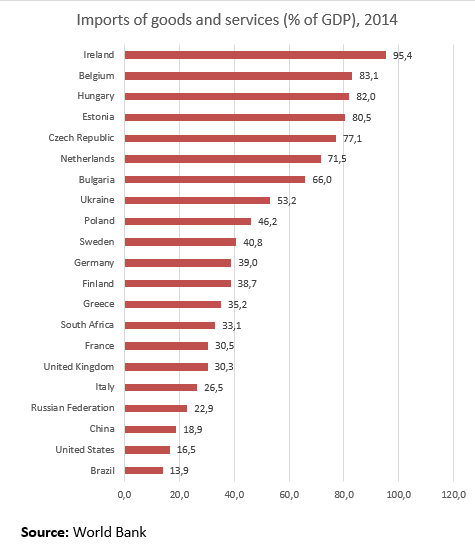
The Russian Central Bank is guided (among other considerations) in its inflation expectations by statistics produced by Rosstat (Russia’s governmental statistics agency) concerning the size of Russia’s imports relative to domestic production. The bank’s inflation expectation in turn is – judging by their policy statements – the decisive factor in its interest rate policy. Unfortunately, it seems that Rosstat has in its published statistics grossly overestimated the share of imports. According to the agency, the share of all imported products of the “consumer basket” would be 38%. Our research shows that the true figure cannot be more than 24%. When approaching the question from different angles we have derived results in the range of 4.9% to 24%.
The biggest problem in Russia’s economy is not its relative dependence on oil and gas revenue, rather it is the punitively high borrowing costs that should occupy the top spot in policy concerns. The Central Bank has been keeping its key steering rate at an inordinately high level of 11% although inflation has long ago fallen well below that. By end of March, the inflation for the past 12 months was down to 7.3% and running forward at a rate of approximately 6%.…
The Russian Central Bank thus proceeds from quite erroneous premises in motivating its cutthroat interest policy by historical inflation records and “inflation risks” based on faulty statistics connected with a distorted view of the share of imports in the national economy. There is yet a third, perhaps more fundamental error, which is the neoliberal belief that inflation is strictly a monetary phenomenon. This when in fact the root cause of Russia’s inflation over the last two decades has been insufficient supply to meet the demand. Therefore, the immediate concern of the Central Bank should be to make affordable lending available for Russian producers. This should be done even at the risk of increasing the inflation in the short-term, because before the supply side is addressed it will not be possible to break the vicious cycle.…
Currency gained most in emerging markets since January lowBloomberg

In the past I have speculated that the point when the rouble will start to decouple from oil prices will be when the total foreign debt that is actually due falls below the amount of Russia’s foreign exchange reserves held by the Central Bank (currently roughly $370 billion).
All the evidence suggests that that point is fast approaching, and if is true that only half of the nominal amount of $515 billion of foreign debt is debt that is actually due, then that point may already have been passed - even it is not yet visible in the published figures.
Given that that is so, since it is very much in Russia’s interests to keep the rouble low in line with oil prices - to choke off imports to support to agriculture and industry and to keep the external trade balance in surplus at a time of low oil prices - I have come round to Jon Hellevig’s view that the Central Bank should cut interest rates without further delay.
Inflation is falling fast and - as Jon Hellevig says - in Russia it is not primarily a monetary phenomenon anyway.
Since inflation is falling fast and since there is no need to support the rouble - on the contrary an excessive rise in the rouble like the one last spring would actually do harm - there is no reason to keep interest rates high. All the high interest rates are now doing is prolonging the recession.
Unfortunately, if recent history is a guide, the Central Bank will once again err on the side of caution, and - spooked by the recent fall in the rouble and worries about further interest rate rises in the US - will decide to keep interest rates high at its next scheduled meeting at the end of January.Russia Insider
The day when interest rates are cut cannot however now be far off. Beyond a certain point not just economic logic but political pressure from business, the Duma and the government will make an interest rate cut inevitable.
If oil prices fall to $25 per barrel, the budget could be reduced without a deficit if the dollar is equal to 210 rubles, estimates economists of Bank of America.USD/RUB is now ~80. The ruble has taken a hit over the last few days with oil falling below $30.
If oil prices fall to $25 per barrel, for a balanced fulfillment of the Russian budget for 2016, the dollar should cost 210 rubles. For the implementation of the budget with a deficit of 3%, something the President of Russia Vladimir Putin in December called the maximum, the dollar should cost 140 rubles, estimates economists of the Bank of America Merrill Lynch.…
In his first stint as a top Russian central bank official in the early 1990s, Dmitry Tulin saw how flooding cheap credit to dying industrial giants delivered hyperinflation instead of growth.
Now back as the bank’s monetary chief, Tulin, 59, has argued internally for easier credit and more targeted lending to industry to revive an economy driven into recession by plunging oil prices and U.S. and European sanctions, say officials who have attended meetings with him. They discussed internal bank deliberations on condition of anonymity.
While Tulin isn’t pushing for a repeat of the failed Soviet-style policies of the early 1990s, his challenge to the orthodox approach of his boss at the central bank, Governor Elvira Nabiullina, underscores the tension facing Russia’s economic policy makers as they try to steady an economy battered largely by forces beyond their control.I often take Bloomberg with a grain of salt, but this piece seems reasonably accurate from what I have been reading elsewhere.
“The external environment is very difficult: geopolitical tensions, sanctions, rising capital outflows, a sharp drop in economic activity, a strengthening of restrictive and regulatory moves by the authorities,” said Alexei Kudrin, a former finance minister who now runs a think tank. “Nabiullina, an advocate of traditional, market-based policies, is trying as best she can to maintain her balance in this very unstable situation.”
While Russian officials say publicly the worst of the economic turmoil has passed, they say in private that the situation is fragile at best and the central bank’s $358 billion in reserves could be drained further if crude prices continue to drop.…
SummaryRussia Insider
- Economic growth in Russia continues to fall.
- Moreover, rising inflation measures are weighing on consumer spending.
- Even as its economy weakens, the Russian ruble is stabilizing against the U.S. dollar.
The ruble’s oil-spurred rally is over, the Russian Central Bank said on Wednesday. The ruble has gained 15 percent this year after losing about half its value in 2014.
“The fast appreciation of the ruble that we saw, linked to the sharp 30 percent upswing in oil, is over,”the Central Bank First Deputy Governor Ksenia Yudaeva said at a conference on Wednesday. “Now we are seeing stabilization.”
The Central Bank is actively trying to reverse the 15 percent gain the currency picked up this year. The latest trick to weaken the currency was to increase the rate for foreign currency repurchase agreements (repo), or how much banks need to spend to take out loans.…
The Russian ruble fell for a third consecutive day, extending losses from Monday when the Central Bank announced it would raise the rate for foreign-currency loans to banks. The Bank is trying to curb the 15 percent the currency has gained this year.
On Monday, the Bank of Russia said it will increase the one-year foreign currency repurchase agreement (repo) to the London Interbank Offered Rate (Libor) plus 2.5 percent. Before the hike, the bank’s repo rate was 1.75 percent plus Libor.
The ruble lost 1.3 percent at the opening Tuesday, trading at 54.03 to the dollar at 11:55am in Moscow, a near 10 percent drop from where the ruble traded at on Thursday at 48.84; the first time it broke the 50 threshold since November.
Against the euro, the ruble lost 0.8 percent at 11:35am Moscow time at 57.69. The currency began to lose momentum Friday, when it nosedived 5 percent.
Despite the drastic loss in the last few days, the ruble is still up 12 percent since the beginning of the year, when it opened at 58.84 per dollar.
Lower oil prices also pushed the ruble to weaker trading levels, with Brent trading down 1 percent at $63.1 per barrel at the time of publication.Someone tell their translator that it hould be "intervenes" instead of "interferes."
The ruble may lose more of its value leading up to the Central Bank meeting on April 30, when it is expected to cut the ruble lending rate.
In other words, we have many, many moving parts to one equation. One can't tell the dominant one, or which are likely to last longer, but my sense is that majority of these forces are temporary and the long-run link between Ruble and oil price will be regained.
Now, assuming oil price dynamics remain where they are today (weak upside), Ruble is likely to devalue again, back to USD/RUB 55-57 range. If inflation does not fall toward 10% in Q2 2015 (and I do not think it will), we are likely to see Ruble move into USD/RUB 60-65 range over this quarter. On the other hand, improved outlook for the economy (signalling, say annual contraction closer to 3.5-4 percent) can see Ruble staying within the USD/RUB 50-53 range.True Economics

