Showing posts with label yield curve. Show all posts

Friday, March 27, 2020

Fed should control yield curve.

*FT Opinion (Registration required)
Why the Fed should put the Treasuries market on a war footing 
Colby Smiththers

Sunday, March 8, 2020

Breaking Market Trends — Brian Romanchuk

The secular bull market in U.S. Treasury bonds has once again resumed in full force, probably driven by short-covering. Meanwhile, risk markets are in disarray. The main question for markets is predicting when these trends will be broken. Since I do not give market forecasts, I will keep this article short, as I will just outline what I think what needs to be kept in mind....
Bond Economics
Breaking Market Trends
Brian Romanchuk

Wednesday, December 4, 2019

Why Rate Expectations Dominates Bond Yield Fair Value Estimates — Brian Romanchuk

Although there are various attempts to downplay rate expectations as an explanation for bond yields. the reality is that they dominate any other attempt to generate a fair value estimate by using "fundamental data". (Since we cannot hope to explain every last wiggle of bond yields without having a largely content-free model, we need to look at fair value estimates.) The reasoning is rather straightforward: so long as the risk free curve slope is related to the state of the economy, bond yields are pinned down by the front of the curve, and the slope....
Bond Economics
Why Rate Expectations Dominates Bond Yield Fair Value Estimates
Brian Romanchuk

Tuesday, August 20, 2019

Bill Mitchell — Inverted yield curves signalling a total failure of the dominant mainstream macroeconomics

At different times, the manias spread through the world’s financial and economic commentariat. We have had regular predictions that Japan was about to collapse, with a mix of hyperinflation, government insolvency, Bank of Japan negative capital and more. During the GFC, the mainstream economists were out in force predicting accelerating inflation (because of QE and rising fiscal deficits), rising bond yields and government insolvency issues (because of rising deficits and debt ratios) and more. And policy makers have often acted on these manias and reneged on taking responsible fiscal decisions – for example, they have terminated stimulus initiatives too early because the financial markets screamed blue murder (after they had been adequately bailed out that is). In the last week, we have had the ‘inverted yield curve’ mania spreading and predictions of impending recession. This has allowed all sorts of special interest groups (the anti-Brexit crowd, the anti-fiscal policy crowd, the gold bug crowd, anti-trade sanctions crowd) to jump up and down with various versions of ‘I told you so’. The problem is that the ‘inverted yield curve’ is not signalling a future recession but a total failure of the dominant mainstream macroeconomics. The policy world has shifted, slowly but surely, away from a dependence on monetary policy towards a new era of fiscal dominance. We are on the cusp of that shift and bond yields are reflecting, in part, the sentiment that is driving that shift....
Bill Mitchell – billy blog
Inverted yield curves signalling a total failure of the dominant mainstream macroeconomics
Bill Mitchell | Professor in Economics and Director of the Centre of Full Employment and Equity (CofFEE), at University of Newcastle, NSW, Australia

Monday, August 12, 2019

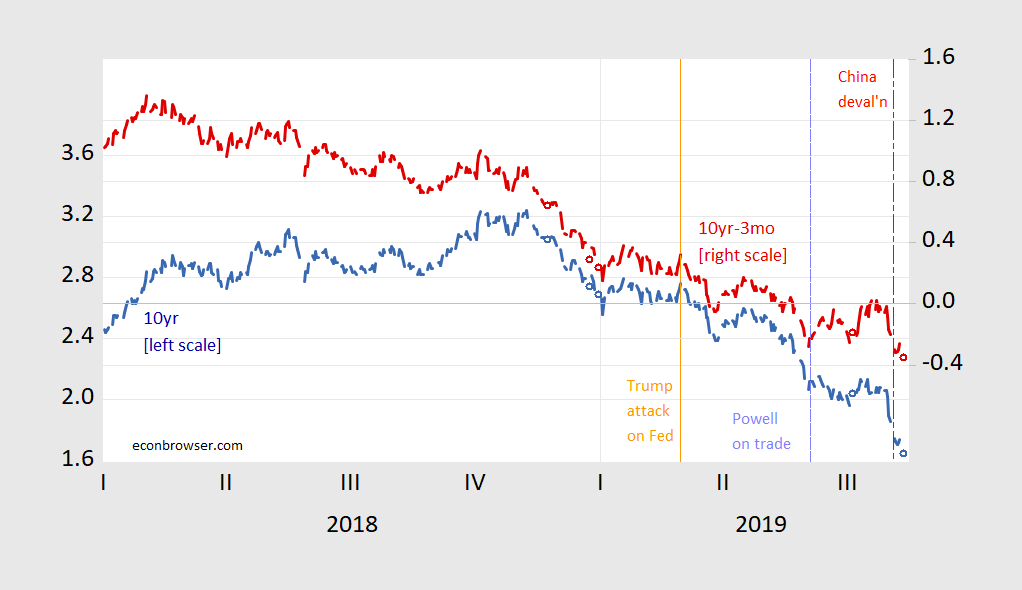
Term Spreads Plumb New Depths as Long Yield Drops — Menzie Chinn


Econbrowser
Term Spreads Plumb New Depths as Long Yield Drops
Menzie Chinn | Professor of Public Affairs and Economics, Robert M. La Follette School of Public Affairs, University of Wisconsin–Madison, co-editor of the Journal of International Money and Finance, and a Research Associate of the National Bureau of Economic Research International Finance and Macroeconomics

Thursday, May 9, 2019

Greg Robb — The Fed is dusting off a QE replacement, last used during World War II


MMT economists have been saying that the government acting through its central bank has this power as currency monopolist to manage the yield curve in addition to setting the policy rate, if it chooses to use it. 

What difference does this make? The 5 and 10 year rates serve as benchmarks for commercial lending. Since housing is such an integral part of the economy, mortgage rates are especially influential and it has been argued that central bank interest setting acts primarily through the housing channel. So flattening the yield curve would make a difference.

MarketWatch
The Fed is dusting off a QE replacement, last used during World War II
Greg Robb | Senior Economics Reporter

Wednesday, March 27, 2019

Brian Romanchuk — When Can Yield Curves Fail As Indicators?

Although yield curve slopes are very effective indicators for forecasting recessions, they are not infallible. This article discusses some of the reasons why a yield curve inversion can be a misleading recession signal....
Bond Economics 
When Can Yield Curves Fail As Indicators?
Brian Romanchuk

Wednesday, July 18, 2018

Brian Romanchuk — The Yield Curve Provides Limited Economic Information

The relentless flattening of the Treasury yield curve has been a topic of ongoing debate -- is this a signal that a recession is near? The key to interpreting the flattening is that bond market participants are not paid to to anticipate economic outcomes (outside the corner case of the inflation-linked market), rather to anticipate the path of short-term rates (and the term premium). The flattening yield curve tells us that market participants (on average) believe that we are near the end of the rate hike cycle, but that does not necessarily mean that a recession is imminent....

Thursday, December 7, 2017

Richard Turnill — What a Flattening U.S. Yield Curve Means

The flatter yield curve is not a recessionary signal, so what is it telling us? Much of this year’s earlier yield curve flattening represented a reversal of the 2016 steepening that accompanied surging economic growth and inflation expectations after the U.S. presidential election. Markets had bet that fiscal stimulus and infrastructure spending would spur growth and inflation. Long-term yields jumped in response. Those market expectations unwound over the course of 2017 when policy changes were slow to materialize and weak inflation readings became the big surprise. Persistent demand for long-term Treasuries pushed 30-year yields lower even as short-term rates rose. We could see long-term Treasuries rising a bit from here—but expect low-trend growth, plentiful global savings seeking income and other structural factors to keep them historically low. Our outlook for growth and inflation supports our preference for equities, including cyclicals—despite the flat yield curve. Within U.S. fixed income, we like Treasury inflation-protected bonds over nominal government debt.
EconMatters
What a Flattening U.S. Yield Curve Means
Richard Turnill | global chief investment strategist at Black Rock

Monday, October 16, 2017

Tuesday, September 19, 2017

Bill Mitchell — When relations within government were sensible – the US-Fed Accord – Part 1

The topic centres on an agreement between the US Federal Reserve System (the central bank federation in the US) and the US Treasury to peg the interest rate on government bonds in 1942. What the agreement demonstrated is that a central bank can always control yields on government bonds, which includes keeping them at zero (or even negative in the current case of Japan). What it demonstrates is that private bonds markets, no matter how much they might huff and puff about their own importance or at least the conservatives who are ‘fan boys’ of the bond markets), the government always rules because of its currency monopoly….
Bill Mitchell – billy blog
When relations within government were sensible – the US-Fed Accord – Part 1
Bill Mitchell | Professor in Economics and Director of the Centre of Full Employment and Equity (CofFEE), at University of Newcastle, NSW, Australia

Monday, April 10, 2017

Brian Romanchuk — How To Approach The Term Premium

The term premium is an important concept in fixed income analysis.

For our own analysis, there are a few ways of using the term premium. Unfortunately, there is no way of extending the analysis for an individual to the market in general, as there is no need for market participants to agree on the term premium before undertaking a transaction. As a result, we should not expect to be able to infer an average term premium implied by market pricing using any algorithm.
This article follows on from the article "The Term Premium Problem," which outlined my thinking about the term premium. I imagine that readers would be most interested in my criticisms of existing techniques to calculate the term premium. My argument is that the problem with those techniques is that they start in the wrong place; there is no technical fix as a result. Rather than attempt to criticise hundreds of complex algorithms, I will instead explain what I see as the best starting point. From that vantage point, the defects of the conventional approaches become more obvious.
Relevant to understanding the bond market and yield curve.

Bond Economics
How To Approach The Term Premium
Brian Romanchuk

Wednesday, March 15, 2017

Brian Romanchuk — Fed Hike Cycle: The Long Game

I discuss rate hike cycle at much greater length in Interest Rate Cycles: An Introduction. The key argument is that bond yields are driven by expectations for the path of short rates, and not some abstract notion of "supply and demand."
If you are trading short-term interest rate futures (fed funds, Eurodollar), yes, the short-term path of the policy rate (and LIBOR spreads) matters. However, if you are looking at the pricing of a 10-year Treasury Note, you need to have a forecast horizon similar to that 10-year maturity.
Bond Economics
Fed Hike Cycle: The Long Game
Brian Romanchuk

Thursday, September 29, 2016

Greg Mankiew — Trumponomics


Greg Mankiw betrays his astonishing ignorance of monetary economics and the institutional structure of international finance. He thinks that the capital markets set US interest rates and determine the yield curve, so a shrinking trade deficit would reduce buyers of US Treasuries, driving up interest rates across the yield curve.
Their analysis of trade deficits, starting on page 18, boils down to the following: We know that GDP=C+I+G+NX. NX is negative (the trade deficit). Therefore, if we somehow renegotiate trade deals and make NX rise to zero, GDP goes up! They calculate this will bring in $1.74 trillion in tax revenue over a decade.
But of course you can't model an economy just using the national income accounts identity. Even a freshman at the end of ec 10 knows that trade deficits go hand in hand with capital inflows. So an end to the trade deficit means an end to the capital inflow, which would affect interest rates, which in turn influence consumption and investment.
As Professor Mankiw observes, this is a freshman error, and is he the one making it! Apparently he cannot distinguish between a model with simplifying assumptions and the real world. The good professor is describing a the world as he would like it to be, not the way it actually is at present.

The Fed sets the interest rate and the yield curve is a projection of the interest and expectations about future Fed rate policy. There is never a lack of USD existing as settlement balances to purchase Treasury securities because the amount of Treasury securities offered is equal to the reserves injected into the settlement system by government spending. Treasury security issuance simply serves to drain the excess reserves created by government spending from the settlement system as reserve accounts at the Fed into Treasuries, which are transferable time deposits held at the Fed.*

Furthermore, the Fed has the capacity to manage the amount of settlement balances in the settlement system so that all transactions clear. When the Fed is not paying IOR and doesn't choose to set the rate to zero, then it sets its target and lets quantity float, by using open market operations, for example.

There is nothing wrong with Professor Mankiw's model as an economic model. However, it is not representational model of way the real world works. While it might have relevance as a teaching gadget, students would be given the wrong idea if they were lead to conclude that the world works like that.

Greg Mankiw's Blog
Trumponomics
Greg Mankiw | Robert M. Beren Professor of Economics at Harvard University

* L. Randall Wray, Modern Money Theory: The Basics, at New Economic Perspectives


Sunday, July 17, 2016

Brian Romanchuk — The Yield Curve And The Cycle

The slope of the yield curve is a topic of wide interest in bond market economics. It can be viewed as an economic indicator, or an instrument to be traded. Within this report, the focus is on how and why yield curve slopes act as economic indicators. The advent of ultra-low interest rates has made some interpretations of the yield curve untenable, but the yield curve is still useful as an indicator. (This article is an excerpt from Interest Rate Cycles: An Introduction.)
Bond Economics
The Yield Curve And The Cycle
Brian Romanchuk

Monday, August 24, 2015

JW Mason — Mixed Messages from The Fed and the Bond Markets


The policy rate and the yield curve. What is means for future Fed monetary policy.

J. W. Mason's Blog
Mixed Messages from The Fed and the Bond Markets
JW Mason | Assistant Professor of Economics, John Jay College, City University of New York

Sunday, August 17, 2014

Brian Romanchuk — Understanding Central Bank Control Of Interest Rates

One topic that periodically comes up is the issue of whether bond yields are "controlled" by the central bank, or whether they are set by "market forces". The typical context of the discussion is whether the bond markets can force governments to follow certain policies. I am in the camp that the central bank does "control" bond yields, but there are some subtleties in understanding how that control is defined.
Bond Economics
Understanding Central Bank Control Of Interest RatesBrian Romanchuk

Tuesday, May 28, 2013

Bill Mitchell – The last eruption of Mount Fuji was 305 years ago

The Report obviously doesn’t comprehend what it means for a central bank to be the monopoly supplier of bank reserves in this case denominated in Yen.

There was a reference to this capacity in a 2004 paper written by Ben Bernanke, Vincent Reinhart, and Brian Sack – "Monetary Policy Alternatives at the Zero Bound: An Empirical Assessment."

The authors examine the future of monetary policy when short-term interest rates, the principle tool of monetary policy get close to zero (as they are now).

They discuss various strategies that a central bank can take to alter the composition of its balance sheet “in order to affect the relative supplies of securities held by the public.”

That is, the amount of bonds held by the non-government sector.

The authors noted that:

Perhaps the most extreme example of a policy keyed to the composition of the central bank’s balance sheet is the announcement of a ceiling on some longer-term yield, below the rate initially prevailing in the market. Such a policy would entail an essentially unlimited commitment to purchase the targeted security at the announced price.

And would completely control longer maturity yields – which means end of scary future a la the neo-liberal economists who seek public attention but cannot tell the same public the truth.

The above authors (Bernanke et al) also state (in a footnote on page 25) that:

In carrying out such a policy, the Fed would need to coordinate with the Treasury, to ensure that Treasury debt issuance policies did not offset the Fed’s actions.

Which means that the two arms of government operate as a consolidated policy sector and target the same aim – maximisation of public purpose.....
The authors also suggest that it is possible that:
… even if large purchases of, say, a long-dated Treasury security were able to affect the yield on that security, the possibility exists that the yield on that security might become “disconnected” from the rest of the term structure and from private rates, thus reducing the economic impact of the policy.
That is possible. The corporate rates which reflect risk as well as inflationary expectations might deviate.
The overall point is that when there are transaction costs and “financial markets are incomplete in important ways”, the central bank can influence “term, risk, and liquidity premiums — and thus overall yields.”
The authors note that historically the strategy has been successful in a number of countries and give examples. Among the examples, they consider the “historical episode” that became known as “Operation Twist”.
I considered the issue of how the central bank can control the bond yield curve at all maturities in this blog – Operation twist – then and now.
So there is never a situation where the bond markets can destroy a nation which has currency sovereignty. Never means NEVER.
Bill Mitchell – billy blog
The last eruption of Mount Fuji was 305 years ago
Bill Mitchell