Showing posts with label housing. Show all posts
Showing posts with label housing. Show all posts
Wednesday, October 28, 2020


Monday, August 24, 2015
Dr. Housing Bubble Blog — When housing becomes unaffordable for the young: The crushing burden of rents and student debt on future home buying.
Tuesday, May 12, 2015
FRBNY — Mortgage Borrowing among Most Creditworthy Abates
Today’s release of the New York Fed’s Quarterly Report on Household Debt and Credit for the first quarter of 2015 reports a flattening in household debt balances. The slow growth in debt balances has left many wondering about the dynamics behind this change—who is borrowing, and who is paying down their balances? Thus, we use the same data set, the New York Fed Consumer Credit Panel (which is itself based on Equifax credit data) to identify the changes in balances by credit score, updating a post from last year with more recent data and also providing an in-depth look at the change in mortgage balances.
The charts below show contributions to changes in debt balances by borrowers’ credit scores (Equifax Riskscores), first looking at the data we presented in our earlier post (2012:Q4 to 2013:Q4) and then the most recent data, from 2014:Q1 to 2015:Q1. Since the figures are expressed as growth contributions, summing the numbers for a given loan type produces the overall percentage growth for that type over the relevant four-quarter period. The changes in contributions since 2013 are relatively modest, but there have been some important developments. The first notable difference is that credit card balances rose more democratically this time—with borrowers with credit scores over 620 all contributing to the increased balance. And there’s one difference that stands out even more, which is that the most creditworthy borrowers held back housing debt growth even more significantly during the most recent four-quarter period....The rest of the report doesn't look good for a housing recovery.
FRBNY — Liberty Street Economics
Just Released: Mortgage Borrowing among Most Creditworthy Abates
Andrew Haughwout, Donghoon Lee, Joelle Scally, and Wilbert van der Klaauw
See also
new American business model new normal.
How Soaring Housing Costs Impoverish a Whole Generation and Maul the Real Economy
Wolf Richter
See also
Driving home prices into the stratosphere has been top priority for the Fed. It’s called the “healing of the housing market.” The higher the home prices, the more they’re “healed.”
It was designed to bail out the banks, their stockholders and bondholders, such as Warren Buffett who is the largest investor in the nation’s largest mortgage lender, Well Fargo, and presides over a vast finance and insurance empire. It was part and parcel of the Fed’s successful plan to inflate all asset prices via waves of QE and interest rate repression, come hell or high water.
Inflating the prices of stocks and bonds is one thing. People don’t have to live in them. Not so with homes. People have to live somewhere. By inflating home prices, the Fed has inflated the costs of everyday life for all Americans. No big deal for the wealthy. But woe to those on a median income....The
People who pay a large part of their household income for rent or a mortgage, or who save assiduously for a huge down payment, don’t have much cash left to contribute to the overall economy. Most of their income simply gets confiscated by inflated home prices, or the resulting high rents and associated expenses. It’s channeled to landlords, PE firms, and REITs that own the homes; banks and investment funds that own the mortgages or the mortgage-backed securities; and a million other entities. Most of it becomes part of the grease that keeps Wall Street from squealing. But nothing happens with that money to move the real economy forward.Wolf Street
How Soaring Housing Costs Impoverish a Whole Generation and Maul the Real Economy
Wolf Richter
Saturday, November 22, 2014
Dr. Housing Bubble — The middle class migration out of California
People look at population growth in California and see nothing that stands out. Digging into the numbers you find some interesting figures. First, the main reason California is actually growing is because of international migration. California for well over a decade is losing domestic residents. That is, “domestic” Californians on a net basis are heading out of the state. On a more micro level, you are seeing the middle class either being phased out of the state or being pushed into lower priced inland regions. It is an interesting trend that is also happening in the tech hungry Bay Area. Housing continues to be an important topic because the vast majority of income is spent on housing. California has one of the highest percentage of families spending half or more of their monthly income on either rent or housing payments. In places like Los Angeles the main international migration is coming from Asia. You also see this driving up real estate values in certain areas and this contributes to domestic out migration. The migration numbers are interesting and shed light on this global trend.Dr. Housing Bubble
The middle class migration out of California: While domestic migration is up, foreign migration is filling the gap.
Tuesday, October 28, 2014
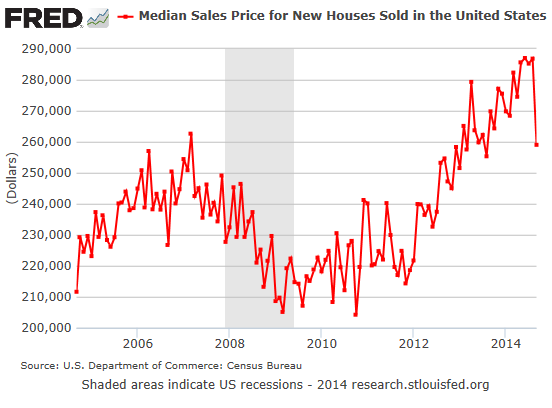
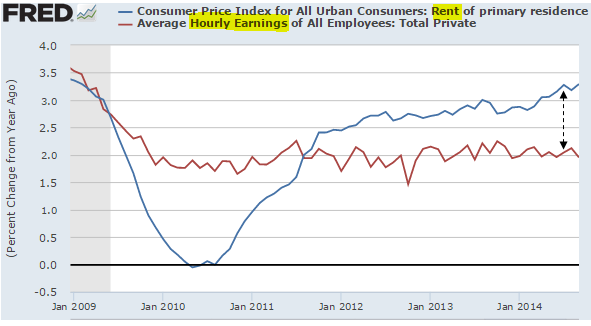
Derek Thompson — Homeownership in America Has Collapsed—Don't Blame Millennials

Atlantic Business
Homeownership in America Has Collapsed—Don't Blame Millennials
Derek Thompson
In 2012, Jordan Weissmann and I observed that young people were turning away from homes and cars, the twin engines of the economy.
Friday, October 24, 2014
Alana Semuels — The Case for Trailer Parks
Houses made in a factory are a cheap and energy-efficient way for poorer Americans to become homeowners—plus, these days, the mass-produced units can be pretty spiffy.They are called "modular homes" and "manufactured homes" now, and some can be "pretty spiffy" indeed. Companies generally offer basic units that are quite affordable, and these can be customized and upgraded to make them spiffier.
A big advantage is that they are relatively simple for just about anyone to do. The fist step is to secure a property, such as a vacant lot in a town, but many people prefer some acreage in the country. The next step is to decide on a manufacturer and negotiate a unit. Then the necessary foundation has to be contracted, as well as a driveway and garage, which are usually owner add-ons. The contracting is minimal. The only wait is usually on the foundation and garage if local labor is busy at the time That's often not an issue now, but it was at the height of the housing boom when the waiting lists were jammed.
There are several advantages to going this route. First, it's a way to get affordable housing with a new home of one's choice instead of being limited to inventory on the market. Most contractors don't usually build affordable homes on spec nowadays and they are reluctant to build smaller units to order, too, since profit is directly proportional to the cost. Contractors prefer big. So most affordable housing is older and smaller housing. Since the demand is high for these houses, the prices tend to be dear in terms of value.
Secondly, it gives everyone the opportunity to contract their own home even without construction expertise. This way it is relative simple for most anyone to get into the business, or to "build" one's own place.
The problem is that this type of housing can be difficult to finance since it is "unconventional." This varies by area, however, and it is becoming more acceptable with improvements in the industry. It is even possible to import modular housing at attractive pricing even with the shipping and 6% duty.
This fledgling industry took a big hit along with the rest of housing, but I predict a big comeback. It's an idea whose time has come. And as the article also points out, a lot of this construction is "green."
BTW, the old "trailers," that is, "single-wides," are still produced but they have largely been replaced with double and triple-wides and by RV's and tiny houses. In 2007, the average new single wide was $37, 100, about half of what the average new double wide cost. That's about what a new truck costs. Tiny homes are comparable in cost, but usually quite a bit smaller than single-wides, which can run over 1000 sq. ft. And the tiny house movement is reportedly growing.
Atlantic Business
The Case for Trailer Parks
Alana Semuels
Monday, October 6, 2014
John Light and Neha Tara Mehta — Are Tiny Houses a Viable Affordable Housing Solution?
I've been following the tiny house movement for some time and find it fascinating. People do some amazingly creative things. Now the trend is bubbling into wider attention. BTW, this phenomenon is ancient and the contemporary tiny house movement has been strongly influenced by it. Moreover, small apartment in cities where RE goes at a premium are examples of tiny houses, and millions of people do just fine living in them. Millions more either live in RV's, which are traveling tiny houses or make extensive use of them. Many tiny houses are constructed on trailers if only to bypass zoning restrictions. And, of course, in less developed countries they are pretty standard. Tiny houses just seem odd from the perspective of suburban living, where the trend is emulating the lifestyle of the wealthy. But affordable mortgage-free living is getting more and more attractive, and the builders of tiny homes and sales of tiny house plans are proliferating into a sub-industry. It's a trend to watch.
Bill Moyers and Co.
Are Tiny Houses a Viable Affordable Housing Solution?
John Light and Neha Tara Mehta
Sunday, August 24, 2014
Dr. Housing Bubble — Building for a future of American renting serfs
There was much celebration regarding the jump in private housing starts. However, once you begin to look beyond the headlines you realize that the big jump came largely because of multi-family starts. In other words, building more rentals in the form of apartments for a growing population that rents. Private starts for places with 5 units or more has now hit a post recession high. This makes sense given the fall in rental vacancy rates and the rise in rental prices. Yet what we find is that more income is being siphoned off into a less productive sector of our economy. Real estate tends to be a big plus for an economy when it happens organically with rising incomes, good overall employment prospects, and first time buyers leading the charge. Today it is more of a shifting of assets into fewer hands while extracting more income from the productive sectors of the economy. Not everyone can have their flipping show on cable television. For example, over 11 million Americans now pay 50 percent or more of their income to rent. Many of those people are here in California. The trend to building rentals aligns with the underlying reality that many future Americans will be less affluent compared to their parents.Dr. Housing Bubble
Building for a future of American renting serfs: Private housing starts for structures with at least 5 units hits a post recession high. More than 11 million Americans spend more than 50 percent of income on rent
Monday, August 11, 2014
Some quick thoughts- Prudential and consumer regulations as a preferential tool for controlling bank money creation?
This quote from the Levy Institute’s recent paper entitled “Federal Reserve Bank Governance and Independence During Financial Crisis” really got me thinking:
“Excessive private credit creation was the key policy challenge facing the Fed after WW2. The Truman Administration ran budget surpluses for several years, but strong bank lending neutralized their effects. The banks, in other words, created an amount of money just about as fast as the Federal Government, through its fiscal policy, contracted the money supply. "
MMT talks a lot about how the creation of bank money affects aggregate demand, and how permanent zero rates might be a good idea going forward. I think we should also begin discussing how growth in bank money might be controlled in this permanent zero environment. It seems to me that if raising interest rates to slow down lending is off the table, then we would need to have other tools available. Since I have been working in financial regulations for a while now, I have come to see firsthand the truth of MMT’s claim that regulations, not interest rates, truly affect lending. And anecdotally, I frequently hear compliance people complaining about how all the new Dodd-Frank rules are curtailing lending. So here are some of my preliminary thoughts on this issue:
- The last few decades have demonstrated the failure of traditional monetary policy tools to control growth in the money supply
- We know that the Fed controls only price of required reserves, and cannot directly control quantities of bank money, since this growth is mostly demand based
- Central banks are moving away from reserve requirements and monetary aggregate targeting anyway. Cant’ push on a string during times of low loan demand
- Inflation can be caused by excessive and imprudent lending. It’s not always due to too much horizontal money creation by federal deficit spending (although its remarkable that the explosion of bad lending and large deficits of the Bush admin were *still* not enough to create inflation)
- Using interest rates to manage an economy has mostly failed, and created enormous side effects:
- Market volatility
- Creates unnecessary interest rate risk burdens for depository institutions (cost of short term funding goes up, while long term assets are fixed)
- Creates risk of deposit flight from traditional banking system into higher yielding shadow banking/money markets which are not as closely regulated or monitored
My premise is that:
- Consumer and prudential regulations can be a much more effective and precise way of reducing lending-based creation of bank money (M2), than the tradition tool of raising interest rates
- Question is how do you develop a regulatory regime that is flexible enough to be ratcheted up or down for macroeconomic needs?
- Housing finance is a major source of bank money growth and therefore aggregate demand, so it is a good place to focus, using these tools:
- Raising/lowering agency (Fannie, Freddie, FHA, VA) conforming loan limits (very influential in housing esp. now that they control so much of the market)
- Weighing of risk-based bank capital
- Risk retention/QRM rules from the prudential regulators
- Qualified Mortgage standards from CFPB
- From the firm perspective, these changes would:
- Increase compliance risk/burdens (bad for banks)
- But decrease volatility/interest rate risk, if rates are permanently kept at zero (good for banks)
Therefore--
With the end goal being full employment, the primary focus of federal financial/fiscal policymakers should be to strike the right balance between US dollar creation via federal deficits, and bank money creation via net bank lending. Both of these money creation forces contribute to aggregate demand, and if they outstrip the ability of the nation to produce a commensurate level of real goods and services, can cause an undesirable rise in the price level. Policymakers should approach full employment with as much of a utilitarian mindset as possible-- the only “moral” issues that should be taken into consideration here are the deleterious social effects of involuntary unemployment.
Thoughts?
Monday, July 28, 2014
Warren Mosler — Pending home sales and why housing matters
So why does housing matter?
Can’t spending simply go elsewhere?
The problem is the oldest of all macro constraints-
If any agent spends less than his income, another must spend more than his income for all of the output to get sold.
It’s also been expressed as ‘the paradox of thrift’- decisions to not spend income and to instead ‘save’ cause sales and income to fall with no increase in net savings.…
So housing matters a lot as it looks to be the only available avenue for the economy to spend more than its income in sufficient quantities to overcome the demand leakages [with no one else stepping up].The elegant simplicity of the sectoral balance approach to macro.
Tuesday, June 24, 2014
Ed Paisley — Piketty’s Treatment of Housing as Capital Is not an Excuse to Ignore His Predictions
Thomas Piketty’s “Capital in the 21st Century” is clear from the beginning: housing and real estate generally ought to be included in the definition of “capital” for the book’s purpose, since the point is to examine the aggregate effect of accumulated wealth that produces an annual return through no effort on the part of its owner. A whole set of Piketty “rebuttals” attacks that treatment.
Lawrence Summers claims that housing price dynamics—namely, the housing bubble and eventual firesale in the 2000s—are driven by supply restrictions and inelastic demand, not capital accumulation.
Kevin Hassett at the American Enterprise Institute says that since you can’t replace workers by houses in production, workers aren’t threatened by the wealth accumulation Piketty emphasizes, since that wealth is attributable in large part to housing.
A group of economists at the Institute for Political Studies in Paris points out that a large portion of the increase in the value of capital—and in France, all of it—is due to housing appreciation, which they argue is sensitive to the decision to value it using market prices rather than the market rental stream. That critique was trumpeted by Tyler Cowen and Veronique de Rugy, and then enlarged upon in a more recent paper by Matt Rognlie, an economist at the Massachusetts Institute of Technology.
My recent column shows why those attacks fail, and why they reflect a larger reluctance on the part of macroeconomic theorists to confront the empirical failings of their received wisdom. Economists have developed a relatively sophisticated understanding of how the value of housing is determined, including by politics. “Capital in the 21st Century” doesn’t explore all of those findings, but they are nonetheless consistent with the book’s main arguments.
In short, the housing-based critique of Piketty’s book is not what its proponents have been desperately looking for—an excuse to throw Piketty’s data, theory, and predictions away.
WCEG
Piketty’s Treatment of Housing as Capital Is not an Excuse to Ignore His Predictions
Ed Paisley
Sunday, June 22, 2014
Sober Look — Rental home shortage is America's next housing crisis
Economists, politicians, and the media continue to focus on slow home sales as an indication of weak housing markets. But they are simply "fighting the last war". The looming crisis is not about how often homes change hands, but about the shortage of rentals and the rising cost of shelter that the new generations of Americans will increasingly face.Sober Look
Wednesday, May 28, 2014
Sarah Knapton — Middle classes will disappear in next 30 years warns Government adviser
David Boyle, a government advisor and fellow of the New Economics Foundation think-tank, said that youngsters can no longer expect the same level of affluence as their parents.
Speaking at the Hay Festival he warned that Britain will be left with a ‘tiny elite and a huge sprawling proletariat’ who have no chance of ‘clawing their way out of a hand-to-mouth existence.’The Telegraph (UK)
He predicted that the average house price will reach £1.2 million by 2045, putting a home beyond the range of most people as wages fail to keep up with huge increases.
Boyle said that the traditional middle classes will need three or four jobs just to be able to pay soaring rents. People will no longer have the space or time to pursue cultural interested...
Boyle claimed that one of the major problems was Margaret Thatcher abandoning The Supplementary Special Deposit Scheme, known as the ‘corset’ which limited how much banks could lend for mortgages.
Although the scheme kept house prices low in the 1970s, Boyle said it was unlikely that today’s buyers would accept having to wait for months for a mortgage.
Instead, he suggests a ‘parallel’ housing market were new homes were sold at the initial price for 100 years.
He predicted that without such a radical solution, mortgages will be inherited and only be paid off by the grandchildren of the original buyer.
“We were rationing mortgages in the 1970s, that’s what kept prices low and I don’t know if we will accept a time again when you have to wait,” he said.
Boyle said the rise in Ukip was fuelled by disaffection of the middle classes.
“You saw this huge revolt. I think what happens when you suppress the dreams of the middle classes is you get rather peculiar and very dangerous political movements beginning to emerge,” he argued.
“That doesn’t forgive people voting in the neo-facists but it does somehow explain it.
Middle classes will disappear in next 30 years warns Government adviser
Sarah Knapton, Science Correspondent
Friday, February 21, 2014
Dr. Housing Bubble — Serfdom nation
I think it is safe to say that investor activity in the housing market has changed the face of real estate buying. Back when the crisis hit in 2007, some analysts were cheerleading the hedge fund crowd as a tiny blip in the market. It is hard to call it a blip when 30 to 40 percent of all purchases are going to investors for close to half a decade. A recent analysis from RealtyTrac found that the estimated monthly home payment for a regular three bedroom home (costs include mortgage, insurance, taxes, maintenance, and subtracting the income tax benefit) rose an average of 21 percent from a year ago in 325 US counties. What about household incomes? That is another story. So it is no surprise that we are largely becoming a nation of renters. It is also no shocker that young households are largely unable to begin household formation via buying a home. Many are living with parents well into “young” adulthood. For the first time in history, we had a six year stretch where we added more renter households than that of actual homeowners.Many details in this post.
Dr. Housing Bubble
Serfdom nation
A principle feature of The American Dream is owing one's own home. That possibility is becoming more and more remote for more and more people. If this crystallizes, it is going to change American culture in ways that cannot be foreseen. But it is quite foreseeable that the consequences will be profound socially, politically and economically.
Friday, January 24, 2014
Dr. Housing Bubble — States where all-cash buying has gone wild for the new feudal lords
The growing disparity of income in the world is a major talking point at the World Economic Forum in Davos. Apparently there are only so many yachts and extra homes a rich hedge fund manager can buy. This large divide is only expanding and consequences are showing up in odd ways like large dark pools of money flooding into the once stale residential real estate market (the place where most Americans used to build their wealth). It was interesting to hear pundits act like apologists for the banking industry with the bailouts acting as if this would help the middle class. Well here we are in 2014 and most of the gains from 2009 have gone to a very small connected portion of our population. This new rentier class is dominating a large part of the residential market. In some states, more than 50 percent of residential real estate sales are going to investors. I was digging through some reports and saw that Florida, the younger sister of California had something like 62.5 percent of all sales going to all-cash buyers (that is, no mortgage was recorded on the sale). Who needs the plebs when you can buy up the entire Monopoly board!
Thursday, September 12, 2013
Bill McBride — Conforming Loan Limits and House Prices

In general the conforming loan limit has moved with house prices, however the conforming limit didn't rise as fast as house prices during the bubble.Calculated Risk
Conforming Loan Limits and House Prices
Bill McBride
Bill McBride — Lawler: Consistent with Other US Housing Reports, Negative Equity Estimates Vary Widely!
CR Note: This is from housing economist Tom Lawler. Lawler has been pointing out the inconsistency in US housing data; this time on negative equity.Calculated Risk
Lawler: Consistent with Other US Housing Reports, Negative Equity Estimates Vary Widely!
Bill McBride
One of the biggest problems in doing "scientific" economics is the quality of the data. GIGO.
Tuesday, August 27, 2013
Bill McBride — Comment on House Prices: Real Prices, Price-to-Rent Ratio, Cities
Even if you don't follow housing closely, this is something to be aware of. Charts illustrate if you just want a quick overview. Housing seems to have bottomed and recovery is in progress. As Bill notes, the figures are through June and don't take into consideration the recent rise in mortgage rates. Latest reports are indicating that this is having an adverse effect on the recovery, along with stagnant incomes in a weak economic recovery and credit still relatively tight.
Calculated Risk
Comment on House Prices: Real Prices, Price-to-Rent Ratio, Cities
Bill McBride
Subscribe to:
Posts (Atom)