Showing posts with label renewable energy. Show all posts

Monday, March 16, 2020

From U.S. to Europe to China to Russia, renewables are now cheaper than coal — Adele Peters

It’s now cheaper to invest in renewable energy than coal in all major markets around the world—and more than half of existing coal plants are also more expensive to keep running than building new renewables, according to a new report. By 2030, the think tank estimates that new renewables will be cheaper than existing coal plants in all major markets....
Milestone.

Fast Company
From U.S. to Europe to China to Russia, renewables are now cheaper than coal
Adele Peters

Tuesday, August 6, 2019

Nick Cunningham — The Threat That Will Send Oil Down To $10

Oil prices will need to trade at around $9 to $10 per barrel in the long run if gasoline is going to be able to compete with electric vehicles and renewable energy. That startling conclusion comes from BNP Paribas, which warned in a new report that crude oil is facing an existential and likely mortal threat from renewable energy and EVs....
Oilprice.com
The Threat That Will Send Oil Down To $10
Nick Cunningham

Monday, April 1, 2019

David Nield — Huge Global Study Just Smashed One of The Last Major Arguments Against Renewables


Think "money" is the biggie. Think again. Energy is real game changer. 

"Money" is to the fore right now, but soon it is going to be energy. Keep your eye on energy technology. The world is in the process of scaling down carbon-based energy use and scaling up alternatives. 

The industrial revolution took off with the coal-fired steam engine that powered steam ships, and railroads and factories. The harnessing of electricity and coal-fired power plants enabled the proliferation of factories and the widespread use of lighting, lengthening the day. The introduction of petroleum-based energy made automobiles and aircraft possible. The standard living of societies was measurable in the amount of energy use.

Shifting among energy sources and scaling up alternatives to replace carbon is a huge challenge. So is replacing petroleum as transportable energy. Batteries are only one solution. This article sets forth another.

Science Alert
Huge Global Study Just Smashed One of The Last Major Arguments Against Renewables
David Nield

Friday, April 1, 2016

RT — China proposes $50tn global renewable energy network

The company running China’s power grid is proposing a $50 trillion global electricity network to tackle pollution and climate change. If it goes ahead the network would use advanced renewable solar and wind technology and be operating by 2050.

Beijing’s network will be the world’s biggest infrastructure project, if given the green light. The State Grid has already signed a memorandum of understanding with the Russian energy grid Rosseti, Korea’s Electric Power and SoftBank Group of Japan.
According to State Grid’s Chairman Liu Zhenya, the planet is facing "three major challenges", which are energy scarcity, environmental pollution and climate change.
Liu added that smart grids, ultra-high voltage (UHV) grids and clean energy are the only way to a green, low carbon, economical, efficient and open energy system with sustainable supply.
Liu also said the global network could boost the share of clean energy to 80 percent of global consumption, displacing fossil fuels as the main energy source.
"China is already the biggest country in the world for wind, solar power generation and also UHV grids. And has scale, so we can learn many things from China's success. Also, by interconnecting, we can help each other on supply and demand,"SoftBank CEO Masayoshi Son told the Global Times.…

Friday, January 15, 2016

Lockheed Martin Compact Fusion: It's closer than you think.

It’s no secret that our Skunk Works® team often finds itself on the cutting edge of technology. As they work to develop a source of infinite energy, our engineers are looking to the biggest natural fusion reactor for inspiration – the sun. By containing the power of the sun in a small magnetic bottle, we are on the fast track to developing nuclear fusion reactors to serve the world’s ever-growing energy needs.
Lockheed Martin
Compact Fusion: It's closer than you think.
ht Ed Rombach, The Rombach Report, in the comments

Tuesday, December 8, 2015

Ramez Naam — Why Energy Storage is About to Get Big – and Cheap

Storage of electricity in large quantities is reaching an inflection point, poised to give a big boost to renewables, to disrupt business models across the electrical industry, and to tap into a market that will eventually top many of tens of billions of dollars per year, and trillions of dollars cumulatively over the coming decades.

Monday, September 21, 2015

Samantha Page — Greenpeace Report Says The World Can Go 100 Percent Renewable By 2050

A new report from Greenpeace says the world can be 100 percent renewable by 2050, and 85 percent renewable in just 15 years.
The 2015 Energy [R]evolution report, the latest in a series that has offered the most accurate projections of any major analysis, worldwide, says that for the first time, the path to 100 percent renewable is cost-neutral. In addition, no new technological advancements are needed, the report says.
“It’s basically political will,” Emily Rochon, a global energy strategist at Greenpeace, told ThinkProgress. “The primary premise of the Energy [R]evolution scenario is we have all of the solutions already on the table to get there.”

Under the scenario outlined in the report, global CO2 emissions would be stabilized by 2020 and would approach zero in 2050. Fossil fuels would be phased out, beginning with the most carbon-intensive sources. By 2030, two-thirds of the world’s electricity could come from renewable sources such as wind and solar.…
Think Progress
This Report Says The World Can Go 100 Percent Renewable By 2050
Samantha Page

Tuesday, November 4, 2014

Jeff Spross — How Renewables In Developing Countries Are Leapfrogging Traditional Power

Lots of poorer countries may be gearing up to largely skip fossil fuel reliance in favor of renewables, if a report released last week is any indication. 
It’s long been assumed that developing nations — particularly those in Africa and Asia — would need to follow the same course as the United States and other western powers, relying on traditional fossil fuels to build their economies before transitioning onto renewable energy. It’s one of the reasons many critics think efforts to keep global warming under 2°C are either doomed or would be hopelessly destructive. 
But according to Climatescope 2014 — a worldwide analysis by Bloomberg New Energy Finance (BNEF) of 55 countries in Latin America, the Caribbean, Asia, and Africa — developing countries’ renewable energy capacity grew 143 percent between 2008 and 2013. By contrast, the wealthy western nations in the Organization for Economic Cooperation and Development (OECD) — in North America, Europe, Australia, and so forth — saw only 84 percent growth. This was while total grid capacity for the nations covered by the Climatescope analysis rose over 30 percent, but grew only 9.6 percent for the OECD countries. 
The report focused on forms of renewable power other than large hydroelectric plants, because those can take years, if not decades, to install, while wind only requires two to three years and solar needs only a few months. But when large hydroelectric is thrown in, Climatescope nations now have 666 gigawatts of clean energy installed, and OECD nations have 806 gigawatts.…
“Clean energy is the low-cost option in a lot of these countries,” Ethan Zindler, a Washington-based Bloomberg New Energy Finance analyst, told Bloomberg news. “The technologies are cost-competitive right now. Not in the future, but right now.”

Like they leapfrogged over landlines to cell phones and to digital transactions bypassing traditional banking services.
Climate Progress
How Renewables In Developing Countries Are Leapfrogging Traditional Power
Jeff Spross

Saturday, November 1, 2014

Physics.org — New solar power material converts 90 percent of captured light into heat


A multidisciplinary engineering team at the University of California, San Diego developed a new nanoparticle-based material for concentrating solar power plants designed to absorb and convert to heat more than 90 percent of the sunlight it captures. The new material can also withstand temperatures greater than 700 degrees Celsius and survive many years outdoors in spite of exposure to air and humidity. Their work, funded by the U.S. Department of Energy's SunShot program, was published recently in two separate articles in the journal Nano Energy.
Physics.org
New solar power material converts 90 percent of captured light into heat
University of California, San Diego

Wednesday, October 29, 2014

Lindsay Abrams — The energy myth that refuses to die: Why renewables are taking over in the developing world

Poor nations are embracing clean energy at twice the pace of rich ones, a new report finds
Not surprising. emerging nations went directly to cellphones, and digital payments, too.

Salon
The energy myth that refuses to die: Why renewables are taking over in the developing world
Lindsay Abrams

Thursday, October 23, 2014

Jeffrey D. Sachs — A New Macroeconomic Strategy


Public investment, especially in renewable energy.

Project Syndicate
A New Macroeconomic Strategy
Jeffrey D. Sachs, Professor of Sustainable Development, Professor of Health Policy and Management, and Director of the Earth Institute at Columbia University, is also Special Adviser to the United Nations Secretary-General on the Millennium Development Goals

Tuesday, December 17, 2013

Sunday, October 6, 2013

Jonathan Larson — Ikea to start selling solar panels at UK stores

This is a solar story with all the great elements. It is proof positive that solar has moved out of the experimental stage. For years I have advised people to follow the Home Depot rule "Don't buy any technology until they start selling it in places—like Home Depot—used to dealing with the problems of the general public." Well, Ikea certainly qualifies. This is really a big deal because MOST Ikea customers are barely qualified to assemble a desk much less install solar panels on a roof and hooking them into the electrical systems—no matter how reliable or cost effective the panels themselves may be. After all, I once heard someone describe assembling a couple of Ikea kitchen cabinets as an "ordeal."

My guess is that Ikea will be providing more detailed installation manuals than their typical pictograph instructions. In fact, they will probably recommend professional installers. Even so, solar is well on its way towards being a normal player in the energy mix. I have been waiting a very long time for this day.
real economics
Ikea to start selling solar panels at UK stores
Jonathan Larson


Thursday, April 25, 2013

Brian McConnell — Solar Energy : This Is What A Disruptive Technology Looks Like


Medium.com
Solar Energy : This Is What A Disruptive Technology Looks Like
Brian McConnell
(h/t Energy Bulletin)

Jeff Spross — Bloomberg Study: 70 Percent Of New Global Power Capacity Added Through 2030 Will be Renewable


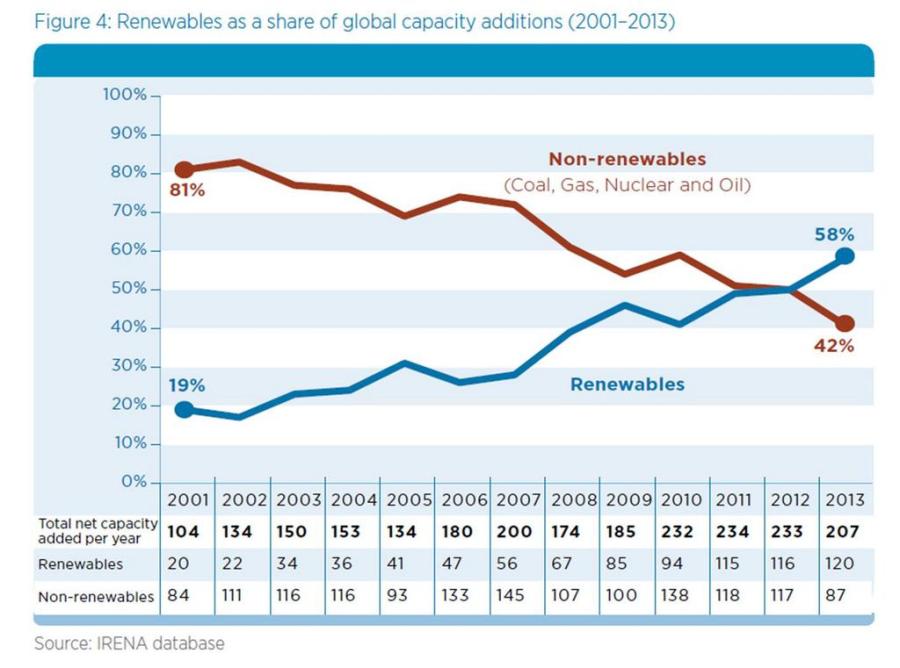
According to Bloomberg’s renewable energy research team, Bloomberg New Energy Finance (BNEF), 70 percent of the power generation the world will add between now and 2030 will most likely be renewable.
That would mean $630 billion in new renewable capacity investments in 2030 alone — over three times what was built in 2012, and 35 percent higher than what BNEF predicted for 2030 a year ago. So not only does renewable energy’s future look formidable, it’s looking more formidable every year we project it....
"This 2030 investment figure is 35 percent higher than that produced in Bloomberg New Energy Finance’s last global forecast a year ago, and the projection for total installed renewable energy capacity by that date is 25 percent higher than in that previous forecast, at 3,500GW."
Cimate Progress
Bloomberg Study: 70 Percent Of New Global Power Capacity Added Through 2030 Will be Renewable
Jeff Spross

Asumes fusion will not be online in 2030. That seems reasonable, even if a breakthrough is made before then. Then the problem will be scaling.

Monday, April 15, 2013

David Roberts — Solar panels could destroy U.S. utilities, according to U.S. utilities

Solar power and other distributed renewable energy technologies could lay waste to U.S. power utilities and burn the utility business model, which has remained virtually unchanged for a century, to the ground.
That is not wild-eyed hippie talk. It is the assessment of the utilities themselves.
 Grist
Solar panels could destroy U.S. utilities, according to U.S. utilities
David Roberts


Sunday, April 14, 2013

Paul Brown — Is Renewable Energy's Biggest Problem Solved?

German researchers have found a way to overcome one of the problems with renewable energy -- the fact that it is not always available -- by linking different options in a unified system.
AlterNet
Is Renewable Energy's Biggest Problem Solved?
Paul Brown | Climate News Network


Sunday, December 30, 2012

Vince Font — A Look Back at Solar Energy in 2012

2012 was a big year for solar, both domestically and globally, with some unlikely players throwing their hats into the ring and upping the ante on achievable power generating capacity. Here's a wrap-up of some of the year's most impactful events in the solar industry, with a little added perspective from some experts in the field.
Renewable Energy
A Look Back at Solar Energy in 2012
Vince Font
(h/t Climate Progress)

Some good news. It's happening in spite of some bankruptcies and industry consolidation.
“Falling pricing is a double edged sword. It’s great for deployment, it’s great for the consumer, and it’s caused greater amounts of solar installation. On the other hand, falling prices have yielded smaller margins for manufacturers, making it tougher to survive in a very competitive climate.”...
In the United States, 2012 showed evidence that growth in the solar industry occurred at a much faster rate than other industries. According to The Solar Foundation’s National Solar Jobs Census report, U.S. employment in the solar industry grew at a rate of 13.2 percent and the sector added 13,872 jobs in 2012, while Bureau of Labor statistics indicated that solar accounted for 1 out of every 230 jobs created.
This information may seem to fly in the face of the numerous solar company bankruptcies and consolidations that have taken place globally in the last year, but according to Kimbis, that’s par for the course in an emerging industry
“It’s just like any other industry,” Kimbis said. “Competition is extreme. This is something that the industry has known about for awhile; companies have been bracing for global competition for the last several years. It’s a story which has repeated itself through everything from personal computing, to telecom, to the automobile industry.”